-
Workers’ Voice newspaper: March-April edition

The U.S.-Israel war on Iran is a major escalation in the Middle East that has dangerous implications for working people everywhere. The brutality of the imperialist assault internationally is paired with the attack on civil liberties by the Trump regime inside the U.S. This includes the continued operations of ICE and Border Patrol, the threats to the 2026 mid-term elections, environmental rollbacks that deeply impact the Black community, and unchecked police brutality.
Our editorial in this issue warns us: “There is a great danger of underestimating the determination of the U.S. corporate elite to drive through this effort. We cannot rely on court rulings or upcoming elections to save us. We must organize now, not only for mass demonstrations and community networks against ICE violence, but to find our way to building a new working-class party through which we can organize our political defense on every plane and on every day.”
In this issue we also have articles on the Epstein files and the ruling class, the San Francisco teachers’ strike, and a review of the new album by U2.
The March–April 2026 edition of our newspaper is available in print and online as a pdf. Read the latest issue of our newspaper today with a free pdf download! As always, we appreciate any donations to help with the cost of printing.
Click on the image to read the paper or message us to get a hard copy:

-
The Democrats have no answers for working people


By JOHN PRIETO
Now that the dust has begun to settle, a clearer picture of how exactly the Kamala Harris campaign lost this election is beginning to develop. For all the lashing out of frustrated liberals, they have yet to find the mark. It certainly wasn’t the fault of Latino voters. And it wasn’t the fault of Muslim or Arab American voters. Nor was it primarily due to male chauvinism or racism. The Harris campaign encountered pitfalls that it could not, or would not, overcome, and it made some policy decisions that alienated sectors of the electorate. But at its core, this election came down to:
Am I better off now than I was four years ago?
This quintessential election-year question, for most working people, could definitively be answered in the negative. According to NBC News exit polls, 68% of voters felt that the economy was “not so good/poor.” A full three-quarters of voters said that inflation had caused their family moderate or severe hardship. A similar number said they were dissatisfied or angry with the way things are going in the country.
Harris, unsurprisingly, lost among all of these groups. In a year when family incomes are being ground to dust under the weight of inflation and the continuing post-COVID employer offensive, Harris chose to jettison any attempt at providing an alternative. When given the opportunity to distance herself from Biden, she refused to identify a single thing she would have changed about the last four years.
While it became somewhat of a trope to identify Trump’s first election victory as the result of economic anxiety and papering over the very real racial animus that certainly motivated and continues to motivate a core part of his supporters, it is clear that to a certain extent, the 2024 election was lost mainly on the basis of economic issues. Instead of running a campaign focused on the very real hardships caused by inflation and distancing herself from a historically unpopular incumbent, she pulled Biden—and consequently the current economic situation—even closer. When people are searching for an alternative and you fail to provide one, they will go elsewhere.
There is no alternative … in the Democratic Party
Did Kamala attempt to provide a solid alternative to Trump? No. Here, she again failed to provide any real motivation for voters to come out for her.
Are you worried about climate change? Too bad! Harris wants more fracking. Are you concerned about Trump’s violent rhetoric around immigration and deportation? Tough! Harris promised to pass the failed Bipartisan Border Bill to put more cops on the border, create a mechanism for closing the border to immigration and asylum claims, and to facilitate the process of deportation. Instead of pushing back against Trump’s racist narrative, she reinforced it, positioning herself as the responsible and experienced border-state prosecutor who could actually get it done.
On trans rights too, Harris again caved to the narratives of the right. Instead of pushing back and forthrightly defending our trans siblings, the best Harris could offer (on Fox News) was a meek “I will follow the law” and an attempted gotcha of accusing Trump of also providing gender-affirming care to prisoners during his first term. This is the best the so-called “most pro-LGBTQ+ administration” can offer? This isn’t an alternative; this is abject surrender to the eliminationist rhetoric around trans people.
In the face of such a transphobic and anti-immigrant Republican Party, what did Harris promise to those concerned about these issues? She promised to work closely with Republicans, hitching her banner to the likes of neocon hatchet-man Dick Cheney and his daughter, Liz, the former U.S. Congress member.
And so, the Harris campaign was seen to stand for a strong border, more fracking, not a peep on trans rights, rejecting free universal medical care, putting Republicans in the cabinet, maintaining the “most lethal” military on earth, and continued weapons and funding for the Israeli genocide in Gaza.
That last position in particular might have doomed her in Michigan. The Harris campaign squandered every opportunity they might have had for a PR win with Arab or Muslim voters concerned about the genocide. They sent Ritchie Torres—perhaps one of the most extreme Zionist members of Congress—to Michigan, along with Bill Clinton, to scold and lecture supporters of Palestine.
In the meantime, on the campaign trail, Harris mimicked Biden by occasionally wagging her finger at the Israelis and mouthing toothless calls for a “cease-fire,” while continuing to advocate arming Israel to the hilt. The Democrats—just like Trump and the Republicans—are not about to withhold support from U.S. imperialism’s key junior partner in the Middle East.
Why was this campaign seemingly committed to alienating their “base” and losing this election? The answer is simple. All of us—immigrants, people of color, LGBTQ+ people, and the working-class—are not their base. We never have been. The base of the Democratic Party, its real base, is the same as that of the Republican Party. They sit on corporate boards together, send their children to cloistered elite schools together, and profit from war and immiseration together.
The liberals were right that there was “no alternative” in the election. None was provided, and their class interests mean that the Democrats could never realistically provide one. But what this indicates is that we need to look beyond the limits of the capitalist system and fight for a real political alternative that is run both by and for working people.
Building the future together
Leon Trotsky identified the growth of fascism in the early 20th century as the result of the failure of the working-class movement to meet the moment of capitalist crisis. Bourgeois democracy was in a shambles, the revolutionary wave had ended, the Stalinized Communist Parties failed to provide effective political leadership, and so the middle-class especially but also some in the working-class turned to the easy answers of fascism.
Today, in the United States, it is very possible that the Trump victory might extend the reach of far-right forces. But the rise of reactionary political groups is due in no small part to the failure of the Democratic Party—and the labor bureaucracy that tail ends the Democrats—to provide any kind of alternative to the crisis of capitalism.
To meet the Trump moment, to fight the growth of reactionary politics, the working class and oppressed must build our own alternative. We saw a hint of how to respond to Trump in the mass militant protests that pushed back against the “Muslim ban” in 2016. But the anti-Trump political momentum was absorbed into liberal NGOs, which ultimately funneled it into the Democratic Party. We must build our own organizations, independent of the Democrats, who—despite partisan wrangling at election time—are linked arm-in-arm with Trump and the Republicans in the joint management of U.S. capitalism and imperialism.
We must fight Trump and the reactionary policies that are most assuredly coming, but we must not let that fight be subsumed under the very institutions and political leaders who create the basis for Trump’s rise. An independent working-class party is what we need. Let us use this moment to cohere the forces that can build it and lead it to victory.
Photo: Paul Sancya / AP
-
State elections: Abortion rights on the ballot


By EMMA GRACE
This election season was hyper-focused on the presidential election, an intense battle between candidates who both claimed to have the answers to all of our problems. But along with that scenario, there was a slow but focused movement around abortion rights. Abortion has been a primary voting issue since the overturning of Roe v. Wade in 2022, and some states had abortion referendums on their ballot. However, the outcome of this election showed us that this issue will continue to be a major fight in our future.
Eleven out of 50 states had abortion referendums on their ballots. Eight of those measures passed, one being against abortion rights. (Nebraska passed an amendment that prohibits abortion after the first trimester unless there’s a medical emergency or the pregnancy is a result of incest or sexual assault) The states with ballot measures included Arizona, which passed Proposition 139: Right to Abortion, which provides a right to abortion before the point of fetal viability. Missouri passed a measure that includes “the right to make and carry out decisions about all matters relating to reproductive health care.”
The other states that passed amendments in favor include Colorado, Maryland, New York, Montana, and Nevada. Colorado’s amendment even allows the use of public funds for abortion. Florida was one of the states that failed to pass its abortion ballot measure, which would have protected the right to abortion up to fetus viability. The measure won majority support from voters but it didn’t meet the 60% it needed to pass. This represents a massive regression in the state’s abortion policies since before Roe was overturned.
Despite this, a massive attack on reproductive rights is underway. Louisiana, a state with one of the highest maternal mortality rates in the country, had nearly zero legal abortions by in-state providers since the Dobbs decision took effect in 2022. However, the state still pushed to pass a law that reclassifies abortion pills as “dangerous controlled substances.” This new law now requires hospitals to keep those drugs locked in medicine cabinets. That means these medications, like Mifepristone and Misoprostol, are not readily available when a patient might need them. Those medications are not just used for abortions; they are lifesaving drugs used for pregnancy complications as well. Doctors have claimed that having those drugs within minutes can be the difference between life and death.
In Texas, providers can face life in prison for interventions with patients that end a fetal heartbeat. Not only must doctors not conduct abortions, but they can barely assist pregnant women who are having severe medical issues. In one case, a pregnant 18-year-old died after three visits to the ER in which she was not fully treated for her life-threatening symptoms. The doctors are left with no options due to the law. They either treat the patient and risk life in prison or minimally treat the patient and hope that is enough. In that case, it wasn’t.
These cases prove that this movement is not just for abortion rights; it’s for every aspect of reproductive health care—birth control, sex education, prenatal care, birthing care, and postnatal care. Maternal leave and child care are another issue as well. Anti-abortion laws are anti-women/pregnant people laws. Race is a major factor in it as well. Black women are already three times more likely to die from a pregnancy-related cause than white women.
For years, the infant mortality rate has been on a slow decline as modern medicine has improved. Since 2022, however, hundreds more babies have died than expected, 7 percent higher than the baseline. This increase was detected several months after the decision to overturn Roe. The reasoning could very well be that pregnant people are being forced to carry to term no matter the state of the fetuses’ health. In most cases, these are the most marginalized people, who have the least access to information and no ability to travel to another state to get the care they need.
The ballot measures that won are an improvement for those states, but that’s only seven out of 50 states. The urgency for this matter is far too important to rely on just amendments. We can’t rely on the Democratic Party either, which has promised to protect the rights of women just to break that promise time and time again. The true power to create change has always been in the hands of the people, by bringing them together, mobilizing them to protest, and demanding rights until they’re achieved.
The Women’s March in 2017 was one of the largest single-day protests in U.S. history, with around 500,000 demonstrators in Washington. In 2022, after the Dobbs decision, thousands took to the streets again. Imagine if this momentum could continue at a more rapid pace! The government would be forced to respond, just as they did with the original womens’ rights movement, the womens’ suffrage movement, the civil rights movement, and more. Working people can create change with the powerful weapon at our hands—militant, independent, and united mass action. Free Abortions On Demand Now!
-
The killing of Robert Jones


By BRIAN CRAWFORD
On Oct. 3, Robert Jones, a 54-year-old professional roadside assistance operator, approached a car stopped in the turn lane. In the car was Christopher Sweeney, an off-duty Philadelphia homicide detective. Jones was wearing his high visibility vest when he approached, and there is no indication that there were any words exchanged between the two men. When Jones got near the vehicle, Sweeney fired several shots through his driver’s side window, hitting Jones and killing him.
Initial reports of the incident described it as an attempted “carjacking”—even though Jones was unarmed and had his own car parked nearby.
The Philadelphia Police Department has neither fired nor charged Sweeney. Currently, he is on administrative leave pending an investigation. This fact, as well as the characterization of Jones as a carjacker in early news reports angers his family. They are demanding that Sweeny be fired and charged with murder.
On Nov. 2, the Jones family and activists protested in front of Philadelphia’s City Hall and marched to police headquarters. One protest organizer told the crowd: “He was executed for the crime of being Black. Sweeney is walking free. This instance of police murder, like Mark Dial’s assassination of Eddie Irizarry [shot by Officer Dial while in his car in August 2023], serves to terrorize Black and Brown communities in Philadelphia, who cannot expect to be safe in their own neighborhoods. This case highlights a clear need to rekindle the fight for community control of police in Philadelphia.”
Meanwhile, like countless others whose family members or friends are murdered with impunity by police, Jones’s family and friends demand justice. His aunt told the rally, “We are asking for the officer to be taken off the force and the streets, to lose his job, and to be jailed.”
“He [Sweeney] is a killer,” said Nicole High, a friend of Robert Jones. “He should not ever, ever be allowed to carry a gun [or] call himself a police officer—on duty or off duty. He killed an unarmed Black man. Everyday the story changes. Tell the truth! You [Sweeney] were scared of a Black man! Tell the truth!”
Drexel University’s Urban Health Collaborative conducted a study that found that of the 39 people killed by police in Philadelphia in the years 2013-2020, 26 were Black. Of the homicides committed by police, 82% occurred in predominantly Black or Hispanic neighborhoods. In cases of non-fatal shootings, 81% occurred in Black and Hispanic neighborhoods. African Americans were nine times as likely to be killed by police as whites.
“Those familiar with the city and its history say there is a well documented history of racial discrimination and police brutality wrought against Black residents,” wrote Josiah Bates for Time magazine in 2020.
The problem is hardly a new one. W.E.B Dubois, in his book “The Philadelphia Negro,” found that in the late 1800s, though Blacks were 5% of the population in the city, they made up a third of the population in the jails. In the years 1950-1960, 90% of people killed by police were Black. Later, in the ’60s, Frank Rizzo became police chief and was dedicated to keeping the Black population “in its place.” Rizzo became mayor in the 1970s, and at the end of the decade, the Department of Justice sued Rizzo and the police department for employing brutality and forced confessions, and “using deadly force where it was unnecessary.”
Philadelphians protested against police brutality following the murder of George Floyd in 2020, as did millions in cities across the country. But as in other cities, their demands to reallocate funds to communities and control of policing went unanswered. The city’s current mayor, Cheryl Parker, stresses that she is committed to “law and order.” The Philadelphia police budget is over $741,000.
Of course, the brutal, murderous legacy of policing is not exclusively owned by Philadelphia; it is shared by police departments across the Unite States. Last year (2023), there were over 1100 people killed by the police nationwide. African Americans are felled by law enforcement at higher rates than with any other group. This means that the struggle against racist state violence must be massive and national in scope.
Simon Mincenich, of the Philadelphia Alliance Against Racist and Political Repression, one of the groups that organized the Nov. 2 event for Robert Jones, emphasized that in order to win against the system, “We will have to organize and fight!” He concluded, “We need to organize ourselves into a new way of life based in community control, democracy for the people that really make up society.”
Photo: Nov. 2 rally in Philadelphia. (John Kirkland / Workers’ Voice)
-
Ghana: Mobilizations against environmental destruction & economic crisis


By CESAR NETO
The West African Country of Ghana experienced an important process of struggle during the month of September and the first days of October, and everything indicates that it will continue throughout this month. The reason for the demonstrations are the lack of jobs, inflation, and pollution caused by artisanal mining, also known as galamsey.
September mobilizations force environmental struggle
In the last three months, we have seen some important mobilizations in sub-Saharan Africa. In July in Kenya, in August in Nigeria, and now in Ghana. In Kenya, workers and poor people are suffering not only from the lack of jobs and wages, but also from skyrocketing inflation. This cruelty, which directly affects people’s lives, has turned into anger, struggle, and demands for “Out with Rutto.” In early August, inspired by the struggles in Kenya, Nigeria’s youth and popular sectors took to the streets against rising fuel prices, inflation and unemployment.
The governments of sub-Saharan Africa are frightened by what has happened in Kenya and especially by the radicalization of youth. The demonstrations were violently suppressed. More than 50 young activists were arrested and will not be released until mid-October.
In September, for the third consecutive month, Africa experienced a new cycle of struggles in the Republic of Ghana. These three waves of mobilizations have some things in common: unemployment, inflation and demands for the end of their governments. But in the case of Ghana, there was an additional factor: the struggle to defend the environment.
The inclusion of the environment, even though there have been no major disasters in Ghana that approach the catastrophe that have been the floods in Kenya or the droughts affecting crops in the Horn of Africa, is something new. The population has come out in defense of aquatic and human life.
During the month of September, there were two major mobilizations against artisanal or galamsey mining. The first was at the beginning of the month, when young activists and intellectuals took to the streets to protest against galamsey, but also against the deterioration of living conditions in the country.
The second wave of mobilizations at the beginning of October, which lasted three days, was against poor living conditions, galamsey, and also for the freedom of political prisoners.
Dying rivers, dying hopes and illegal mining
Illegal mining is destroying the rivers of the Republic of Ghana, leaving more than 250,000 people without drinking water and at high risk for contracting disease. The population sometimes goes for weeks without water and is forced to use water with a high concentration of alum, a chemical used in water purification plants.
March against illegal mining on Oct. 11

March against illegal mining on Oct. 11. Osaberima Tsibu Kwaw Darko, Paramount Chief of the Denkyira Traditional Area, wrote to the president of the Republic of Ghana, Akuffo-Addo, stating that galamsey must be banned: “We will not sit and watch our water being destroyed; we will not sit and watch our children struggling to get good quality drinking water in the future. We do not have the money to import water from outside, so today we are telling the media that Osaberima Tsibu Kwaw Darko is calling for an embargo on galamsey; whether it’s small-scale mining or whatever, our water is more important.”
According to a study in the Health Sciences Investigation Journal, people exposed to the pollutants used in galamsey can suffer from various respiratory, neurological, cardiovascular, and congenital diseases. These diseases are caused by the indiscriminate use of mercury, cyanide, lead, arsenic, iron, carbon monoxide, etc. But it is not only people who are affected, as forests are destroyed and family farms cannot grow crops due to pollution.
The #StopGalamseyNow campaign has gained a lot of traction on social media and is driving mobilizations against artisanal mining and the Akufo-Addo government.
A country destroyed by foreign debt
In 2002, Ghana’s parliament decreed the autonomy of the central bank (CB). The aim was to control inflation and return growth to the economy. In the 10 years prior to CB autonomy, inflation averaged 28% and gross domestic product (GDP) was in the range of 1.45%.
The CB with autonomy set targets, and from 2003 to 2007 inflation fell to 10% and growth rose to 2.71%. The decrease in inflation and the increase in GDP were mainly due to a fiscal policy based on the reduction of taxes and government spending. The agreement with the International Monetary Fund (IMF) and the World Bank to implement the Highly Indebted Poor Countries Initiative program also contributed. During this period, Ghana’s public debt fell from 58% of GDP in 2002 to 22.5% in 2007.
In 2008, with the end of the HIPC program, inflation began to rise again, and by 2021 the public debt had already reached 79.2% of GDP.
The autonomy of the Central Bank and the agreement with the IMF and the World Bank further depressed the country, increasing inflation and creating more unemployment.
The public debt and its consequences, as well as the impact of galamsey on life and health, are the basis of the two waves of mobilizations that took place in September.
Mining exploration and the economic crisis are putting the Akufo-Addo government in check
In order to meet the demands of the IMF and the World Bank, the autonomous central bank has imposed a continuous devaluation of the local currency, the Ghanaian cedi. In addition to the devaluation of the Ghanaian cedi, there has been an ongoing decline in the value of raw materials exported by semi-colonial countries. A 2003 OXFAM study found that “in 1975, a new tractor cost the equivalent of 8 tons of African coffee, but in 1990, the same tractor cost 40 tons.”
This combination of currency devaluation and falling commodity prices means that today “a ton of cocoa costs about $1,300, while a 4×4 vehicle is worth $120,000. So you need about 92 tons of cocoa to trade for a 4×4. But to harvest one ton, you need at least 8 hectares of land. The average cocoa farmer in Ghana owns only one hectare, which means he would have to work for more than 500 years to produce enough cocoa to buy a 4×4”.
As a result, exports bring in less and less money to the central bank and imports have become more expensive, causing inflation.
Akufo-Addo, steward of the semi-colony
In his first term, Akufo-Addo gained popularity with the slogan “Ghana beyond aid.” But this popularity did not withstand the effects of the global crisis, the Covid-19 pandemic and the consequences of the war in Ukraine. In 2022 and 2023, inflation exceeded 40%, press freedom was abolished, and the country that was considered the freest media in Africa fell to 13th place in the Reporters Without Borders Press Freedom Index. The repression of social movements has increased drastically, in part due to the repression of the struggle to defend the environment.
Under pressure from agreements to pay the public debt, Akufo-Addo has had to increase exports more and more. The control of gold production in any form of exploitation does not cross Akufo-Addo’s semi-colonial mind. He prefers to see environmental disasters increase and the suffering and struggle of the poor population. He has chosen the side of big international finance capital.
Akufo-Addo and his relationship with imperialist lobbies (The Coudert brothers)
Akufo-Addo, before his second term as president of the republic, had been the foreign minister and attorney general of the republic. His political training took place during the time he worked for the international law firm of the Coudert Brothers. This is a firm that for over 150 years (1853-2006) acted as international lobbyists, from defending private investors in the construction of the Panama Canal; advising the governments of Russia, France, and Great Britain in preparation for World War I; dealing with financiers, presidents, and ambassadors to resolve corporate ownership cases around the world; acting as confidential intermediaries for Allied arms purchases in World War I; and as interventionist supporters in World War II. Its client list includes major transnational corporations. Akufo-Addo has thus been trained by the most sophisticated bourgeoisie against national and workers’ interests.
The struggle continues
Organized Unionism, the banner under which various unions are uniting, has announced a national strike in the first half of October to demand an end to galamsey, the release of prisoners from recent demonstrations, and better living conditions.
The strike is expected to affect hospitals, schools, transportation, public services and the judiciary. If confirmed, the strike structured by organized labour will involve the Trade Union Congress (TUC); Ghana Federation of Labour (GFL); Ghana National Association of Teachers (GNAT); National Association of Graduate Teachers (NAGRAT); Coalition of Concerned Teachers (CCT); Civil and Local Government Staff Association of Ghana (CLOGSAG); Judicial Services Staff Association (JUSAG); Ghana Registered Nurses and Midwives Association (GRNMA); Ghana Medical Association (GMA); University Teachers Association of Ghana (UTAG); Technical Universities Teachers Association of Ghana (TUTAG); Technical Universities Administrators Association of Ghana (TUAAG), among others.
Building Independent Trade Union and Political Organizations
The challenge is immense. It is necessary to suspend the payment of the public debt, to nationalize mineral production, to end the autonomy of the central bank and, above all, to build a workers government without bosses and imperialists.
All this may seem like a nearly impossible task. But it is not. The first way is to help build new union and youth leaderships that are more militant than those who have led these organizations for years. It is also necessary to build a strong political organization that orients the struggles to the program of the Fourth International.
Article published in http://www.opiniaosocialista.com.br, 12/10/2024
-
Trump or Harris? There’s no good choice for working people
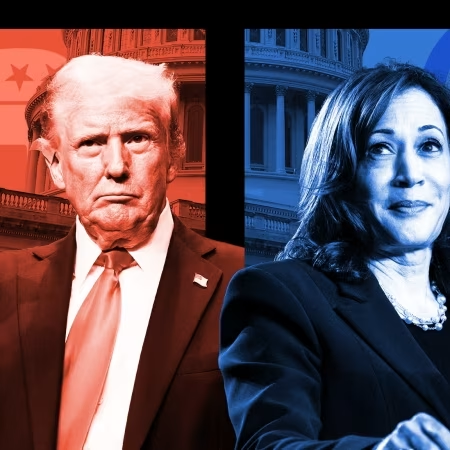
By MICHAEL SCHREIBER
Nov. 5—Speaking in Philadelphia on Monday night, Kamala Harris called the presidential contest “the most consequential election of our lifetime.” Not to be undone, Donald Trump told a crowd in Reading, Pa., “Nov. 5 will be the most important day in the history of our country.” Of course, readers might recall that politicians and the media said the same thing in 2020, in 2016, and even before that.*
Nevertheless, there is no doubt that the U.S. ruling class believes that the presidential election holds great portent for an economy that is suffering from extremely weighty pressures. Rana Faroohar, writing in The Financial Times on Nov. 3, summed up some of the major concerns of U.S. capitalism: “On Tuesday, Americans will vote in what will probably be the most consequential presidential election of our lifetimes [there’s that cliché again!]. The candidates couldn’t be more different, but the challenge left to them will be the same—how to renew a sense of national purpose and dynamism in a country that may well have reached the peak of its competitive powers. America is still enjoying its post-pandemic growth spurt. But major economic, political and social headwinds lie ahead.
“Partisan politics will not end with this election; indeed, they may get worse. Productivity is slowing, the population is ageing, social media silo-bubbles create division and the country faces competitive threats from China and other emerging markets, which are increasingly banding together in their own post-Washington consensus alliances.”
That’s how most capitalists understand the stakes: They see the prospect of major crises ahead, which will need strong and even harsh measures to overcome. And they want a White House administration (and a Congress) that can do the job. For many capitalists, “partisan politics” are a secondary matter; they donate money to both parties with the expectation that both will bow to their interests. Studies have shown that donations from corporations and business-related associations are just about equally as generous to both the Republicans and the Democrats.
But how do working people fare in this election? For the working class, as always, the outcome will be bleak no matter which of the two big capitalist parties wins. Both presidential candidates, and their parties, represent and respond to the narrow interests of the wealthy elite—despite the mask that their candidates put on at election time to pretend that they somehow speak for the interests of those who must work for a living.
Since workers and oppressed people lack an independent party of their own, they are forced to watch the boxing match that the two parties stage every election season. At the end of the contest, working people are asked to choose between the candidates. After judging whether the candidates are apt to keep at least some of their snake-oil promises, the choice often boils down to which one they think might be the “lesser evil.”
So, will it be Trump or Harris who gains the position of heading up the political administration of U.S. capitalism? Most of the polls indicate that the result will be extremely close. Let’s take a snapshot look at what the two Big Business candidates are promising to the electorate:
Trump’s platform
This time, as in the last two presidential elections, the Republican Party ticket is headed by a buffoon and scoundrel—a racist, a liar, an abuser of women, a social reactionary, a staunch pal of white supremacists and the far right, and a wannabe authoritarian strongman.
Nevertheless, Trump, like a carnival barker, has appealed to voters with the vision of a glittering future once he is re-installed in the White House. According to pre-election polls, he has won over a strong contingent of working-class voters with his promises in regard to the economy.
Trump has reinforced his campaign by building on the fact that, as recorded by a New York Times/Siena College poll in October, 75 percent of voters say the economy is in bad shape. Just last week, after a report from the Labor Department had showed anemic growth in employment—in part because of hurricanes and the Boeing strike—Trump crowed: “That brand-new jobs report proves decisively that Kamala Harris and Crooked Joe have driven our economy off the cliff.”
Trump’s main recipe to gain more jobs is to boost U.S. industry by imposing tariffs on foreign-made products to an unheard of extent. “We will not let countries come in, take our jobs, and plunder our nation,” Trump has said. “The way they will sell their product in America is to build it in America, very simple.” Left unsaid is the degree to which Trump’s plan of added tariffs would contribute to inflation.
At the same time, he affirms, the Trump White House will nurture U.S. industrial production by slashing taxes, rolling back Biden’s electric vehicle incentives, and expanding fossil fuel production with an environment-be-damned “drill, baby, drill” policy. Along the way, he has assured working people, he would eliminate taxes on tips, overtime, and social security.
Immigration has also been at the center of Trump’s rhetoric. In order to counter the alleged “invasion” of the United States by immigrants, he will “seal the border” while undertaking the largest mass deportation of immigrants in U.S. history.
Trump declares that he will end the war in Ukraine “in the first 24 hours” of his presidency. He will take quick and severe measures to clear out the “rogue bureaucrats” as well as the Deep State “enemies” who have corrupted the federal government. Trump also promises to cut federal funding to schools that teach about trans rights and “critical race theory” and says that he would even “protect women” in some unspecified manner
Harris’s platform
The Democratic Party is opposing Trump with a candidate who is far less crude in her speeches but generally offers a continuation of the predatory capitalist and imperialist policies of her predecessor, including active support to the genocidal atrocities of the Israeli state. At the same time, she offers very little to augment social programs at home or any real efforts to deal with the climate emergency that threatens the planet.
Harris’s promises to the electorate have been much more modest than her opponent’s. In general, she has been running as the “non-Trump” candidate, who will protect “our democratic values” against “division, chaos, and distrust”—and even challenge Trump’s “fascism.” “Fight for freedom!” she proclaims at her rallies.
Her major commitment has been to sign a law restoring the right to abortion, if Congress enacts such a measure (which is doubtful). But in general, despite the signature call of her campaign for a “fresh start, a new way forward,” Harris has indicated that few changes from the policies of Biden would take place under her watch.
Like Biden, Harris tried to assure voters that economic problems in the United States are not nearly as bad as some make them out to be. It is hard to deny, however, that inflation soared due to the COVID pandemic and the supply problems that followed, rising to a degree unmatched in 40 years. Skyrocketing prices of food, gas, and other necessities were soon augmented by ballooning mortgage rates and insurance premiums. Moreover, the Biden administration allowed the tax subsidies in its American Rescue Plan to elapse at the end of 2021, which caused child poverty to increase once again.
In poll after poll, people state that they are suffering from price rises—and a strong percentage say that they “did better under Trump.” Accordingly, Harris affirms that she “has heard” the complaints of working people and the “middle class,” and that “our biggest challenge is to lower costs.” In order to do that, she pledges to induce the big pharma companies to lower prices and—in some unclear manner—to ban price gouging on groceries. But at the same time, she repeatedly reassures big business that nothing she is proposing would be too thoroughgoing or radical. “I’m a capitalist,” she proudly informed business leaders in Pittsburgh.
Unlike some candidates in earlier Democratic campaigns, Harris now ignores any mention of expanding the Affordable Care Act, and she outright opposes plans for single-payer health insurance (i.e., Bernie Sanders’ past slogan of “Medicare for All”). She has promised that 10 million new homes would be constructed under her administration, but the task would apparently be left to private industry to fulfill; the federal government is no longer in the business of constructing affordable housing. The Green New Deal, which Harris endorsed four years ago though it was in itself an inadequate response to climate change, has now been forgotten (except as a stalking horse for Trump). And the so-called “left” of the Democratic Party—Sanders and the Squad—are rarely heard from anymore, having been pulled into the mainstream behind Harris.
As the campaign season progressed, and Harris became slightly more explicit about her proposals, she moved more and more to the right. Her rightward drift can be seen in regard to several issues. In 2020, in a nod to concerns over climate change, she said she was against fracking; now she merely says that she believes the U.S. should draw from a variety of power sources, and that the use of fossil fuels should not be excluded. At one point, during the height of the George Floyd protests, she professed to be for defunding the police; now she stresses her pro-cop credentials as a prosecutor in California.
Harris has even tried to outdo Trump in promising to clamp down on immigration. She now endorses constructing more walls across the southern border, a measure that the Democrats opposed when Trump attempted it. In her speeches, she repeatedly praises the horribly restrictive “bipartisan” border bill that Trump pushed his minions in Congress to shoot down earlier this year. And no longer do the Democrats talk of forging a “pathway to citizenship” for immigrants, refugees, and DREAMERS.
Aside from a few words of sympathy for the 42,000 Palestinians slaughtered by Israel’s incursion into Gaza, Harris differs little from Biden (or Trump) in her support to apartheid Israel. She has doubled down on her pledge to keep supplying Israel with weapons in its murderous war against the Palestinians, its invasion of Lebanon, and its missile attack on Iran.
While Harris’s utterances on foreign policy might not be as shrilly nationalistic as those of Donald Trump, the perspectives of the two candidates do not diverge very much in substance. Both Harris and Trump (as with Biden) intend to pursue, if not ratchet up, the increasingly militaristic “Great Game” of inter-imperialist rivalries and trade wars. Whereas Trump apparently feels he could manipulate this country’s imperialist competitors by bullying—and perhaps get his way with Putin and Xi though a combination of flattery and threats—Biden and Harris appear to stand by the old Teddy Roosevelt colonialist slogan of “speak softly and carry a big stick.” In her address to the Democratic National Convention, Harris vowed: “As commander-in-chief, I will ensure America always has the strongest, most lethal fighting force in the world.”
Meanwhile in the campaign, Harris’s watchwords have now become “cooperation” and “consensus.” And in that spirit, she has offered Republicans a full “seat at the table” (including a cabinet post). Dozens of neo-con politicians and ex-military brass have taken the olive branch and flocked to the Harris campaign. One can speculate that this movement toward the Democrats has taken place not only because they fear Trump’s antics such as cozying up to rulers like Putin and Xi might tear apart their own projects but also because they see some confluence with the policies of the Democratic Party—especially in the matter of enforcing U.S. political, economic, and military hegemony in the world.
As a consequence of the neo-con movement toward the Democrats, former Republican Senator Liz Cheney—who still disagrees with Harris on the question of reproductive rights—is a frequent speaker at her campaign rallies. And former Vice President Dick Cheney, one of the architects of the U.S. invasion of Iraq and considered a war criminal by many people, has likewise become a vocal Harris supporter.
Which way for working people?
For many months, working-class voters have been bombarded by propaganda distributed by the partisans of Harris and Trump. Both candidates and their parties profess that they will provide a glorious “new future” for the country, which will give working people all they need. And the only thing that working people have to do is to come into the fold and vote them into office.
Unfortunately, the candidates’ promises are hollow. History shows that when the chips are down, both the Republicans and the Democrats always sacrifice the interests of working people in order to enable Big Business to keep humming smoothly and profitably.
Despite the millions of dollars that most unions pour into the campaigns of the Democratic Party, and despite all of the union members who go door to door stomping for Democratic candidates, elected Democrats generally give short shrift to the demands of union members at contract time. When called upon, Democratic and Republican administrations alike will send in the cops or National Guard to break up strike picket lines. Or they will appoint cumbersome arbitration boards to shove down the throats of the workers a contract that doesn’t really meet their needs.
It’s a matter of class loyalty; both parties serve the interests of the wealthy, not those of working people—and neither Trump nor Harris are any different.
No matter who wins today’s election, our best option for achieving meaningful change is to stay in the streets. We need to build giant protest movements that can make it clear to the profit-hungry rulers of this country that if they don’t fulfill our demands, they will be swallowed up by rebellion.
And finally: The systematic oppression and exploitation of U.S. working people will only change when the victims, in their millions, break with the two big capitalist parties and build their own independent party. We need a militant working-class party that fights every day for the oppressed and exploited and looks to the inauguration of a workers’ government.
NOTE:
*Democratic presidential nominee Joe Biden tweeted in October 2020, “There’s just one month left before the most important election in our lifetime.” Bernie Sanders echoed him two days later “This is the most important election, not only in our lifetime but in the modern history of our country.” In 2016, Donald Trump said, “This is by far the most important vote you’ve ever cast for anyone at any time.” The cliché is repeated in almost all presidential elections.
Graphic: The Financial Times via Getty Images
-
Elon Musk’s robots: Wasteful playthings for the wealthy elite?


By HERMAN MORRIS

Tesla’s Optimus robot. In the latest Tesla investors meeting, Elon Musk made the prediction that in less than 20 years, AI-powered robots would be in everyone’s home and workplace and would be available to purchase at the relative price of a consumer grade vehicle. Tech journalists were quick to point out that this claim is almost assuredly a lie, given that Musk has repeatedly made similar claims that some sci-fi-esque technology is five to 10 years away, only to continually have to revise that estimate. Some examples are electric cars for $25,000, pneumatic tube-based mass transit, full self-driving cars, and rockets that will take humans to Mars.
All of these promises have failed to materialize under his leadership despite being perpetually only a few more years away. This raises the question, though, of why Musk and his ventures continue to receive billions of dollars of funding for the undertakings his firms engage in—and what is he delivering in return for his efforts?
Billions in government subsidies
What defenders of Elon Musk and his firms are quick to point out is that, even when one accounts for the missed deliveries for his pie in the sky dreams, there are still R&D and manufacturing achievements occurring under his watch that are simply not happening elsewhere. In large part, this is true. SpaceX was the first organization to successfully reuse a first stage rocket from launch to launch, and Tesla to this day is still the biggest EV producer in the U.S. and has one of the biggest EV charging networks in the country.
What his supporters fail to acknowledge, though, is that this is all being done on the back of billions of dollars of government contracts and subsidies, non-union labor, and flagrant disregard for the environmental impacts of his ventures. The reality is that while human society is still fully capable of making tremendous leaps in industrial organization and research, very rarely is private capital able to be deployed productively to achieve those gains.
The reliance on state funding can be felt in almost every aspect of Musk’s venture. Government contracts fuel SpaceX and the Boring Company. For example, NASA has awarded SpaceX $4.4 billion for contracts in which its new Starship rocket would be used to land astronauts on the moon. And the Pentagon is looking to give SpaceX billions of dollars more to build satellites to be used as part of a new military and spying network in outer space, which would be launched with SpaceX rockets.
In the meantime, Tesla is able to chalk up roughly a quarter of all the net profits that it reports to a complicated regulatory program that allows it to sell clean energy credits earned from the U.S. government. This is in conjunction with a program of union busting, as the original Tesla auto factory in Fremont (and as of 2022, the most productive Tesla factory in the U.S.) is a non-union shop despite repeated attempts to organize.
All of this coheres into a system in which massive amounts of public wealth are transferred to the control of a single person, who is only able to deliver on a fraction of his promises through a robust program of disciplining labor and cutting regulatory corners.
The future today, but for whom?
There is a political dimension to what Musk promises and what he delivers. Musk paints a picture of a utopian future where tech innovation and large-scale production become a democratizing force allowing even the low-wage working class to, for example, purchase an electric vehicle (and this was the stated goal of Tesla for over a decade). However, what has been delivered instead is a mostly luxury line of cars, with the cheapest option only being available to the top layers of the working class who happen to qualify for an EV tax credit and live within a still small electric-charging network.
Most importantly, trying to address the real climate issue generated by U.S. car production and usage by exclusively advocating electric cars is a fool’s errand. Without a massively expanded mass transit network, there is little hope of actually getting to the emission levels we need.
Ironically, the Boring Company is undertaking one of the most important and difficult tasks of improving transportation in the metro areas of the United States, namely that of digging large underground tunnels. For all that trouble, instead of outfitting it with high-density rail transit that is affordable to the people who need it to commute, he is opting to make it a one lane highway exclusive to Teslas.
SpaceX straightforwardly proposes a mission that is elite and closed off. Even if the firm does figure out how to transport humans to Mars, the cost and time away from family and work to make a trip to the planet would exclude all but the very few who could go on a journey Musk himself says will end in their death.
It is easy to imagine what the likely outcome of the Tesla robot is, then. There is plenty of reason to doubt the success of the venture in the first place, but if Tesla is somehow able to make the industrial and research breakthroughs necessary to mass produce and productively deploy general-purpose autonomous robots, it won’t be for the benefit of all of society.
Instead of reducing the time and effort that workers need to perform their tasks—i.e., reducing the amount of hours on the job without a reduction in pay—robots will be almost exclusively used to throw out of work some of the most desperate and marginalized layers of the working class. The layoffs will be focused on those who do the hardest and most repetitive tasks of industrial and domestic labor. So even if this venture is successful on capitalist terms, it is still a loss for the workers, who wouldn’t be able to secure a just transition and have no path to enjoying the benefits of this technology for themselves.
Large-scale research and development projects can bring society a lot of good. Vaccines, leaps in computer technology, and industrial production of home goods have obviously been beneficial to society at large. The issue is that increasingly large projects are being conducted under private direction, private profit, and exclusive use. This is ironic as these same projects are not possible for people like Musk without significant state backing, and the strictest cost-saving measures such as using the cheapest labor possible while dodging environmental policies. Vastly increased waste, power demands, and greenhouse gas emissions have been associated with the AI “revolution,” and Musk’s AI-based robots will undoubtedly add to the problem.
Instead of giving away our societal wealth to be squandered by an increasingly unstable and walled-off elite, workers should have the right to democratically determine what sorts of projects and research are needed to progress our society and to carry that work out under democratic control of their working conditions. Working people already know better than any single billionaire the most important tasks to improve society since they already have to live with the consequences of the crises we face today.
With the deepening crisis of climate change, there is more work needed than ever before to save our planet from the absolute worst effects. If we continue to allow people like Musk to make decisions on how our economy is run, we will waste what time and money we have left.
Photo: Elon Musk (Business Today)
-
Building a Palestine solidarity movement that can stand up to repression


By ERWIN FREED
On Oct. 15, the United States and Canadian governments designated the Palestinian prisoner solidarity organization Samidoun as giving “material support to terrorist organizations.” Simultaneously, the Netherlands banned Samidoun’s European coordinator, Mohammed Khatib, who is also facing having his asylum status revoked in Belgium. No government or anyone else has presented any evidence to substantiate these charges. In fact, a special dossier produced by the Israeli government alleging to make this case states only that “it is likely that donations made through the Samidoun website benefitted Barakat and the PFLP” (page 24).
As the Canadian socialist publication Spring Mag points out, “Though Samidoun has not been linked to any attacks, violence, or financial activity, … the reasoning given in the [Canadian] government’s press release largely revolves around its ties to the PFLP [Popular Front for the Liberation of Palestine]. These ties seem to consist of sharing similar positions and having former and current members in common, with no evidence of financial or other more substantial forms of connection.”
The method of making vague accusations for “material support to terrorism” or “domestic terrorism” is used by the government to criminalize speech and organization by groups and individuals who politically oppose U.S. imperialism’s favored policies. Designating Samidoun as an organization that “supports terrorism” is an attempt to intimidate anyone standing in solidarity with Palestine into silence.
Samidoun’s targeting is only the latest case in a year of some of the most aggressive acts of repression carried out by the U.S. government in recent years. Three Palestinian defendants caught up in the government witch hunt against the Holy Land Foundation (HLF)—at the time, the largest Muslim charity organization in the United States—are still in prison, with 49 years remaining on their sentences. American Muslims for Palestine continues to face a lawsuit, based on the same bogus claims made against HLF, “connecting” them to Hamas. Dozens of people remain caught up in the Stop Cop City dragnet, charged with “domestic terrorism” for actions that the government has never offered any proof they committed.
At the same time, activists must understand the current moment as part of an escalating series of new laws, policies, and programs set up to surveil, disrupt, and politically disarm movements for social justice and against imperialism. Virtually identical measures and technologies are often developed and pointed at oppressed communities in the U.S., especially Black, Indigenous, and Latino peoples. And similar technologies, strategies, and even agencies are used on the Palestinian populations in Gaza and the West Bank. It is important to view domestic repression as part of the totality of political and military operations of U.S. imperialism.
Anti-Palestine solidarity dragnet
In Oct. 2023, Israel began the highest iteration of ethnic cleansing in Palestine since the 1948 Nakba. These attacks are fundamentally supported by the United States, including through political defense, weapons transfers, operational intelligence, and military guidance. Earlier this month, over 100 U.S. troops were sent to Israel as part of the U.S.-backed Israeli bombing of Iran, which began early morning local time on Oct. 26.
Solidarity with Palestinians against the U.S./Israeli genocide in Gaza exploded immediately, particularly on college campuses. The movement is an inspiration to all who believe in the possibility of a peaceful, just future. Public spotlight on the genocide and U.S./Israeli militarism in the Middle East exposed hundreds of thousands of U.S. residents to the reality of Israeli apartheid and settler-colonialism. Massive demonstrations in Washington, D.C., alone brought hundreds of thousands into collective action. Virtually every state has seen mobilizations, from vigils and speak-outs to encampments on college campuses.
The forces of domestic “counterinsurgency” immediately got into motion. As early as Oct. 10, 2023, President Biden put out a statement on X, saying, “This is not some distant tragedy—the ties between Israel and the United States run deep. … In cities across the country, local and federal law enforcement partners are closely monitoring for any domestic threats in connection with the horrific terrorist attacks in Israel.”
In the same period, Muslim and Arab community members began reporting door knocks and baseless interrogations by Federal Bureau of Investigation (FBI) agents. An article by The Intercept explains that these investigations “included FBI officers visiting a Texas mosque to meet with leadership and ask about any ‘troublemakers’ in the community, and FBI agents seeking to question an individual who was detained by Immigration and Customs Enforcement … for a green card issue.”
FBI Director Christopher Wray warned in a Nov. 15, 2023, statement to the House Committee on Homeland Security that since Oct. 7, “a rogues gallery of foreign terrorist groups has called for attacks against Americans and our allies.” He then listed a number of claims by disparate Islamist groups with no apparent connection to the United States or to each other.
In an attempt to stoke the flames of Islamophobia and to build faith in federal intelligence agencies, Wray pointed at specific actions that the FBI had taken between Oct. 7 and the committee meeting. He said, “Across the country, the FBI has been aggressively countering violence by extremists citing the ongoing conflict as inspiration. In Houston, we arrested a man who’d been studying bomb-making and posted about killing Jewish people. Outside Chicago, we’ve got a federal hate crime investigation into the killing of a six-year-old Muslim boy. At Cornell University, we arrested a man who threatened to kill members of that university’s Jewish community. And in Los Angeles, we arrested a man for threatening the CEO and other members of the Anti-Defamation League.”
All of these claims were hyperbolic attempts to politically justify counter-intelligence and mass surveillance operations against oppressed communities and the Palestine solidarity movement.
Briefly looking at the specific arrests mentioned by Wray helps to demystify the FBI’s so-called “counter-terrorist” strategy. The first example, in Houston, appears to have been Sohaib Abuayyash, a 20-year-old Palestinian-Jordanian asylum-seeker. The FBI used Abuayyash’s arrest on minor gun charges in October 2023 as a way to publicly slander him and create a narrative that a group of “radical” Arabs were making threats against Jews, despite this having nothing to do with the actual arrest.
After Wray’s statement to the House Committee on Homeland Security, the mainstream press ran wild, reporting that Abuayyash was arrested for making concrete plots against Jewish community organizations. The groundwork for this propaganda offensive was laid in a Nov. 2, 2023, CNN article. The headline read, “Jordanian arrested in Houston supported killing ‘individuals of particular faiths,’ judge’s order said.” The “judge’s order” that was referenced appears to be an order calling for Abuayyash’s pre-trial detention, filed on Oct. 24, 2023. The order does indeed include these quotations. However, all of the evidence presented by both the prosecution and defense remain sealed.
That article also includes a quote attributed to an anonymous “law enforcement source” that makes the specific claim that Abuayyash was actually plotting to kill Jews, a charge not presented in the actual court case. An article from the Jewish Chronicle, headlined “Jordanian man arrested for plan to ‘attack Jewish gathering,’” does the dirty work of the original CNN piece. Here the newspaper combined the unnamed “police source” with the judge’s order, doubling down on the unsubstantiated implications of the first article. Through a sleight of hand, irresponsible reporting became “fact.”
Of course, the Feds never substantiated any of the above claims, and Abuayyash was acquitted on the gun charges by a jury in February, although he was not freed but put into immigration detention. There is very little reporting on his acquittal, especially considering the hysteria whipped up by the media during his initial arrest and detention.
The incident in Cornell was that of Patrick Dai, who publicly posted threatening antisemitic statements on a student-oriented discussion board. The role of the FBI itself was limited to getting Dai’s information from the forum administrators and Charter Communications and interviewing Dai.
The Dai case is unfortunate and somewhat bizarre, but certainly does not rise to the level of an international terrorist conspiracy. Even prosecutors agree that Dai struggles with mental health issues. Further, Dai claims he was effectively playing the role of a provocateur. He later anonymously apologized on the same forum. According to Dai’s attorney, “He believed, wrongly, that the posts would prompt a ‘blowback’ against what he perceived as anti-Israel media coverage and pro-Hamas sentiment on campus.”
There is no readily apparent public information on the alleged arrest in L.A. of “a man … threatening the CEO and other members of the Anti-Defamation League.”
Lastly, the FBI had nothing to do with arresting Joseph Czuba, the Chicago landlord who murdered his six-year-old Palestinian tenant, Wadea Al Fayoume. Due to a 911 call, Czuba was arrested immediately after killing Fayoume and stabbing his mother.
Repression on university campuses
After the opening salvos from the FBI and other alphabet agencies, local police, politicians, and college administrators—coordinating with Zionist non-profits like the Alliance in Defense of Liberty (ADL)—took over the overt side of pacifying the Palestine solidarity movement. Over a year later, although no “terrorist plots” connected with the Palestine solidarity movement have been uncovered, the political repression has only deepened.
The big crackdowns began during the Spring 2024 encampment movement. As part of a playbook that was replicated by potentially hundreds of different police departments, university administrators called the cops on peaceful encampments, which were then brutally raided. Three thousand students were arrested between April and May alone, with many still waiting for either trials or negotiated “accelerated rehabilitation.”
Simultaneously, in May 2024, the U.S. ruling class made clear to university administrators that it is not messing around, putting them through humiliating public hearings in front of congressional committees. In some cases, these sorts of measures helped push administrators (who did not really need much of a “push”) to intensify the brutality of the campus crackdowns. Perhaps most egregious was the situation at Columbia University, where police utilized highly militarized tactics and even shot a gun inside a building during an operation to clear an occupation by student protesters.
The UAW has in many ways been at the forefront of union solidarity with Palestine. There is a strong push from the ranks, especially among UAW graduate-student members. Locals have taken bold stands against repression and for Palestine, including the historic strike by 48,000 Local 4811 members in the University of California system. In a brazen overstep of its stated aims, the federal monitor assigned to oversee UAW elections twice made statements condemning the union for taking pro-Palestine positions.
Over the summer, campus administrators worked with private organizations, local police, and federal intelligence agencies to develop a common strategy for repressing the Palestine solidarity movement at colleges and universities. One notable example is the joint Hillel/Secure Community Network (SCN) “Operation Secure Our Campuses.”
According to an August 2024 statement by Hillel, the effort “will leverage SCN’s national, regional, and local resources, along with the national network of security professionals, to deploy critical resources to protect Jewish students at colleges and universities, to include: full-time intelligence analysts dedicated to monitoring campus developments and providing intelligence support; assessments of Jewish facilities on campuses; direct consultations on physical security and emergency plans and procedures; and enhanced coordination with law enforcement and public safety officials and centers of Jewish life.”
Secure Community Network defines itself as “the official safety and security organization of the Jewish community in North America.” The group’s leadership is filled with former FBI, CIA, DHS, and urban police agents and officers. SCN has direct access to intelligence from at least the FBI and National Security Administration (NSA) through the Public-Private Analytic Exchange Program led by the Office of the Director of National Intelligence. The group also has its own, privately funded “National Jewish Security Operations Command Center” (JSOCC) in Chicago, which SCN claims runs “24/7/365” and “intakes and analyzes intelligence and information, providing timely, credible threat and incident information to both law enforcement and community partners.”
In announcing “Operation Secure Our Campuses,” Hillel acknowledged that “ahead of the new academic year, SCN co-hosted a campus safety roundtable discussion with the Major Cities Chiefs Association, which had participation of law enforcement and public safety officials from 92 universities across 24 states, including representatives from the FBI, law enforcement association leaders, and Jewish security professionals.”
Private organizations like SCN and the Israel on Campus Coalition (ICC) work with police and U.S. and Israeli intelligence agencies while also maintaining lists of people expressing pro-Palestinian sentiment for potential blacklisting, blackmailing, and doxxing through initiatives like the Canary Project. These Zionist civilian-spy networks are prevalent on many campuses and existed long before this current upsurge.
Josh Nathan-Kazis, writing for the Jewish website Forward in 2018, points out: “The list of Jewish groups that do anti-BDS [Boycott, Divest, Sanction] work on campuses is bafflingly long. A partial tally includes StandWithUs, AEPi, CAMERA, the David Project, the David Horowitz Freedom Center, Jerusalem U, AIPAC, Sheldon Adelson’s Maccabee Task Force and the Zionist Organization of America. The total amount of American Jewish and Israeli government funds flooding the anti-BDS effort is easily in the tens of millions of dollars each year.”
Nathan-Kazis goes on to explain the particular organizing role held by ICC, “The Israel on Campus Coalition, once a branch of Hillel and now an independent entity, plays air traffic control among anti-BDS groups. When a BDS resolution crops up, the ICC convenes conference calls, coordinates efforts and offers support to Hillel professionals.” The I.C.C. also maintains its own private, high-tech intelligence center worth millions of dollars and with a network of human informants.
The U.S./Israeli/Zionist private-public spying apparatus also carry out bizarre psychological warfare operations, such as in 2018 at George Washington University, where, in the lead-up to a student senate vote on a pro-Palestinian resolution, “Anonymous fliers, websites and social media campaigns appeared out of nowhere to attack the student activists. And, on the day of the vote, two adult men, dressed as canaries, showed up to do a weird dance in the lobby of the college building where the student government was set to vote” (https://forward.com/).
Perhaps more than anything else, these networks and organizations serve to give concrete strategic direction for the repression of pro-Palestine activists. The reality is that U.S. university and college administrators are broadly supportive of Zionist goals without any prodding. However, they rely on the joint efforts of groups like SCN to help develop operational plans and coordinate between campuses.
During a summer of meetings like the SCN-sponsored one described above, campus administrators rolled out new explicitly anti-speech, anti-assembly, and anti-Palestinian regulations. A Mother Jones report lists over 30 school systems, representing over 60 campuses, that enacted new protest policies between May and August 2024. This, as they acknowledge, is far from a complete list.
These new measures include bans on “camping,” mask bans (despite campus communities’ health concerns), mandated “registration” for protests (handing over activists’ information directly to the state or police and in many places effectively curtailing emergency demonstrations), limiting locations where protests are “allowed” (giving law enforcement a tactical edge as well as giving the university more tools in their arsenal to shut down demonstrations), banning “unapproved signage,” bans on “amplified sound,” and more.
Merging private “security” organizations, federal and local police, corporate interests, and intelligence agencies to target social movements are all important aspects of the post-9/11 security state. These trends are most obviously embodied by so-called Intelligence Fusion Centers, which are meant to combine intelligence from different agencies, private individuals and corporations, and police departments.
Fusion centers exist in every state and have been exposed multiple times for largely surveilling social movement groups and Black and Latino community members without any sort of probable cause. The centers are a product of post-9/11 surveillance expansion and have been used not only to police protest but also to charge Black and Latino people as “gang members” due to nothing other than liking posts on social media.
Notably, the Crime Prevention and Information Center (CPIC), a Chicago-based fusion center, dispatched a “counter-terrorism” team in May at the behest of the law firm Greenberg Traurig. There were no threats made against the firm, but representatives reached out to CPIC to coincide with a press release announcing a baseless lawsuit claiming that American Muslims for Palestine (AMP) “supports” Hamas.
Building a movement capable of standing up against “counterinsurgency”
In a hidden camera interview released as part of an exposé, CEO Jacob Baime of the Israel on Campus Coalition “described ICC as basically a clandestine Israeli military command. ‘It’s modeled on General Stanley McCrystal’s counterinsurgency strategy in Iraq. We’ve copied a lot from that strategy that has been working really well for us, actually’” (The Nation). We should take this self-identification seriously, but we also need a clear understanding of the political terrain in which this struggle is unfolding.
The military framing of pro-Palestine, environmental, and other social justice movements as “insurgencies” by the U.S. government and its allies is not an accident. However, the primary focus of these movements has nothing at all to do with “military” action but rather winning over and organizing the masses of people to political ideas —including a free Palestine, Black liberation, a livable earth, and so on.
“Counterinsurgency” theory has many different aspects and schools. An important component that is universal to all counterinsurgency strategies is identifying and isolating the “activist minority” in a given community. Therefore, it is important that movement organizations not allow our isolation by the state and various Zionist and reactionary forces in society.
The crackdowns and face-offs by the cops, and in some cases far-right Zionists, has produced a contradictory mentality of brazenness and fear in many Palestine organizing spaces. On the one hand, a core of activists feel that while the state is already pulling out all of the stops for repression, the genocide continues and Israel’s war on the Middle East expands, despite more than a year of mobilizations. On the other hand, there is a belief among some activists that protection from the repressive apparatus requires small, “vetted” groups of trusted individuals, often pulled from one’s own friend group.
These mentalities combine organizationally, for example, by student groups implementing their own internal measures to create environments of strict political homogeneity and external secrecy. In one particularly bad variant, activists see themselves as martyrs, willing to bear disciplinary and legal charges as a “sacrifice” for Palestine. In doing so, they often abandon their own political defense as a transactional cost of building “solidarity.” However, when we do not defend ourselves and others in the protest movement, we are unnecessarily allowing the state to disrupt movement organizing.
Activists need to be aware that repression against individuals and even groups is not solely or even primarily meant to deter those people from standing for Palestine. Instead, these attacks are a warning to the broader community that pro-Palestine activity, and even thought, can get you in trouble. They are part of constructing a narrative that organizers and organizations are “dangerous” and outside of the community, whatever that might be. When students, or anyone, is arrested in alleged connection with a social movement, there can be a chilling effect on the movement as a whole. We need to be in the best possible position to fight against not only arrests and other means of government subversion, but also against the fear this creates.
For starters, that means spaces should have clear, democratically elected and recallable leaderships; clear demands that open rather than close conversations with the 70% of people who support an end to the genocide; and put the responsibility directly on the state for any attempts at movement repression.
These goals can be accomplished through open, well-publicized organizing that brings together all organizations and individuals in basic agreement with the principles listed above. The “security” of our movement is determined in the first and last instance by the support it has within U.S. society as a whole and the working class in particular.
Activists have a rational fear of disruption by Zionist organizations, including Mossad, in collaboration with U.S. intelligence, local police, and campus administrators and agents of capital. However, the methods that are often taken to combat infiltration and disruption are the opposite of what can be really effective to creating a strong, defensible movement.
The situation mentioned above, in which an already existing group shifts toward becoming smaller, more self-contained, and increasingly “militant” in its rhetoric can fall directly into the counterinsurgency trap laid by the cops. Police and institutional leaders are handed an easy pretense to crack down on movement leaders, who have done the work of isolating themselves from the broader base by insisting on organizing conditions that are incomprehensible to people outside of the activist core.
Instead of depending excusively on already activated “cadres,” the movement needs to expand and use every attempt at repression to spread the message of ending U.S. aid to Israel, fighting the new McCarthyism, and for a free Palestine. Activists need to be aware of the surveillance and infiltration and organize in ways that allow for creating the broadest possible audience and participation for every action.
Concretely, this means two things: One is formulating demands in a way that is both principled, politically understandable, and actionable to the broadest layers of supporters. Right now, an example of this type of demand is, “End all U.S. funding to Israel.” Many people agree with this demand, and implementing it would effectively end the genocide. However, it is completely unacceptable to U.S. imperialism. The ruling class and its representatives up and down the line are unwilling to actually end U.S. funding to Israel, except in a modified, conditional way.
The second part is being prepared to politically defend ourselves and our civil liberties. Israel plays a central role in U.S. imperialist strategy, particularly in the Middle East. The reasons for this are substantial, ranging from Israel’s role as a middleman in controversial arms sales for the United States, the state of permanent war the IDF maintains with its neighbors, and the surveillance and policing testing-grounds that are the West Bank and Gaza. In short, Israel is fundamental to U.S. imperialism.
That simple fact means that no matter what our movement says, and how clearly it is that we are the ones for peace and stability, the domestic political police forces are mobilized against us. There is a long and heroic history of turning these attacks by the state into a rallying cry around which the movement builds strength.
Many touchstones of the United States left are political defense campaigns that took on a mass character. Free Huey! Free Angela! Free the Chicago Seven!
The general strategy is to organize a united-front defense committee on the largest scale possible, which can take the story into the community and build real support. A good example from 1962 is the Free the Bloomington Three campaign. Three students at Indiana University were arrested on charges of “sedition” under the 1951 Indiana Anti-Communism Act for organizing a demonstration calling for an end to the military blockade on Cuba and attending a talk by Black revolutionary socialist Leroy McRae titled, “The Black Revolt in America.”
The Committee to Aid the Bloomington Students (CABS) was co-chaired by two prominent professors, and day-to-day organizing was carried out by a team of activists, largely from the Socialist Workers Party and Young Socialist Alliance. That team grew immensely as the campaign began in earnest. Efforts included “fundraising, distribution of literature, the securing of a legal team, the attaining of prominent sponsors, and several national and regional tours of the three defendants were coordinated with local CABS. … By 1965, over 1300 faculty members on 95 college campuses became sponsors.”
CABS also took the opportunity to distribute tens of thousands of copies of “The Black Revolt in America,” sharing the piece well beyond the original audience. The attempt by the university and the police to silence the ideas of Black liberation and Marxism completely failed, and the exact opposite occurred. The massive support for the Bloomington Three led to not only the charges being dropped but also the repeal of the Indiana Anti-Communism Act itself.
These are the best methods we have to fight and win against political repression. Both capitalist parties are aggressively clamping down against the Palestine solidarity movement. We can fight and we can win, but it means taking every attack on our movement seriously and using them to spread the message of a Free Palestine as broadly as possible.
Photo: Police arrest a protester at the Art Institute of Chicago in May 2024. (Scott Olson / Getty Images)
-
Who will defend the Lebanese people?


By JAMES MARKIN
As the Israeli army ruthlessly bombs Beirut and Israeli troops advance into southern Lebanon, the people of the country are suffering mass casualties every day. The Lebanese Health Ministry reports that over 2,700 people have been killed by Israeli attacks during the past year, and over 400,000 have fled into Syria. In the face of this carnage, the Lebanese army has withdrawn from the south, leaving behind only Hezbollah and UN peacekeepers in the way of the invading Israeli army. For those not familiar with the situation in Lebanon, the idea of a sovereign nation’s army withdrawing in the face of a military invasion might seem shocking. But both the Lebanese ruling class and the various imperialist ruling classes have systematically neglected the interests of the people since the country gained independence from the French in 1943.
History of imperialism in Lebanon
After the First World War, British and French imperialisms divided the Middle East between them in the notorious Sykes-Picot agreement. The French got Syria and—drawing on their long claim as “protectors” of the Christians of the Middle East—proceeded to carve out Lebanon in order to be a homeland for the Maronite Christians. While this sectarianism might have been the justification, Lebanon was one of several mini-Syrias that the French created, with the goal to make Syria easier to rule. The French High Commissioner for the Levant, Henri Gouraud, remarked of this strategy, “It will be easy to maintain a balance among three or four [Syrian] states that will be large enough to achieve self-sufficiency and, if need be, pit one against the other.”
In fact, the borders of Lebanon never made any sense as a Christian homeland since, with the Muslim-majority city of Tripoli and other populous Muslim areas included, the country was never able to boast a Christian majority. As the Syrian nationalist George Samné once put it, “What kind of a ‘Christian homeland’ is this, where half of the population is Muslim?”
However, the lack of a Christian majority was not the cause of Lebanon’s troubles. Instead, Lebanon has suffered from debt and exploitation by imperialist powers, and endured a series of major economic and social crises. As if these problems weren’t enough, Lebanon has been a victim of Israeli aggression from the beginning. Israeli troops entered Lebanon and destroyed villages during the Nakba in 1948, and Lebanon received huge numbers of Palestinian refugees then and in the 1967 Naksa that followed.
Away from home and without citizenship in Lebanon, this refugee population looked to the Palestinian Liberation Organization (PLO) in order to provide services for them in the refugee camps. In 1978, Israel invaded southern Lebanon with the goal of wiping out the PLO in the country. Israel’s use of heavy and indiscriminate artillery fire flattened Lebanese villages, killing thousands of Lebanese and Palestinian people and displacing hundreds of thousands more.
Ultimately, the PLO was forced to withdraw, and the UN drew the “blue line” demarking the border between Israel and Lebanon as well as the zone between the border and the Litani River. After five months of carnage, Israel withdrew back across the blue line and the UN established the United Nations Interim Force in Lebanon (UNIFL). Since the 1970s, a series of Israeli invasions of Lebanon have occurred, with the most recent one being in 2006. Each time, the UN failed to prevent the invasion, and the “peacekeepers” ended up more as reporters on what was happening, rather than actually keeping the peace.
U.S. imperialism is behind this invasion.
Now Israel has invaded Lebanon again. It has been clear since the very beginning of Israel’s campaign of genocidal violence in Gaza that an invasion of Lebanon was on the table. That was especially given that Hezbollah rocket attacks, intended to deter Israel’s killing in Gaza, forced Israel to evacuate much of its population from the extreme north of the country, including from the Syrian territory it still occupies—the Golan Heights. This exodus from the north has only contributed to Israel’s broader economic crisis, which threatens to hamper Israel’s conduct in its genocidal war. By invading Lebanon, Israel is hoping to degrade Hezbollah as a fighting force, and push them across the Litani River, allowing them to return Israeli workers to the north and in so doing, potentially provide help to their flagging economy.
The policy of the Biden White House toward Lebanon has shifted. While Biden has long signaled his frustration with the Israeli war effort and has said he was working to contain it in order to prevent regional war, his policy toward the war in Lebanon is one of thinly veiled support. An article for the New Republic reported that while Biden was publicly making unconvincing appeals for Israel not to invade Lebanon, behind closed doors his top aides were signaling a green light. Since then, U.S. government officials have openly celebrated the Israeli murder of Hezbollah leader Hasan Nasrallah without any reservations. These examples clearly show that Biden supports Israel’s carnage in Lebanon for the time being.
This is because the United States sees an opportunity in this war against Lebanon. This has been stated in public by Amos Hochstein, a business advisor to the White House, who was recently dispatched to the Levant as part of the broader US diplomatic offensive. In discussions with the acting Lebanese prime minister, Najib Mikati, Hochstein stated that the administration’s previous ceasefire plan for Lebanon was “off the table” and that now the priority should be on electing a new president for Lebanon. The country has been without a president for two years, a situation that many have blamed on Hezbollah as its political allies have sought to prevent the selection of a candidate not aligned with their interests. Indeed, the U.S. is not a neutral party here; just like Hezbollah, they want to make sure that any president selected is amenable to Washington.
Hochstein, speaking to Lebanese broadcaster LBI, made a Freudian slip when saying that a solution to the war would come after there had been “a comprehensive effort to have the Lebanese armed forces strengthened, have them deployed in the south as they should be deployed across all quarters of Lebanon … [and] at the same time, have a new government, once we elect, select—once Lebanon selects—a new president, that is how we bring about the end of this conflict.” This slip of the tongue represented only a slightly clearer version of what Hochstein had said previously in public: The U.S. sees this war as an opportunity to weaken Hezbollah and create a more stable Lebanese government under U.S. influence.
Standard Israeli policy: Kill all witnesses
Israel is prosecuting the war in Lebanon using the tactics it has honed in Gaza—mass terror bombings. Lebanon, unlike Gaza, however, is an independent country that has not been fully been cut off from the rest of the world. While Israel’s international PR could not be worse, it is clear that in Lebanon there are more eyes watching what the IDF is doing. This is why, just as in Palestine, Israel has carried out a campaign of death against journalists. Out of the many cases of Israeli assaults on journalists in Lebanon, one case that has been particularly well documented is the murder of Issam Abdallah last year. A report recently released by the UNIFIL peacekeepers states that Abdallah was “likely” killed when an Israeli tank crew unleashed machinegun fire against a group of journalists near the Israeli-Lebanese border.
It is this exact kind of report that has caused Israeli aggression against the UNIFIL mission. Israeli Prime Minister Benjamin Netanyahu has repeatedly called for the UN to withdraw the UNIFIL mission from southern Lebanon, while Israeli government-linked propaganda accounts have accused the UNIFIL of providing cover for Hezbollah. Meanwhile, Israeli troops on the ground in Lebanon have repeatedly attacked and made aggressive actions towards UNIFIL peacekeepers. The most egregious incident occurred on Oct. 13, when an Israeli tank brigade forced entry into a UNIFIL base and detonated shells that emitted a noxious gas that hospitalized 13 UNIFIL personnel, despite their gasmasks. More recently, on Oct. 20, Israeli bulldozers demolished UNIFIL watchtowers along the Israeli border. The message that Israel is sending is clear; they want to push out the peacekeepers in order to remove potential witnesses to their crimes.
This Israeli aggression against the UNIFIL personnel has resulted in an international backlash, especially from countries such as Ireland and Italy, which contribute significant numbers of troops towards the UNIFIL mission. However, as usual, this kind of backlash is unlikely to make Israel back down as long as the United States continues to support it. Just as always, United Nations rules and resolutions are merely suggestions as long as you have the backing of one of the permanent Security Council members. While the role that the UNIFIL plays as passive recorders and reporters on Israeli war crimes in Lebanon is positive, it falls far short of any of the alleged goals of the United Nations. The UNIFIL ultimately will not do anything to protect the people of Lebanon as the Israeli war machine rolls over their homes.
Who will defend the people of Lebanon?
Despite much of the rhetoric in the Western capitalist press, ultimately, the destabilizing force in Lebanon is not Hezbollah but Israel. As long as the Israeli process of dispossession of the Palestinian people continues, it will need to have control over its neighboring Arab countries, whose working-class populations loath Israel and see it for what it really is—a state meant to rule over the complete dispossession of the Palestinian people. Without Israeli control over these countries, this broader Arab working class represents an existential threat to the Zionist state.
In Lebanon, this continued friction is part of what created Hezbollah as existing political institutions failed to stop Israel’s violations of Lebanese sovereignty and massacres of its people. Even if Israel and the U.S. are able to defeat Hezbollah, which seems unlikely, something new will arise in its place to play the same role and represent the same interests. That said, it is clear that in the current war, the best outcome for the people of Lebanon would be for Hezbollah to prevail over the invading Israeli forces. As long as Israeli troops remain in Lebanon, there is little possibility of positive change.
This again raises the question: who can defend the Lebanese people? We know that the U.S. and Israel are willing to butcher countless thousands in Lebanon in order to their way. The existing state apparatus of Lebanon is paralyzed, caught between different capitalist camps—those fully under the influence of the U.S. and those whose interests don’t align at this moment. The United Nations, the Lebanese state, Hezbollah, etc., all merely represent different capitalist interests that have so far failed to protect the Lebanese people. If the people of Lebanon are to see a new day in which they don’t have to worry about bombs falling on their homes and invading soldiers walking their streets, they need to rise up and take matters into their own hands.
The only solution lies with the defeat and destruction of the State of Israel, the end of U.S. imperial domination over the Levant, and ultimately, the overthrow of the existing social system in Lebanon and the Middle East. The only forces with the power to carry out this revolutionary change are the working people of Lebanon, united in struggle with the Arab working people of the entire region. Together, they have the power to build a future in which life is valued and peace reigns.
Photo: Israeli troops at a staging area on the border with Lebanon, October 2023. (The Times of Israel)
-
India: Victory in the doctors’ protest


By ADHIRAJ / NEW WAVE
For 40 days, the junior resident doctors have been out on strike, protesting for their gamut of five demands :
- Justice for the victim, a speedy investigation, uncovering the motive for the rape and murder, and just punishment for the perpetrators
- Identify those involved in tampering evidence, and covering up for the murder, and ensure just punishment for them.
- The removal of Police Commissioner Vineet Goyal.
- Ensure the safety of healthcare workers across hospitals.
- Ensure proper conditions of work in hospitals across the state.
Within these five core demands are 18 other demands, which aim at improvement in facilities, creating a system of referrals, dismantling the politically dominated health committees, making rest rooms and improving sanitation facilities at hospitals.
These demands represent the most basic infrastructural and policy requirements to provide better healthcare for the public. The whole of Bengal, the world, and the country came out in protest in solidarity with them, and hundreds of thousands remain out protesting in support of the doctors.
After much dragging, the state government, which tried to avoid entering talks with the doctors on one flimsy excuse after another, finally agreed to come to discussions. Not only that: The Chief Minister has conceded to one of the key demands of the protesters, the removal of the Deputy Health Secretary, the Deputy Chief of Kolkata Police North, and Chief of Police Vineet Goyal. Both of these actors were involved in the cover up of the murder and rape of “abhaya,” the young female doctor at R.G Kar hospital.
This is a victory for the protesters, and a humiliation for the arrogant and corrupt TMC government. The protesting doctors have since stated that they will not hold back their protests on mere assurances; only after concrete steps are taken to fulfill the core demands of the doctors will there be any step back.
This development comes as solidarity protests in other parts of India have been rekindled, with doctors in Delhi going back on strike in support of the doctors in West Bengal. At the same time, solidarity protests across the cities of West Bengal continue to move on, with hundreds of thousands protesting in Kolkata and other cities, coming on night vigils and helping the protesters encamped in front of the health department headquarters.
The victories of the protests would not have been possible without the solidarity they received from doctors across the country, in the world, and from citizens from all walks of life within Kolkata and the state of West Bengal.
R.G Kar hospital, where the murder and rape took place
For the first time, a popular mobilization took on the corruption and arrogance of the TMC government and won! The political significance is no less than the peasant agitations in Singur and Nandigram, which also aroused massive solidarity protests within Kolkata and wide support from the rest of the country.
A timeline of events :
On the 9th of August, a female junior doctor working at Kolkata’s prestigious R.G Kar hospital was raped and murdered. The crime happened while she was working 36-hour shift. The doctor was understandably exhausted and sought to rest for the night before continuing to work in the morning. However, R.G Kar did not have any secure rest rooms or proper washrooms for the doctors to use. She was forced to find space in the seminar room. It was here that the crime was committed.
Once the murder and rape was committed, the cover-up began. The incident was reported to the doctor’s family as an act of suicide. Preparations were made to dispose the body in a hurry before any autopsy could be done. It was the intervention of junior doctors at the scene that stopped the ambulance from leaving the hospital before any autopsy. During the entire ordeal, the parents of the murdered doctor were barred from seeing their daughter one last time. They had to wait for three hours, and kept in the dark about the fate of their beloved daughter, before they learnt of what had happened.
The efforts at cover-up did not end there; over the course of the investigation of the Central Bureau of Investigation, it was revealed that evidence was tampered with. Efforts had been taken at the behest of the disgraced principal, Sandip Ghosh, to hide the truth of the rape and murder of the doctor. The principal issued orders to demolish the seminar room in the name of conducting repairs, while investigations were still going on. The authorities delayed for hours before filing for an FIR at the nearest police station, all the while hiding the truth behind the death of the doctor. These actions were straight from the administration. Having no faith in the administration or the police, the junior doctors at R.G Kar hospital began their protest, demanding safety at the workplace, on the 9th of August.
Soon the protests expanded beyond the R.G Kar hospital, and spread across the city, and eventually the whole country. By the 11th of August, the doctor’s protests had gone national, with solidarity protests as far afield as Mumbai and Delhi. As the days passed, a rushed investigation by the Calcutta police caught the perpetrator of the crime, a lackey of the principal Sandip Ghosh, who had been caught through CCTV footage and eye witness evidence. The perpetrator, Sanjoy Roy, was caught and used as a scapegoat to douse the protests. However, the doctors did not roll back the protests, seeing through the government’s strategy. The strike of junior doctors at R.G Kar hospital was followed by strikes covering all 260 government hospitals in the state of West Bengal.
The sudden spread and scale of the protests had thrown the government onto the back foot. Police measures failed to limit the protests, threats failed, so violence was used. The protest entered the 5th day, and calls were given to reclaim the night. Midnight protests broke out throughout the city and eventually the rest of the state with solidarity protests across major cities in India. The midnight protests began on the night of the 14th of August and would extend over into Independence Day, the 15th of August. It was then that the peaceful protest gathering at R.G Kar hospital was attacked by a mob of TMC backed goons.
Not only did they assault the doctors, they also attacked the police and broke through their flimsily guarded barricades before entering near the crime scene to tamper evidence. The incident gave the police an excuse to use restraining orders to prevent “breakdown in law and order.” This was abused by the police to try and prevent protests from gaining ground. Assemblies were restricted around R.G Kar and across Central Calcutta.
The day after, the Chief Minister herself came down to protest, in an act that was both a farce, and an attempt to intimidate the doctors. The TMC had to project its organizational strength, while pretending to stand in support of the victim, hiding its complicity in the massive cover-up that was happening. Few took the bait, and the protests continued to gain strength and support. The doctors had the support and sympathy of everyone in the state, and especially those who felt wronged by the ruling TMC party and its institutionalized corruption.
From here on, the investigation into the case was taken over by the Central Bureau of Investigation, and the Supreme Court took suo-motu cognizance of the case. The Supreme Court has since done its part in blunting the sharpness of the protests. The solidarity strike of junior doctors in Delhi ended soon after the initial directions by the Supreme Court, to form a national task force to look into the safety of healthcare workers, and the deployment of the paramilitary Central Industrial Security Force to R.G Kar hospital.
The protests
The protests began at R.G Kar hospital, led by junior doctors, but quickly spread to every other hospital. By the third day of the protests, the whole city was engulfed in protests. These were not political protests or led by any political party, though doctor’s unions, medical students unions, and bodies linked with the CPIM took an active part in the protests.
For the most part, the protests remained an apolitical citizens-led protest where no party flags were visible in marches and people from all walks of life—cutting across the class divide—united to protest against sexual violence and the institutionalized corruption that made it possible. At its peak there were protest marches, big and small, breaking out in every corner of Calcutta. It wasn’t long before the protests spread to other cities and towns of the state of West Bengal, and then to the rest of the country.
The protests resonated beyond the borders of India among the Bengali communities in the USA, UK, and Europe. These protests were unprecedented for how quickly they spread and how they seemed to be intensifying. Even after efforts by the TMC led the government to crush the protests and pacify the people, the protests simply kept growing, pushed by the striking junior doctors who were committed to leading the protests to a successful conclusion.
On the contrary, attempts to curb the protests only strengthened the resolve of the striking doctors, and inspired more people to join into the protests, coming to marches, protesting on streets, and holding candle light vigils or torch marches. Every other night saw midnight vigils under the slogan of “reclaim the night.”
A key inspiration behind the protest movement was the success of the youth-led protests in Bangladesh, which toppled the Sheik Hasina-led Awami League government. In terms of brutality and corruption, the Awami League outdid that of Mamata Bannerji. It is quite fitting that Sheik Hasina and the Awami League was a key investor in Calcutta real estate, investing in the corrupt structure of Mamata Bannerji and the TMC in West Bengal. The question everyone asked in their mind was, if the youth of Bangladesh could overthrow Sheik Hasina despite the murderous rampage by the police and paramilitary, why couldn’t they challenge Mamata Bannerji?
The answer to this was clear on the streets, where the youth came out in the hundreds and thousands to protest. The intensity of the protests rightly irked Mamata Bannerji and the TMC violence against peaceful protesters was a panicked reaction. However, she could not crush the youth with batons and bullets alone, she was forced to hold back once the protests reached the capital and the doorstep of the Supreme Court. The court was compelled to step in and direct the state forces to refrain from violence and restrain themselves.
The worst of the police repression stopped thanks to the solidarity the doctors got. The spectre of the Bangladeshi revolution haunted Mamata Bannerji, should a doctor be injured of god forbid, killed in the course of the protest, it would spark a wider agitation, one she would not be able to contain.
An urban protest movement was something Mamata Bannerji was not prepared for. Her power rested on layers of terror and blackmail, the TMC’s power in the countryside was nearly absolute where they have perfected their terror tactics. In the city, they had honed their tactics to ensure apathy and fear kept people divided, isolated and demoralized. That apathy has been shattered by these protests.
The intervention of the political parties
A lone priest faces off against water cannons during the march to the secretariat 27th august
Soon after the protests erupted, the main bourgeois opposition party in West Bengal, the BJP (which is also the ruling party at the national level), attempted to seize the leadership of the protests. These attempts included turning the protests in an overtly political direction, where they borrowed one of the slogans of the Bangladeshi protest movement that ousted Sheik Hasina, and turned it toward Chief Minister Mamata Bannerji: “Dofa Ak, Dabi Ak, Mamata’r Padatyag” (“One point, One demand, The resignation of Mamata Bannerji”).
Unlike the doctors’ demands, which hit at the issues that affected the junior resident doctors, the demand raised by the BJP targeted the political apparatus without establishing any organic link with the protests. At the same time, there were protests breaking out in Maharashtra, ruled by the BJP in coalition with the Shiv Sena, both right-wing parties. In the Maharashtra town of Badlapur, a shocking incident of rape of a six-year-old girl student at a government school came to light. The perpetrators were linked with the school administration, which was linked with the BJP.
The brazen two facedness of the BJP was right before the protesters. On the one hand, they claimed to stand by the doctor who was raped and murdered, yet in a state ruled by them and their coalition partners, the BJP put the full force of the police behind arresting protesting parents of the children of the government school. The protesting parents were given a seven-day remand while the accused was given a mere three-day lock up!
The Congress Party remained almost silent while Calcutta and West Bengal erupted into protest. They were tied down by their commitment to the INDIA alliance, of which the TMC was the third largest force. Soon after the protests erupted, another key alliance partner, the Samajwadi Party, expressed its solidarity, not with the protesters, but with Chief Minister Mamata Bannerji! The Congress had been practically wiped out in the previous national elections and the state elections before that. This action will no doubt wipe out what remained of their credibility.
While the INDIA alliance expressed its solidarity with the TMC, or cooperated with their silence, they marched in protest in Maharashtra. This event proved that both national parties are utter hypocrites. For them, oppression is only worth talking about when it happens in their opponent’s states.
Of the major oppositional political parties in West Bengal, only the CPIM and its affiliated organizations, chiefly the DYFI and the Junior Doctor’s Association, could provide some leadership. The party’s appearance on the scene did not happen until weeks after the protests broke out. Here the party’s members participated in the protests without their banners and posters. It was not until after the 27th of August when the dubiously named “chatra samaj” (student’s society) attempted to organized a march to the state secretariat.
The march to the secretariat was a decisive turn in the protests, because it ended the BJP’s attempts to gain leadership of the doctors’ protests, and served to alienate the party from the protests. The call to march mobilized at best 7000 people, with barely any presence of school students. The state gathered an overwhelming police presence to face off against protests that turned out to be rather underwhelming. The media put the spotlight on the protest, which ultimately resulted in nothing but an embarrassment for the BJP and saw the fizzling out of them and the RSS’s efforts at taking over the protests.
The heavy policing included water cannons and barricades, and the use of force to attack peaceful protesters. These tactics remained restrained, as the police were not equipped with lethal arms and there was no application of lethal force. This remained so throughout the protests.
In the weeks after, the junior doctors took to the streets to meet with the police chief and give a list of grievances to him. The BJP leadership was shooed away from the protest site. The round-the-clock protest presence forced the police commissioner to bow and finally meet with them. This marked the end of the BJP’s involvement in the protest movement.
The Congress continued to host rallies on the sidelines of the protest, while the CPIM intervened in the protest against the Calcutta Police, coming out in force. However, at no point did the party vie for leadership of the protests, and while the influence of the party could be seen, they did not provide leadership. Critically, the CPIM did not mobilize healthcare workers across the country in solidarity through their trade-union networks. For the most part, the trade-union networks remained on the sidelines of the protests, which remained a youth, doctor, and student protest.
The intervention of central agencies
The protests had forced the Supreme Court to take cognizance of the case, and soon afterwards, the matter came before the High Court at Calcutta, and the CBI was directed to take over the investigation. The CBI’s involvement gave the TMC a political agenda—to deflect blame for slow investigation over to the CBI, and by extension, the central government at Delhi. The CBI regional headquarters in Calcutta’s Salt Lake suburb became a protest. This was a site of the protests where the doctors could directly challenge the investigating authorities and demand justice for the victim.
As the CBI took over the case, they too had become a target of the protests. Here, the doctors had trumped the political strategies of the BJP and TMC, silencing both sides. On the one hand, it aimed their ire at a central government agency, which comes under the national government, controlled by the BJP. On the other hand, it silenced what had been a standard strategy of the TMC, to paint the protests as a BJP conspiracy. The TMC could not show themselves as defenders of minorities in the face of yet another BJP conspiracy. The doctor’s sincerity and spirit cut through the cynical calculations of bourgeois political parties.
The Supreme Court, which had taken up the case, is still presiding over the matter. The court could not but be shaken by the events, once the protests had reached the capital, and the doctors in Delhi had gone on strike in solidarity with their Bengal comrades. The Supreme Court had directed the formation of a National Task force, and authorized the CISF (Central Industrial Security Force) to take over the security at
R.G Kar hospital. This move was welcomed by the doctors, and served to end the strike action at Delhi. The Supreme Court helped pacify the protests, and stemmed the possibility of its expansion into a wider national movement. This would not be the first time that the judiciary played a reactionary role in this whole affair.
A month into the protests, the Supreme Court had attacked the protesting doctors, setting a deadline for heading back to work. The doctors did not accept such an arrogant diktat and kept the protests along with all their protest sites. The strike continued, as did the large solidarity protests. What’s more, the Indian Medical Association had declared their support for the striking doctors and prepared to begin protests in Delhi.
The final phase of the protests
It was not until the 9th of September, exactly a month since the day that the horrible crime had been committed, that the government finally bowed and agreed to discuss the demands of the doctors. The Chief Minister asserted there would be no live streaming, on the flimsy ground that the Supreme Court was presiding over the matter and it would be illegal. Since the Supreme Court had been broadcasting their proceedings live, this argument fell flat on its face.
What ensued after this point was a test of wills between the protesting doctors and the stubbornness of the Chief Minister to have the meeting with the doctors on her terms, and with the ability to control the narrative. The Chief Minister remained adamant in her position, and the doctors did not budge, sensing the Chief Minister’s attempt to control the narrative. The first meeting to discuss demands at the secretariat failed. The Chief Minister circulated pictures of empty chairs in the hall with a lone Mamata Bannerji sitting in wait, a clear attempt at turning the narrative in her favour.
Her sudden appearance at the doctor’s protest site in front of the CBI headquarters in Calcutta’s CGO complex was a cunning attempt at trying to turn the narrative in her favour and pose a challenge to the doctors. The media in their neutrality ultimately served the TMC, with some newspapers swerving entirely towards the government’s narrative. The tired old propaganda against strikes and protests began to resurface in leading newspapers like The Times of India and The Telegraph, all targeting the doctors on strike, even as public sympathy remained with them.
In a surprise move by the Chief Minister, she arrived at the protest site and directly addressed the doctors, subtly challenging them to come to her home for discussions, reiterating her desire to address the junior doctors’ grievances. The doctors rose to the challenge and arrived at the Chief Minister’s private residence, where she yet again, refused meeting.
An iconic photo emerged here, of doctors standing in the rain before the Chief Minister, flanked by her security details, with their hands folded before her. The attempts by the TMC to turn the narrative in their favour had failed. However, after more than a month of protests, the doctor’s resolve started to crack, exhaustion had set in, and they were ready to concede ground. The doctors agreed to meet without any livestreaming, without video recording, but minutes of the meeting would be recorded.
The government too was pushed to a corner; with the festive season around the corner, the TMC could not afford to see protests during the Pujas. The strategy of using festivals and spectacle to pacify the masses remained a key strategy of the TMC during these protests.
Over the course of the negotiations, the government agreed to concede to 3/4th of the demands raised by the doctors. The Police Commissioner was transferred, money was sanctioned for improving security at hospitals, infrastructure would be improved, and the Deputy Chief of North Zone of the Calcutta Police was also transferred.
The most important victory, perhaps, is the ouster of the corrupt former principal of R.G Kar and the revocation of his license. The gangster Sandip Ghosh will never head another hospital. The doctors had smashed a pillar of the TMC’s nexus of corruption, and exposed the whole system before the nation and the world. The final victory, of bringing all those who worked to help cover up the investigation into the doctor’s death and rape, is yet to be achieved.
On the 21st of September, the doctors withdrew from their protest sites, and resolved to return to work, but only for emergency services. This marks the end of the protest as we have seen it. However, the protests haven’t ended entirely, and won’t end till all demands are met. This was declared by the junior doctor’s leadership on live TV.
Conclusions
The doctors’ protest was a watershed moment in the recent history of West Bengal and Calcutta. It has ended the apathy and reactionary status quo that had reigned over the region. The protest comes right after the revolution in Bangladesh, which served as an inspiration for the youth and workers of West Bengal. Latent in these protests is the potential for a South Asian revolutionary struggle. However, the protests also exposed several challenges that stand in the way of realizing this.
The doctors’ protest showed the fault lines in class struggle in West Bengal. The state is still suffering from the effects of deindustrialization following partition, and most stable jobs can only be found in the service sector. Most of the populace are dependent on agriculture, either in the cultivation and trade in food crops like rice, or in cash crops like jute and tea. The last five years have seen an ever-increasing crisis in West Bengal’s agricultural sector, especially in the tea industry, a crisis induced by climate change and the near collapse of rice mills.
Amidst a situation of industrial stagnation, the service sector, which includes healthcare, has become a prime source of employment for educated youth. When it comes to healthcare, the state government in West Bengal follows the same policy that exists nationally and among most bourgeois party-led state governments in India, to encourage privatization.
A typical lame excuse given by apologists for such a policy is that the government simply can’t afford healthcare for all, and the private sector has to step in. Such an argument forgets that the right to proper medical treatment and access to healthcare is part and parcel of the right to life! It is the duty of the government to ensure good quality healthcare to all its citizens; to leave such an essential service at the mercy of the profit motive is the root cause of a rotten healthcare system.
West Bengal’s highly privatized healthcare system benefits only those with access to good healthcare and medical tourists, while the majority of the population who do not have access to the facilities that private hospitals can bring are left to overburdened public hospitals. Taking up the burden of healthcare for the masses are 260 government-run medical schools and hospitals, whose staff and resident doctors are overburdened, overworked, and underpaid. From time to time, when junior doctors have protested for safety measures and proper infrastructure in hospitals, the government has usually responded with assurances—but no concrete policy change has happened. The problem festered until it reached the dire conclusion we saw on the 9th of August.
The doctors’ protest came at a time when discontent was rising against the TMC government and its highly criminalized system of administration. There are regular strikes and protests in the tea-growing regions of North Bengal, against an administration that has all but forgotten they exist; there have been protests by aspirant teachers who have been denied a job in government schools because of the SSC scam; there were major protests before the elections at the village of Sandeshkhali, where the tyranny of TMC-aligned gangster politicians run large. All of this discontent was concentrated into an explosion of general anger around the junior doctors protest.
Much of the discontent was concentrated among the educated and urban youth of West Bengal, whose prospects within the state grow ever dimmer, thanks to the crisis of capitalism and the policies of the TMC government in the state. The conditions are not dissimilar from those of Bangladesh, which saw a largely urban youth and working class overthrow the Sheik Hasina regime. In West Bengal, the industrial working class has been weakened by de-industrialization; it is in the service sector, like healthcare and education, where the working class has struck back.
The wide support that the doctors received cut across class lines, covering most of the urban populations across the state. This is not to say that the rural population stood by the TMC; they too sympathized with the protesting doctors. The TMC has its core support base among the rural population among the more prosperous rural villages of Southern West Bengal. For the first time, the party finds itself facing the prospect of losing their support! This political impact cannot be understated.
Limits of apolitical protests
In recent years, we have seen two successful mobilizations in India. In 2020, we saw the farmers’ agitation against the three farm laws. This protest won because of the determination of the farmers and the wide support and solidarity it received across the nation from farmers and non-farmers.
The discipline and organization of the protesting farmers ensured they could sustain the protest in the face of heavy handed policing and a stubborn government that would rather see them die from COVID than come to negotiations. Hundreds of farmers died over the long-drawn-out protest, but the Modi government was forced to bow at the end, withdrawing the farm laws. The political fallout of the farmers’ agitation saw the BJP battered badly in the national elections. Their super majority has been wiped out, and they are now reliant on allies to remain in power.
A key feature of the farmers’ agitation was their success in keeping oppositional political parties at arm’s length. The farmers did not denounce any support they received but did not surrender their agitation to any political party. To this extent, the farmers’ agitation was apolitical. This made it difficult for the ruling party to denounce it, and made it much easier for people to sympathize with the farmers and their issues. However, the farmers’ organizations did not remain apolitical. While staying independent of the control of the mainstream bourgeois and Stalinist parties, they made a conscious political choice to oppose the BJP in the national elections.
In the case of the doctors’ protest, we saw some of this dynamic once more. The doctors were resolute in their decision to remain independent of any political party. Any strategy by the BJP to take over the protest and turn it in a direction of their liking failed. The doctors remained focused and determined; their protests never devolved into violence or rioting, showing discipline. At the same time, it would be wrong to see the doctors’ protest as purely apolitical. The fact that they targeted the state administration and reached the doorstep of the Chief Minister shows a degree of political consciousness. Soon after the protests were partly withdrawn, the doctors went to flood hit districts in the state to open medical camps.
The protests have been partially withdrawn with some demands yet to be agreed upon, and most demands agreed yet to be acted on. The state is yet to take steps to improve the working conditions at public hospitals, security remains nearly absent, and while a major pillar of the TMC’s syndicate has been broken with Sandip Ghosh’s arrest, the system of blackmail in government hospitals more popularly known as “threat culture” remains in place. The system the doctors challenged has not yet changed, and it is likely that they will return to a complete strike or protesting on the streets. As of writing this, the doctors have declared they would go to protest during the holy day of Mahalaya, which marks the beginning of the durga puja festivities.
At this time, most oppositional political parties have given up any support for the doctors, with only the CPIM and Left Front parties remaining in support, and vocally so. The junior doctors are in the same political position as the farmers were in 2021. They had won a significant victory without needing the leadership of any political party, nor surrendering to any political agenda of the mainstream parties. The farmers did not have a political protest, but they chose to become political for the election. The doctors fight for systematic change, but such a change cannot be achieved without political change, this is an inescapable fact. It remains to be seen if the doctors will walk this path.
For now, the energy of the protesting doctors remains in place, along with wide sympathy among the people of the state and beyond. The strength of the junior doctors to continue fighting comes from the unbroken solidarity that it received. As long as the solidarity stays strong, the protests will continue till real systematic change is achieved!
An agenda for systematic change
“Abhaya” was the name given by the protesting doctors to the doctor who was raped and murdered at R.G Kar. The name literally means fearless. The doctors have shown their fearless determination in the face of a stubborn enemy in the form of Mamata Bannerji and the TMC. Their agenda hits at a core part of the TMC’s rule over the state of West Bengal, calling for an end of the system of intimidation and corruption in public hospitals, improving infrastructure and calling for justice for the victim.
The fight has exposed the corruption in the system, it has exposed the politics of the TMC and the Chief Minister in particular, and it has exposed the shambolic state of affairs in public hospitals in West Bengal. Now, there needs to be a fight for systemic change.
The protesting doctors have rightfully identified that none of the mainstream parties can be relied upon to bring about the needed systemic change. However, without that systematic change, there will be more Abhayas; there will be more suffering and injustice. The root cause of the rot must be identified in the system that tolerates and even encourages privatized medicine. Healthcare becomes a service rather than a right, leaving overburdened and underfunded public hospitals to deal with the masses who can’t access expensive private hospitals or doctors.
The first step to challenge this is to demand increasing investment in public healthcare, creating conditions where service and infrastructure in public hospitals would be as good if not better than private hospitals. This is a foundation on which good healthcare system can be built. To get to this point, the agitation must expand. Such an agitation requires conscious revolutionary leadership, one that is aware of the limits of the capitalist system and what can be achieved within it. Such an agitation, which brings together every section of healthcare workers, from junior doctors, nurses, staff, ASHA workers and practicing doctors, would be unstoppable!
Our ultimate goal is for everyone to have access to healthcare as a right, rather than a service for profit, where patients aren’t harassed, and doctors are respected.
JUSTICE FOR R.G KAR!
DOWN WITH TMC!
END THE THREAT CULTURE !
END THE SYNDICATES! NATIONAL HEALTH SERVICE FOR ALL!
-
NYC forum: Working people in the U.S. need a labor party!


A successful forum in New York discussed the tasks ahead for the working class and oppressed
By JOHN KIRKLAND
On Saturday, Oct. 12, a forum, organized jointly by the Freedom Socialist Party (FSP) and Workers’ Voice (WV), took place. More than 50 people gathered in the FSP’s Freedom Hall in New York’s Harlem district to hear speakers on the topic, “Build a Labor Party: A Voice for Workers and the Oppressed.”
The idea for a joint forum emerged from discussions between the FSP and WV on the topic of the labor party, in which both organizations agreed that they had a convergence of perspectives on the stakes of the 2024 election and the need for an independent political instrument for the working class and the oppressed.
The speakers included Elias Holtz, a member of the Writers Guild of America East and of the Freedom Socialist Party National Committee; Hutch, a long-time trade-union militant, a Teamster active in Labor for Palestine, and a member of Workers’ Voice; and Sultana Hossein, recording secretary for the Amazon Labor Union (ALU) / IBT Local 1, and a member of the National Mobilization for Reproductive Justice. A fourth scheduled speaker was unable to attend.
All three speakers gave lively answers to a series of questions developed by forum organizers. Following the presentations, the live stream was stopped to allow in-person audience members, watch parties in Seattle and the Bay Area, as well as Zoom participants to engage in discussions of the labor party question.
The audience in New York asked a series of important questions on the practicalities and potential pitfalls of the fight for working-class political independence: How do we address arguments to vote for the “lesser-evil?” How do we deal with the uneven political consciousness of workers, and especially backward thinking among co-workers? How do we deal with the labor bureaucracy and their subordination to the Democrats? Other audience members raised the idea of revolutionary socialist election campaigns as a vehicle for spreading the revolutionary program.
Need for a social transformation
During the forum, the panelists weighed in on the possible role a labor party could play in U.S. and world politics.
Workers’ Voice member Hutch said, “When I think of a labor party, I first think of a rebuilt fighting labor movement, where the unions have been politicized. They’re mobilizing their members for not just the economic struggles on the job day to day but also for the larger political struggles around access to health care, abortion rights, the struggle for immigrant rights, solidarity for the freedom of Palestine. … I don’t think that we can build a labor party rooted in just a handful of workers in their workplaces shouting for a labor party. It’s going to be a big social transformation that happens in the course of struggle in the course of big strikes … led by the rank and file.”
Sultana Hossein of the ALU continued, “When I think about a labor party, I think about us, every single person in this room right now, working-class people, who are organizing our communities. We are organizing around different struggles every single day, but we don’t actually have a political vehicle to push the things that we need as working-class people.”
FSP member Elais Holtz said, “A labor party is really harnessing the power of the working class and the power of the unions which we’ve seen the power of the unions over the past couple of years to advocate for their members and win demands. I think there’s a stark contrast to the ability to win in a strike struggle as compared to trying to pass legislation through the Democratic Party.”
Hutch discussed the potential effect of a labor party. “If you talk about a labor party,” he said, “It’s kind of opening up the idea of class independence. It’s opening up the idea that there’s alternatives we can fight for.” He continued, “It means every one of us in here going back into our workplaces, into our communities and having discussions, starting labor party clubs in your unions, and building that consciousness up in your unions. This will help revive the labor movement and at the same time build a political vehicle for us to advance our causes.”
Elais Holtz stated that in four more years, “We know we won’t be where we are [now]. We’ll be with a bigger right wing, we’ll be with more flooding, more climate change, more crisis, more attacks from the bosses. I’m sure a lot of people in this room agree, but I am losing my mind at how much the Democrats enable the far right. They let them get up there and say whatever they want, and they [Democrats] move to the right on immigration.”
Sultana Hossein pointed out that a labor party could “help us organize around so many different issues and movements. Just like in our unions, we’re not just organizing for material changes to our working conditions, better pay, safer working conditions, benefits … but seeing our unions as a vehicle for social justice in our communities as well. The things that actually affect workers on a day-to-day basis are not just in the workplace.”
She continued, “The same political parties that attack our unions are also attacking our reproductive rights, and I see a labor party as being a way to fight for us. In the Mobilization for Reproductive Justice, for example, a lot of the work we do is trying to get the AFL-CIO to convene an actual convention where we’re able to talk about the ways we together can fight for reproductive justice in our unions.
“Labor also plays a really critical role in the struggle for Palestinian liberation. As workers, we have a distinct power to actually shut down production and do what it takes to make those in power, the ruling class, actually listen to us … The labor party is a vehicle for us to be able to organize to wield that power.”
Harnessing the power of the unions
In the months prior to the forum, both organizations published articles highlighting the fight for a labor party.
In the article “Build A Labor Party!,” the FSP argued that “a labor party could leverage the power of unions to demand an end to the occupation of Palestine, advance reproductive rights, defend immigrants and people of color from racist attacks, defeat anti-trans legislation, and mobilize to urgently deal with the climate crisis. It could lead union drives and help unions coordinate their campaigns for better wages and benefits. And it could be a powerful force to bring workers together in a united front to oppose the growing far right.
“In contrast to the corrupt parties of the bosses, a labor party could be led by members and able to hold candidates accountable to the platform. The timing is right. More people than ever are fed up with the Democratic and Republican parties, while unions have never been more popular.
“And why not! Organized labor has the power to push things forward, as shown by successes won during the 2023 strike wave. That power is desperately needed to answer the multiple crises of our moment.”
In August, Workers’ Voice member Ernie Gotta wrote, “Yes, we need a labor party! A response to Hamilton Nolan.” In this article, Gotta debunked the fantasy that the Democratic Party is an arena of struggle for working-class people and organizations: “The reason we need a labor party that is independent of the capitalists is the same reason we don’t let our bosses participate in our union meetings. Think about how absurd it would be if your boss had the same voting and speaking rights in your union meeting as you do. In the Democratic Party, it is far more serious because the capitalists have the money and the power in a very uneven coalition.”
Gotta continued, “A political party—whether Democrat, Republican, Green, or Labor—has a class character. The Democratic Party is an old formation that at one time was represented by presidential figures and slaveholders like Andrew Jackson. The Democrats masterfully shifted from being the leading defenders of chattel slavery to today acting as the leading proponents of wage slavery. They went from implementing Jim Crow laws to overseeing the New Jim Crow, mass incarceration, and the school-to-prison pipeline.”
Why a labor party and not a “third” party?
As Marxists, we believe in the central role of the working class in the struggle against capitalist exploitation and for socialism. At the same time, consistent Marxists join every fight against oppression. The struggles of the oppressed are inextricably linked to the struggles of the working class. One of the major tasks of the working class is achieving our independence from the capitalist parties who serve the interests of the ruling rich above all else.
The organized labor movement has some 14 million members in the U.S. A party based in a significant section of the unions and drawing into its ranks unorganized workers and women, Black and Latino/a organizations, and LGBTQI+ people would decisively shift every social and economic struggle—from police brutality protests to strikes—in favor of the working class.
In every election cycle, the energy and money of our unions is placed in service of a party that falls short of following through on its promises made to workers. Worse yet, the Democrats stabbed rail workers in the back by stopping a potential rail strike. It’s clear that the Democrats could not win elections without the unions’ get-out-the-vote efforts. Imagine how decisively the balance of class forces could shift because of the efforts of an independent labor party!
This successful forum is just the first step in a longer process of fighting for class independence. Comrades in Workers’ Voice and the Freedom Socialist Party have no illusions that we alone can win that fight. The fight for working-class political independence will require the unified activity of all forces on the left and in the unions who want to end the political subordination of our class to the bosses’ parties. Such a united front effort can win this fight.
Of course, building the new party will not be easy. It will also require a parallel fight to build a class-struggle leadership in the unions. Moreover, there is no guarantee that an independent labor party would have a revolutionary program. Most likely, militant workers would have to fight within the party for a consistent class-struggle and anti-capitalist program.
A working-class political party would stand in contrast to multi-class “progressive,” “green,” or “left” parties. The electoral platforms of these parties tend to compromise with ruling-class norms, advocating measures that would only go part of the way toward solving the basic problems faced by workers and the oppressed. Moreover, they often fail to engage with the day-to-day struggles of working people.
In comparison, a labor party would engage the power of the unions, and the many workers who do not yet have a union, in defense of workers’ rights and the oppressed. Imagine for a moment a party that fights for the rights of the Palestinian people instead of funding genocide. Imagine a party that will fight for affordable housing, national health care, and a real living wage for all workers!
A labor party, a fighting voice for workers and the oppressed, can and must be built. Such a party, one that struggles every day and not just on election day, offers the hope of a real alternative to the far right, the capitalist crisis, and the treachery of the Democrats. Let’s take the next step together! We have a world to win!
Readers can view a video of the forum HERE.
Photo: Panelists from left to right: Elais Holtz, Sultana Hossein, and Hutch.
—