-
April 9 webinar: ‘Wars on the People’ — Repression and resistance at home and abroad


The UNITED LEFT PLATFORM, an alliance of revolutionary socialist organizations, invites you to an April 9 webinar with an activist panel on confronting and anti-immigrant terror and attacks on democratic rights at home, and U.S. imperial crimes around the world.
This roundtable discussion will represent some of the important experiences of the rising movements resisting the domestic and global rampages of U.S. imperialism under the Trump administration, with perspectives on how these struggles can become powerful, unified, and politically independent. From beating back ICE terror in Minneapolis to opposing the U.S.-Israeli wars on Palestine, Iran, and Lebanon, and the U.S. threats to Cuba and Latin America, we see the critical necessity of bringing the struggles together for the common purpose of collective liberation.
The speakers will discuss how the concrete experiences of May Day organizing can connect domestic resistance to MAGA authoritarianism to opposition to U.S. wars and imperialism as a whole. The panelists will give brief initial responses to focused strategic questions, followed by open discussion. JOIN US!
Thursday, April 9, 8 p.m. Eastern; 5 p.m. Pacific
SPEAKERS:
• Kip Hedges – school bus driver and longtime union activist in Minneapolis
• Avery Wear – Tempest, San Diego Socialists, LSAN
• Omid Rezaian – IMHO
• Dan Piper – Workers’ Voice, CT Civil Liberties Coalition
• Meg C – Speak Out Socialists
• Ashley Smith – VT Tempest Collective
CHAIR: Blanca Missé, Workers’ Voice
REGISTRATION INFORMATION:
https://us02web.zoom.us/webinar/register/WN_R702vOe8QluM7Mha7LVF5g
-
Workers’ Voice newspaper: March-April edition

The U.S.-Israel war on Iran is a major escalation in the Middle East that has dangerous implications for working people everywhere. The brutality of the imperialist assault internationally is paired with the attack on civil liberties by the Trump regime inside the U.S. This includes the continued operations of ICE and Border Patrol, the threats to the 2026 mid-term elections, environmental rollbacks that deeply impact the Black community, and unchecked police brutality.
Our editorial in this issue warns us: “There is a great danger of underestimating the determination of the U.S. corporate elite to drive through this effort. We cannot rely on court rulings or upcoming elections to save us. We must organize now, not only for mass demonstrations and community networks against ICE violence, but to find our way to building a new working-class party through which we can organize our political defense on every plane and on every day.”
In this issue we also have articles on the Epstein files and the ruling class, the San Francisco teachers’ strike, and a review of the new album by U2.
The March–April 2026 edition of our newspaper is available in print and online as a pdf. Read the latest issue of our newspaper today with a free pdf download! As always, we appreciate any donations to help with the cost of printing.
Click on the image to read the paper or message us to get a hard copy:

-
Defend Tom Alter and fight the New McCarthyism!


By JAMES MARSH
Dr. Tom Alter, a respected and tenured university professor, was fired by Texas State University (TSU) President Kelly Damphousse on Sept. 10, 2025, for remarks he delivered at a socialist conference in his capacity as a private citizen. After clips of his comments were taken out of context and circulated online by a self-described fascist streamer, they came to the attention of Texas Gov. Greg Abbott, who politically pressured TSU to fire Dr. Alter. He was fired without due process, in violation of both Texas State University policy and Texas state law.
This attack is another in a wave of politically motivated attacks on professors and teachers as part of what is often called the New McCarthyism (referring to the Red Scare-era attacks on free speech in the 1950s). These attacks today are attempting to strangle free speech in schools and academia by rewriting history and restricting what can be taught to ideas that are palatable to the far right.
Speaking about his termination at a forum at Haymarket House in Chicago this March, Dr. Alter stated, “Damphousse fired me over comments I had made three days earlier in a presentation I gave during an online socialism conference. And I made this presentation on my own time, in my personal capacity, online from my home office on a Sunday morning…”
“In his Facebook post announcing my immediate termination, Damphousse claimed I was inciting violence. … The student newspaper at Texas State University published a transcript of my conference talk, and the overwhelming public opinion from those that read the transcript or happened to view my talk online was that I was in no way inciting violence.”
The clip in question of Dr. Alter had plainly been edited to cut from a discussion of his politics to an off-hand comment about working at TSU. The footage was doctored so that far-right commentators could fabricate claims that he was advocating violence in his capacity as a Texas State professor. The claim is fundamentally false.
In short, President Damphousse carried out a flagrant political attack that misrepresented Dr. Alter’s comments and trampled on his right to speak as a private citizen as part of a far-right witch hunt.
At another talk, at a community bookstore in Chicago in January, Dr. Alter discussed the hearing he was given by President Damphousse in which he presented evidence in his defense. “After I explained to him that the fascist video was edited to make it seem I was discussing my employment at Texas State, he asked me, ‘But what does it look like?’ As if the truth does not matter, just how things appear on the internet.”
Dr. Alter is one of many teachers, professors, and student activists on the front lines of attacks under the New McCarthyism, especially targeting the teaching of ideas about gender, race, and settler colonialism in Palestine. These attacks are only escalating as the ruling class increasingly turns to authoritarian methods.
Why does his fight matter?
The stakes of fights like these are clear. If progressive forces cannot defend themselves and their right to openly organize, then the movement can be dismantled.
But the forces of the working class that can defend civil liberties from far-right attacks are powerful. The vice president of the Chicago Teachers Union, Jackson Potter, speaking alongside Dr. Alter at Haymarket House, provided one such example of far-right attacks on civil liberties: ”I think it’s high time that we start thinking about what Tom has got fired for. … How do we protect and defend the remnants of democracy, and then how do we advance them? And this election is not guaranteed.”
Potter went on, “So, what are you willing to do about it? When we asked that question the last couple of weeks in mass trainings, everyone says, if there is election interference, we’re ready to shut it down.
“And that’s what they did in South Korea, right, in 2024, when a similar situation occurred? A president declared martial law, the union movement leadership was the first arrest warrant they issued, and the general trade-union movement then shut down that country in a general strike—and 10 days later that guy was in jail where he belonged. So I think we know our trajectory, don’t we?”
The working class must defend its power to speak freely and organize openly. Civil liberties were not written into the Constitution with the working class in mind. The freedom envisioned by many of the drafters of the Constitution was freedom for slave owners. But these civil liberties were seized on by the working class, and it has been a long hard fight to defend every inch of maneuvering room for the movement for workers’ power.
The New McCarthyism threatens these civil liberties inside schools, universities, and elsewhere while a broader range of attacks on the free expression of activists threatens the working class as a whole. An injury to one is an injury to all. The fight for free speech must extend to everyone in the working class, inside and outside of the classrooms, or the rollback will erode the rights of anyone trying to organize.
Dr. Ellen Schrecker, a historian of McCarthyism in the 1950s, spoke alongside Dr. Alter about this New McCarthyism. “People keep asking me…” she said, “You know, how is what’s happening today different from McCarthyism? Is it a replay?”
“I’m a trained historian, and I believe in nuance and complexity, and putting everything into context. And now I have to say, no more context, no more nuance. It’s worse. It’s much worse than it’s ever been. … And I’m talking mainly about higher education here, but it’s applicable everywhere, and we know it.”
This New McCarthyism is targeting many sectors of progressive social movements. Palestine activists like Leqaa Kordia, only recently released after a year in ICE detention for peacefully protesting at Colombia University, or Dr. Idris Robinson, also fired from TSU by President Damphousse for speaking about Palestine in his capacity as a private citizen, have faced sustained repression on and off campus. Professors of race and gender presenting critical viewpoints have been purged from teaching positions, as at the New College of Florida, where a far-right purge attracted media attention when one of the college’s newly appointed board members announced he was abolishing the gender studies program and dumping the books in the garbage, and where Dr. Erik Wallenberg was dismissed in 2023 for writing publicly about how this purge restricted students’ ability to learn Black and Queer history.
Dr. Wallenberg, speaking alongside Dr. Alter, stated that this purge was part of “the right-wing dream of remaking education,” and warned of the likelihood that “there’s going to be a lot more firings. There’s going to be a lot more intimidated people. … It’s not just a question of Texas and Florida. This is happening across the country. … It’s not just a Southern problem.”
These attacks are part of a general strategy by the far right to exert political control over educational curricula and silence free speech by intimidating teachers and professors—restricting educators who would challenge the ruling-class interests in keeping the working class divided, in controlling what is included in acceptable discussion, in limiting how students understand their histories and their futures.
The University of Texas Board of Regents this February called for limits to university programs so that students can graduate without confronting “unnecessary controversial subjects,” but without defining what constitutes a controversial subject. This strategy targeted everything from Queer filmmakers to Plato, which a professor at Texas A&M University was ordered to remove from their curriculum this January for touching on “gender ideology.”
The New McCarthyism in our schools is only one front in far-right attacks on civil liberties and free expression as the ruling class grows more authoritarian in repressing challenges to its power. In the streets, immigrant rights activists have seen cases from Dr. John Caravello, who faces a misdemeanor charge baselessly escalated to a felony for protesting against ICE, to Alex Pretti and Renée Good, murdered by ICE agents for their resistance to ICE raids in Minneapolis. Entire cities from Chicago to Los Angeles have been occupied by the National Guard as part of the creation of a quick reaction force to quell imagined “civil disturbances,” while Washington, D.C., continues to be occupied. The Trump administration is threatening to “nationalize” local elections, and his advisors recommend sending ICE to police polling stations, disrupting the electoral process and threatening democracy.
This is where Dr. Alter’s firing connects to the struggle against capitalist authoritarianism in this country. This wave of repression must be fought at every turn or the civil liberties the working class has fought so hard for will be dismantled.
The movement in the streets must defend itself. The path to establishing this capacity is by building as broad a base as possible to defend against these attacks on civil liberties, establishing connections between unions, civil liberties advocacy groups, grassroots community organizations, socialist organizations, and all groups invested in the defense of the ability of the working class to speak and demonstrate freely and openly.
Dr. A. Naomi Paik, the co-founder of the community organization Sanctuary For All, spoke alongside Dr. Alter in Chicago about the importance of organizing to defend civil liberties in the face of ICE terror. She underlined that “one of the most important steps” to prepare for ICE attacks and attacks on civil liberties in general is “relationship building. … None of the other shit matters without relationships.”
What can we do?
Dr. Alter’s defense campaign provides a model that only grows louder when people like President Damphousse try to silence progressive political views in flagrant attacks on the free speech of private citizens. This turns attacks into a chance to bring new people into the movement to defend civil liberties, to establish relationships between defense groups, and to organize a powerful fightback against the New McCarthyism and the rise of capitalist authoritarianism underway in this country.
Dr. Alter’s defense campaign includes whoever stands for free speech for all. It aims to defend the power of the working class to organize freely and openly. Check out the Committee to Defend Tom Alter to donate (helping support Tom and his family in this difficult time) or join the defense campaign.
Dr. Alter’s speaking tour, which has taken him to events across the country from California to Chicago to Texas to speak alongside other activists part of the struggle to defend civil liberties, will continue in Connecticut next week, Austin on April 22, Philadelphia on April 25, New York City on April 27, and elsewhere in the months to come. For details, see the Committee to Defend Tom Alter website.
-
No Kings rallies brought millions of protesters into the streets


By MICHAEL SCHREIBER

March 28 at the San Francisco Civic Center. (Jeanne Marie Hallacy / Mission Local) The No Kings mobilization on March 28 was a powerful outcry against the forces of war and reaction. It was the largest single-day outpouring of street protests in U.S. history. The massive flood of people was fueled by widespread opposition to the U.S. and Israeli war on Iran, as well as by the resistance to ICE’s immigrant roundups shown by the people of Minneapolis in the winter.
The March 28 events signaled that millions of people are ready to go into action against the authoritarian and criminally destructive policies of the Trump administration.
Simultaneously, the No Kings / No Tyrants movement saw rallies taking place in at least 15 other nations. Demonstrators came out not only to resist the spread in their own countries of far-right movements and authoritarian politicians—who are generally allies of the MAGA movement in the U.S.—but to protest Trump’s war on Iran. Some 500,000 marched against racism and the far right in London; protesters also came together in Rome, Paris, Madrid, Mexico City, Amsterdam, Sydney, Tokyo, Berlin, Toronto, and other big cities.
In the United States, the size and geographic spread of the protests were remarkable. Over 8 million people marched and rallied in more than 3300 cities, suburbs, and small towns in every state. No Kings organizers reported that two-thirds of participants who signed their lists lived in small town or rural areas—a 40% increase in this demographic over the last No Kings marches in October.
Leah Greenberg—a founder of Indivisible, the major group in the No Kings coalition—commented on this statistic in an interview with “Democracy Now” host Amy Goodman: “Well, what we’re seeing with this march, and all of our data suggests the same when we look at who is organizing new Indivisible groups or new activist collectives around the country, is that the resistance to Trump and to MAGA is reaching farther and deeper and more significantly into red and rural areas than it ever has in the past, in the first Trump term or ever before.”
This was the fourth massive nationwide mobilization since Trump took office for his second term. Each outpouring has been successively larger than its predecessors. Some 3 million people took part in the “Hands Off” protest in April 2025; that was followed by “No Kings” rallies in June 2025 (5 million) and October 2025 (7 million)—surpassed once again by this past Saturday’s over 8 million people.
Indivisible, the major nationwide coordinator of the No Kings rallies, called for “No ICE, no wars, no kings” as the themes of the day—and each of those issues was prominent on the hand-drawn signs that people brought to the marches. Indivisible came together in 2016 by people that had been associated with the campaign of Bernie Sanders and the so-called “progressive” wing of the Democratic Party; since then, it has grown to encompass thousands of local affiliates. Other major forces in the No Kings Alliance include 50501, MoveOn, the ACLU, Public Citizen, and dozens of other organizations, including some national unions. Nationally, some 500 groups sponsored and organized actions.
Huge crowds in the big cities
The turnouts in major cities were immense. According to the organizers, about 200,000 joined the flagship event in St. Paul, Minn.—despite the bitter cold and a sharp wind. It was the largest in Minnesota history, Indivisible co-founder Ezra Levin announced from the stage. The rally took place outside the Minnesota State Capitol in solidarity with the many people from the state who mobilized against ICE several months ago.
The chair of the rally, comedian Liz Winstead, co-creator of “The Daily Show” and founder of Abortion Access Front, stated, “You chased out of this state pure evil. … You chased out the fun-sized fascist Greg Bovino. You chased out that evil Kristi Noem. She’s so evil, I’m starting to think that her dog took his own life.”
Bruce Springsteen performed his song, “Streets of Minneapolis,” inspired by the January killings of Renée Good and Alex Pretti by federal immigration agents. “King Trump’s private army from the DHS, guns belted to their coats, came to Minneapolis to enforce the law—or so their story goes,” he sang. In his introductory remarks, Springsteen mourned the deaths of Good and Pretti but said people’s continued pushback against ICE has given hope to the rest of the country. He concluded, ”This reactionary nightmare, and these invasions of American cities, will not stand.”
Joan Baez and Maggie Rogers sang Bob Dylan’s “The Times They Are A-Changin’.” Baez told the crowd that she first sang it at the 1963 March on Washington with Martin Luther King Jr. “I am honored to be standing in resistance with all of you today in this city on this day in this moment,” Baez said. “Thank you, Minneapolis.”
Large marches were held in all five boroughs of New York City; the major one in Manhattan stretched for over a mile down 7th Avenue and through Times Square. The organizers claimed that 350,000 people participated in the Manhattan march. About 180,000 filled Boston Common, according to estimates by both the police and the rally organizers. An initial count from Indivisible put the crowd in Seattle at from 90,000 to 100,000, and the participants in Los Angeles were expected to top 100,000. Police said that 40,000 marched in San Diego.
Tens of thousands marched in Washington, D.C., crossing the bridge from Arlington Cemetery—where Trump wants to construct a towering victory arch—past the Lincoln Memorial and into the National Mall. Signs read, “Put down the crown, clown!” and “Regime change begins at home!”
Various estimates put the number of marchers in Philadelphia at from 40,000 to 80,000. The total seemed smaller than at the No Kings mobilizations of last year; this was perhaps partly due to the fact that additional marches took place this time in suburban cities and towns—as well as to the unseasonably cold weather. This writer spoke to a woman at the Philadelphia march who told me that her son, a soldier in the Army, had been sent to Bahrain. She was clearly terrified that Trump’s threats to deploy U.S. troops in an invasion of Iranian territory might be carried out and that her son could soon be mobilized in the action.
Several large demonstrations took place in the Bay Area, including 20,000 in Oakland and from 60,000 to 100,000 estimated in San Francisco. Workers’ Voice members in San Jose report that about 10,000 participated in that city’s protest: “We talked with many of them; when we asked what had brought them out, the answer was ‘everything!’ We discussed the cost of the war, and how that could be used for things such as health care and education.”
Most sources state that about 200,000 marched in Chicago; the march extended for over a mile. According to a Workers’ Voice reporter in Chicago, the crowd seemed smaller than last October, which took place soon after the National Guard had occupied the city. On the other hand, our reporter wrote, “There were politically sharper signs” than in October, with a younger crowd; “the chants seemed to be largely about abolishing ICE and against war with Iran.”
Around the country, many marchers spoke out for the rights of immigrants. Chants of “ICE out now!” and the earthier “Fuck ICE” were frequently heard on the marches. The necessity to protect civil liberties and democracy—such as the right to vote—was another common theme that was reflected in signs, chants, and interviews.
Many signs addressed the economic problems that working people are facing. Even before the war on Iran, people were increasingly beleaguered by higher prices for food and other necessities, a shrinking job market, and large cutbacks in government spending on social benefits. Signs reminded people: “Gas is over $4!” Another slogan at the rallies was “Money for health care, not for war!” In Atlanta, where a group of trade-union leaders led the thousands who marched toward Georgia’s Statehouse, demonstrators demanded a $25-an-hour minimum wage.
Trump was often the direct target of the slogans that people carried on their signs. This reflected the plummeting poll numbers for Trump as president. A Reuters/Ipsos poll from March 20 to March 23 gave him a 36% favorable rating for his performance in office, compared to a 62% unfavorable rating. The New York Times daily average of polls showed 40% approval and 56% disapproval as of March 27.
Many blasted Trump’s corruption, narcissism, warmongering, lying, sexual assaults and association with pedophiles (i.e., with Epstein), actions against trans people, and racism. A sign in St. Paul had a little square mustache scrawled on a Trump face and proclaimed, “Heil Trump!” Another in Indianapolis demanded, “Maybe next time, don’t let a child molester start WW IV.” A woman in Atlanta held a sign that pointed out, “A felon married to an immigrant is telling us that the problem is immigrants and felons.” Others stated, “Make America kind again!” and “Make the guillotine great again!” “No faux king way!” said one. A number of signs merely stated, “Shame!”
The Democratic Party
Democratic Party politicians frequently appeared as speakers in the No Kings actions. The flagship rally in St, Paul, for example, featured at least six elected Democrats—including Gov. Tim Walz, Lt. Gov. Peggy Flanagan, and Rep. Ilhan Omar—plus Senator Bernie Sanders, who is an “independent” who supports and caucuses with the Democrats. The prominence of Democrats at the rallies is not coincidental. The major organizational sponsors of the No Kings mobilization are now turning their attention to the midterm elections; they hope to work for Democratic Party candidates in order to “win back” both houses of Congress.
Indivisible, for its part, encourages its chapters to endorse and work for candidates “who align with your values” in elections, and prints a guide to help instruct people how to do that. Of course, these candidates are generally Democrats, since undemocratic restrictions allow few candidates other than the nominees of the two major parties to get on the ballot. Moreover, only candidates with a large amount of money behind them can usually win elections, making the overwhelming majority of politicians—Democratic or Republican—beholden to wealthy capitalist donors.
But supporting Democratic or other big-party politicians places limits on how far a struggle can proceed with its demands and strategies. The Democratic Party, which like the Republicans represents the interests of the U.S. capitalist class, will resist any demands that upset the regular workings of U.S capitalism. For example, most congressional Democrats voted for the almost $1 trillion war budget and have regularly approved measures to deport and “close the border” against immigrants. They have rejected demands to abolish ICE, merely calling for minor reforms like body cameras, judicial subpoenas, and removing the masks. The Democrats will only bend to important and fundamental demands when the power of a mass movement or an aroused working class forces them to make concessions.
The role of labor
The AFL-CIO and the the National Education Association, the Service Employees (SEIU), the American Federation of Teachers, and AFSCME (government workers)—all actively endorsed No Kings Day, as did Unite HERE, UE (Electrical, Radio, and Machine workers), the Postal Workers, Communication Workers of America, and a number of city and state labor councils and union locals.
In January, at the height of the ICE raids and violence in Minnesota, National Education Association President Becky Pringle said: “Educators know ICE does not belong in our schools—its presence creates fear and trauma for students and communities. As educators, we have a moral and professional duty to protect every student, no matter where they were born. That is why the 3-million-member National Education Association is partnering with the No Kings Coalition, standing with parents, neighbors, and faith leaders to mobilize against the brutality we are witnessing in Minneapolis and across the country.”
At the same time, AFL-CIO President Liz Shuler issued a statement supporting the No Kings movement and blasting Trump’s “Anti-Worker Agenda.” She pointed out: “The Trump administration has committed the single biggest act of union-busting in history, attacked good jobs across the country, launched a brutal assault on immigrants, ripped health care from millions, jeopardized the essential services that working families rely on, and threatened our fundamental freedoms.”
Last month, Schuler reissued her statement, which concluded: “The Labor Movement is taking action, speaking up and fighting back! Union Members across the country will be in the streets on Saturday, March 28th, for No Kings Day to powerfully say that our government doesn’t answer to a king—it answers to Working People.”
Despite the endorsements and ringing testimonials by top labor officials, however, just a few unions put any effort into organizing their members to participate in the No Kings marches. AFSCME promoted No Kings on its website and included a downloadable flyer advertising the March 28 events, but most unions did not even do that. And major industrial unions, such as the Steelworkers, Auto Workers, Transport Workers, and Teamsters appear to have mostly ignored No Kings—at least, on the national level.
In some cities, groups of workers marched behind their union banners, but in general, organized union contingents were rare. For that reason, the power of the organized working class, which could provide real muscle for the movement against the Trump administration’s reactionary policies, still remains muted.
Building for May Day Strong
The groups in the No Kings coalition are urging people to now mobilize for May Day Strong, a nationwide event of “collective action” (see maydaystrong.org). The May 1 action is being organized under three pledges: “No work, no school, and no shopping.”
In addition to Indivisible, several large unions, including the AFT, AAUP, NEA, Starbucks Workers United, and the UE say that they are mobilizing. According to Payday Report, “Dozens of local union groups, including the North Carolina AFL-CIO, the Milwaukee Labor Council, and UFCW 3000, have signed on to support the May Day actions.”
The Chicago Teachers Union is pushing to have the mayor and the Board of Education declare May 1 as a “Day of Civic Action.” CTU Vice President Jackson Potter said in a statement, “If we still want to have democracy in the midterms this November, public schools that provide our students with quality education, and unions to defend workers’ rights, then it is up to every Chicagoan to stand up for what we believe in and show the authoritarian billionaire in Washington that when he breaks every rule, we will not go along with business as usual.”
May Day Strong is inspired by the Jan. 23 action by Minnesota residents to skip work and school in protest of ICE. The event had support from major unions and labor federations across the state. Some 75,000 to 100,000 marched through Minneapolis on that day. The upcoming action also recalls the May 1, 2006, work stoppage by immigrants, which involved millions of working people across the country.
Speaking on March 31 at a No Kings online follow-up session, Neidi Domínguez, the executive director of Organized Power in Numbers, stated that over 1300 actions were scheduled last year on May Day. This year, she said, will be even bigger. The activities will stress themes such as “Expand democracy, not corporate power,” as well as “No ICE!” “No war!” “Tax the rich!” “Hands off our vote!”
Indivisible leader Ezra Levin addressed the March 28 rally in St. Paul with a similar message: “The next major national action of this movement is not going to be just another protest. It is a tactical escalation. It is an economic show of force inspired by Minnesota’s own [Jan. 23] Day of Truth and Action. We all saw this—thousands of teachers and nurses, community leaders and faith leaders, showing up in sub-zero temperatures and showing that they were not going to put up with business as usual while a secret police goon squad was murdering Americans in the streets. We need to do that nationally, y’all. We need to do that all over the country.
“So on May 1, on May Day, across the country, we are saying, ‘no business as usual! No work, no school, no shopping!’ We’re going to show up and say, ‘we’re putting workers over billionaires and kings!’”
The need for democratic coalition building
Following the last No Kings mobilization in October, we wrote: “The organizers appear to be taking a step forward in looking to form partnerships with local grassroots activist organizations around the country. However, true coalitions are built when people feel that they have a real voice in decision-making, and when the course of action is agreed upon democratically.
“Moreover, the leaders of coalitions should be representative of and accountable to the participants. Unfortunately, at this point, the national leadership of the No Kings Alliance still seems rather obscure (nobody elected them), and their decisions on what, when, and how to conduct activity seem to be made from the top down.”
Today, the proliferation of chapters of Indivisible, 50501, and other groups is a sign that democratic planning and organization is continuing to take place on the local level around the country. However, these chapters are most visible in smaller communities and are mainly active in planning relatively small local activities. To all appearances, the larger marches and rallies in major metropolitan centers are still planned in a predetermined and top-down manner.
When building for May Day Strong and subsequent marches, rallies, and strikes, activists should realize that the value of mass mobilizations takes place in part during the planning stage. That is the period of coalition building, when alliances can be made among activists and organizations, and when the participants have the opportunity to democratically discuss and determine key items such as the movement’s goals and demands. These coalitions should aim at including a broad range of groups, trade unions, and communities, while organizing meetings and assemblies that ensure the ability for all participants to have a voice and a vote.
All out on May Day! Into the streets!
Top Photo: March 28 in Chicago. (Kamil Krzaczynski / AFP / Getty Images)
-
Freedom for Guillermo Medina Reyes!


By VALENTINA SALGADO and MAURICE M.
The recent detention of Guillermo Medina Reyes by ICE agents in San Jose, Calif., is a direct attack against immigrants and against the entire working class of this country. His arrest is part of a state offensive that combines immigration repression, the criminalization of protest, and a detention apparatus that clearly serves the interests of the ruling classes.
Guillermo’s case cannot be understood outside the concrete functioning of the capitalist state—a set of institutions (police, courts, legislatures, national and local executive bodies, prisons, ICE) designed by the boss class to control, divide, and discipline the working class, particularly its immigrant sectors.
Guillermo was born in Mexico and arrived in the United States at the age of six. His entire adult life unfolded in the San Francisco Bay Area, where he became a tattoo artist, a worker, an artist, and a community organizer deeply committed to the defense of immigrants. This trajectory explains why the state targets him: because he has demonstrated that immigrants not only have the right to live here but can also organize, fight, and challenge the very structure of immigration repression.
From a young age, Guillermo faced a system of punishment that left him marked in the eyes of the government. At 16, he was convicted as an adult of attempted homicide and served over 12 years in prison. After completing his full sentence, instead of reclaiming his life in freedom, the state transferred him directly into ICE custody. This practice constitutes a form of double punishment imposed on immigrants after their release from prison.
But Guillermo’s criminal record does not nullify any of his rights. No offense or crime justifies deportation, persecution and surveillance, or immigration-related incarceration. Immigrants, regardless of their past, possess fundamental rights, including due process, the right not to be arbitrarily detained, and the right to organize politically. Workers Voice defends these rights and organizes all workers to win the full and unconditional right to citizenship for all immigrants.
In 2022, Guillermo was detained at the Golden State Annex immigration detention center in California, which, like 90% of all immigration detention centers, is run by corporations that profit from suffering, in this case the GEO Group. There, he organized his fellow detainees through a hunger strike and a work stoppage and participated in a class-action lawsuit against ICE and that corporation for abusive conditions and retaliation. Through this, Guillermo demonstrated that collective organization and struggle can emerge even under the most adverse conditions. That experience made him a leading figure in the fight for immigrants’ rights and a target for persecution.
Finally freed in 2023, Guillermo “turned [his] life around” from his teenage years. But this did not end the persecution, and Guillermo continued to draw ICE’s ire as he participated in protests, stand in solidarity with other detainees, and publicly denounce the repressive and exclusionary immigration system.
In May 2025, he faced a misdemeanor vandalism charge related to a mental health episode. ICE attempted to use that incident to imprison him again. A federal judge issued an order preventing that arbitrary arrest. Subsequently, a court issued a preliminary injunction prohibiting ICE from detaining him without judicial review.
In August 2025, Reyes was arrested again and accused by Alameda police of attempted carjackings. Reyes has said that the arrest occurred following a mental health episode caused by the stress of the deportation proceedings. The community in San Jose has continued to rally behind him, supporting him at immigration hearings through late January 2026. But on Feb. 13, the judge issued a decision ordering his re-detention without bond.
The following day, federal agents violently apprehended him outside his home in San Jose. He was transferred to the California City Detention Center, where hundreds of immigrants await deportation in degrading conditions. This detention is part of ICE’s deployment as a political police force, reinforced by the current administration with astronomical budgets, dozens of new private detention centers, and a model of repression that seeks to prevent any form of organization among immigrants, workers, students and communities.
Guillermo’s persecution highlights the political nature of immigration detentions. It is no coincidence that those who lead strikes, protests, or speak out, like Guillermo, are the first to be targeted by repression. The state seeks to sow fear, discourage resistance, and isolate activists.
But our response cannot be fear. The recent experience of the working class shows that where there is organization, there is strength. In Minneapolis, in January 2026, 50,000 protesters brought the city to a standstill and drove out 700 ICE agents. The recent massive and militant strike at the JBS meatpacking plant in Greeley, Col., demonstrates the power of workers’ joint action across national boundaries: there, 3000 immigrant workers managed to launch a joint action against their employers despite speaking more than 57 different languages.
Such mass actions are capable not only of halting repression, but also of demonstrating that the working class has the potential to dismantle the tools of the state and win all kinds of rights when it acts in unity.
The struggle for Guillermo’s immediate and unconditional release is part of a broader battle for the rights of the working class. This includes defending all immigrants, securing the full and unconditional right to citizenship, and building a multinational workers’ movement independent of the capitalist parties. Neither Democrats nor Republicans are allies in this struggle. Both have built and financed the repressive apparatus that today detains, deports, and imprisons.
Our task is clear. We must unite unions, community organizations, and popular movements, independently from the Democrats and Republicans, in a national campaign capable of confronting the state and securing the freedom of Guillermo and all the regime’s immigration and political prisoners.
Immediate and unconditional freedom for Guillermo Medina Reyes!
Full and universal right to citizenship for all immigrants!
Abolish ICE!
Workers’ organization to defeat immigration, labor, and political persecution and exploitation!
-
March 28 in London: The biggest British protest ever against the far right


By MARTIN RALPH
Half a million people marched in London on 28 March against the far right and for many other reasons. It was organised by Together Alliance, a coalition formed in 2020 to oppose racism and the far right, which brought together over 80 organisations from trade unions to community groups, anti-racist organizations, and environmental activists.
Most of the participants marched in their blocks. Many unions campaigned to build the march as a target for the far right or fascist targeting migrant and immigrant workers and communities, promising to target unions and have a chance of winning many local elections in May.
Many people marched for Palestine against genocide, against the war on Iran and Lebanon, against Trump and the privatisation of the NHS and its huge debt transferred to patients, and against austerity. Many said they were marching for a future without war and oppression and expressed their horror at the climate catastrophe that capitalism and imperialism have created. There were many Palestinians and Iranians on the march alongside all those people who are losing benefits, such as disabled people and many others.
The far right/fascists have put themselves forward as defending women, but in the weeks leading up to 28 March, many packed meetings to defend women from the fascists and sexism took place; such feelings were strongly expressed during Ramadan in Iftar events.
We should not forget another aspect: the role of youth. It was difficult to estimate the number, as many very young people on the march had, for the first time, pushed their parents to take them. These were part of the mobilisation of many social movements, including youth, Black, and LGBTQ+ movements, alongside organisations of precarious workers and poor communities. The artistic community also mobilised singers, songwriters, playwrights, actors, and many others.
It was the biggest and most diverse march since the Iraq marches in the early 2000s, and the biggest-ever UK march against the far right. As the ‘Together Alliance” said, “Our members represent over 15 million people. We are teachers, firefighters, care workers, cleaners, midwives, engineers, and so much more.”
Perhaps all left-leaning political parties supported the demo. Your Party and the Green Party were part of that and may see a resurgence if the main leadership stops trying to control from above.
The police challenged the march’s numbers, saying there were 50,000, but they could not be sure! With the helicopters, drones, and AI, of course, they knew but just decided not to let us in on their secrets. This march outnumbered any the far right had organised, such as the Tommy Robinson event, which got 110,000 last September and was the biggest ever far right demonstration.
There are many questions raised now about how to continue this great demonstration as a democratic united front to defeat the far right and capitalism. To do that, trade unions must seek deep alliances with other forces on the demonstration and assist communities in defending themselves and defeating any attempted far-right attacks. This means organizing training in self-defence. More importantly, it means continuing to build mass actions and organizing them broadly in local union meetings and neighbourhood or city assemblies and offering a concrete political alternative to the government parties.
Campaigning in the May local elections is underway, and Farage’s Reform Party hopes to do well. If they get elected, they will try to cut services for immigrants, push for all ‘illegal’ immigrants to be expelled, and support the war by Trump and Israel against Iran and support genocide (although the feeling is so strong against the Iran war, over 59% in a recent YouGov poll, they try to hide their real policies).
The Together Alliance can build alliances among workers, youth, and people in all cities, fight for the ideas of class mobilisation, and build for a general strike that would help remove the fascists from the streets. The demonstration showed the strike wave had not been forgotten; in fact, it began with a 60,000-strong demonstration bringing together many trade unions pledged to fight. At that time, union leadership did not organise to combine all their separate issues into one national general strike, but they could have done it.
Now the support for a general strike from all those different forces in Together Alliance would be huge. It is time to challenge the racist Labour government and all their pro-Zionist support and war efforts for the USA against Iran, and their goals of privatisation.
The Together Alliance and the unions must open this discussion to prepare for the future and build the resistance. That 220,000 have joined the Green Party is a sign of the desire for a real change, but for both the Greens and Your Party the central problem is that they are unable to assist the working class to take the lead in these struggles and help the class to build links with all the social movements with the aim to end capitalism. While the Greens’ programme is very radical in regard to Palestine, Trans people, and against Trump, it is pro-capitalist.
The youth and millions of others are looking for a future. That future is socialism, workers’ power, and the socialist revolution. Only the power of the working class can defeat the far right by removing profit and the private ownership and control of land and big business.
Photo: Reuters
-
25 days since attacks on Iran began: Take to the streets to defeat Trump and Israel!


By FABIO BOSCO
Twenty-five days after the start of the U.S.-Israeli military aggression against Iran and Lebanon, President Trump has found no easy solutions to overcome the international oil crisis and Iran’s surprising military strategy.
On Sunday, March 22, Trump made statements indicating negotiations to end the war and a five-day postponement of attacks on Iranian power plants. The aim of these statements was to prevent a runaway rise in the price of oil and to buy time to decide next steps—whether to end the war or to escalate the aggression.
In reality, Iran’s tactic of attacking Arab countries hosting U.S. bases—all of which are major oil and gas producers—and blocking the Strait of Hormuz is currently prevailing over the overwhelming military superiority of the United States and Israel. The prospects for a negotiated ceasefire are very slim. Trump presented Iran with a list of demands amounting to total surrender, which does not correspond to the current state of the conflict.
Trump wants nothing less than the complete end of Iran’s nuclear and ballistic missile programs, an end to support for allies in the region such as Hezbollah, Hamas, the Iraqi Hashd Shaabi, and the Yemeni Ansar Allah (better known as the Houthis), as well as the unrestricted opening of the Strait of Hormuz. All this in exchange for a ceasefire and some relief from the heavy imperialist economic sanctions. On the other hand, the Iranian regime, strengthened by the international energy crisis which it currently controls, demands just war reparations for all the deaths and destruction caused by the aggression of the United States and its Zionist acolytes, as well as an end to the criminal economic sanctions, and guarantees that the United States and Israel will not attack the country again, which requires the closure of U.S. bases throughout the Middle East.
The negotiations are being conducted through intermediaries: the governments of Pakistan, Turkey, Egypt, and Oman. But there are no clear signs that they can bear fruit in the short term without resulting in a defeat for one of the sides.
Alternatively, Trump is awaiting the arrival of a naval reinforcement with 2000 Marines scheduled for this Friday (March 27). And in this way, he could possibly attempt a ground invasion of the strategic island of Kharg, the main terminal for Iranian oil exports, or of other islands and territories around the Strait of Hormuz. He could also attempt the risky deployment of military commandos to Isfahan in search of the 404 kg of enriched uranium whose whereabouts are unknown, but which is likely to be in the city’s underground facilities.
However, this gamble on escalating military aggression is very risky, as Iran has demonstrated that it can not only strike the region’s main oil and gas production centers but also launch missiles against less-protected Israeli targets, as occurred in the cities of Dimona and Arad in the Naqab Desert, or even targets 4000 km away, such as the British base at Diego Garcia in the middle of the Indian Ocean. There is still conflicting information regarding the sinking of a U.S. battleship in the Indian Ocean or the downing of a modern, U.S.-made F-35 aircraft in the skies over Tehran, which would be a major blow to the cowardly aerial aggression of Trump and Netanyahu.
Israel continues territorial expansion and the genocide in Palestine
For the State of Israel, this war has so far borne some fruit. On the one hand, the genocide and ethnic cleansing being carried out against the Palestinian people in Gaza and the West Bank continue at full speed, supported by Donald Trump’s “Peace Plan” and the smokescreen provided by the aggression against Iran.
Furthermore, the Zionists are planning territorial expansion in southern Lebanon and Syria. In Lebanon, they have already killed more than a thousand Lebanese and displaced a million people, in addition to the destruction of neighborhoods and villages in the south of the country, in the capital Beirut, and in the Bekaa Valley.
Their plan is to occupy Lebanese territory up to the Litani River and, ultimately, continue on to Beirut. They are counting on the inaction of the Lebanese government, which limits itself to calling for negotiations with the aggressor, while also threatening to crack down on the Lebanese resistance, instead of calling on the Lebanese people to confront the Israeli invasion with arms in hand.
In Syria, the Israeli plan is to occupy the south of the country, from the Golan Heights to the province of Sweida, passing through the provinces of Quneitra and Daraa. The Syrian government is banking on diplomatic aid from its Turkish allies and the Arab League, whose support has failed to halt the Zionists’ steady advances. Meanwhile, it is negotiating with Putin for the extradition of Bashar al-Assad and the recovery of part of the hundreds of billions of dollars he embezzled, in exchange for Russia being allowed to maintain its bases in Tartus and Hmeimim.
It is clear that to carry out this plan for a Greater Israel, the Zionists depend on the military, political, diplomatic, and financial support of U.S. imperialism, and on the traditional international complicity of the 62 countries denounced by the UN Special Rapporteur on the Palestinian territories, Francesca Albanese.
Russian and Chinese Imperialist Opportunism
Russian imperialism, one of the main beneficiaries of the war, maintains its role as a major oil exporter to the Zionist genocide machine. In addition, it is negotiating with the Trump administration to halt the supply of logistical information to Iran in exchange for the United States halting the supply of logistical information to Ukraine. However, this benefit is limited because more than 40% of Russia’s oil and gas production capacity has been reduced as Ukraine has intensified drone strikes on its reservoirs and port terminals.
Chinese imperialism is already becoming another beneficiary of the war. Iranian oil continues to flow to its refineries, and its extensive strategic reserves guarantee, for now, the functioning of the economy. At the same time, it is consolidating its energy transition policy to avoid dependence on fossil fuels, and it benefits from the loss of credibility of U.S. imperialism, presenting itself as a “more predictable and reliable” imperialism (though it remains imperialism).
The Iranian people: against imperialist aggression and against the dictatorship
The Iranian people face a very difficult situation. On the one hand, the death toll from imperialist aggression has already surpassed two thousand, in addition to the widespread destruction of schools, hospitals, the pharmaceutical industry, oil reservoirs, and gas production and distribution centers, which threatens the survival of the population. On the other hand, the dictatorship executed three political prisoners who participated three months ago in a wave of popular protests.
The extent of the destruction is so great that even the son of the former Shah, Reza Pahlavi, criticized the bombing of his former residence in northern Tehran. For this man, his former palace is far more important than the lives of the two thousand Iranians killed, or the ten million residents of Tehran suffering from acid rain, or even the 175 victims of the bombing of a school, most of whom are girls aged seven to 12.
Reza Pahlavi supports the military aggression against Iran, and for this reason, the monarchist forces he leads are losing credibility among the population both inside and outside the country. On the other hand, the social base of the Iranian dictatorship is being galvanized and strengthened by the events in defense of the country.
The working-class and popular sectors opposed to the dictatorship are already opposing the criminal imperialist attacks and understand that an end to the aggression is necessary to resume their struggle for democratic freedoms and living conditions.
Take to the streets against imperialism!
For the PSTUB and the International Workers’ League (Fourth International), the military defeat of the United States and Israel will represent a step forward for the struggle of the Iranian people and all Arab peoples. This will also demonstrate that not even the most powerful nations are invincible. For this reason, all workers and oppressed people of the world must stand on the side of the military victory of the Iranian regime, Hezbollah, and the Palestinian resistance against the criminal U.S. and Israeli aggression.
But this in no way implies political support for the Iranian dictatorship, or for the so-called “axis of resistance.” On the contrary, the Iranian regime could, at any moment, strike a deal with imperialist and Zionist forces to ensure its survival, abandoning the Palestinian and Lebanese resistance, just as it did in October 2023 and 2024, respectively, amid the genocide in Gaza and the massacres in Lebanon.
Therefore, we cannot place any political trust in the Iranian dictatorship; rather, we must demand the release of political prisoners, arms for the people to confront a potential imperialist ground invasion, as well as wage increases and the distribution of food to the entire population—particularly the one million displaced people—to address the food shortage.In any case, it is essential that the working class and youth in all countries take to the streets to defeat imperialist aggression and in solidarity with the Palestinian, Lebanese, and Iranian peoples. This weekend we have the “No Kings” protest on March 28 in the United States, and Palestinian Land Day around the world; these are opportune moments to express workers’ and popular support for the oppressed peoples against imperialism.
-
Despite growing crises, Trump continues his attacks


By FABIO BOSCO
Trump has found no easy victory in Iran. The whole world must be in solidarity with the military struggle against imperialist invasion. But securing national liberation and casting out imperialism for good will require going beyond the Ayatollah regime.
Overthrowing the Iranian regime and seizing the country’s oil reserves has proven more difficult than Trump expected, following 18 days of U.S.-Israeli aggression against Iran.
The aggression is devastating: 16,000 bombings; 1500 dead (including leaders of the Iranian dictatorship such as Supreme Leader Ali Khamenei and the head of the National Security Council, Ali Larijani); more than a million displaced; schools, hospitals, pharmaceutical factories, and historic buildings bombed; acid rain over Tehran as a result of bombs dropped on five oil depots around the capital.
But it is Iran’s asymmetric response that has regionalized the conflict and affected the economy and the world order, in addition to dividing Trump’s supporters in the United States.
Furthermore, according to some U.S. military experts, the aggressors’ stockpiles of extremely expensive defensive missiles are being depleted at a faster rate than Iran can produce low-cost missiles and drones, and casualties are also rising among the aggressors’ ranks, though they remain hidden by censorship.
The launch of Iranian missiles and drones against Arab countries hosting U.S. bases and the blockade of the Strait of Hormuz means that the United States has failed to defend those countries, requiring them to consider a new defense strategy that does not rely exclusively on the presence of military bases belonging to the world’s greatest military power.
The blockade of the Strait of Hormuz raised the price of oil by around 50% on the international market, as well as shipping rates, affecting all countries. Frightened, Trump asked for help from European and Japanese imperialism, as well as South Korea and Australia, to ensure the passage of oil tankers using naval forces. All refused, highlighting the United States’ isolation, and pressed instead for a ceasefire and a diplomatic solution.
Iran announced that the blockade in Hormuz is selective: countries that purchase oil using the Chinese currency may pass. This decision has made the export of Iranian oil to China viable, and China has also benefited from the expansion of Russian oil exports to supply its immense market. These developments may affect new oil export contracts, weakening the U.S. dollar.
In fact, Putin is, in the short term, the main beneficiary of the aggression against Iran. Trump lifted the sanctions against Russian oil exports for 30 days. This decision has bolstered the coffers of the battered Russian economy by some $150 million a day. This did not prevent the Russian government from providing logistical information to the Iranian government, which is fighting to defend itself.
China took advantage of the many crises related to the military aggression against Iran to resume large-scale military maneuvers around Taiwan. On March 14 and 15, the Taiwanese government detected 26 Chinese aircraft and seven ships around the island. During that period, it also imposed a selective “blockade” on ships bound for Taiwan, giving priority to Chinese vessels carrying electronic components vital to industries around the world.
The United States’ need to bolster military defense in the Middle East amid the aggression against Iran has sparked diplomatic crises and a loss of U.S. credibility. One example of this is the South Korean government’s protest on March 12 against the attempt to transfer the advanced THAAD radar system from the Korean Peninsula to the Arabian Peninsula. Two of those radars were destroyed by Iranian missiles, and the construction of new equipment will take several years.
Israel, the devastation of Lebanon, and the ongoing genocide in Palestine
The Israeli aggression against Lebanon is also devastating. There are over 1000 dead and over 1 million displaced, in addition to 80,000 Syrians who have returned to Syria. The bombings are reaching the entire south of the country, as well as the capital, Beirut, and areas of the Bekaa Valley. Israel has issued evacuation orders for the entire south of Lebanon, including the city of Sour, which points to a military occupation in preparation for reaching the Litani River and, eventually, advancing toward the capital.
The Lebanese resistance is fighting Israeli incursions around the strategic town of Khiam, near the Lebanese-Palestinian border. But the Lebanese government has no intention of opposing the announced Israeli invasion. Divided, one faction seeks direct negotiations with Israel with French support, but Israel will only agree to negotiate after occupying the south of the country. Another faction wants to launch a civil war against Hezbollah, which would aid the Israeli invasion. The only real solution is to fight against the Israeli occupation through the general arming of the entire population.
In occupied Palestine, the genocide against the Palestinian population in Gaza and the West Bank continues. Every day, Israeli forces kill and wound Palestinians, advancing the occupation of land in Gaza (where they already control 60% of the territory); and in the West Bank, troops advance alongside Zionist settlers. The Peace Council led by Trump sponsors these violations of the ceasefire agreement and human rights.
According to Francesca Albanese, the UN Special Rapporteur on human rights in Palestine, the Israeli economy is transforming from an “occupation economy” into a “genocide economy”—that is, what the Zionist state has, in truth, always been. It is an economy based on the arms industry, the mobilization of the population into the armed forces, the ethnic cleansing of Palestinians, territorial expansion into Lebanon and Syria, and the pursuit of regional hegemony.
However, the economic outlook for the State of Israel, which had improved following the ceasefire in Gaza, has worsened considerably. The Ministry of Finance forecasts military spending of three billion dollars a week, which will lead to inflation and tax hikes in the medium term. The mobilization of 300,000 reservists will cause labor shortages, as well as conflicts with Haredi Jews who refuse military conscription. Iranian and Lebanese drones and missiles force the population, as sirens wail, to take shelter in bunkers several times a day, which erodes support for the war—although it still enjoys a broad majority backing—and fuels the exodus of Israelis to Europe and the U.S. Furthermore, the goal of disarming Hamas and the other resistance forces has failed. The Palestinian resistance continues to fight.
Trump escalates the war despite its cost
In the United States, the war of aggression against Iran is already unpopular. Only one in four Americans supports it. Even these may change their minds if the death toll rises (it is already 13) and if inflation skyrockets, which is certain.
The cost of this war is astronomical. This month, the government has requested an additional $11 billion from Congress to cover initial costs. A cut of just $50 billion from the Pentagon’s $850 billion budget would be enough to restore food assistance to four million poor Americans, as well as establish free early childhood education for all and build 100,000 public housing units per year. The slogan “Money for jobs, not for war!” is already visible at protests. This stands in opposition to the Pentagon’s greed, which is now asking for an additional $200 billion on top of its budget to wage war.
Divisions within the Trump administration’s social base are deepening. Trump had promised to keep the United States out of distant and endless wars. That is why the aggression against Iran is being publicly criticized by prominent figures in the MAGA movement such as Tucker Carlson and Steve Bannon. David Sacks, White House advisor on AI and cryptocurrencies and a tech billionaire, advocated for a swift exit from the war. And the director of the U.S. National Counterterrorism Center, Joe Kent, resigned in opposition to the war.
However, Trump has decided, for now, to continue the aggression against Iran and is considering the possibility of seizing Kharg Island, Iran’s main oil export hub, or even sending troops to seize some 400 kilograms of enriched uranium believed to be stored underground at the Isfahan nuclear plant in the center of the country.
Any action by Trump on Kharg would provoke Iranian bombings against the oil industry facilities of the Gulf countries. For its part, a ground incursion into Isfahan has a high probability of failing. Faced with the possibility that a quick victory could turn into a quick defeat, it is also possible that U.S. imperialism will attempt to end the war in some way.
Opposition to the invasion is growing in the Iranian population
The Iranian population is divided into three segments. The social base of the Iranian dictatorship, which had been demoralized by the massacre of more than 20,000 protesters on Jan. 8 and 9, 2026, and the arrest of thousands more in dozens of Iranian cities, has now been strengthened by the regime’s military response to the military aggression against the country.
Within the opposition, the sector in favor of U.S.-Israeli aggression is shrinking in the face of the bombs that are destroying the country and killing civilians. Historical experience teaches that imperialist aggression brings only destruction, death, and totalitarian regimes. Furthermore, the population has realized that it is highly unlikely the regime will fall due to airstrikes that kill thousands of Iranian civilians.
The monarchists, gathered around the son of the former Shah, Reza Pahlavi, are increasingly viewed by the majority of the Iranian people as those who supported a military aggression against their own country. This is the same result as what happened to the MEK party, which supported Iraq in the war against Iran in the 1980s.
The majority of the Iranian people are against the bombings. But they remember the massacre carried out by the Revolutionary Guard (IRGC – Pasdaran) two months ago. It is necessary to organize within the country and in the diaspora. Efforts in the Iranian diaspora to take to the streets against imperialist aggression and in support of Iranian self-determination should be supported.
Inside Iran, it is crucial to keep alive and build support for the independent unions, student organizations, women’s rights movements, and organizations of oppressed nationalities. In the event of a ground invasion, it is necessary to undermine U.S. and Israeli forces, following the example of European partisans during World War II. At the end of the war, activists around the world must support their efforts to revive workers’ and popular struggles for wages, the release of political prisoners, women’s rights, and the autonomy of oppressed nationalities.
For the unconditional defense of Iran
The global working class cannot adopt a position of neutrality in the face of the current imperialist aggression. From the U.S. to Europe, Palestine, Iran, and the entire region, it must support by every means possible Iran’s struggle against U.S. and Israeli aggression. The defeat of U.S. imperialism would open a new path for Palestinian resistance and the national liberation struggle, as well as the possibility for the Iranian masses to resume their struggle against the Islamic regime with greater force. It would also weaken the authoritarian Trump administration, which is carrying out a ruthless persecution of the immigrant community and restricting democratic freedoms.
Against the propaganda of Trump and the EU, which seeks to limit Iran’s defensive and military capabilities, working people and socialist organizations around the world should unconditionally support Iran’s efforts to defeat the imperialists and the Zionists. The crimes of the Iranian theocratic regime against its own people do not change the fact that it is the Iranian state—and in particular the apparatus controlled by the Islamic Revolutionary Guard Corps—that today constitutes the only real military front opposing U.S. imperialism. Therefore, its defensive actions against the U.S. and Israel deserve the whole world’s support and solidarity, defending Iran’s right to protect its national sovereignty by any means and supporting the Iranian regime’s counteroffensive against the missiles targeting imperialist bases and Israel.
In the U.S., NATO countries, and all nations militarily allied with U.S. imperialism (such as the Gulf states hosting military bases), worker and youth organizations should demand the closure of all U.S. and European bases in the region.
At the same time, while taking up the war against the U.S. and Israel, support and participation in the military front against imperialist-Zionist aggression against Iran cannot be confused with giving any kind of political support for the Ayatollahs’ dictatorship. The only road for the full liberation of the Iranian people is to maintain an opposition to the Iranian regime while supporting a victory for the regime against imperialist-Zionist aggression.
Whether or not it will be possible for that military front, currently led by the regime, to evolve into one led by the independent proletariat, only time will tell. But as things stand today, the Iranian resistance is led by the regime, and the coherent position to defend the self-determination of Iran is to support its efforts to defeat the imperialist and Zionist attacks. Only in this way will it be possible to advance in the strategy of building organizations of struggle and working-class power (which do not yet exist) under the leadership of a revolutionary party.
Against false equivalences
Although the current war in Iran combines two tasks—national liberation and the struggle against the dictatorial bourgeois regime—these two cannot be equated. One cannot oppose the U.S., Israel, and the Iranian regime in the same way, creating an imaginary third camp consisting of the Iranian masses who would be outside the war. Today, the defense of Iran cannot be reduced to the abstract defense of “the Iranian masses,” but rather takes the form of materially supporting the military front led by Khamenei’s reactionary regime in all its defensive actions.
Trump and Netanyahu’s military aggression against the Iranian regime is an aggression against the Iranian people as a whole, not just the regime; it is an attack on the national sovereignty of the Iranian people, on their right to decide what kind of state, government, and economic and military programs they want to have. In that sense, the war is against aggression. Therefore, criticism and political opposition to the regime must be understood as part of the struggle for national liberation.
There are sectors in Iran and on the global left who believe that “this is not our war,” that “we must not be forced to choose between Khamenei and Trump.” Yet for the Iranian people to be able to choose any government at all, Trump’s offensive must first be defeated. History demonstrates—from the partisans of Yugoslavia to the revolutionaries of China, and including the lesson of the MEK’s failure when Iraq invaded Iran and the crimes committed by the recent U.S. occupations of Iraq and Afghanistan—that the working class can only advance if it joins the struggle against the invader. This can only be achieved if the very forces that took to the streets in December 2025 and January 2026 with slogans against Khamenei, Trump, and Pahlavi become part of the military struggle against Zionist imperialist aggression.
The class logic of national defense
As in all national liberation struggles, it is key that the exploited and oppressed sectors—that is, workers, peasants, women, national minorities, and students—participate in the military resistance against the U.S. and Israel without abandoning for a single moment their own demands and their independent organization.
The leadership of the Iranian regime, due to its bourgeois class character, will not be able to carry out the tasks of national liberation to the end.
Iran may defeat the current offensive by the U.S. and Israel, but the regime’s methods of repression and civil war against the Iranian working class limit the struggle for defense against imperialism because they prevent all the country’s social forces from mobilizing effectively to carry the national liberation struggle through to the end.
Therefore, the most advanced sectors of the working class and the social movements that have taken to the streets must keep alive the masses’ capacity for independent mobilization during this war; to demand that the government immediately halt the repression, the Basij’s civil war tactics against Iranian dissidents, and the release of all political prisoners. These social forces are necessary today to preserve Iran’s independence from the U.S.
Furthermore, they must demand that the Iranian regime—both the regular army and the Islamic Guard—arm the workers, particularly in the face of the possibility of a ground incursion by imperialist and Zionist forces. To achieve this, the most organized sectors of the working class and the youth can begin to form local committees of peasants and poor workers, oppressed minorities, women, and sexual dissidents, with the participation of the unions, so that they may be part of this military front against imperialist-Zionist aggression, employing whatever tactics are necessary.
Photo: An elderly woman is helped following an airstrike on residences in Tehran. (Getty Images)
-
Britain: The campaign against Palantir


By GERRARD VANNAR
We are reprinting two articles by Gerrard Vannar that appeared in the online journal of the International Socialist League, the British section of the International Workers League – Fourth International. The articles give background behind the widespread protests against the entry of the Miami-based spy-tech company Palantir into a number of British government departments. These include the National Health Service as well as police agencies. Palantir was founded by Peter Thiel, a prominent supporter of Trump and far-right causes.
The U.S. military-tech company Palantir has been tasked with amalgamating data across NHS [National Health Service] England into what is known as the federated platform (FDP). Palantir’s CV boasts clients who are among the most violent organisations of Western imperialism: the CIA, Homeland Security, and ICE in the U.S.; the IDF in the Zionist entity; and the Department of Defence in the UK.

The firm specialises in making disparate, messy data sets coherent. Foundary, the name for the civilian software, is interoperable with Gotham, the equivalent for military systems. This has allowed, for example, ICE to use health data to identify, track, detain, and deport migrants in the U.S. In February, Reform UK announced policy to build an ICE-style force that can ‘relentlessly identify and detain all illegal migrants in the UK…[a Reform government] will automatically share data between the Home Office, NHS, HMRC, DVLA, banks and the police.’ The Labour Party is laying the technical infrastructure ahead of time to make that possible.
A 2025 open letter from the NHS Chief Data and Analytical Officer Network concluded that the NHS already has ‘similar tools in use that presently exceed the capability and application of what the FDP is currently trying to develop or roll out at a system level.’ This leaves the argument espoused by proponents that the FDP will improve wait times, patient care, and efficiency in the NHS ringing hollow. Rather, the FDP is part of the ruling class’s cynical and sinister attempt to sell off the NHS bit by bit until there is nothing left.
The fightback to block the rollout of Palantir’s FDP is well and truly on across England. Health workers have been spearheading the campaign with significant support from health justice groups and Palestine solidarity groups. Last year, the BMA (the doctor’s union) passed a motion rejecting the FDP and resolved to lobby relevant NHS bodies to terminate the contract. The union is currently developing guidance for members on when and how to refuse to use the FDP without compromising patient safety while at work. This is with the view to move ‘away from the platform entirely’ when a suitable alternative has been developed.
Such an alternative exists in Greater Manchester, where a grassroots alliance of staff, patients, and local community groups came together to block the rollout at hospitals in their area. They successfully managed to get the integrated care board (ICB, the bureaucratic unit responsible for administering the rollout) to halt the process and work with a local firm (albeit a private one) to develop an alternative. The ICB specifically cited grassroots opposition, including from the local Unite branch, when justifying their decision.
Unison has also been active on this front and raised concern back in 2023 when the contract was announced. Following a motion passed in the London NHS branch, General Secretary Andrea Egan sent a letter to the Health Secretary Wes Streeting earlier this month. It detailed their opposition to Palantir due to their role in powering Israeli war crimes in Palestine, deportations in the U.S., and paying an ‘odd’ amount of tax in Britain.
The Green Party has also made this a priority, saying they will ‘use every means at [their] disposal, including that of [their] many thousands of members to get [Palantir] out of the NHS.’ Greens members are already reaching out to local campaigners to develop alliances.
While keeping Palantir out of the NHS is certainly worthwhile in and of itself, this defensive campaign needs to link concretely to offensive struggles in the pursuit of health justice in the UK and abroad. The strategic decisions taken now are incredibly consequential for what becomes possible in the future.
There are currents in the campaign eager to use it to build confidence, structure, and momentum that can be deployed in other struggles: around border violence against migrants; against British imperialism overseas, in West Asia in particular; and for a healthcare system under the control of workers and users, for example. A base of health workers that can take initiative, strategise across sectoral and trade union divides, and connect political struggles to economic demands would be well placed to serve the broader movement of the working class in Britain and internationally.
Time will tell how the more radical currents within the campaign will fare against the reformists.
- Palantir out of the NHS!
- Build patient-staff alliances!
- Abolish border violence and imperialism in healthcare!
First published here by International Socialist League (Britain, IWL)
No Palantir in NHS – Patient Data in Danger
By GERRARD VANNAR
Palantir, a U.S. AI and tech firm, is set to roll out a platform for amalgamating all patient data in NHS England. In 2021, they were awarded a £300 million contract for the project. And yet four years on, just 15 percent of NHS trusts are using it and there is sizeable pushback from NHS workers and patients. So who is Palantir? How did we get to where we are now?
Corporate bastion of imperialism
Palantir was set up in 2003 by U.S. tech czars Alex Karp and Peter Thiel. Early investment came from the CIA’s capital investment wing, In-Q-Tel, which helps firms working with US state intelligence get off the ground. Their rise has been steady, cutting their teeth providing intelligence and AI services for U.S. agencies such as Homeland Security, ICE, state police forces, and the FBI. As an example, Palantir powers deportations through its ‘ImmigrationOS’ tool which is designed to enable ICE agents to identify, track, and deport noncitizens using data from social security, tax declarations, and other state databases.
The company shamelessly chooses clients that advance US imperialism and Western hegemony. This orientation is clearly a reflection of the leadership’s ideology. Karp’s national chauvinism is frequently on display. For example, in a November 2025 letter to shareholders, he wrote, ‘It is and was a mistake to casually proclaim the equality of all cultures and cultural values. Some have proven to be wondrous and generative. Others destructive and deeply regressive.’ He defends the U.S., saying it is the centre of western culture from which other junior partners orient, as a falconer to the falcon. Palantir is not simply profit chasing by propping up US interests, they are doing the most to keep Western imperialism afloat through crisis after crisis.
As an auxiliary force for imperialism, Palantir predictably took their services to Israel where they are now deeply involved with the IDF at an operational level. Details are kept tightly wrapped of course, but a UN report suggested their software is being used in ‘real-time battlefield integration for decision making.’ In other words, Palantir’s AI tools are being used to analyse areas and identify targets for the IDF. Karp’s biography further boasted of Palantir’s role in providing intelligence for the 2024 coordinated pager attacks in Lebanon. The attack was significant not only for its egregious disregard for civilian life and international law, but also for how technically sophisticated its planning and execution was.
The new front: healthcare
Palantir has also started working in civilian sectors in recent years. During the 2020 pandemic, they secured a contract to build a covid database for a token sum of £1. Regular procurement procedure was abandoned, and the NHS executives rushed the deal through. Having got one foot in the door, Palantir’s remit massively expanded with the deal a year later to build a nationwide platform for all patient data known as the federated data platform (FDP). Up to now, patient data is organised at a trust level, making it clunky to transfer information if patients move trusts, or if someone has to attend A&E while travelling to another part of the country, for example. Palantir being the chosen firm to ‘fix’ this very real issue raises several serious issues.
Privatisation of the NHS
The British government has been selling off bits of the NHS for decades and in the 10 Year Health Plan from July last year they finally owned up to actively seeking ‘partnership’ with private providers. A report by Keep Our NHS Public found private sector outsourcing of NHS clinical care, support staff, and administration has a litany of general consequences including compromised patient safety, wider health inequalities, poorer work conditions for staff, and services cost for everyone. The trend continues in the massive sell off of patient data.
Geopolitics
Palantir’s profit motive naturally prompts one to ask what they would do with the world’s largest health data set. Pithy assurances from its execs that they will not sell off patient data to third parties do not ease one’s mind. It might not even be their decision. The company is, of course, headquartered in the US and subject to US laws. Recent efforts by the US pharmaceutical giants and the Trump administration to strong arm the UK and other supposed allies into paying eye-watering prices for medicines point to a dangerous situation on the horizon: a Trump-supporting US firm holding all patient records in Britain could be used as leverage in bad faith negotiations to extort revenue for the US capitalist class.
In late 2025, negotiations between the Swiss Army and Palantir for a potential deal collapsed after the Swiss released a report warning their data would be at risk of foreign access and they would be locked in long term due to administrative dependence on Palantir. The UK government has dismissed similar warnings when challenged on the NHS contract.
Imperial borders on the wards?
Palantir has developed specialist expertise in intelligence gathering of an enemy in war. Their presence in the health sector is not only morally depraved, it brings the most violent and punitive parts of the British state into the hospitals and GPs around the country. One feature of Palantir’s project is the so-called ‘drag-and-drop’ function between its civilian software and military software (known as Foundry and Gotham, respectively). Integrating the two mean that one person’s health record could be linked, through the FDP, to their other records in the police, immigration, or welfare, for example. It is entirely conceivable that the Home Office could be rapidly notified if someone who has overstayed their visa presents to hospital thus triggering the sequence of events leading to deportation, much like the ImmigrationOS model in the US.
Fightback
Health workers are organising a fightback. Health Workers for a Free Palestine is working with Corporate Watch, Keep Our NHS Public, and other grassroots groups to prevent the rollout of the Palantir contract. There have been some significant wins along the way. In Manchester, the integrated care board (ICB, the bureaucratic body made up of a few Trusts that is responsible for the deciding on the rollout in local areas) has refused to use the FDP. Instead, they’ve developed a local alternative after staff and patients led a mass campaign in the local area. The BMA passed a motion last year which rejected the FDP which has opened opportunities for rank-and-file members to carry the campaign into their local Trusts. Activists in other unions are following suit. Patient-staff alliances are growing across the country to try and replicate these successes. Such formations will be critical in the broader push to re-nationalise the NHS under the control of workers and users.
We call for:
• Build patient-staff alliances to fight for the NHS
• Defend the NHS and Palestine from Palantir
• Build the Fight Back
• For a fully comprehensive, integrated, publicly accountable and publicly provided, free at the point of delivery NHS, based on need without privatised franchises.
• Re-nationalise the NHS and social care under the control of workers and users.
Keep up to date with the campaign at https://nopalantir.org.uk/ @hw4fp.uk on Instagram
-
The Iran War is not an accident

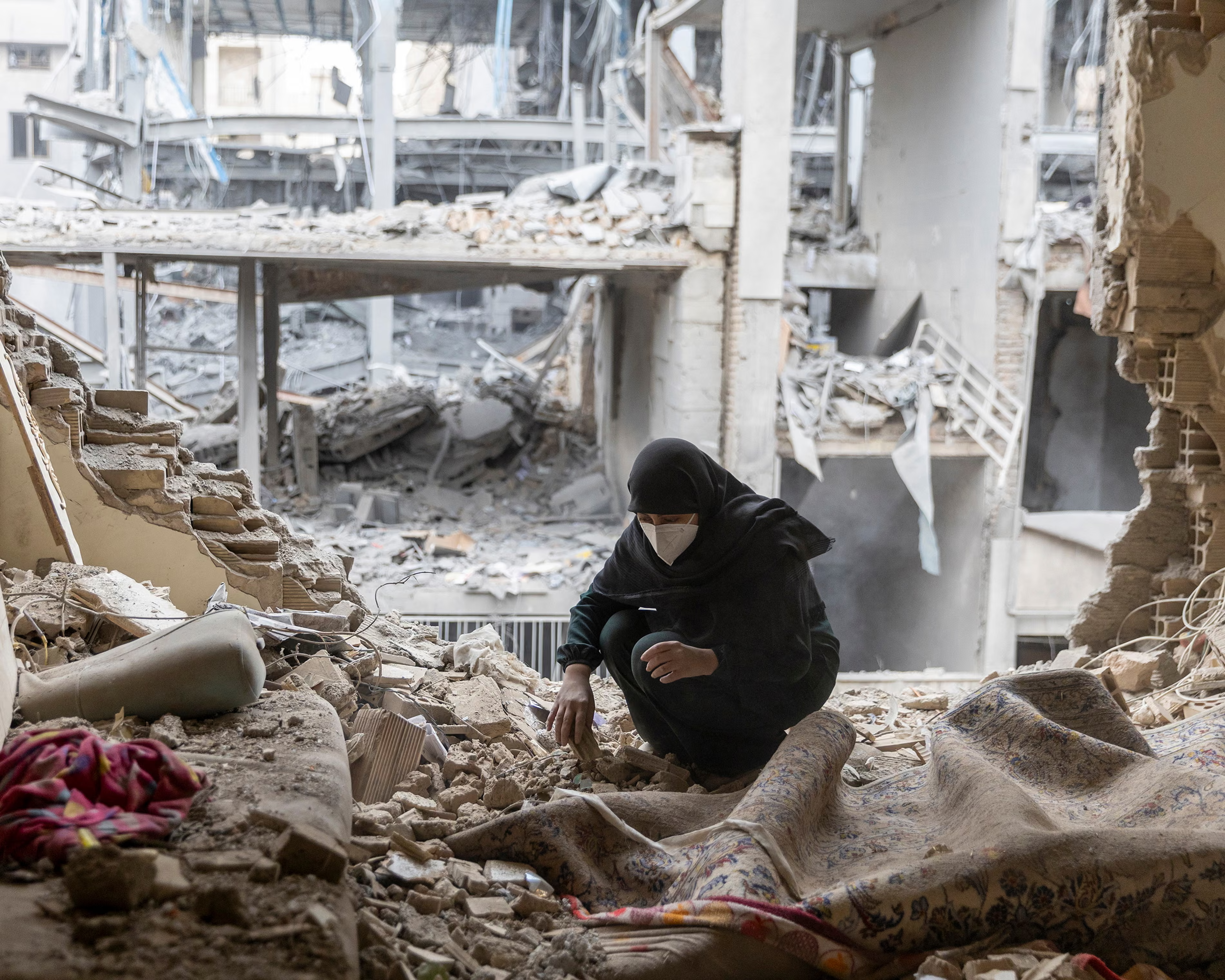
By CARLOS SAPIR
Nearly a month into the horrific U.S.-Israel assault against Iran, the ensuing military, political and economic crises appear to be spiraling out of the imperialists’ control. With Iran still controlling vital maritime traffic through the Strait of Hormuz and imperialist forces continuing escalations of attacks against oil refineries and other civilian energy and water infrastructure, the global economy is reeling. Meanwhile, Iran continues to fire long-range missiles at a steady pace against Israeli, U.S., and British targets, even as its short-range drones take center stage in the battle over the Gulf.
Given the chaos, the idea that the invasion was due to either the unique stupidity of Trump, or that Trump was “tricked” by Israeli operatives into taking this course of action, is seductive for a large swath of people. But what these conspiracy theories miss is that, blunders included, the invasion of Iran has been fully consistent with decades of U.S. imperialist policy.
The bipartisan consensus behind imperialism
While the Democratic Party has criticized the conduct of the current war, its leaders nevertheless support the principle of attacking Iran. Since the abbreviated attack on Iran in June, DP leadership has egged Trump on toward confrontation with Iran, using playground-style nicknames in an apparent attempt to get under Trump’s paper-thin skin. But the imperialist agreement on Iran runs much deeper than just that, and its reflection in Europe can also be seen in the EU, British, French, and German governments cheerleading the initial strikes against Iran.
Dating all the way back to the coup against Mossadegh in 1953, imperialist states have worked together to frustrate and attack all attempts for Iran to assert its political or economic independence. While the Pahlavi-dynasty Shahs were willing accomplices for U.S. and British imperialism, these imperialists saw the 1979 Revolution and the regime that emerged from it as an obstacle and an enemy to their hegemony over the Middle East.
Though occasionally pivoting to tools of diplomacy rather than outright war, such as under Obama (and still nominally favored by the leaders of the EU), this approach was not a policy of peace but a continuation of war by other means, a proposal to integrate Iran directly into the framework of their imperialist economic hegemony, while unilaterally insisting on invasive checks and surveillance of its military capacity. While nuclear disarmament on a global scale would be laudable, that is not the goal of demanding that Iran concede its military capabilities while Israel, Britain, and the U.S. (the only country to have actually used a nuclear bomb at war) are allowed to militarize freely.
This is not to say that the U.S. has perfectly executed its war plans. It has made many obvious blunders in its attempt to subjugate Iran, including friendly fire incidents at the tactical level, failing to account for economic impacts at the strategic level, Trump making erratic comments, and the government generally failing to present a coherent propaganda line of what is happening. Some of this bungling has drawn criticism and denunciations from the allies and enemies of imperialism alike. But the military logic of the U.S.-led effort to isolate and dominate Iran has been a steady march toward war, with the main questions for the U.S. government being how and when, not if.
How Israel and Joe Kent serve U.S. interests
While the Democrats and conservatives fed up with Trump can try to salvage their own reputations by blaming this catastrophe of a war on Trump and his advisors’ stupidity, the MAGA crowd needs another scapegoat, and Israel is both a perfect fit and an eager participant in this capacity.
Israel’s conduct toward Iran has been no less despicable than that of the U.S., and it is rightfully a pariah in the eyes of the world for the waves of occupation, dispossession, and genocide that it has unleashed against Palestinians. But while the Israeli government and Trump’s government may have a different calculus for their ability to tolerate economic pain, popular discontent, and other pressures stemming from a given war, it is the longstanding policy of U.S. imperialism to bolster Israeli hegemony across the Middle East in order to further its own interests.
The Israeli air force continues to be entirely logistically dependent on U.S. industrial support, not to mention the broader economic and diplomatic support that the U.S. has continually lent Israel since the 1970s. For decades, U.S. presidents have recognized Israel’s role as “an unsinkable aircraft carrier” and a counter-revolutionary attack dog ready and willing to strike against any threat to the continued expansion of U.S. and European hegemony across the region.
The fact that Israel will go ahead and launch attacks that the U.S. is not quite ready to carry out itself (at the moment, including an ongoing invasion of southern Lebanon) is a feature, not a bug. It lets the U.S. offload the blame for the most unconscionable acts of violence carried out to secure its hegemony.
This process involves officials like former Counter-Terrorism Director Joe Kent publicly denouncing the Israeli role, absolving the U.S. of wrongdoing in the process. The antisemitic implication that Israelis have secretly taken hold of the U.S. government is a further bonus for the far-right crowd that Kent is trying to sway; never mind that Kent himself has had much more direct control over U.S. (and by extension, Israeli) policy and practice than 99.9% of the Jewish population.
Israel, of course, has committed and continues to commit terrible crimes, and is rightfully condemned by people who oppose racism and imperialism everywhere. But the fact that it leads the charge of imperialism’s wars is not a sign that it secretly controls the U.S. government; it’s a consequence of the fact that the U.S. and other imperialist states intentionally cultivate relationships with racist, militarist states precisely because they are entrenched in a military logic that favors constant confrontation with forces that might oppose imperialism.
The U.S. government stands by Israel for the same reason that it stood by apartheid South Africa, by dictatorships across Latin America from Guatemala to Chile, and even by the Pahlavi Shahs in Iran. Defeating all of these regimes means stopping imperialism writ large, which is a struggle that must ultimately also be carried out inside the heart of imperialism itself.
By building a mass movement against imperialist war in the U.S. today, we can stop the heart of the machine that spreads racism and destruction throughout the world. Our goal is not just to replace the president with someone more “competent,” or to remove some imaginary cabal of Illuminati that’s secretly controlling everything. We need to build working-class opposition and political power that can uproot the imperialist war economy and rebuild from the bottom up.
Money for jobs and education, not for wars and deportation!
Hands off Iran! Hands off Lebanon! Free Palestine!
Photo: Bomb damage in Tehran. The Red Crescent reports that over 8000 civilian sites have been bombed by the U.S. and Israel in the war. (Majod Sheedi / Getty Images)
-
Remembering Walid Khalidi, historian of the Palestinian cause


By SORAYA MISLEH
Walid Khalidi, a leading authority on the Nakba (the Palestinian catastrophe that began with the establishment of the racist and colonial State of Israel in 1948), passed away on 8 March at the age of 100. His legacy is essential for understanding the history and memory of Palestine.
His research is crucial for understanding the immense injustice that the Palestinian people have suffered for 78 years, and for combating the disinformation and dehumanization that sustain colonization, apartheid, ethnic cleansing and genocide.
Palestinians are confronted with anti-history on a daily basis in the form of false narratives that demonize their legitimate resistance, while they endure brutal national oppression. Understanding Palestinian history and memory is a vital step towards confronting this reality and achieving liberation.
Walid Khalidi, who was aptly called ‘the historian of the Palestinian cause’, provides us with his extraordinary research, particularly in two fundamental encyclopaedic works:
All That Remains: The Palestinian Villages Occupied and Depopulated by Israel in 1948 (1992) and Before Their Diaspora: A Photographic History of the Palestinians’ 1876-1948 (1984). The latter book contains a rich photographic record of Palestinian life and places prior to the Nakba, compiled from nearly 500 rare photographs.
In All That Remains, alongside a map of historic Palestine showing the locations of over 400 villages destroyed during the ethnic cleansing carried out by Zionist militias in 1948, there is detailed documentation of these villages before, during and after the Nakba.
One of those villages is that of my paternal family: Qaqun. Walid Khalidi is a key reference for many researchers and students, and his work formed the basis of my own research for the book Al Nakba: Um Estudo Sobre a Catástrofe Palestina (2017).
His work was instrumental in broadening my understanding of Qaqun, the village where my father, Abder Raouf, was born in 1935 and from which he was forcibly displaced at the age of 13. He referred to his village as a ‘paradise’ before the Nakba, and like millions of refugees, he described it lyrically. In this place of memory, he connected with his land, from which he had been torn away, and with the prospect of liberation and return.
Born in Jerusalem in July 1925, Walid Khalidi revealed the details of the Dalet Plan, which was drafted in the late 1940s and set out how the Zionist movement intended to carry out its final plan for ethnic cleansing. Plan Dalet sealed the fate of the Palestinians in the Nakba of 1948.
Although Walid Khalidi was a pioneer in researching and exposing the planned expulsion in order to establish the racist, colonial state of Israel, it was Ilan Pappé’s book The Ethnic Cleansing of Palestine that gained Plan Dalet greater academic recognition in Nakba studies.
However, in the introduction to his work, Ilan Pappé acknowledges that he drew from that source, and that Arab and Palestinian historians had already explored this path before him, explicitly mentioning the work of Walid Khalidi. But these voices had not been heard or considered credible.
Walid Khalidi, a professor at the universities of Oxford and the American University of Beirut, a researcher at Harvard, and the co-founder of the Institute of Palestinian Studies in 1963, may not have enjoyed the same international recognition, but he is widely respected by any serious researcher of the Palestinian question.
As is almost inevitable for Palestinians, Walid Khalidi combined academic knowledge with political commitment. For example, he resigned from the University of Oxford in 1956 following the French, British and Israeli invasion of the Suez Canal and joined the Palestinian nationalist movement.
In the political arena, he advocated for the so-called ‘two-state solution’ and went on to join the Jordanian-Palestinian joint delegation at the 1991 Madrid Conference. A few years earlier, he had served as a special advisor to the Arab League.
However, in a 1997 article marking the 50^(th) anniversary of the UN General Assembly’s recommendation to partition Palestine, Khalidi was unequivocal: “No, the 1947 UN partition was not the legally, morally, justly, balanced, pragmatic and viable ‘compromise’ formula that it is claimed to have been”.
Addressing the debate over whether the Palestinians should have accepted the partition, he questioned how a plan could be fair when more than half the territory was allocated to the creation of a Jewish state despite Jews representing less than a third of the population and owning only 7% of the land. Meanwhile, the Arab majority owned most of the land yet would be left with barely 45% of the territory.
In the same article, however, he refers to the negotiation process as a path, though he notes the ‘flaws’ of the Oslo Accords signed in 1993, stating:
‘No lasting reconciliation is possible if its ingredients are torn from their historical context and based on a misleading narrative of the past.’
Regardless of his seemingly defeatist view of what would be just, and his mistaken view of what would be possible—the ‘two-state solution’, which never aimed for anything more than a peace of graveyards — recognising the importance of Walid Khalidi means acknowledging his legacy, and valuing the history and memory recounted by the children of that land.
The legacy of Walid Khalidi will remain with us until Palestine is free, from the river to the sea.