By DEAN COHEN
A personal memory
It’s the early summer of 1965, and I’m standing in my bedroom. I’ve got my brand new electric guitar strapped on and my trusty transistor radio is on my dresser tuned to WORC, our favorite local rock and roll station in Worcester, Mass. I’m trying to use my newly learned chords (three to be exact—E7, A, and B7) to play along with the songs I’ve been hearing on the radio—the Kinks, Stones, Beatles (of course), and my favorites, the Yardbirds and the Animals. Suddenly, two pistol shots ring out of the tiny speaker, a snare drum rimshot followed by that kick drum boom. My head turns to the radio as the organ and piano follow the drum intro forcing me to immediately sit on the edge of my bed and LISTEN for the next six minutes!
Now, I’ve always been a LYRICS guy, trying to paint a picture in my head as the singer sings the words. The barroom scene from Lloyd Price’s “Stagger Lee,” for instance. Stag “shot the poor boy so bad, ‘till the bullet went through Billy and broke the bartender’s glass.” ( Not too hard to paint THAT picture, I’d seen enough Westerns).
But who WAS the “Mystery Tramp?” The “Diplomat?” “Napoleon in Rags?” And what about “Miss Lonely?” The singer seemed not only to be asking her “How does it feel,”,he seemed to be asking me as well.
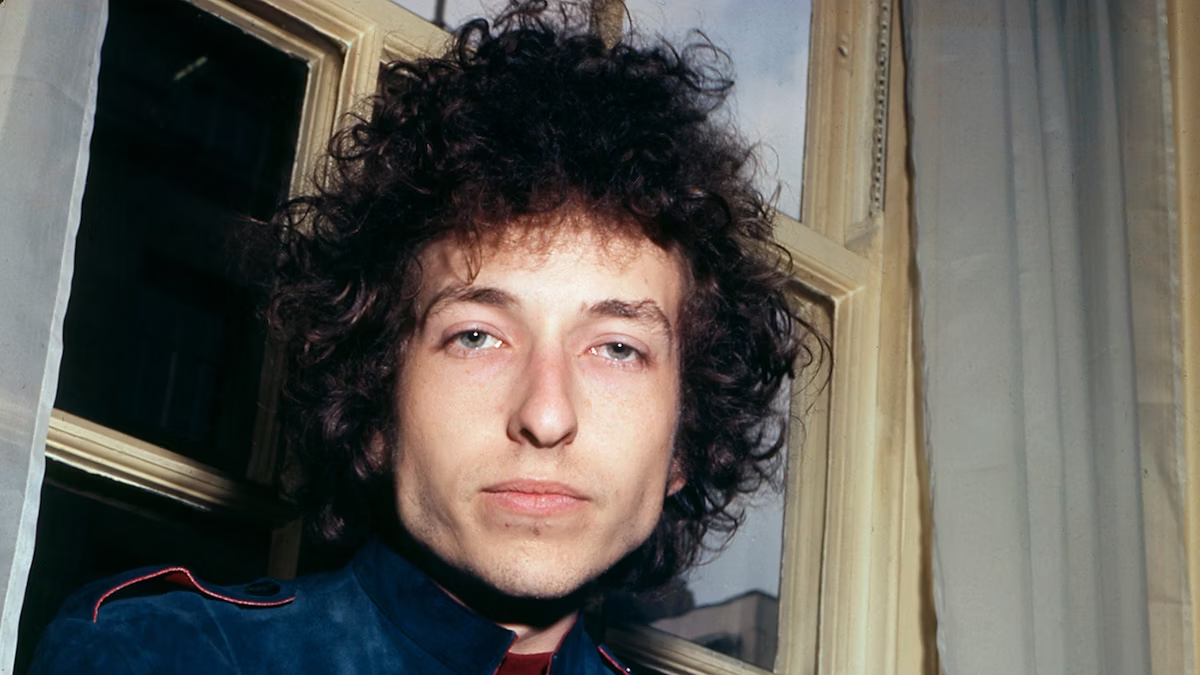
The six minutes went by like a freight train, and the disk jockey informed us that we had just heard the latest release, “Like a Rolling Stone,” from Bob Dylan. DYLAN? Bob Dylan? Oh, yeah. He had that record out earlier in the year. “Subterranean Homesick Blues,”, cut that reminded me of Chuck Berry’s “Too Much Monkey Business.” And didn’t he write that song “Blowin’ in the Wind” a couple of years ago that my mom liked so much? Later that summer, I heard Dylan’s next release “Positively 4th Street,” and I remember thinking, “I don’t know who he’s mad at, but I’m glad it ain’t me, babe!”
“A Complete Unknown” — not a complete letdown
Movie buffs and Bob Dylan fans received a much anticipated Christmas gift on Dec. 25 with the official release of “A Complete Unknown,” a film dealing with Bob Dylan’s rise from complete obscurity to his famous appearance at the 1965 Newport Folk Festival. That being said, Christmas gifts can either be everything we could have hoped for, (an official Red Rider 200-shot air rifle with a compass in the stock and this thing that tells time, for instance), or fall short of expectations. And, depending on your viewpoint, this gift was both.
Recently, Donna and I went to see the Dylan biopic, and I’m happy to report that we didn’t hate it. We didn’t LOVE it, but, truth be told, I dug it. Sure, it was a typical Hollywood biopic, and, as such, had its share of mistakes, omissions, and screwed up timelines. It was definitely better than some, but not as good as others; “Reds” (Warren Beatty’s portrayal of revolutionary journalist and pioneering communist John Reed), and “Ray” (with Jamie Foxx as Ray Charles) come to mind.
But Timothee Chalamet was outstanding as Dylan, as was Monica Barbaro as Joan Baez. Edward Norton played a great Pete Seeger, and Dan Fogler was very good as Dylan’s manager, Albert Grossman. As a matter of fact, the entire cast shone. Elle Fanning’s portrayal as “Sylvie Russo,” a fictionalized Suze Rotolo, was also outstanding.
A couple of things that really bugged me, however, were shown to have taken place during the climactic scene where Dylan appears on stage, Fender Stratocaster in hand, fronting the electric band. The ENTIRE crowd is shown loudly booing and even throwing bottles and festival programs at the musicians. While some programs were thrown on the stage, the truth was that, at most, about half the crowd was displeased with the performance and booed, with the other half cheering loudly. (That Fender Strat, by the way, was found abandoned on a private plane and recently sold for just under a million bucks! As baseball’s Casey Stengel used to say, “You could look it up.”)
The infamous fistfight that occurred between Dylan manager Grossman and “old guard” musicologist Alan Lomax was shown as taking place during Dylan’s electric set. However, that incident actually took place two days before following Lomax’s condescending introduction of the Paul Butterfield Blues Band, an integrated group from Chicago that Albert Grossman had decided to take on as clients. It was the Butterfield Band’s exciting set and the resulting fisticuffs that convinced Dylan that he needed to go electric that weekend.
And then, there was the virtual nonexistence of the “Mayor of MacDougal Street,” Dave Van Ronk—but more about Dave and Suze Rotolo later.
American folk music — a background
A most glaring omission in the film—and, frankly, one that I expected—was the entire context of the folk music boom in the U.S., its left-wing background, its effect on Dylan’s development as a musician and songwriter, and his effect on it.
Folk music has been around for as long as there have been, well, folks to sing music. The folks who came over to the Americas brought their music with them from the “old country.” Those different musical traditions mixed and mingled with each other. They changed and developed as the country and the people mixed and mingled and changed and developed into the music of the hills, the fields, the plains, the prairies, and the cities.
Hill music begat bluegrass, bluegrass begat country. Field hollers and work songs begat the blues, and the blues begat jazz; in short, there was a whole lotta begatin’ goin’ on. Blues legend Robert Johnson was just as at home singing country tunes along with “Crossroad Blues,” “Hellhound on My Trail,” or pop tunes like “Yes Sir, That’s My Baby, No Sir, I Don’t Mean Maybe.” Country music’s first ‘superstar,” Jimmy Rogers, the Singing Brakeman, could sing the blues with the best of ’em and his signature “Blue Yodel” was the inspiration for Howlin’ Wolf’s classic howl. By means of mixin’ and minglin’, a uniquely American music was developing.
Folk music turns left
Folk music had long included a large amount of social commentary. Whatever was bothering the folks, they tended to sing about. But folk music began to take on a distinctly left slant during the Great Depression and much of that came from the Communist Party with the advent of the Popular Front. As the CP began recruiting more members from the Appalachian coalfields, the Southern cotton and tobacco fields, and the farms of the Southwest, CP organizers began to hear more and more of the music of those areas. Some of the best practitioners of the music like Josh White, Huddie Ledbetter (Leadbelly), Sonny Terry and Brownie McGee, and, of course, Woody Guthrie were influenced by the left.
Woody and Pete
Woody was born Woodrow Wilson Guthrie to a middle-class family in Okemah, Okla., on July 14, 1912. His father, Charles, was a fairly well-off businessman and land owner. Charlie was also a stone racist, who took part in the kidnapping and lynching of a Black couple, Laura and L.D. Nelson, the year after Woody’s birth. It was an incident that Woody never shied away from and he wrote a few songs about it. He also referred to his father as a Klan member.
He grew up exposed to the blues, and to country and folk tunes of the region, and by his early teens he had become a good guitarist and harmonica player. By the early 1930s, a series of tragedies had befallen the family, and with the Dep

ression and the dustbowl deepening, Woody split for LA with thousands of other migrant “Okies.” He found work singing and spinning folksy tales on radio station KFVD with singing partner Maxine “Lefty Lou” Crissman. The pair became very well known throughout the region, and a KFVD newscaster introduced Woody to the Communist Party, then just beginning its Popular Front period. It was an association that was to last the better part of the next two decades. He began writing a regular column of folksy observations and humor, “Woody Sez,” for the Daily Worker and the CP’s West Coast paper, The Peoples Daily World. Woody’s wanderin’ ways got the best of him and by 1940, he cut out for the Big Apple. It was in New York that Woody was to meet Pete Seeger, and the two men would go on to deeply influence each other’s lives.
Pete Seeger was born in New York City, May 3, 1919, to a deeply religious family. His father, Charles, was a Harvard-educated musicologist and pacifist, and it was through Charles that young Peter developed his love for a wide range of musical styles. But it was his love of American folk and blues, as well as world music, that would stay with him for the rest of his life. Through his father, he met Alan Lomax, a folk music archivist working for the Library of Congress.
Pete joined the Young Communist League (YCL) in 1937 where he met other folk musically inclined young activists like Cisco Houston, Millard Lampell, Lee Hayes, and Beth Lomax Hawes (Alan Lomax’s sister), and after his arrival in New York, Woody. They all formed the Almanac Singers, the seminal political folk group.
With the rise of the CIO, folk music once again became an effective tool in organizing drives and union rallies, a practice used by the Industrial Workers of the World (IWW) two decades earlier. And the Almanacs were right in the thick of it. They traveled the country, and there was hardly a union struggle, strike, or rally that they didn’t sing for.
But a lot of the left wing of the folk music scene, unfortunately, tended to follow the Stalinist Party line—with all the resulting twists, turns, and excesses. With the advent of the Stalin-Hitler Pact, songs proclaimed that American boys would not be fighting in any wars to protect British and U.S. imperialism. After the Nazi invasion of the Soviet Union, however, American boys would definitely be joining the fight against fascism. And, of course, during party gatherings there would be the obligatory singing of “Earl Browder is our leader; we shall not be moved.”
Following World War II, the CP-line sing-along had its last hurrah with the short-lived Henry Wallace Progressive Party movement. At PP rallies you could hear “Wallace is our leader, we shall not be moved!” But after Wallace’s disastrous showing in the presidential election of 1948, the party-line sing-along began to decline, and fast.
With Pete going into the Army and Woody joining the Merchant Marine, the Almanacs broke up during the War. Following the Wallace campaign, Seeger and fellow former Almanac Lee Hayes teamed up with Ronnie Gilbert and Fred Hellerman to form the Weavers.
Folk goes mainstream — and meets the witch hunters
From our vantage point today, it is hard to realize just exactly how huge the Weavers were during the early ’50s. Following their formation, there were a couple of “dry” years, but in 1950 they scored a residency at the Village Vanguard and a record contract with Decca Records. What followed was the Weavers becoming the hottest musical act in the country. Their first release on Decca, a cover of Leadbelly’s “Good Night Irene” backed with “Tzena, Tzena,Tzena,” became a double-sided hit, with “Irene” going to No. 1 on the Billboard charts for 13 weeks! That was followed by a stream of hit records like “On Top of Old Smokie,” “Kisses Sweeter Than Wine,” “Michael Row The Boat Ashore,” “The Midnight Special,” and of course, “Wimoweh” (which was to become a huge hit a decade later for the Tokens doo-wop group as “The Lion Sleeps Tonight”). The Weavers seemed unstoppable, until they ran headlong into the Red Scare witch hunt.
Pete had joined the CP in 1942, but had quit the Party by 1949. But in 1953, Seeger and Hayes were “outed” as communists by the red-baiting entertainment rag Red Channels. Under such tremendous pressure, the Weavers broke up. Decca not only dropped the Weavers, but the label deleted the group’s entire catalog. The year 1955 saw Hayes and Seeger hauled before the House Committee on Un-American Activities (HUAC). Hayes pled the Fifth Amendment, but Seeger tried to plead the First (upholding the right to free speech). It didn’t work for the Hollywood 10, and it didn’t work for Pete. He was handed a 10-year sentence for contempt and spent the next six years fighting the charge. It was finally thrown out on a technicality in 1961, an event shown in “A Complete Unknown.”
December 1955 saw the Weavers reunite for a packed concert at Carnegie Hall, but Seeger’s solo gigs at college campuses were much more satisfying and he walked away from the group in 1958. By that time, the Folk Music scene was booming. In 1959, George Wein, founder of the already well-known Newport Jazz Festival, founded the Newport Folk Festival. The original board of directors included Albert Grossman, Pete Seeger, Alan Lomax, Oscar Brand, and Theodor Bikel—and later, Peter Yarrow representing the “youth.”
The Folk Festival had its share of serious problems. While being built on a façade of working-class solidarity and racial and gender diversity, that diversity was clearly lacking at the top. The initial board members were all older white men. And a kind of racism developed in the showcasing of Black performers. For example, Texas Blues guitarist and singer Sam “Lightnin’” Hopkins was booked for the 1964 and 1965 festivals. When “Lightnin’” played his gigs in his home state, he would appear wearing a stylish mohair suit and Stetson hat, and playing an electric guitar. But at Newport that look was just not gonna cut it! In order to appear on the Newport stage, off came the mohair suit and Stetson, to be replaced by a more suitable pair of overalls and straw hat. The electric guitar was, of course replaced with a more “authentic” acoustic one. It was a “gentle” racism, but racism none the less.
Young people across the country, concerned with the growing threat of the Cold War and nuclear annihilation, yet energized by the civil rights movement, were having folk music jam sessions they called “hootenannies.” They gathered together in city parks, college campuses, crowded lofts, and basement coffee houses, flailing away on banjoes and strumming guitars, playing their versions of their favorite old tunes. The folk revival provided them that same sense of community and connection to the past that the music always had.
And folk music was becoming big business, too. Corporate or “commercial” folk music groups, like the Kingston Trio, the Limeliters, the Chad Mitchell Trio, and the New Christy Minstrels began cranking out huge hit records. Old tunes like “Tom Dooley” and “Michael Row Your Boat Ashore” topped the charts and produced big profits for the record labels and song publishers (at the expense, of course, of the original songwriters). But the hits also served to drive the revival to new heights. There were areas in almost every big city where the “folkies” would gather—and nowhere more so than in New York’s Greenwich Village and Washington Square Park. And Greenwich Village had its outsized hero, its own Paul Bunyan, the Mayor of MacDougal Street, Dave Van Ronk.

The Mayor of MacDougal Street
New York-born Dave Van Ronk was drawn to music at a young age. By the time he was 16, he had left home and was living full time in the Village. Initially playing a tenor banjola (a cross between a banjo and a mandolin), he was first attracted to older jazz styles. When he found it difficult to hang with the jazzers on gigs, he moved to guitar and gravitated to the blues styles of Reverend Gary Davis, Furry Lewis, and Mississippi John Hurt. He became an expert in various finger-picking styles and was soon recognized as one of the top players in the Village. He quickly became a mentor to nearly every young, aspiring folk or blues musician who appeared on the Greenwich Village scene. This included a young Bob Dylan.
During one particular time when Dave needed to make a few bucks, he obtained seaman’s papers from the National Maritime Union. Working as a mess hand on tankers, he shipped out for a year before returning to gigs in the Village. This served to enhance his status in the Greenwich Village scene. He was even approached by Albert Grossman to take part in a folk music “super group” that Grossman was planning, with Village regulars Mary Travers and Peter Yarrow. Dave’s solo gigs were becoming more regular, and he turned Grossman down. Grossman then turned to another Village regular, Noel Paul Stookey. As Peter, Paul and Mary, the rest was history, although it might have been Peter, DAVE and Mary! You can’t make this stuff up!
Van Ronk was also attracted to left politics. Through older members of New York’s Libertarian League, he became attracted to anarchism and by his late teens had joined the IWW. From there he joined the Socialist Party’s youth wing, the Young Peoples Socialist League (YPSL). From the YPSL, it was onto the Socialist Youth League (SYL), a group associated with the remnants of Max Shachtman’s Independent Socialist League. The Young Socialist League merged with others to form the Young Socialist Alliance and Dave became a YSA member. The YSA supported the political positions of the Socialist Workers Party, and went on to play a huge roll in the development of the anti-Vietnam War movement.
Van Ronk joined the SWP, but left the party in 1964 with a split that became the Workers League (WL)—now the sectarian Socialist Equality Party. It’s doubtful that Dave was ever active with the WL or even agreed with the issues that produced the split. It was more likely his irascible, contrarian nature and independent streak that caused his break from the SWP. Outspoken as he was, he never shied away from expressing his views. According to his widow, Terri Thal (who served as Bob Dylan’s first manager), Van Ronk considered himself a Trotskyist until the day he died following a long battle with cancer in 2002.
As stated above, Van Ronk became an important mentor to Bob Dylan, and introduced young Bob to many of the most important figures on the Village scene. None, however, was more important than a self-described “red diaper baby,” Suze Rotolo.
Suze

Susan Elizabeth (Suze) Rotolo was born in New York in 1943 to Joachim (Pete) and Mary Rotolo, both active members of the Communist Party USA. Pete had been active as a shop steward in the United Electrical, Radio and Machine Workers Union at Morganthaler Linotype in Brooklyn, and Mary worked as a writer and journalist. During the Spanish Civil War, Mary had worked in Spain for the International Brigades. In 1958, Susan’s father, Pete died of a heart attack.
Although Suze and her older sister Carla rejected their parents’ Stalinism, they both took up Pete and Mary’s devotion to the cause of racial justice and equality and nuclear disarmament. By the early ’60s, Suze was working full time for the Congress of Racial Equality (CORE) and also working closely with the Student Nonviolent Coordinating Committee (SNCC). Carla was also around the Village folk scene. She worked as an assistant for archivist and Newport Folk Festival board member Alan Lomax, and at times, would join Dave Van Ronk and Dylan onstage singing harmonies. It was during this period that Carla Rotolo and Van Ronk introduced Suze to Bob Dylan.
Dylan was completely smitten with Suze. It wasn’t only her beauty. He was attracted to her activism and her parents’ background as union activists. Suze’s mother, Mary, hated him. Despised him. DETESTED him. She didn’t trust him and didn’t want him around her daughter, but there wasn’t much that Mary could do about it. For the rest of her life, Mary would only refer to Dylan as “the twerp.”
Suze Rotolo’s influence on Dylan caused him to write some of his most famous songs of social commentary like “Masters of War” and “The Times They Are A-Changin’” and also some of his best love songs like “Don’t Think Twice, It’s Alright” and “Boots of Spanish Leather.”
Interestingly enough, however, it was her introducing Bob to the works of surrealist poets and authors like William Blake, and especially Arthur Rimbaud, that began to draw him away from the “protest” songs. He began to write songs with surreal imagery, like ”Gates of Eden” and “It’s Alright, Ma, I’m Only Bleeding.” Songs like “My Back Pages” and “Maggie’s Farm” were to proclaim his independence and exit from the folk music field. Rotolo died in 2011 following her battle with lung cancer. Her memoir, “A Freewheelin’ Time,” and Dave Van Ronk’s “The Mayor of MacDougal Street” both make great reading for anyone interested in those times.
To wrap up
The film works best, despite its flaws, by accurately depicting the tenor of the times in the Greenwich Village scene of the early to mid-1960s. But it didn’t delve deeply enough into Dylan’s relationship with Suze Rotolo/Sylvie Russo, and the end of that relationship following her return from six months in Italy with her mother and Dylan’s relationship with Joan Baez.
Also accurately depicted, in my opinion, was the profound change that came over Dylan in response to increasing fame. That fame increased exponentially with the release of each album. To protect himself, Dylan cloaked himself in a persona that was, in equal measure, condescension, suspicion, and cutting humor and put downs—what Chicago Blues guitarist and Dylan collaborator Mike Bloomfield (portrayed in the film by Eli Brown) described as “character armor.” Personally, I think that Bloomfield and Van Ronk each deserve their own biopics, but that’s just me.
I hope that you all have found interest in this. I know I’ve left out some important information, like the rise and influence of Black gospel music and its importance to the development of folk music, blues and rock n’ roll (think Sister Rosetta Tharpe). But perhaps that’s for another time. For now, I’ll leave you with the words of the great jazz poet and singer, Jon Hendricks:
“I wrote the shortest jazz poem ever heard.
Nothin’ ’bout huggin’, kissin’. One word.
LISTEN!”
Thank you Mr. Cohen for the well written, thoughtful review!
Un artículo imprescindible. Mis respetos.
And Phil Ochs?