By CARLOS SAPIR
In the more than a decade that has elapsed since Russia first invaded Ukraine in 2014, trying to put an end to the successes of the Maidan movement that ousted a pro-Putin patsy government, Ukrainians have often had to adapt to rapid, qualitative shifts in their living conditions. These realignments have been felt from the rear echelon to the front line.
On Oct. 13, Ukrainians faced another such massive shift as the U.S. decided to cut its Starshield satellite-based logistical support for Ukraine across the board. At the flick of a switch, Ukraine suddenly lost access to key components of its missile defense system, as well as its ability to communicate and spot enemy movements across the front line and into Russian territory. While some functions have since been restored, access continues to be limited and its future is unclear.
Soldiers on the front line were left in the dark, as were drones and artillery companies. Meanwhile, in Kyiv and other cities, what had become a routine of hearing sirens and making one’s way to the bomb shelter was shattered by a delay that left only short seconds between the siren and deadly impact.
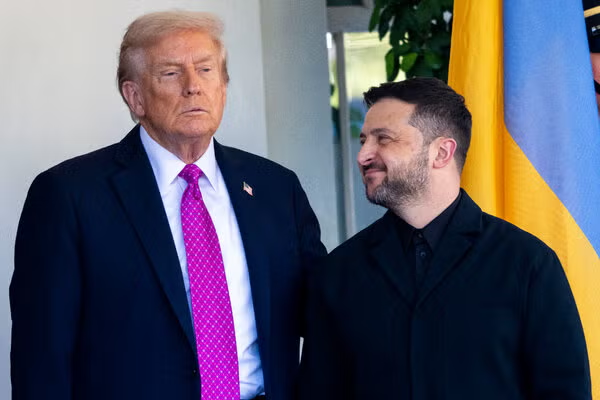
This brutal stab in the back to Ukraine came accompanied by a surreal exchange of public statements between Trump and Putin, announcing an “energy truce” while missiles rained down on Ukraine, then lambasting Zelensky for not accepting the said “truce” and blaming him for the rise in diesel fuel prices.
The Trump administration followed this with the announcement that the U.S. would lift its sanctions against Russian exports of diesel oil, and quickly affirmed that the U.S. has arranged a deal to buy oil from Russia. The administration is urging European nations to also boost their purchases of Russian oil. In addition, the White House announced that—for at least a 60-day period—it was waiving sanctions that Congress passed last month against Russian officials, oligarchs, and financial institutions.
Trump’s motives in giving these incentives to Russia are clear, transparent even. He desperately wants to do anything he can to lower diesel prices, a key driver of inflation, even though the quantities of fuel advertised in the public deal amount to only about a half-day’s worth of demand: a drop in the bucket that is unlikely to move markets.
At the same time, Russia appears to be wooing Trump with promises of business deals and joint ventures. Projects that are under discussion include a network of data centers running on nuclear power generated in Russia. But while Trump’s betrayal of Ukraine is particularly brazen, the roots of the U.S.’s domineering attitude to Ukraine go much deeper, into the bedrock of the imperialist relationship between the two countries.
The bipartisan imperialist program
U.S. support for Ukraine, similar to its relationships to dozens of other semi-colonial states around the world, are based on a calculus of self-interest, with a view towards maintaining Ukrainian dependency on the U.S. while advancing U.S. interests. As we have noted since the beginning of the full-scale invasion in 2022, imperialist “aid” is never free: it comes with devilish strings attached, in the form of crippling debt, ceding control over domestic economic policy, and the vulnerabilities that accompany reliance on the U.S.-NATO military apparatus. This last form of premeditated coercion has become particularly apparent this week, but it did not start there.
During Joe Biden’s term as president, the U.S. was already trying to stop Ukraine from targeting Russian oil refineries. The Kursk campaign in summer 2024 was a further point of confrontation, with the U.S. unwilling to support Ukrainian military maneuvers that pushed into Russian territory. The limits of U.S. interest in the war were already clear: this was not a proxy war with the goal of toppling the Russian state, nor was this borne of a genuine interest to defend Ukrainian national liberation. U.S. intervention on the Ukrainian side has been a conservative investment to keep its imperialist competitor Russia preoccupied, without threatening military risk to NATO’s own forces nor toppling Russia’s dominion over its sphere of influence, while increasing its own political and economic domination of Ukraine itself.
Ukraine isn’t just at the mercy of the U.S. ruling designs on its own territory, it’s also at the mercy of U.S. decisions to pursue imperialist war elsewhere in the world. Thanks to the U.S. decision to launch its own “special operation” against Iran, Ukraine no longer receives Patriot interceptor missiles and has completely run out, leaving the country almost entirely exposed to Russian missile attacks. Zelenskyy’s attempt to sway U.S. empire by firing on Iranian ships in the Caspian Sea has fallen flat, and underscores the dead end of his pro-imperialist policy, serving only to undermine international solidarity with Ukraine. If he were to double down on this approach, it would potentially overshadow the legitimacy of Ukraine’s war for self-determination. For now, he has dropped this tactic, not having received approval from the U.S., and Ukraine’s armed forces are focused on fighting the invading Russian army.
International working class solidarity
Ukrainians find themselves in a desperate military situation. As part of the general principle of support for national liberation against imperialist invasions, Ukrainians have the right to seek arms and aid wherever they can find it, and we do not withhold our solidarity for them because of having received such support from NATO’s imperialists.
But at the same time, even as we denounce this awful blackmail and betrayal by U.S. imperialism, we cannot simply advocate for the U.S. to keep Starshield running and send more weapons to Ukraine. To do so would be to provide cover for the re-establishment and retrenchment of the same imperialist ploy; it would further subordinate Ukraine’s autonomy to the whims of the U.S. ruling class. True autonomy for Ukraine can only come from the development of nationalized, local defense production under the democratic control of the Ukrainian working class.
Our vision of solidarity needs to be organized and led by working people, separate from the machinations of imperialist governments. It takes the form of convoys that both provide a modest amount of direct aid as well as strengthening political ties that can endure these times of crisis and prepare us for the international conflicts to come. These ties are not formed with the Zelensky government and its assortment of petit bourgeois imperialist wannabes but with unions and other working-class organizations that represent the rank and file of the Ukrainian people.
Today, these efforts alone are not enough to arm Ukraine against the Russian invasion. But this lack of capacity today does not mean that we can magically bridge this gap by appealing to the imperialist U.S. government, nor ignore the immense costs that imperialist military support entails down the road. As Ukraine fights day after day, we must support them with our working-class methods and forces, to help where we can while we join forces internationally to grow stronger.
Lower photo: Aftermath of a Russian missile strike on an apartment house in Kyiv in February 2022. (Alex Lourie / Redux)