By AVA FAHY
The Trump administration has launched a full-frontal assault against all oppressed and exploited sectors of the population, and women are no exception. This International Women’s Day, Workers’ Voice takes stock of the women’s movement almost three years onwards from Dobbs v. Jackson Women’s Health Center.
Since the catastrophic Supreme Court decision that overturned Roe v. Wade and Planned Parenthood v. Casey, the impact of abortion bans on reproductive health in the U.S. has been dire, particularly for Black pregnant people who are more than three times as likely to die from a pregnancy-related cause than white people.
Most states that have implemented abortion bans or severe restrictions have not also tracked the correlated factor of maternal mortality. Independent reporting reveals the violent, terrible impact of abortion bans. In Texas, which punishes abortion providers with up to 99 years in prison, the rate of sepsis spiked more than 50% for women hospitalized with pregnancy loss in their second trimester.
Sepsis is a life-threatening condition, and indeed, Texas women like Josseli Barnica and Neveah Crain died of sepsis that could have been prevented had doctors not delayed performing an abortion until their fetuses ceased their heartbeats. Candi Miller and Amber Thurman of Georgia, and an unknown amount more in states with abortion bans or restrictions, died in the same way. Porsha Nguzemi of Texas similarly died of hemorrhaging when doctors delayed lifesaving abortion care.
Trump and Musk’s Project 2025 seeks to ban and criminalize medication abortion, the most common form of abortion, and often the only form of abortion care available to rural patients and people in abortion deserts—which have become all the more common post-Dobbs. The attack is two-pronged: First, they have launched a lawsuit seeking to reverse the FDA approval of mifepristone, a major abortion pill. Second, they seek to expand and enforce the Comstock Act, an 1873(!) federal law that criminalizes mailing information on reproductive care. Under Project 2025, the proposal is to criminalize anyone who sends or receives not only abortion pills, but potentially anything used for abortion, up to and including speculums and analgesics. This could amount to a nationwide ban on abortion—which experts estimate would increase maternal mortality by 24% nationally and by 39% for Black people.
Project 2025 also seeks to expand surveillance of pregnant people, and a number of Republican legislators have introduced proposals for registries of pregnant people to be monitored and prosecuted if they obtain abortions. Similar surveillance of pregnant people already takes place, primarily among people with a history of incarceration or substance use, and it leads to traumatizing and deeply unethical criminal charges for behavior while pregnant. This kind of surveillance sends a clear message to women and pregnant people: you have no autonomy while pregnant.
What do we do? One vital solution is to fight back through the labor movement. Union struggles are a mechanism by which working women can win vital freedoms. Unions can fight for health benefits and can even wage struggles for reproductive justice by winning protections for workers seeking abortions or other reproductive care. And the unions can link up with and help to organize demonstrations in the streets for reproductive rights and in defense of health clinics.
Black and Asian women led the gains in union membership growth in the U.S. over 2024. They were the only demographics to see an increase in union numbers, with every other demographic decreasing. Growing efforts to unionize retail, caregiving, and hospitality sectors may be behind this growth, as these sectors are traditionally dominated by women.
Unionized working women earn more money—on average, about 19% more than their non-union counterparts, and they are far more likely to have health insurance coverage. These benefits and wage improvements are particularly beneficial for working women of color, who face particularly harsh discrimination at the intersection of class exploitation, racial oppression, and gender oppression.
Successful contract fights for paid family leave and paid sick time disproportionately benefit women, who are more likely to be responsible for childcare and elder care. Retirement benefits, too, benefit women workers, who tend to earn less than men over their lifetimes, despite their longer lifespans.
As important as these labor wins are—and make no mistake, they can be the difference between life or death—the liberation of women and the end of gender oppression will not be won on a union-by-union basis. It will certainly not be won by the efforts of the Democratic Party, under whose watch Roe was overturned with little more than a shrug from the Democratic president or Congress. It will not be won by NGOs like Planned Parenthood or the Guttmacher Institute, who are beholden to their wealthy ruling-class donors, dependent on government grants, and are thus incapable of engaging in the class struggle because of their allegiances. It will be won by creating a class-struggle left wing in the union movement, with a pointed focus on developing the leadership of women and Queer people. It will also require a mass movement in the streets, independent from the Democrats and the Republicans and ruled by the needs and methods of working-class women and Queer people fighting for their rights.
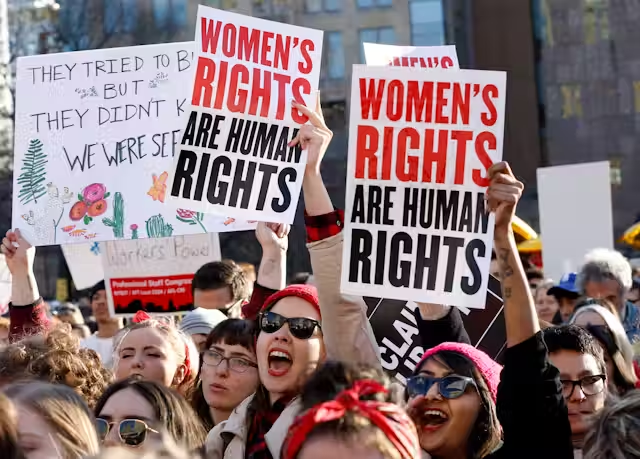
On March 8, millions of women will take the streets worldwide to protest for women’s rights. In individual cities, hundreds of thousands will chant and march together to bring an end to gender oppression. This is unlikely to happen in the United States for the same reason that May Day is seldom commemorated—lingering Cold War attitudes toward International Women’s Day’s socialist origins.
International Women’s Day burst forth proudly from an international movement of socialist working women. Luise Zietz and Clara Zetkin proposed at the 1910 International Conference of Socialist Women that they must organize a special Women’s Day to promote not only women’s suffrage but labor rights for working women and democratic rights for women and children. On March 8, 1917, women textile workers in Petrograd organized a Women’s Day demonstration that swallowed the entire city, developed into a general strike, and, with the strength that they demonstrated in the streets, marked the beginning of the February Revolution. The Tsar abdicated only a week later.
In the United States, International Women’s Day often passes without much notice. But there is no reason why it should be ignored, especially since women’s rights and reproductive rights are under such harsh attacks. The assault on women’s rights by Project 2025, and by Trump, Vance, and their flunky Musk—alongside the hard-won rights of all oppressed people and the working-class—necessitates a serious movement of working women to organize beyond electoral politics and take matters into their own hands.
This March 8, U.S. women and their allies should seek out a March 8 event—they do exist, even if their sizes are usually humble—and attend. If one isn’t available, they should look to the movements of women internationally as examples of strong women’s movements carrying their struggle into the streets. Women’s movements in Ireland, Argentina, Mexico, Colombia, and more have recently successfully won abortion rights after years of restrictions.
The only real solution to the end of women’s oppression is an end to the sexist, patriarchal capitalist system. The end of that system will only be won by building a huge movement of working people in the streets, communities, and workplaces, organized by an independent revolutionary socialist party that includes the mass participation of working women.