-
Workers’ Voice newspaper: March-April edition

The U.S.-Israel war on Iran is a major escalation in the Middle East that has dangerous implications for working people everywhere. The brutality of the imperialist assault internationally is paired with the attack on civil liberties by the Trump regime inside the U.S. This includes the continued operations of ICE and Border Patrol, the threats to the 2026 mid-term elections, environmental rollbacks that deeply impact the Black community, and unchecked police brutality.
Our editorial in this issue warns us: “There is a great danger of underestimating the determination of the U.S. corporate elite to drive through this effort. We cannot rely on court rulings or upcoming elections to save us. We must organize now, not only for mass demonstrations and community networks against ICE violence, but to find our way to building a new working-class party through which we can organize our political defense on every plane and on every day.”
In this issue we also have articles on the Epstein files and the ruling class, the San Francisco teachers’ strike, and a review of the new album by U2.
The March–April 2026 edition of our newspaper is available in print and online as a pdf. Read the latest issue of our newspaper today with a free pdf download! As always, we appreciate any donations to help with the cost of printing.
Click on the image to read the paper or message us to get a hard copy:

-
Trump and right-wing allies wrangle over H-1B immigrant program


By HERMAN MORRIS
Over 2024’s Christmas holidays, a debate erupted within the incoming Trump administration over the H-1B program for certain categories of highly skilled immigrant workers. Trump selected Sriram Krishnan, an Indian American venture capitalist and an advocate of raising country caps on green cards, for his presidential cabinet. This sparked an immediate backlash from the nativist wing of the Trump movement, with Steve Bannon and Laura Loomer accusing Trump of not standing by his anti-immigrant principles.
At the same time, tech CEOs such as Elon Musk vigorously defended the program as an economic necessity. In response, Trump has for now given rhetorical approval to the H-1B plan, saying that “it’s a great program.” On the surface, this seems like a bizarre retreat from his fire and brimstone rhetoric on attacking immigrants, which includes talk of mass deportations, further militarization of the border, and ending birthright citizenship. In reality, this debate exposes the contradictions that the incoming Trump administration is going to face when the new president tries to deliver on his promises to terrorize and deport immigrants.
What is the H-1B program?
The skilled workers who are being debated have been largely brought to the U.S. through a visa program known as H-1B. It is the largest worker visa program in the United States and allows for 65,000 workers to enter the U.S. every year, along with an additional 20,000 slots reserved for workers with advanced degrees. While the H-1B program covers most private-sector jobs that require a college degree, most of them are issued to the tech industry. Of the companies awarded H-1B visas in 2024, the top 10 were all technology firms.
H-1B visas do not necessarily permit a permanent stay. If a worker on the program loses their job, they have 60 days to find a new H-1B employer or they will become undocumented and face deportation. While the H-1B provides the option for permanent residency, the waits can be enormously long due to draconian per-country caps. In the case of Indian workers, it can be over 100 years. For many others, it is still a matter of several years in which they cannot change job titles or employers. (It is possible to keep their place in the green card line while changing employers, but this is again subject to bureaucratic overhead).
Moreover, a permanent residency card still does not entitle the person to benefits enjoyed by a full U.S. citizen, such as voting or running for office, and it can be revoked if the person is convicted of a criminal offense.
H-1Bs have been a godsend for the tech industry for two reasons. One is that it has allowed the industry to expand at a rate faster than the U.S. economy can add new domestic technology workers. Secondly, it has created a vast underclass of tech workers who are exploited at a higher rate than citizens and permanent residents, since they are often tied to a single job and switching jobs while keeping an H1-B is much more difficult.
For many foreign workers, this bargain is still worth it. Even with the diminished civil rights they receive working in the U.S., for many it’s a huge financial step up from what they made back home; taking an H-1B job can mean lifting themselves or even their entire family out of poverty.
Many immigrants to the United States are coming to escape the economic, climate, and political crises of their own countries. Often these crises are imposed on them by the U.S., through the destabilizing impact of its economic policies, environmental degradation caused by its resource extraction operations, and its support of reactionary regimes around the world.” While it’s critical to end the American military occupations overseas and to lift U.S. sanctions on countries like Cuba, the workers of these oppressed and economically underdeveloped regions also deserve the right to seek out better conditions. That right can only be upheld by ending all deportations and guaranteeing full civil rights to immigrant workers, including the right to change jobs, to quit their job, to unionize, to vote, and to gain an efficient path to citizenship.
Workers as the pawns of capital
While the U.S. GDP may be at the highest level it’s ever been, most workers in this country have not seen their wages keep pace with inflation, leading to their lives getting materially worse in the past four years. The Democrats and Republicans have no real solution to this problem. Trump blames the low wages on the allegation that immigrants are taking the jobs of U.S.-born workers. This is despite the fact that most immigrants to the U.S. work the most menial and lowest paying jobs in the country and that the U.S. Chamber of Commerce has been complaining about a labor shortage, claiming that we are still 1.7 million workers short of where the workforce was pre-pandemic.
In some respects, H1-B workers are the ideal target for someone like Trump. These workers are in most instances highly compensated and highly trained, compared to the median American worker. Almost always, they perform a job that requires completion of at least a four-year degree. Trump could plausibly kick these workers out of the country and pretend to have secured a victory for American workers by opening these positions for them. Instead, we are seeing the tech capitalists get their way, and Trump is indicating that H-1B’s will be carved out of what appears to be a historic assault on immigrants.
The reason for this is very simple: Trump does not represent workers, U.S.-born or otherwise. Even more importantly, tech capital specifically is funding his campaign and victory fund, with right-wing tech capitalist Elon Musk having actively campaigned for him, and corporations like Meta and Amazon making hefty donations to his inauguration fund.
The “progressive” politician Bernie Sanders postures a pro-worker stance on this issue, saying that the H-1B program should be opposed, or only used as a “short-term fix,” because the “guest workers” take jobs at relatively low wages that workers who are citizens should be doing. Instead of standing on the side of full rights for immigrants, Sanders wrote in a rather-short-sighted opinion piece for Fox News that “the answer is to hire qualified American workers first”.
Organizations like the American Immigration Council dispute the allegation that H-1B workers drag down wages or take the jobs of native-born workers. First, the Council states, “Immigrant workers and native-born workers often have different skill sets, meaning that they fill different types of jobs. As a result, they complement each other in the labor market rather than competing for the exact same jobs.” The Council also points out that immigrant workers augment economic growth in the United States by such means as spending their wages in the U.S. economy and stirring businesses to expand operations in the United States rather than searching for new opportunities overseas.
Nevertheless, some studies have shown that, at least in certain fields, H-1B workers tend to earn less than local median wages. The Economic Policy Institute, for example, found that large tech firms—such as Amazon, Google, and Microsoft—use the program to underpay workers. Their 2020 study showed that 60% of all H-1B jobs were assigned wage levels that were lower than median salaries—as much as 17% to 34% lower in computer work.
Moreover, immigrants in the H-1B program must deal with the constant fear of firing and deportation, and cannot readily change jobs. The category is also a bulwark against unionization, as this class of H-1B workers have far more to lose by getting fired than permanent residents.
For these reasons alone, it is essential for the labor movement in the United State to fight for the rights of H-1Bs and all immigrant workers. Only when H-1Bs and other immigrants gain full democratic rights, and receive wages, benefits, and working conditions that are equal to those of workers who are citizens can all workers in the U.S. organize and strike on truly the same plane. These rights must include the right to leave one’s job, the right to stay in the country, the right to vote, and the right to become a citizen through a speedy process.
The bottom line is this: H-1Bs (and other forms of immigrant workers) are a boon to capitalists. Their lack of civil rights make them far easier to discipline and underpay than full citizens.
Capitalists may tolerate shock displacements of immigrants, as it helps to terrorize an already precarious workforce into worse (and cheaper) conditions, but divisions within the capitalist class can be expected to widen if Trump tries a deportation policy on the scale of what he is threatening. Case in point: In his first term, Trump did try many times to keep H1-B workers out of the U.S., first by banning new H1-B visas in 2020 and second by cynically trying to raise the wage floor for H1-Bs so high (far higher than the wages of similar employees) that companies would claim that they were unable to afford it. Both actions were swiftly blocked by the courts.
It is important to also remember that the capitalists who are protecting these workers today, will happily throw them the out of the country tomorrow if the economic or political situation changes enough to where it is more convenient to them, much like Operation Wetback in the 1950s, which deported over a million farmworkers to Mexico, many of whom were either working legally or were outright U.S. citizens.
Ultimately, the two parties and the capitalists who run them see immigrant workers, like domestic workers, as pawns to deliver the profits they need to keep the economy running on their terms. This division between the two sets of workers is far more beneficial to the capitalists than it is to workers who are U.S. citizens, despite any additional crumbs they may get from relatively higher wages and full citizen rights. Separating immigrant workers as a second-class source of labor drags down all workers, whose wages and working conditions are pegged against those of people who can’t afford to leave their job.
The answer to this problem lies outside the road that either of the major capitalist parties lay out. U.S. workers gain far more by aligning with immigrant workers than with their boss who demonizes them.
Ending the terror regime of deportations and endless bureaucracy designed to demoralize and discipline the workers coming to the United States will be a key struggle in the years to come as more and more workers migrate to this country to escape persecution, economic crises, and climate disasters. This is why Workers Voice calls for an end to all deportations and equal rights for all immigrants. An Injury to One is an Injury to All! Anything less is just another tool that the boss can deploy against working people.
Photo: Donald Trump and Elon Musk (Chris Unger / Zaffra LLC / Getty Images)
-
1000 Days of War: Is Putin playing “Russian roulette” with nuclear warheads?

{:en}

By TARAS SHEVCHUK
We are living through a period of seismic changes and a series of interlinked political events, starting in the U.S. with the triumph of Donald Trump and the tensions caused by the composition of his future cabinet. We are also facing the escalation represented by the participation of thousands of North Korean troops in the Russian aggression against Ukraine. Faced with this evidence, Ukraine obtained from Biden the belated “limited authorization” to attack targets on Russian territory with weapons manufactured in the West. Putin’s response was immediate, launching the new hypersonic “Oreshnik” missile, capable of carrying nuclear payloads, over the city of Dnipro—a major industrial centre in south-east Ukraine. This attack was accompanied by an explicit threat to escalate the conflict “if red lines are crossed,” hitting the countries supplying arms to Ukraine.
And it also left an explicit and complimentary message to Trump as the new president-elect, urging him “not to allow the outgoing White House administration to continue to undermine the path of negotiations.” It is no coincidence that several Trumpist Republicans are repeating this narrative against Biden’s decision. In the face of these events, the NATO Council held an emergency meeting and spoke of the “imminence of global war.” These events have brought the war in Ukraine back to the attention of broad sections of the population, beyond the politicized sectors.
It is logical that hearing about the “imminence of nuclear war” has an impact, even if it is only rhetorical for the time being. We will try here to analyze the root of Putin’s threat to play “Russian roulette” with nuclear warheads. But apart from the alarm and rhetorical dueling from one side or the other, the essence of the U.S. administration’s policy has not changed qualitatively: to restrict the supply of offensive weapons to Ukraine. Let’s see what is behind such thunderous statements as the missiles launched and the bombs threatened to be dropped.
Let us start by pointing out that the threat of the “nuclear club” is exactly what Putin needs—and Western imperialism uses—to put pressure on Ukraine to make its government sit down to negotiate “peace” with annexations and force it to accept the partition of Ukraine. This is what the U.S., the EU, NATO and, of course, China and even the Pope have been doing for most of Ukraine’s war of national liberation, which has been led by the majority of its working class, despite the politico-military leadership of the country that is subservient to the dictates of imperialism.
Why? Because the “blitzkrieg” planned by the Putin regime to take Kiev in a few days and conquer Ukraine by sweeping away the Zelenski government and forming a puppet government close to the Kremlin, purging all possible leaders who could promote an active resistance, has become a war that has lasted for a thousand days and will intensify the disputes between the imperialist powers in the framework of the crisis of the current world order.
And the U.S., the hegemonic power in decline, has very much in mind the embarrassing fiasco in Iraq and the recent defeat suffered by the Taliban resistance in Afghanistan. That is why all the powers are using the hypocritical discourse of “avoiding escalation” and accuse the other of escalation. But they are all in a feverish arms race, anticipating an inevitable future global armed confrontation.
An aggression that started 10 years ago
In reality, Russian aggression began with the annexation of Crimea and the incursion of Russian paramilitaries into Donbass and the self-proclamation of separatist republics in response to the popular Maidan uprising that deposed President Yanukovych. At the time, both the U.S. and the EU merely expressed “concern” and looked the other way—even Germany’s President Steinmayer visited the annexed Crimea!
When the full-scale invasion of Russia began on Feb. 24, 2022, the Kremlin troops advanced towards their Ukrainian targets from Belarus, from the city of Belgorod on the Russian border towards Kharkov, from the annexed Crimean peninsula and from the territories occupied since 2014 in Donbass. The imperialists’ predictions of Russian aggression were so ominous that Biden offered Zelensky a quick evacuation, fearing that the advance of the invaders would make a rescue operation impossible. But the president was forced to turn down the kind offer from the “White House.” Why?
At that moment, tens of thousands of Ukrainian volunteers, inspired by true patriotism, took the resistance into their own hands and flocked to the arsenals to demand weapons—and, against bureaucratic inertia, to seize them—to confront the aggressors in the suburbs of Kiev. Despite a huge loss of life among the population, they managed to drive the invaders out of the whole of northern Ukraine. From there, the Ukrainian armed forces grew from 50,000 untrained, unmotivated and unarmed troops before the invasion to 450,000 today, most of them from the urban and rural working classes. And a significant proportion of them volunteered in the first months of 2022. And despite the many casualties and exhaustion caused by the 1,000 days of war, these troops are much more experienced than when they started.
The Ukrainian masses proved—once again to the world—that an armed, resisting people can stop and expel a far superior military power. And that is why the imperialists began to fear this self-organized popular resistance—although subordinated to the military general staff—more than the invader and occupier itself. This is because this resistance has a latent, objectively revolutionary dynamic and its possible triumph can trigger not only the collapse of the Putin regime but also a weakening of its repressive control in the whole region of the former USSR, where the masses are subjected to similar regimes. This regime can still do a lot of damage to Ukraine with missiles and drones, but its ambition to occupy the whole country has failed.
The current situation
Despite Ukraine’s heroic efforts and the war crimes committed by the Russians, the eastern and southern fronts have been stabilized for months to the benefit of the Kremlin. But as Kiev’s enormous difficulties in regaining all its territory become apparent, so does the Kremlin’s growing desperation. Russia is more dependent than ever on China, it is also dependent on military hardware—hundreds of thousands of Shajid drones from Iran, and millions of heavy artillery rounds and now thousands of troops from North Korea. And it continues to hire mercenary soldiers in various countries.
The recent surprise advance of the Syrian rebels against the dictator Assad, who seized Aleppo and the Idlib region, is forcing the Putin regime to send troops, planes and weapons not only to defend the Syrian regime—of which it is the mainstay—but also its own two military bases in that country [this was written before the fall of the Assad regime in Syria—editors]. Another region where Russia’s influence is suffering turbulence and instability is the Caucasus. Violent clashes have again broken out there, led by the Georgian masses against the repressive forces, in rejection of the recent electoral fraud that gave the victory to the Georgian Dream party, linked to business with Moscow and the suspension of talks with the European Union. And also in Abkhazia – an autonomous region that broke away from Georgia 30 years ago – where the population rebelled and ousted the Russian puppet government.
Military and socio-political situation in Ukraine
As a result of the imperialist policy, which can be summarized as: colonization, indebtedness, critical aid, and blackmail to force it to negotiate peace with annexations, Ukraine is on the defensive in the military and economic field. It is also on the defensive in the diplomatic arena. It is in this context that Zelensky presented his “plan for victory”. Its content is based on the highly unlikely invitation to join NATO.
However, this general defensive situation has contradictory aspects, mainly because of the potential still present among the masses. It must be said, however, that this potential is not inexhaustible, and we can see that its dynamism is waning. But this potential is also reflected in the armed forces. In particular, the vital needs of the war—despite the neo-liberal government’s policy to the contrary—have forced the services of the Ukrainian Armed Forces to dust off a remaining part of its important military-industrial complex (MIC).
In these two years it has developed its own production of drones (including naval ones) and missiles in smaller quantities, which have hit and set fire to important refineries, radars and arsenals or missile and ammunition depots located many hundreds of kilometres inside Russia, seriously affecting the supply of the invaders with firepower. Attacks are also intensifying, with Ukrainian missiles hitting Crimea.
A key question mark over the prolongation of the war is being raised today: Will Trump cut off loans to Ukraine more drastically and trigger its capitulation? On the part of the Ukrainian regime, we see the acceleration of preparations in the face of this likelihood. But it is because of a correlation of forces with the masses that emerged on the Maidan in 2014 and still persists, despite the reactionary “democratic” drift and the spillover effects of Putin’s counterrevolutionary aggression, that Zelensky is very careful not to appear overtly discouraging of resistance. But he does announce the search for “an early end to the war” and “a just peace.”
A revolutionary class policy for the war of national liberation
Despite the difficult defensive situation, it is possible to reverse it, defeat Putin’s invasion and expel the Russian occupiers from the entire territory of Ukraine. To do this, Ukraine needs modern weapons, long-range artillery and several dozen F-16 fighter jets.
We condemn any “peace initiative” that involves annexations. The only just peace is one that respects Ukraine’s territorial integrity. We reject NATO, the U.S., and the EU for their hypocritical imperialist blackmail and plunder, while surrendering the sovereignty and integrity of Ukraine and negotiating annexations with Putin. We reject this plunder and demand the following:
• Cancel Ukraine’s foreign debt to the IMF and all imperialist usurers!
• Confiscate all Russian assets and enterprises and those of the Ukrainian oligarchs who continue to serve the aggressor regime!
• Centralize the economy in the hands of the state, under workers’ control, in the service of national defence!
• All the economy and resources of the nation at the service of victory in the war and not at the service of the profits of the oligarchs and transnational corporations!• We call on the European and world working class, especially the peoples subjugated by Putin’s dictatorship, to show active solidarity with the armed resistance of the Ukrainian working people!
• We denounce the hidden defenders of Putin who try to isolate the Ukrainian resistance for its national liberation with “pacifist” argumentsThe Ukrainian working class is at the forefront, sacrificing its life for the sovereignty and integrity of the country. But to whom do the fruits of this economy and the whole country belong? Who does the power of the Ukrainian state serve? We, the workers, will continue to fight for an independent Ukraine! This independence will only be possible with a government of the workers and not of the oligarchs, who are linked to the powers that negotiate with Putin the division of Ukraine!
For these reasons, all our efforts are concentrated on building an independent political organization of the working class.
-
LA fires: Capitalist greed helps to fan the flames


By ERWIN FREED
This article was updated on Jan. 13.
Fire reigns in Los Angeles. A perfect storm of drought, extremely high winds, and low humidity combined with the effects of over 100 years of capitalist development, urban sprawl, and poor forest management to create the onslaught. The weather in Southern California is forecast to remain warm and windy, with not a drop of rain, for some days to come—ideal conditions for fires to continue to spread. Ironically, as a likely consequence of climate change, most of the rest of the country is seeing unusually wet and cold conditions.
Major fire disasters have increased in frequency in the Los Angeles area, becoming virtually a yearly occurrence. And whereas “fire season” used to run from about August to November, the danger now persists throughout much of the year. “A majority of the largest, deadliest, and most destructive wildfires in state history have all occurred within the past 10 years,“ meteorologist Eric Holthaus pointed out in a piece for Fast Company. ”The emergence of extreme wintertime wildfires in California presents one of those classic ‘this is climate change’ moments: A specific set of weather conditions are now occurring in such a way to produce the potential for rare disasters to become much more common.”
The current LA fires are unprecedented in their size and in the amount of destruction they have caused. As of Jan. 13, at least 12,300 structures have been destroyed, with an estimated cost of over $250 billion in damages. Over 179,000 people have been under evacuation orders. At least 24 people are dead, although the final number will likely be higher.
Climate change is making fires more intense. Capitalist political economy is making them more deadly. This is the case all over the world; interested readers can see previous articles in Workers’ Voice on Canada and Brazil.
California has a history with this convergence that deserves study. Genocide carried out by U.S. imperialism and its settler foot soldiers against the area’s Indigenous peoples in the mid-19th century paved the way, or perhaps laid the tracks, to our current hellscape. By the end of the 1800s, timber industrialists induced the state and federal governments to implement a forest management policy of “total suppression,” which continues to this day.
For thousands of years, as was well known to everyone in the U.S. Forest Service who made these decisions, Indigenous communities maintained controlled burns, which became a regular part of the land’s life-cycle. Abandoning these basic forest management practices creates a massive buildup of kindling.
As Euro-Americans carried out a great replacement in what is now the “American West,” they brought new non-native plant and animal life with them. This includes all of the famous palm trees that line Southern California’s streets. UC Division of Agriculture and Resources points out that “invasive plants often increase the frequency of fires by providing more-continuous fuels that are easier to ignite.” In addition, as the earth warms, trees, brush, and other plants are becoming drier in this region, and therefore more susceptible to uncontrollable burns.
Real estate capital has taken an increased role in creating fire catastrophes in recent years. In particular, Los Angeles and nearby communities like Malibu are in historic fire zones, where forest fires roll to the sea. Mike Davis made the point about the ludicrousness of this situation in his important essay “The Case for Letting Malibu Burn.” As gentrification drives so-called “exurban sprawl,” more and more communities are placed directly in areas with a “wildland-urban interface” (WUI). These decisions by developers to build cities and towns where massive forest fires are an inevitability is an essential cause of the current crisis.
“Disaster capitalism” is in full swing both economically and ideologically. Paralleling the process of defunding essential services and infrastructure repair, the 2024-2025 LA budget cut $17.5 million from the city’s fire department. At the same time, the police department’s funding has grown, including for effectively permanent vacant positions.
Fox Business has already put out an article insinuating that money is being redirected from firefighting to “homelessness.” That same article claims that most of the money appropriated to for fighting homelessness is unused. We could go further to say that the city, and the United States in general, have completely abandoned homeless communities. A small, but related and important, example was a fire on South Block last December that burned a “vacant” building that housed many people. Homeless people are the most at risk and vulnerable to all disasters. There is a big question of if, and more likely how, the ruling class will use this current tragedy to deepen attacks against homeless communities.
Federal, state, and local authorities appear to have been caught completely unprepared for the possibility of a fire of this scale. Evacuation has been disastrous in itself, with many people abandoning their cars on roads and freeways and running for their lives. After escaping the frequent fires in the region, thousands of long-time, working-class residents are facing continuing crises as insurers pull out of California.
Ultimately, there is no amount of “fire fighting” or suppression techniques that can stop the destruction of large blazes in California. The confluence of climate change, environmental destruction, and corporate water theft mean that the scale of the disasters can only grow. Capitalists’ interests are best exemplified by the legions of “private firefighters” paid millions of dollars to carry out the Sisyphean task of protecting individual mansions and estates.
Hundreds of prisoners are currently fighting the fires in Los Angeles, with many receiving $1 per hour or even less for their hazardous work. Prisoners comprise about 30% of California’s wild-land fighter-fighting crews; many are brought in from out of state. They are all paid next to nothing. Prisoners are generally given the most dangerous and back-breaking “dirty work” in fighting fires, and have high injury rates.
Looking toward the future: Rebuilding one of the most “iconic” cityscapes in the country will certainly take the form of accelerating gentrification and attempting to smash immigrant, Black, and workers’ organizations. It is the task of working people everywhere in the United States to look clear-eyed at this situation and understand that it will only repeat itself in worsening ways, especially as climate change intensifies and Trump persists with his “drill, baby, drill” obsession. The only alternative to continuing devastation is a mass build-out of renewable infrastructure, ending the practices of unsustainable, deadly development on an international level, and rematriating land to Indigenous communities. Working people have a direct interest in creating these changes, and they are the only social force capable of carrying them through all the way.
Photo: Gene Blevins / Reuters
-
Factory farms enable the spread of bird flu


By OSCAR ECHEVERIA
A new uptick in H5N1 avian flu cases is raising alarms, as dairy farms around the country have reported infections among cattle in at least 860 herds across 16 U.S. states, marking the first major outbreak among cattle; which served as a new mammalian vector for the virus to evolve in and infect humans. According to the CDC, 66 people have confirmed cases of H5N1 in the United States, and the infections have already shown the severity of the virus. The USDA had spent $1.7 billion since 2022 trying to contain bird flu on poultry farms. This spending is mainly split between disease prevention on farms and reimbursement for large die-offs at factory farms; for example, a single Iowa facility killed 4.2 million hens due to bird flu. The bird flu will cost billions of more dollars in expenses and losses if we do not make drastic systemic changes.
Notably, the profitability of the U.S. poultry industry relies on economic practices that favor scale and efficiency over health, safety, and morality. Concentrated animal feeding operations (CAFOs) are spaces where birds are raised and fed in the confinement of small enclosures to maximize efficiency. The low quality of life and high stress environment promotes immunodeficiency in the birds, creating ideal conditions for disease spread.
The analysis of authors Rob Wallace and Mike Davis demonstrate capitalism’s exploitation of nature and point out that its drive to maximize investments has created the conditions for modern pandemics.Economic practices like deforestation and factory farming have pushed wildlife into close proximity with humans and livestock, allowing an opening for a myriad of new zoonotic diseases to be passed onto humans, burning through large swaths of human populations in waves.
Additionally, federal resistance to the prevalence of zoonotic type of illness has become increasingly lethargic, with a lack of timely response from regulators of domestic food production, as well a practice by the USDA of cutting private deals with the farm ownership in order to encourage reporting and communicating animal sickness to the USDA.
Avian flu poses a significant threat to human populations for a number of reasons. Most are relevant to this situation because of their ability to turn industrial factory farms into viral factories. The most adaptable are likely to produce strains that quickly make their way through the agricultural system and into humans. These strains are often the most pathogenic strains, defined by their high mutation and reassortment rates; this allows for a high degree of adaptability to novel or unfavorable environments.
An influenza strain adapted from bird to cow—two organisms that are a few hundred million years divergent—is a strain that was likely more adaptable, which would subsequently be a boon to forming new strains that obfuscate immune memory in the future, paralleling subsequent SARS Covid variants.
There has not been any documentation of H5N1 human to human transmission thus far. In fact, the last avian flu pandemic was the Spanish flu of 1918, and researchers estimate that the Spanish flu (H1N1) R0 ( pronounced R naught) was 2-3. In comparison WHO initially estimated the R0 of Covid-19 to be 1.4 and 2.4. For those who don’t know, R0 is used to denote the amount of individuals a person is expected to transmit to on average and is a valuable tool in determining vaccination percentages necessary to achieve herd immunity. Although the context of the Spanish Flu and the time in medical knowledge certainly favored the virus in terms of average expected subsequent transmission, it did at the time seem to spread a bit better than Covid-19.
What does this mean to the upcoming period of quacks entering already lackluster federal agencies? They would be quacks like RFK Jr., who is anti-vaccination, proposing to orient government resources away from epidemiology and infectious disease, and reorienting towards tackling chronic illness. Although the response to Covid-19 under Trump’s first term was entirely inadequate, imagine a Covid-19 with no safeguards and no response by the government. Would RFK buckle under the political pressure caused by a runaway virus? What would that even look like from a man that doesn’t believe the evidence?
A fear that many scientists hold to this day is ham-fisted responses to these type of zoonotic illness that would look similar to the war on mosquitoes with DDT of the 1930s to the ’60s. Likewise, a war on birds similar to China’s “four pests” campaign’s war on the sparrow could yield catastrophic results. [The killing of over one billion sparrows in 1958-60 led to the proliferation of locusts and other crop-eating insects, which resulted in famine in some parts of China.]
Humans fundamentally depend upon nature to survive. The practices of animal production under capitalism and destruction of the natural world is the driver of these illnesses that now seem to be constantly on the verge of rocking the foundations of the world. The connection between humans and nature through economic activity is a metabolism that has grown out of control under the capitalist pressure for expansion of profit. This is largely because there is a rift that has solidified under capitalism between the connection of humans and nature, called the metabolic rift.
Capitalists who own these industries alienate workers from what is produced and how it is produced. We need workers who have a connection to the industry and land, not the capitalists to inform the economic planning, to undo and reconcile these destructive food-production practices.
Photo: Getty Images
-
Zionist war and genocide intensify in the new year


By JAMES MARKIN
Ever since the beginning of the Israeli assault on the people of Gaza, each new day, week, and month have brought with them fresh barbarity and horrors as Israel seeks to wipe out a significant percentage of the population of Gaza. Israel rang in the new year with yet another massacre in Gaza. As a rain storm flooded shelters across the besieged strip, Israeli bombs killed 26 in the early hours of 2025. The Gaza Health Ministry reported that the dead included at least four children. The situation in Gaza has deteriorated to a status quo without any of the features of civilization as Israel has continually made infrastructure, especially medical infrastructure, a target.
This has especially been the case in northern Gaza as Israeli politicians have called on the government to implement the so-called “Generals’ Plan,” which seeks to completely depopulate that region of Palestinians by declaring any Palestinian in the region as a legitimate military target. While this is not yet the official military policy of Israel, it is close enough to the status quo. This was symbolized by the Dec. 30 Israeli attack on the Kamal Adwan hospital, followed by further attacks on the remaining two medical facilities in northern Gaza. During the attack on Kamal Adwan, doctors were forced to strip off their clothes and were arrested while soldiers set the facility ablaze, potentially burning patients alive. One of the kidnapped doctors, the hospital’s director, Dr. Hussam Abu Safiya, has become a cause célèbre as Israel has gone back and forth between denying that they have the doctor in custody and justifying his kidnapping by pretending that he is a ranking leader of the military wing of Hamas.
Israel’s goals with these attacks are clear: they want nothing less than the complete depopulation of northern Gaza, potentially as a precursor of annexation. This is genocide and ethnic cleansing of the most brutal kind as part of what Netanyahu hopes will be the beginning of the end of the war on his terms.
Has the “Axis of Resistance” collapsed?
Since the beginning of Israel’s genocide in Gaza, a political framework became increasingly popular among those fighting for the liberation of Palestinians—the so-called Axis of Resistance. This framework refers to the constellation of several political forces: Hamas itself fighting in Gaza, the Shia theocratic government of Iran, Hezbollah and its allies in Lebanon, the Zaydi-Shia Ansar Allah government in western Yemen (popularly known as the Houthis), and the more minor Shia Islamist militias in Iraq and Syria.
Since the beginning of the war, the forces that group themselves under this label have contrasted themselves with the Arab regimes such as Egypt and Jordan, which have refused to take any concrete steps to oppose the Israeli genocide. At the same time, some of the forces within the “Axis of Resistance” were doing a lot more resisting than others. Of course, Hamas fighters in Gaza, who every day fought to defend the rubble of what was their homes, were doing all they could in the face of a war machine that was backed to the hilt with American weaponry.
The same might be said of the Houthis in Yemen, who launched a series of daring attacks, mustering what they could of their meager weaponry in order to weaken Israel and its imperial allies. This military support for Gaza has resulted in crushing retaliation from the U.S. and Britain, with Israel itself launching a series of attacks on the Houthi capital of Sanaa in late December. Nevertheless, the Houthis have hung on and continued their dogged attacks on Israel, with drone strikes hitting targets in the Zionist state as recently as Jan. 2.
While Hezbollah’s cross-border strikes into Israel put pressure on the Israeli economy and were used as a justification for a full-scale Israeli invasion of Lebanon in 2024, they fell short of what some thought Hezbollah was capable of. Nevertheless, Israel’s invasion of Lebanon has seemingly seriously damaged Hezbollah and resulted in the killing of its charismatic leader, Hassan Nasrallah.
Iran also has held back, only launching a series of missile and drone attacks following particularly severe Israeli provocations. No doubt Tehran was cowed by the potential of all-out war with Israel, with the specter of U.S. involvement looming before them. The low impact of the two strongest pieces of the Axis demonstrate the limitations of relying on nationalist forces tied to Middle Eastern capital for defense of Palestinian self-determination. It shows the serious problems with the whole model of the Axis of Resistance.
Israel tries to strangle revolutionary Syria in the crib
Indeed, of all of those grouped within the supposed Axis of Resistance, the efforts taken by the former Syrian dictator, Bashar al-Assad, to oppose Israel were by far the lamest. He clung to the mantle of a friend of Palestinian resistance merely by playing host to offices of Palestinian factions and by allowing Iranian weapon shipments to pass through his country. This somehow merited him the label of a member of the Axis of Resistance even as Hamas fighters gave their lives in brutal urban warfare in Gaza.
When the Syrian people rose up against Bashar al-Assad’s government during the Arab Spring in 2011, some Palestinian factions hosted and backed by al-Assad supported the regime and even fought for him during the civil war. This was despite the fact that al-Assad and his Russian allies indiscriminately bombed Palestinian refugee camps within Syria during the war. Hamas seemingly stood alone as the only Palestinian party to have given some support to the Syrian rebels. Now in 2025 with the collapse of the al-Assad regime, this alignment has been revealed for the catastrophe that it was. While the average Syrian, of course, sympathizes with and supports the Palestinian people, the Palestinian political parties now have to reckon with a future where they need the support of Syria, despite Syrians having seen some of these groups as standing on the wrong side of their bloody civil war.
On the other hand, Israel has reacted to the fall of al-Assad with horror and moved quickly to attempt to shape the situation on the ground. While Bashar al-Assad was no friend to Israel, he also did not represent much of a threat. Israel’s fear of a potentially anti-Israel democratic government in Syria has been demonstrated by their actions since the fall of al-Assad. The IDF immediately moved to seize land in the country, and the Israeli air force carried out the single largest series of air strikes in Israeli history, systematically destroying weapons depots and Syrian military capacity. As the new year dawned, Israel claimed that IDF commandos blew up weapons factories deep within Syria. The still-forming post-revolutionary government of Syria seems unable or unwilling to oppose these very severe Israeli attacks.
The West Bank and the Palestinian Authority
As all this has unfolded, there has been a new resurgence in the crisis of the Palestinian Authority in the West Bank, which dates back to the early months of 2022. At that time, a series of new armed groups emerged in the northern West Bank cities of Jenin and Nablus, which were not afraid to directly attack Israeli troops. When the PA moved to crack down on these groups, which they deemed as “outlaws,” Palestinians rose up in support of the militias, angry at the PA’s collaboration with the state of Israel. While the PA was seemingly able to regain control over the old city of Nablus before the start of the current war, the northern West Bank has continued to be a center of resistance to the Israeli occupation. In particular in the northern city of Jenin, the coalition of armed groups known as the Jenin Brigades continued to politically dominate the refugee camp.
In the waning days of 2024, both Israel and the PA have increased violent crackdowns in this region. In early December, the PA launched an assault on the Nablus refugee camp, killing a Jenin Brigades commander, the journalist Shatha Sabbagh, and others. Facing severe criticism for these fratricidal attacks, the PA moved to broaden its crackdown on dissent by following in the footsteps of its paymaster Israel and banning al Jazeera. Israel has also begun the year with its own attacks in the northern West Bank, killing and injuring teenagers in the balata refugee camp, in the city of Nablus.
What can socialists do in the face of Israeli genocide?
As the new year dawns, opposing the increasingly unhindered Israeli attacks on the people of the whole Middle East becomes more and more critical for those across the world. For workers in the imperialist core, the fight of the Palestinian people is our fight too.
Without the weapons that the U.S. gives Israel (including 100% of its combat aircraft), the Zionist state would be unable to prosecute this war. Not only does the U.S. support Israel with funds that could be spent on education, infrastructure and health care at home, but also the collaboration with Israel trains and develops the repressive apparatus that can and will be used against workers here. We have already seen the Palestine issue be weaponized to crack down on political speech in the United States. It is therefore the duty of the working class in the United States to oppose this war and to work to end U.S. support for it.
Image Credit: Wikimedia Commons
-
How can we defend women’s and Queer rights?


By CHRISTINE EVANS
The incoming Trump administration has committed itself to deepening the current attacks on the rights of women and other oppressed sectors of the population. The direction in which Trump and his allies seem to be headed may be glimpsed in “Project 2025,” a document drafted last year by some of the new president’s close advisors and under the auspices of the far-right Heritage Foundation.
Project 2025 lays out a vision for directly attacking women, Queer, and other oppressed people’s rights. The document advocates a ban on abortion medication and the end of relatively easy “no fault” divorce. It projects a larger ideological offensive to stigmatize gender non-conformance, normalizing the “Christian” nuclear family model and returning to the acceptance of violence against unruly women.
An analysis of the far-right plan suggests that national legislation to criminalize abortion after 12 weeks is already in preparation. This is in addition to the effort reflected in legislation enacted by 13 of 50 states to attack bodily autonomy by making abortion illegal and via the anti-trans legislation enacted by 17 states. To this same end, there are states and federal efforts to increase the criminalization of women who fail to carry pregnancies to term as child killers, and to criminalize poor and working-class families as “unfit” for child rearing as part of a larger ideological project to normalize patriarchal notions of raising children. The latter is accompanied by the growing number of states newly allowing child labor in meatpacking, chicken processing, and other sectors.
In addition to direct attacks on women’s bodily autonomy and self-determination, Project 2025 targets 31 states in which the Trump team advocates weakening of child labor rules via “waivers” from landmark federal worker protection laws like the Fair Labor Standards Act (FLSA). This process has been underway for some time. It coincides with a dramatic plan to weaken public education—removing the authority of the federal Department of Education, repressing teachers and professors who address social injustice, and legislating funds for private religious and racist academies, as well as home schooling. The entire package is designed to increase the vulnerability of women and gender non-conforming people, to enlarge the pool of workers willing to work for less than a survival wage, to cut federal social spending, and to deepen the inculcation of authoritarian psychology and norms.
Why are these attacks on the agenda now?
Capitalism is both a system of producing value and producing life. Through these processes, the system reproduces and reshapes itself physically and structurally. Attempts to reinforce traditional gender roles are a common response by the capitalist class to its economic woes. Similarly, the profiteers’ insistence that childcare, eldercare, emotional development, and the care of workers are a personal and individual responsibility, rather than a social one, saves the bosses billions. The expectation that this work is unpaid via the family or at low cost by women workers who are earning close to slave wages in institutional and commercial settings allows the bosses to reduce labor costs dramatically. Keeping wages low in areas of social reproduction, where women are employed out of proportion to their numbers and in precarious positions, impacts the struggle for livable wages for the whole class.
The far-right section of the ruling class seeks to deal with the current economic crisis by returning to the norms of social reproduction that prevailed before the gains of the Second Wave of the women’s movement in the 20th century and the later expansion of rights for LGBTQIA+ people. Most ominously, the far right is anxious to reestablish social expectations that facilitate unpaid labor for domestic work, cheaper female labor in commercial childcare and eldercare, child labor, and political authoritarianism with a strong current of misogyny and machismo.
Yet, both capitalist parties are complicit in these rollbacks. Although the Democrats give lip service to protecting bodily autonomy, they have collaborated in slashing social welfare. They have failed to secure reproductive justice legislatively or constitutionally on a national basis, and they have used coercion and threats to push the movement out of the streets and back into machine politics. All of the efforts initiated in 2020 when Trump was first elected were funneled right back into “get out the vote” efforts for the Democratic Party, with few results for us.
Building a working-class fightback
The only real solution to the chauvinism, racism, and sexism behind the ruling-class offensive is the elimination of the profit system. The only social force with enough potential power to do that is the organized working class—committed to Black self-determination and the rights of immigrants and other oppressed people, with women and Queer people in the front ranks. Those who produce the goods and run the transportation, energy, and communication systems are the only ones who could put a brake on the self-serving methods of the ruling class, and firmly anchor a new social order that puts human needs first.
Putting this process into action requires simultaneously building a mass movement in the streets whose power cannot be throttled by the big business political parties and creating a class-struggle left wing inside the current union movement. The latter would dramatically expand the reach of organized labor and put it at the service of the majority of working people and the oppressed.
If we can manage to jumpstart this kind of organizing, history shows that we can prevent reactionary advances and even roll back the rightward capitalist offensive. And if we can build this kind of movement, we will also have gone a long way toward creating the conditions in which working people can consider and prepare for the more fundamental solution of replacing the sexist and racist for-profit system once and for all. -
The fall of Assad is a victory for the Syrian people and the oppressed of the world!


A joint statement by socialist organizations (see the note at the end of the text)
Jan. 2, 2025
1. The Syrian Revolution, which began with the popular uprising in March 2011, led on 8 December 2024 to the fall of a 54-year dictatorship, with advances and setbacks over these thirteen years. This is a historic event – both for the country itself as well as for the Middle East and globally. It liberated the popular masses from the yoke of the Assad tyranny and smashed one of the longest-lasting and most brutal dictatorships in the world. It destroyed a pillar of imperialist order in the Middle East which was a puppet of Russian imperialism (Putin was one of the most important supporters of Assad), as well as of the bourgeois-repressive Iranian regime, and which made sure that Israel did not have to worry about its northeastern border. It inspires the masses in the region and makes the dictators tremble as they fear a revival of the Arab Revolution. The revolutionary overthrow of Assad – irrespective of its unfinished democratic character – is a victory for the workers and oppressed all around the world!
2. While we have supported the liberation struggle against the Assad regime since, we never harboured any illusions or gave political support to the leadership of the movement for its overthrow. We now share the jubilation of the masses about the downfall of the dictatorship, but we do not inspire confidence or give political support to the new government headed by al-Julani. We recognise that al-Julani’s HTS and other factions are pro-bourgeois nationalist and Islamist forces. The overthrow has opened a revolutionary process in the country in which the masses spontaneously try to organise themselves and to punish the killers and torturers of the old regime. However, the new rulers in Damascus oppose a deepening of such revolutionary process and want to build a bourgeois regime which is accepted at the table of imperialist and regional powers. For this purpose, al-Julani tries to pacify the revolutionary process and to disarm and demobilise the masses.
3. We denounce those “socialist”, “communist” and Bolivarian parties which supported the Assad dictatorship as a so-called “anti-imperialist force”, and which now mourn its downfall. They spread slander against the overthrow of Assad, claiming ridiculously it would have been a conspiracy of the U.S. and Israel. These friends of Russian imperialism and its allies “forget” that the Assad regime never fired a single shot against the Zionist state of Israel for more than half of a century. And if Israel would have orchestrated the downfall of the regime, why does Israel’s foreign minister denounce the new rulers in Damascus as a “terrorist gang”?! And if the Zionists would welcome the new government, why does its air force launch hundreds of attacks against civilian and military targets in Syria in order to disarm the revolutionary forces?! In fact, the Israeli Apartheid state clearly would have favoured the continued existence of the Assad regime. It is no secret that it held close ties with Assad’s intelligence apparatus as it had been recently reported by various news outlets like Middle East Eye and even the reactionary Zionist Israel Hayom. It will be forever a badge of shame of Stalinism that the two Syrian “Communist” parties were part of Assad’s regime until the bitter end and supported its counterrevolutionary war against the Syrian people since 2011.
4. We do not agree with those socialist organisations which, while opposing the Assad dictatorship, refuse to support the Syrian Revolution. They denounce the struggle between the rebels and the regime as a conflict between “reactionary forces” in which socialists could not take a side. They claim that the revolution was merely a coup d’état by separating the profound popular and democratic struggle of the masses which began in 2011 from its result – the civil war and the final offensive of the rebels from 27 November to 8 December 2024, which was supported and cheered by millions of people on the streets. They wrongly deny the fact that the popular victory against Assad is an unfinished democratic revolution which socialists need to drive forward in the process of permanent revolution. It is the duty of revolutionaries to support revolutions, even if they have an unfinished and limited character.
5. The key task for the masses now is to defend, to deepen, and to expand the Syrian revolutionary process. It must be defended against counterrevolutionary attacks by remnants of the Assad regime. All reactionary attempts to stoke sectarianism and to discriminate ethnic and religious minorities must be repelled by popular mobilization. Likewise, the newly conquered democratic liberties must be defended against authoritarian measures of the new regime. In order to withstand al-Julani’s attempts to hijack the revolution, the masses have to build their own independent organisations, taking up the experience of the coordination committees from the beginning of the 2011 revolution, in workplaces, neighbourhoods and villages, armed militias which are subordinated to such councils, as well as trade unions, student associations, women’s organizations, etc. As revolutionary socialists, we advocate the formation of a workers’ and popular government, which should nationalize the key sectors of the economy under workers’ control and open the road to a socialist Syria.
6. Along this path we must support the Syrian people’s struggle for emergency measures driven by popular mobilization. Among these measures is the demand for trial and punishment of the torturers, the creation of conditions for the return of millions of refugees, full right to protest and to organize politically and socially, free and democratic elections, guaranteeing full equality for women in all spheres of society, recognizing the rights of ethnic and national minorities – such as the Kurdish people – to autonomy or even a separate state, if they so demand, and respecting the rights of all religious communities in the country. Urgent measures should include the nationalization without compensation of all the assets of the Assad oligarchy, the cancellation of debts to Iran and Russia – the powers which are mainly responsible for the devastation of the country – the expropriation without compensation of companies related to these countries, the suspension of payment of public debt in order to use these resources to meet the immediate needs of the Syrian people.
7. A truly free Syria must be independent and expel all foreign powers. This means it has to close all imperialist military bases (those of Russia as well as of the U.S.). Likewise, it should kick out the Turkish military, which only serves Erdoğan’s goals to oppress the Kurdish people and to subjugate Syria. It is of particular importance to liberate all occupied territories of Golan and to drive the Israeli forces out.
8. The fate of the Syrian Revolution is closely linked to the liberation struggles across the Middle East and to the emergence of a revolutionary political alternative in Syria. It is therefore indispensable that the Syrian Revolution links with the Palestinian liberation struggle and declares its unambiguous support for the heroic resistance against Zionist occupation. Likewise, it needs to reach out to the oppressed masses in Egypt, Jordan, Iran, Türkiye and the whole region and support their desire for freedom, justice, and dignity. Down with all Pharaohs, Kings and Sultans! Smash the Zionist state, the aircraft carrier of imperialism in the region! For a free, secular, and democratic Palestine from the River to the Sea.
9. The task of the most advanced forces of the Syrian workers and oppressed is the formation of a new revolutionary socialist political alternative which aims at driving forward the struggle to defend, deepen and expand the revolutionary process and supports the independent organisation of the masses. Such a new political leadership must be built in opposition to the new regime and fight for workers’ power in a socialist Syria as part of a socialist federation of the Middle East.
10. We, the undersigned organisations, call for an international solidarity campaign with the Syrian Revolution in defence against its internal as well as external enemies. Such a campaign should be linked with solidarity activities with the Palestinian liberation struggle. We demand an immediate lifting of all sanctions against Syria. Likewise, the workers and popular organisations in Europe, Türkiye and other countries should oppose any attempts by reactionary governments to expel Syrian refugees. Furthermore, we also call the Syrian working people to advance their self-organisation, fully independent from the HTS-led government, to fight for the most critical demands for the working people, as well as for workers’ power!
Signatories:
International Workers League [International Secretariat] – Fourth International (LIT-CI, www.litci.org)
International Unity of Workers – Fourth International (UIT-CI, www.uit-ci.org)
Revolutionary Communist International Tendency (RCIT, www.thecommunists.net)
P.S. We invite organizations that agree with it to join this declaration and campaign.
Photo: Young people in Istanbul celebrate the fall of Assad. (Kemal Aslan / AFP)
-
Struggle for trans rights will need to accelerate under Trump

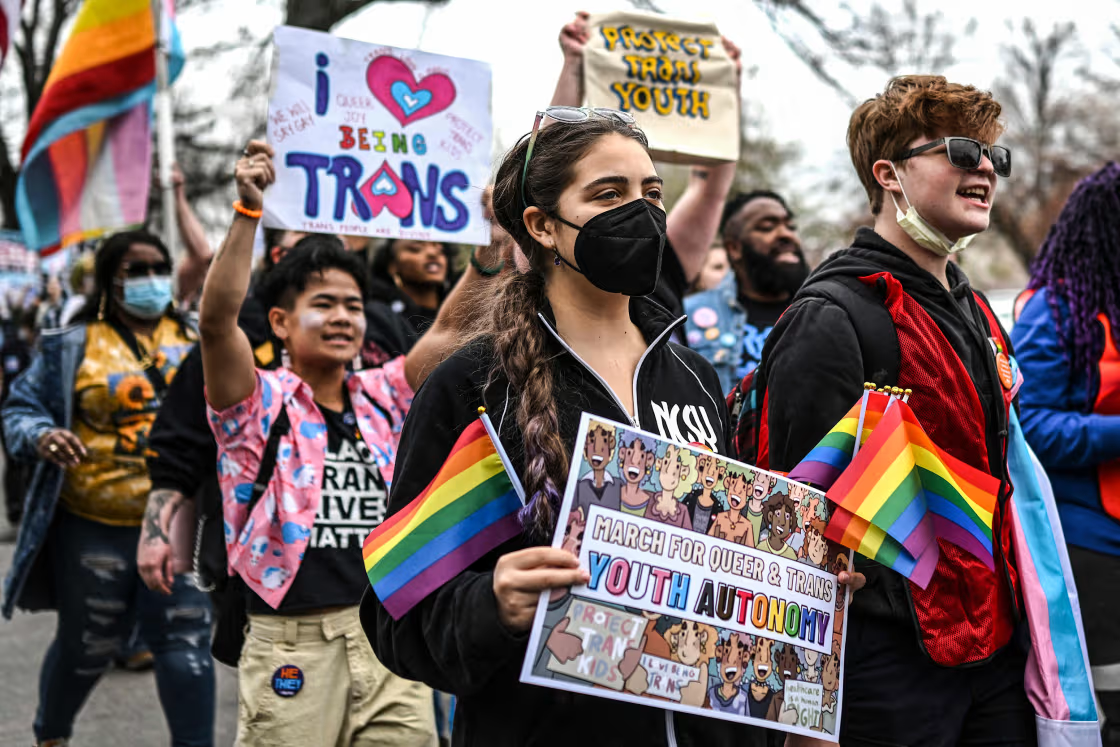
By RUSS O’SHEA
For the past few years, trans people have been put in the spotlight in quite a grotesque way. November’s election saw the trans community scapegoated for virtually any societal problem in the service of the political game. The Republican Party viciously attacked the trans community and President-elect Donald Trump has repeatedly promised to destroy trans lives. Not mincing words, Trump laid out a plan to, on day one, ban trans people from the military, schools, bathrooms, and sports, as well as to ban life-saving gender-affirming care. This follows previous iterations of the plan, which also included targeting teachers, parents, and medical providers of trans people.
The implications of these attacks are very grave, and it logically follows that phone calls to suicide hotlines by trans people increased 700% following the election. The expectation is that Trump’s second term will echo the anti-trans offensive of his first, but will show yet unseen brutality, helped by a more developed network of anti-trans forces than existed back then.
At the same time that the Republicans are making dire threats, Democrats proved themselves completely unwilling to defend trans rights during the election, with some candidates following the GOP playbook and adopting anti-trans messaging as part of their campaigns. Some around the party claimed that its failure at the polls points to a need to “move right” on trans issues and others indicated that trans people and other minorities like Arabs and Latinos are to blame for the loss. The perspective of leaving trans people behind was seen in action when the party refused to fight provisions in the military budget (NDAA) that would prohibit its health insurance from providing gender-affirming care to children of service members. The passage of this budget is no doubt welcome news for Trump and his ambition to kick trans service members out of the military, continuing Biden’s greenlighting of the nation’s largest employer to discriminate against trans people.
The concession on this budget is the latest chapter in the Democrats’ legacy of doing nothing to meaningfully challenge the thousands of attacks on trans rights over the last few years. Yet trans people are still told time and time again that the Democrats are their only option: “Being crushed slowly under a tighter and tighter thumb is better than being crushed immediately” is the message.
The contradiction between the Democrats’ “progressive” message and their apparent disdain for trans people is further complicated by the trans legislators who run under their banner. One such politician, Sarah McBride, earned the title of being the first openly trans state senator elected to office, representing Delaware. But the tension was made clear as McBride, like her Democratic Party colleagues, conceded to the right-wing assertions that trans people should not have the right to use the bathroom aligning with their gender identity, which effectively means trans people don’t have the right to use the bathroom at all. This conciliation will simply embolden the right wing to continue attacks on bathroom access, like the bans in Ohio and Florida, and pursue the use of bounties on trans people, as is seen in Odessa, Texas.
Without a political party that is interested in defending trans lives, what options are there to stop the offensive that the incoming administration promises to accelerate? The only choice is what trans people have always had to do: take the fight for life into their own hands. What is necessary now is the construction of a mass movement that demonstrates these attacks are against the will of the vast majority of people. This movement could be significantly empowered if it were to join with and find allies in other movements—like those for immigrant, Black, and women’s rights, as well as the climate and Palestine movements. In 2020, the solidarity between the movements for Black lives and trans lives was powerful enough that it put pressure on a conservative Supreme Court to mandate that it is illegal to fire workers on the basis of gender identity or sexuality.
A robust opposition to the offensive would be achievable with the help of a democratically organized, rank-and-file-led labor movement energized to fight for trans rights on the shop floor, in contracts, and in the streets. Already, a number of union locals are recognizing the importance of defending trans people. Last year, UAW Local 2325 won gender-affirming care as part of its contract. Making gains like this doesn’t just immediately improve the living conditions of trans people; it creates space to have conversations about how legal assaults are attacks on all workers. As the culture war continues to rage, educating workers on issues like trans rights will become more and more important to establish solidarity and defend the entire working class from the divide-and-conquer tactics that make the destruction of its wages and living conditions easy. In fact, trans people are under attack because it allows the powers that be to do precisely this.
In the grand scheme of things, combating these attacks will require much more than voting in the “correct” candidate or avoiding the “wrong” one. It will require a social transformation away from the current system, which is set up to help the politicians serve their corporate masters. The foundation of such a transformation can be laid by building a movement that is ready to fight for trans rights and all rights and has the perspective of broadening to every social layer it can reach.
Photo: Andrew Caballero-Reynolds / AFP / Getty Images
-
It’s Panama’s canal


By CARLOS SAPIR
As the second Trump administration prepares to take office, Trump himself has suddenly set his sights on Panama, making several statements that he wants the U.S. to seize the Canal back. As it is, these comments are a brazen, imperialist insult. If these comments are in the slightest bit serious, they represent the biggest threat to Panamanians’ well-being since the o
riginal construction of the Canal. In addition to being the focal point of the modern economy of Panama and a vital international trade route, the history of the Panama Canal is a history of imperialism and the international struggle against it.Construction for the Canal was first planned by a French company in the late 19th century, inspired by the success of the Suez Canal in Egypt, with predominantly Chinese and Afro-Caribbean workers traveling to Panama (then still a province of Colombia) to work on the project. European engineers, unfamiliar with the climate of Panama, did not adequately anticipate the wet season, leading to catastrophe, thousands of workers’ deaths, and a stalled project.
In 1903, seizing upon an internal political crisis within Colombia, President Theodore Roosevelt dispatched the U.S. fleet to block Colombian attempts to restore control over Panama—in the process cementing the establishment of an independent Panamanian state under U.S. military control. Construction of the Canal, now led by the U.S., would resume immediately, and in this state of coercion the newborn government of Panama signed a treaty giving the U.S. custody of the Canal and a strip of land surrounding it (and thus bisecting the country), known as the Panama Canal Zone. At the time, even usual cheerleaders of U.S. imperialism like The New York Times denounced the seizure as “an act of sordid conquest.” Although the U.S. was more prepared to carry out the project to its completion, construction was still a deadly endeavor, and thousands of workers would pay the true cost of the Canal’s construction with their lives.
While Panamanians (rightfully) immediately chafed at the handing over of vital assets to an imperial power, and the borders of the Canal Zone became a site of regular protests, the next chapter in the history of the Panama Canal would be set off by a wave of solidarity with international anti-imperialist action taken against another, similar imperial imposition in the 1950s—the nationalization of the Suez Canal by free Egyptian forces challenging the British Empire, and the failure of an imperialist coalition of British, French, and Israeli forces attempting to retake it. Inspired by the anti-imperialist victory in Egypt, protest activity and anti-U.S. sentiment in Panama increased, with students leading the protests.
In 1964, Panamanian high school students marched through the Zone with a Panamanian flag, and were attacked by U.S. police and personnel, tearing the flag apart. Further furious demonstrations followed, devolving into riots as they confronted Zone police forces. Zone police opened fire on the crowds, and the Panamanians fought back against them. The brave Panamanians who lost their lives–and especially the high school students–are commemorated yearly on Jan. 9, known as Martyrs’ Day.
The events of Martyrs’ Day, and the general political climate surrounding it, made it clear to the U.S. government that the writing was on the wall and that the people of Panama would not let them hold on to the Canal indefinitely. In 1977, President Jimmy Carter would sign an agreement with the Panamanian government promising the return of the Canal in 1999. While this treaty was ultimately honored, the intervening years would also witness a first-hand example of what the U.S. military deployment in the Canal Zone meant for Panamanian politics.
Throughout the 1980s, Panama suffered in the shadow of General Manuel Noriega. A Panamanian general, Noriega was also a heavily entrenched CIA asset and had extensive connections to the international drug trade. Following the death of President Omar Torrijos in 1981, Noriega became the country’s de facto dictator from the shadows, with the support of U.S. power. In this capacity, Noriega turned Panama into a conduit for both drugs and counter-revolutionary U.S. military aid to reactionary regimes across the continent, perhaps most infamously including the Contras in Nicaragua, all while assassinating political dissidents, clamping down on protests and rolling back democratic rights. Noriega’s fortunes would sour, however, with the H. W. Bush administration ultimately deciding he had become more of a liability than an asset by the end of the decade.
Following an attempt to dismiss an election result in 1989, the U.S. began to pressure Noriega to resign. Noriega instead doubled down and began to harass the U.S. presence in Panama while officially naming himself as the actual head of state of Panama for the first time. This was a miscalculation, and H. W. Bush responded with a full-blown military invasion of Panama, launched from inside the Canal Zone. Noriega was arrested, and several hundred Panamanians were killed during the fighting.
While Noriega is remembered as a tyrant and a villain by the people of Panama, the U.S. invasion made clear the threat that had hung over Panama’s politics since construction of the Canal began: So long as a foreign military controls the Canal Zone that bisects Panama in two, it holds the true power over the country, and any regime formed in Panama can rule only at its discretion. More importantly, the experience of the Noriega regime demonstrates that the U.S. support for a government in Panama was not based on any sort of democratic principle. It was not Noriega’s mockery of democracy in Panama that caused U.S. intervention—he had been doing that since he first seized power at the beginning of the decade—it was his fall of grace as a CIA asset and an instrument of U.S. power in Latin America that led to his ouster by U.S. invasion.
Today, following the handover in 1999, the Canal is a focal point of the Panamanian economy. It is also mired in ecological trouble, both in terms of the Canal’s impacts on the surrounding areas and also through the threat of climate change putting the Canal out of commission entirely due to shifts in rainfall and water flow. Decisions of how to manage and maintain the Canal must be made by Panamanians, who will live with the consequences, not by unaccountable imperialists in North America.
In 1977, at the time of the Carter-Trujillo treaty, U.S. segregationist Senator Strom Thurmond is reported to have said, “The canal is ours, we bought it and paid for it, we should keep it.” But if workers have a right to the work they create, the Panama Canal cannot belong to imperialist capitalists: It belongs to the workers of Panama, who faced mudslides, disease, and floods to build it, who marched against the Zone for as long as it divided their country, and who continue to operate the Canal today, 24 hours a day, as it meets the needs of international trade and the whims of capitalism. It is only the Panamanian working class, in solidarity with workers and oppressed peoples across the Americas, that can fight to set the Canal to work for the needs of the people and break it away from the capitalist bottom line that it serves.
It is far from certain that Trump will attempt to once again rob Panama of its patrimony; what is certain is that if U.S. imperialism tries to do this, the people of Panama will be there to remind it of why it had to retreat from Panama in the first place. From inside the U.S., we as Workers’ Voice will rally alongside the Panamanian community and all other people outraged by imperialist greed to demand: Hands off Panama!
References
- McCullough, David (1977). The Path Between the Seas: The Creation of the Panama Canal, 1870–1914. New York: Simon & Schuster. ISBN 0-671-24409-4.
- Meding, Holle Ameriga. “The Día de los Mártires—Spontaneous Demonstration, Heroic Myth, or Political Instrument? The 1964 Panamanian Flag Riots in the History of US-Panamanian Relations.” Global Histories: A Student Journal 4.2 (2018).
- Parker, Matthew (28 February 2007). “Changing course”. The Guardian. ISSN 0261-3077. Archived
- Galván, Javier A. (December 21, 2012). Latin American Dictators of the 20th Century: The Lives and Regimes of 15 Rulers. McFarland. ISBN 978-0-7864-6691-7.
Image: Museo del Canal de Panamá
-
Donate to help support Ukraine’s workers!

{:en}

Support Ukraine’s resilient workers! Help us provide electrical generators through their unions!
By UKRAINE SOLIDARITY NETWORK, U.S.
Winter is coming to Ukraine, temperatures are dropping, but nearly 60% of the country’s electrical generating capacity has been knocked out by unrelenting Russian air strikes. After causing tens of thousands of civilian casualties, the Russians are bent on freezing every child, woman, and man.
The Ukraine Solidarity Network in the United States has teamed up with two Ukrainian trade unions, the Free Trade Union of Railway Workers and the Independent Trade Union of Miners of Ukraine, and an NGO called Kryal to provide portable electric generators to families in need. Our initial goal is to raise $6,000 for 12 portable generators for union members and their families.
These brave workers and their families are in urgent need of support. The UN reports that Russian attacks on Ukraine’s energy infrastructure are impacting millions, creating serious humanitarian and public health risks, and adding hundreds of thousands to the 10 million already displaced by the war. Other critical systems including water and education are also being severely disrupted.
Join Us in Standing with Ukraine’s Workers! Your donation will provide essential power to some of those who need it most. Click here to download our flier to use in your activism in your community!
Let’s show our solidarity with Ukraine’s rank-and-file workers and the vital work they do under unimaginable conditions. Donations will be collected through GoFundme and sent to Kryla’s bank account from where it will be transferred to the official bank accounts of the unions.
GoFundMe page:Photo: Ukrainian rail workers.