-
UPSURGE IN BOLIVIA: United Left Platform webinar on June 26


Upsurge in Bolivia: What It Means for the Fight Against MAGA and U.S. Imperialism
Jun 26, 2026 8:00 PM -
Workers’ Voice newspaper: June-July edition

Trump continues his assault on working and oppressed people: From the attack on voting rights to the environmental impact of the war on Iran to abortion rights to the struggles of immigrant meatpacking workers on the picket line, this edition is filled with insightful views on how working people are confronting the horrors of capitalism under the management of the Trump administration. Also in this issue read about migrant workers in Africa, the struggle against data centers, and the meaning of recent elections in Hungary.
The June-July 2026 edition of our newspaper is available in print and online as a pdf. Read the latest issue of our newspaper today with a free pdf download! As always, we appreciate any donations to help with the cost of printing.
Click on the image to read the paper or message us to get a hard copy:

-
Genocide in Gaza continues — with food as a weapon


By JAMES MARKIN
Every day in Gaza brings another massacre as this July has turned into the deadliest month in Gaza in over a year, according to the British-based charity, Islamic Relief Worldwide. Last week, Israel launched a new offensive against Deir al-Balah, the neighborhood in central Gaza. Deir al-Balah is one of the few remaining places in the strip with infrastructure and buildings largely still standing. For this reason, it has become one of the few places with humanitarian infrastructure that remains independent of the Israeli war machine. And for that reason, Israel’s attack on the area is a natural next step that follows Israel’s broader military strategy over the last few months.
In that time, Israel has attacked churches and hospitals, but their favorite target has been lines of hungry Palestinians waiting for food. In one case, on Sunday, July 20, Israeli troops opened fire on a group of Palestinians near the Israeli border, where they were awaiting a UN convoy of flour, causing mass casualties and the deaths of nearly 100 people.
These attacks are no accident. Since the beginning of the war, Israel has been trying to shape the facts on the ground to enable a total transformation of the Gaza strip. It has systematically destroyed infrastructure and bulldozed homes, displacing nearly the entirety of the population and attempting to concentrate them into a “humanitarian zone” in the south. Of course, this is not for the humanitarian benefit of Palestinians, but rather to further subject them to the control and brutality of the IDF.
In order to carry out this plan, since the early days of the war Israel has perpetrated a brutal and targeted campaign against humanitarian organizations that are independent of its control, such as UNRWA and World Central Kitchen, thus gaining more control over the food distribution process.
The final stage of the Israeli operation was the creation of the U.S.-sponsored “Gaza Humanitarian Foundation“ (GHF). As with the “humanitarian zone,” humanitarianism is really a smokescreen for the true goals and activity of the GHF, which in reality seeks to leverage the distribution of food in order to further Israeli war goals. Videos have repeatedly showed soldiers at GHF distribution sites using pepper spray and even live rounds against those seeking food. According to the UN, as of July 21, 1054 people were killed trying to get food since late May, including 766 at GHF food distribution centers. Just as with Israeli attacks on UN peacekeepers in Lebanon during their invasion last year, the real reason Israel has sought to substitute the GHF for the UN is demonstrated by Israel’s actions. Unlike the UN, the GHF can be counted on to go along with Israeli narratives and plans to use humanitarian aid distribution in order to change facts on the ground in a way that enables Israel’s ultimate goal.
Those on the ground warn that attacks on Deir al-Balah could lead to the destruction of water desalination plants and other critical infrastructure. The Israeli attacks also targeted officials of the World Health Organization; the organization reported that its employees were stripped and interrogated by IDF soldiers, and one of them is still under IDF detention. The IDF offered a flat denial that many of these events happened, instead insisting that “the military is in constant communication with these international groups,” and claiming that the IDF and the WHO continue to cooperate. That this kind of blatant attack on WHO officials happened without significant condemnation from the great Western imperialist powers illustrates the extreme degree of support that U.S. imperialism offers to its proxy state, Israel.
Predictably, Israeli attacks have led to the death of Palestinians from malnutrition. According to al-Shifa hospital, 21 children have died in the last three days from malnutrition. The United Nations reports that one in five Gazans is suffering from acute malnutrition. This is not just a consequence of Israel’s activity; it is a goal of their current strategy, to twist the arm of the civilian population in Gaza until the situation is so bad that they will willingly sign up to be removed.
To that end, Axios reported that an Israeli intelligence official was in Washington in order to seek American help with a reported scheme to potentially deport “hundreds of thousands” of Gazans to third countries. According to the Axios report, the countries named by the Israeli intelligence official were Ethiopia, Indonesia, and Libya. The feasibility of this plan in the face of both Palestinian resistance, political realities and underlying logistical problems, remains low. However, it is clear that a significant portion of the Israeli ruling class is dead set on this outcome, and it is the duty of the working class around the world to stop it through mass action.
The Israeli intelligence official’s visit to the United States underscores the fact that U.S. support will be necessary if Israel is to have any hope in carrying out its dream of mass ethnic cleansing of the Gazan population. This is why workers here in this country have an even more serious duty to oppose U.S. support for genocide in Gaza.
Photo: Palestinians wait for food cooked by a charity kitchen in northern Gaza, May 15. (Mahmoud Issa / Reuters)
.
-
What does Mamdani’s primary win mean for working people?

{:en}

By TONY STABILE and GUILLERMO SCHRODER
Zohran Mamdani, a DSA (Democratic Socialists of America) member and New York State Assemblyman representing parts of Queens, won the Democratic Party mayoral primary in New York City on July 1. His electoral success demonstrates a groundswell of support for left political policies and a heightening of the crisis of legitimacy confronting the Democratic Party. Mamdani claims that his successful primary campaign serves as an example of how Democrats can “unite our party and build our party such that we can take on and defeat this right-wing authoritarianism we’re seeing in Washington, D.C.”
What happened
Mamdani entered the primary race as a practically unknown candidate. Polling at little over 1% in February of this year, Mamdani’s focus on everyday economic reforms and social media expertise quickly helped him gain prominence quickly. While Cuomo and Adams remained mired in various baroque sexual and financial scandals, Mamdani outlined a clearer vision for addressing issues such as the New York housing crisis, the high cost of child care, underfunded public transportation, and inflated grocery prices.
Mamdani won against significant odds. The Democratic Party establishment vigorously opposed his candidacy. Democratic leaders such as Sen. Chuck Schumer and Rep. Hakeem Jeffries refused to endorse Mamdani in the primary, while New York Representatives Laura Gillen and Tom Suozzi did not mince words about his politics—Gillen calling Mamdani the “absolute wrong choice for New York,” and Suozzi pronouncing his “serious concerns” about the Assemblyman. That’s not to mention the tens of millions of dollars from top Democratic donors (including billionaire Michael Bloomberg) that went into Andrew Cuomo’s Super PAC, which was attempting to defeat Mamdani in the primary and now to defeat him in November.
Crisis in the Democratic Party
After its disastrous defeat in the 2024 presidential election—as well as its cowardly inaction in the face of Donald Trump’s assault on the civil rights of immigrants, the LGBTQ community, and women—the Democratic Party finds itself in a moment of crisis. Neither Democrats nor Republicans can claim to represent the working class. Moreover, the majority of workers do not regularly vote in any elections.
What little support Democrats once had among the working class, Black people, and Latinos is eroding by the day, and their bid to court affluent, college-educated voters has failed as well. Democratic Party support for the Israeli genocide, coupled with domestic austerity, has driven them to historic lows in terms of overall public approval.
Mamdani, for his part, is not quiet about his plan to revitalize the decrepit Democratic Party. He has already begun to play the role of an “outsider” candidate, bringing in people disaffected by the leaderships of both parties’ establishments. This recuperation of voters is a significant concern for the Democratic Party, which lost significant elements of its “historic” base to Trump or to non-participation in the 2024 election.
The Gothamist recently published an analysis finding that “Mamdani won 30% of the primary election districts Trump won in the 2024 general election and garnered over 35,000 votes in districts that went for Trump. Around the Jamaica Hills, Queens intersection where Mamdani filmed last November, voters in 2024 moved toward the GOP by nearly 25 points. On Tuesday, Mamdani won there with 84.2% of the vote.” These statistics illustrate the effect of Mamdani’s politics, whether he intends it or not, which utilize his history as an activist and his “anti-establishment” ethos to bring disgruntled voters back into the fold of the Democratic Party.
More recently, Mamdani has sought to gain backing from the “centrist” mainstream of the Democratic Party, meeting with party leaders in Washington, top party donors, and big business executives in New York. Simultaneously, his rhetoric has gradually inched toward the right. He has steadily backtracked on his previous unapologetically pro-Palestine positions and was seen shaking hands with NYPD officers at the New York City Pride parade, who have been banned from official participation since 2021.
Mamdani is a young and charismatic Democratic candidate with a political platform focused on real, material concerns that has resonated with voters. His candidacy could be a boon to the otherwise floundering Democratic Party. It remains to be seen whether the Democrats will accept this gift or attempt to crush Mamdani in the general election. This issue divides the party. On the one hand, Mamdani has selected Jeffrey Lerner, a top DNC and Obama adviser, as his communications director, and is considering keeping Jessica Tisch as NYPD Commissioner. On the other hand, some Democratic donors and functionaries appear to remain attached to Adams and Cuomo, both of whom have filed paperwork to run as independents in the general election.
What does this mean for workers?
Since Bernie Sanders’ first presidential campaign in 2016, we have witnessed a surge in “progressive” Democrats running for office. Sanders’ movement prepared the ground for Rep. Alexandria Ocasio-Cortez, who, in turn, inspired countless local, state, and federal candidates. It is rare to see a Democratic primary without a candidate in this “progressive” mold. Meanwhile, despite this near-limitless supply of politicians professing anti-racist and pro-working-class policies, a growing and dangerous movement of right-wing populism persists in the United States.
As a rule, the demands of capital, particularly as they are personified in large donors and party officials, drive these “progressive” Democratic politicians to act against working-class interests. For instance, Ocasio-Cortez voted to break the railworkers’ strike in 2023 and just recently voted against cutting funding for Israel’s Iron Dome missile defense program. Sanders notoriously voted in support of H.R. Res. 64, Authorization for Use of Military Force, which authorized the government to use force after 9/11. More recently, Sanders campaigned strenuously to elect Biden in 2020, who unconditionally fueled the genocide in Gaza with financial and military aid.
Mamdani’s election in the Democratic primaries was a powerful sign of the popularity of seemingly “socialist” policies aimed at addressing people’s immediate material needs. Nevertheless, it remains uncertain whether he will adhere to his professed intentions once in office, let alone deliver on the promised reforms. It is already clear that even if we were to assume the best of Mamdani as an individual, the institutions of the U.S. state and its capitalist beneficiaries, including significant elements of the Democratic Party itself, are prepared to fight any but the most timid proposals for reform. Meanwhile, figures like Sanders and AOC will lure him into joining the Democratic Party political machine.
The decisive factor in advancing working-class politics in New York City is the level and direction of activity by the membership of unions and organized, progressive social movements. Winning reforms is a key aspect of mobilizing these bases and building working-class consciousness and organization on the road to gaining revolutionary power. The struggle for significant reforms, however, must be guided by and rooted in a principled, independent working-class party that fights for change regardless of who is in office. It is not a matter of throwing any left-wing candidate with socialist rhetoric into governmental power. History proves that such attempts to gradually transform capitalism into socialism by electoral means end in failure and misery for the working class. Instead, workers must use elections to mobilize our class’s forces and measure our strength in the struggle for revolution.
The ultimate test of a left-aligned electoral campaign is whether it strengthens the organization of the working-class movement toward socialism—a movement capable of producing its own leaders and fighting for its own revolutionary interests in the class struggle. Our current situation in the U.S. requires diligent work and concrete steps toward building an independent working-class party that fights uncompromisingly every day for working people and the oppressed. Unfortunately, Mamdani’s attempt to rekindle faith in the prospects of a “progressive” Democratic Party and increasing entanglement in its party politics will only perpetuate politically fatal illusions and hinder the challenging but necessary collective work of party building.
Photo: Richard Drew / AP
-
Trump: Hands off Brazil! Bolsonaro to jail!

{:en}

By UNIFIED SOCIALIST WORKERS PARTY (PSTU), Brazil
On the afternoon of Wednesday, July 9, the president of the world’s leading imperialist power, Donald Trump, announced a 50% tariff on Brazilian products. However, unlike Trump’s tariff war against the rest of the world, the main argument used by the leader of imperialism was his defense of former president and lackey Jair Bolsonaro, who is under investigation and on trial for attempted coup.
The imposition of tariffs on semi-colonial countries such as Brazil constitutes, in itself, an attack on sovereignty. Justifying the sanctions by defending Bolsonaro constitutes an unprecedented escalation by his administration against Brazil’s self-determination. In other words, Trump is attacking Brazil at Bolsonaro’s behest! A total disgrace! Trump wants to decide who the Brazilian people elect. He is trying to circumvent Brazilian justice and guarantee impunity for the coup leader who has always treated him with unwavering loyalty while protecting big US tech companies so they can continue spreading fake news and disinformation that favors the far right.
Fake news, incidentally, is reflected in the “letter” Trump sent to Lula. Contrary to what the U.S. president claims, trade relations between Brazil and the U.S. are not “unfair” to imperialism. On the contrary, Brazil has had a trade deficit with the U.S. for 16 years. This is precisely because, in recent years, Brazil has regressed in its role in the international division of labor. It is increasingly specializing in the export of primary products, to the point of depending on imports of industrial products with higher added value and technology.
This scandal further reveals how the Brazilian far right is subservient and servile to imperialism, and how hypocritical its supposedly patriotic rhetoric is. They advocate direct interference in the country to safeguard their interests and guarantee impunity for the coup plotters. Congressman Eduardo Bolsonaro, who has “self-exiled” himself to the United States, has been planning this reprisal against the country for months, issuing direct threats and sending “messages” to Lula’s government and the Federal Supreme Court (STF).
The working class must demand a response from Lula’s government that opposes the economic policies it has been imposing, which deepen the country’s subordination and surrender, whether through the privatization of sectors such as oil or through the fiscal framework that drains the resources and wealth produced by the working class to large banks and foreign investors through public debt. Furthermore, it does not address the extreme right-wing coup regime, whether by handing over ministries to extreme right-wing parties or outsourcing the fight against coups to the judiciary.
We must reject Trump’s attack and the servility of the far right! Trump, hands off Brazil! Lula, no more conciliation! No amnesty for the coup plotters! Jail for Bolsonaro and all the coup plotters!
-
Britain bans Palestine Action in an alarming abuse of state law


By JIM STEAD
International Socialist League, Britain
Since this article was written, repercussions from the British government’s banning of the solidarity group Palestine Action have continued. Close to 100 people have been arrested around the country on “suspicion of terrorism” for participating in protests against the government’s move. The Metropolitan London police said that its officers would act when “criminal offenses”—including expressing support for proscribed groups or organizations through “chanting, wearing clothing or displaying articles such as flags, signs, or logos”—are committed.
On July 16, a man was arrested in Glasgow for displaying a poster in the window of his home that supported Palestine Action. Five days earlier, a man was arrested outside a music festival in Glasgow for wearing a T-shirt with the words “Palestine Action” on it.
There is a real chance that these repressive actions by the British authorities could be used as a model to reinforce and deepen the measures by governmental bodies and police in the United States against Palestine solidarity groups. It is important that working-class and civil liberties forces around the world firmly reject the repression against Palestine Action in Britain. — WORKERS’ VOICE EDITORS
On 4 July 2025, the British parliament proscribed Palestine Action, with just 26 MPs voting against. Jeremy Corbyn (independent left MP) asked, unsuccessfully, for the proscription vote to be taken in three parts because the bill included two other proposed proscriptions—a violent neo-Nazi group ‘Maniacs Murder Cult’ and an ultranationalist white supremacist ‘Russian Imperial Movement’.
The UN experts had urged the United Kingdom not to ban the “direct action” group Palestine Action as a terrorist organisation under the Terrorism Act 2000. Banning Palestine Action makes criminal offences out of actions relating to the group, including membership, inviting support for it, arranging a meeting in support of it and publicly wearing clothing or carrying articles associated with the group. Disproportionate penalties of up to 14 years in prison could apply. [i]
PA was a non-violent protest organisation against the genocide of Palestinians and against the use of British military equipment enabling Israel’s genocidal attacks and bombing of men women and children and the wholesale destruction of Palestine. The ‘final straw’ for the Labour government was PA members spray painting two RAF planes with red paint.
PA had great support from the youth and Palestinian activists across the country. Many link this struggle with the direct action of the suffragette movement before World War I, and the women of Greenham Common (who took direct action against the storage of nuclear weapon) at an RAF base.
Hypocritically, as MPs vote to proscribe PA, 200 female MPs gather in parliament to pay tribute to the suffragette movement, wearing sashes in the colours of the suffragettes.
On 5 July many unions attended demos, with their flags. Mass protests continue in support of Palestine as state repression attacks the right to protest. The London Police have increasingly used criminal law to harass pro-Palestine activists and journalists, most commonly for what speakers say. Under the Criminal Justice Act 2003, courts are imposing bail conditions and exclusion zones around protest sites, as imposed on climate protesters. Universities have called on the police to arrest BDS campaigners rather than engage with their demands and use court injunctions, which can trigger contempt of court decisions leading to up to two years imprisonment if ignored.
The British government is reshaping the law to demonise, persecute, punish and intimidate pro-Palestine activists, as they fail to say why ‘criminal’ acts cannot be prosecuted under criminal laws.
An authoritarian move
The proscription of Palestine Action constitutes an authoritarian move, criminalising non-violent protest and freedom of expression, setting a very dangerous precedent for the rights and freedoms of all in the UK.
A survey recently found 57% of the British public supports a full arms embargo on Israel.[ii] Hundreds of thousands regularly join protests calling for an immediate end to arms exports to Israel.
Anti-Terror laws expand state repression further by weaponising vague terms like ‘support’ (Section 12 of the Terrorism Act 2000) and ‘glorification’ to criminalise dissent, turning protest chants, social media posts, and even solidarity into ‘terrorism’.
What is happening poses a grave danger to the working class and anyone fighting for justice, as none of us can be free until Palestine is free.
As many workers and activists are calling for a new party. Its programme must include Free Palestine as a responsibility of the working class and its organisations. At the same time, unions need to build larger and wider democratic united fronts with all the oppressed and workers to combat the attacks on workers and democratic rights nationally and across the world. We call on all unions to build bigger union blocs on Palestinian demos!
Support BDS!
Leaflet your and other workplaces to support Palestine!
Stop military equipment and all trade with Israel!
Expel the Israeli embassy from Britain!
[i] https://www.ohchr.org/en/press-releases/2025/07/un-experts-urge-united-kingdom-not-misuse-terrorism-laws-against-protest
[ii] https://palestinecampaign.org/polling-reveals-huge-public-support-for-arms-embargo/
-
Observations on the July 9 general strike in India


By MAZDOOR INQUILAB
It had been four years since the last major general strike by central trade unions in 2021. Since 2010, there had been a general strike once every year by trade unions until the pandemic hit.
The past strikes were massive one day strikes that caused large, but temporary, disruptions to the system, without materializing into a lasting or sustained campaign. The strike of 9th July was no different in this regard. Like earlier general strikes called by the trade unions, it did not concretize a long term programme for agitation.
The trade union strike comes at a time when the Modi government is desperate in its attacks against the working class, youth and peasant masses. The success of the farmer’s agitation energized the masses of the country, and dealt a massive political defeat to the Modi government; it is significant that farmers’ unions which participated in that mobilization also came out in support of the general strike.
The strike had an impact across the nation, but the intensity varied from state to state. Though the trade unions claimed 250 million workers joined the strike, the real figure is likely to be far less, considering that many central trade unions aligned with the BJP, like the BMS (Bharatiya Mazdoor Sangh), opposed the strike.
Repression of the strike was seen in different parts of the country, most prominently in West Bengal and Tamil Nadu, where governments led by bourgeois opposition parties moved in to foil the strike. The TMC sent its goons to act as strike breakers, and the workers’ strike overlapped with the existing political contest between the ruling TMC (Trinamool Congress) party and the cadres of the Communist Party of India (Marxist). Live footage of TMC goons and the police beating up protesting strikers could be seen on the news.
In Tamil Nadu members of the LPF (Labour Progressive Federation) acted as strike breakers in the transport sector, particularly in bus transport. LPF union members stepped in to drive buses left vacant by striking bus drivers. It is worth remembering that the LPF was also opposed to the Samsung workers’ strike.
The strike received solidarity from the youth, from farmers, from activists, and it had the sympathy of the vast majority of India’s masses. Despite repression in different regions, despite the traitorous actions of large trade unions, the strike drew tens of millions. Large protests took place in major cities across the country. Both formal and informal sector workers participated in the strike, bringing the most precarious workers into the strike.
Trade union leaders have stated that this general strike was but the first step in a long term movement for securing labour rights. Whether or not this materializes remains to be seen.
The condition of the Indian working class
It is worth remembering why the working class has gone on the path of struggle, why this general strike happened in the first place. The immediate reason of course is the passage of the Labour Codes, but that is not the only reason.
Since the neo-liberal onslaught of the 1990s, there has been a steady empowerment of the Indian capitalist class at the expense of Indian workers. Trade unions have declined in power, while hire-and-fire laws have made it easier for bosses to control workers. The most significant change however, is the increasing precariousness of work.
With successive governments privatizing state assets, employment in the public sector has either declined or moved further towards contract labour. The increasing push of capitalism into India’s hinterlands has resulted in the crippling of Indian agriculture, the more vulnerable sectors of rural India have been forced to find work in the cities, either as seasonal workers, or as migrant workers. Millions have been thrown into the meat grinder of India’s job market, where few positions are given for low wages to millions of applicants.
Migrant workers fill the ranks of gig workers, casual labour and contract labour. Much of India’s construction sector is powered by workers from the countryside seeking seasonal work in India’s cities. There is little to no protection for migrant workers, and with global warming, they face greater heat stress. Migrant workers were the worst affected during the pandemic lockdowns, many simply died trying to walk back home.
In the decades before the neo-liberal reforms, the public sector was the main provider of jobs. One could hope for a steady permanent job in the public sector, but today even the public sector is not immune to the contracting trend. Whether it’s the railways, telecom, power, contract labour is displacing regular permanent employment. In the competition for jobs, the fresh inflow of new workers from the countryside and small towns has swelled the ranks of low-paid, precarious work, depressing wages for workers across sectors.
Though not regularized as permanent workers, contract workers are often made to work the same hours, and do work that is similar or the same as those of permanent workers, but without any of the rights and protections. This is the situation for contract workers in a publicly owned company like BSNL (in the telecom sector), one can only imagine how much worse the situation is in the private sector, where unions are generally weaker.
The scenario for industrial labour is especially bad, considering the findings in the Annual Survey of Industries data. According to the data, in FY23, a total of 14.61 million workers were employed by 253,000 factories across India. Of them, 5.95 million workers (40.7 per cent) were on contract, the highest ever yet recorded, as compared to only 40.2 per cent in the preceding financial year. To make matters worse, such precariousness is combined with longer working hours, and stagnating pay.
Since the COVID pandemic, real wages have been largely stagnant. Meagre raises have not kept pace with inflation, and has workers have been forced to make do with less. According to the NITI Aayog (India’s alternative to the planning commission), salary increases have not kept pace with inflation for the last seven years. The real wages of workers have largely stagnated across rural and urban sectors. This, even as corporate profits reach a 15-year high, climbing 22% in 2024.
The stagnation of real wages, was one of the driving forces behind the Samsung worker’s strike. The fight for the recognition of the Samsung workers union continues. Longer working hours and increased expenses, coupled with a capitalist class that has been emboldened to treat workers worse, have only made these tensions worse. The most shameless capitalists publicly urge the beleaguered and burdened Indian working class to work 70-hour weeks, industry lobbyists urge the government to raise the working week to 90 hours, at a time when Indian workers are already working 60-hour work weeks, with even worse conditions in the unregulated informal sector.
India today is one of the most unequal countries in the world, wealth disparity has become worse than it was during the British Raj. There is no longer any mystery to where the fruits of the worker’s labour is going: while the Ambani family is building a billion dollar skyscraper, half of Bombay still live in slums. Those slums are now set for redevelopment, again for the benefit of another billionaire family. Today India’s richest 1% hold 40% of the country’s wealth. While billionaires buy property in foreign countries and Indian companies acquire businesses and land across the world, Indian workers are left living hand to mouth.
This is the context in which the central trade union called for the general strike on 9th July.
The political situation around the strike
It is important to understand the political context of the July 9th strike. Between 2014 and 2021, we witnessed the reactionary triumphalism of the Modi government. They could act as they pleased, pass whatever laws they wanted, ride roughshod over the weakened enfeebled opposition, crush workers’ rights, and punish dissent with ruthlessness. Nothing displayed this attitude of impunity better than the sudden demonetization that overnight destroyed tens of millions of people’s cash savings. Despite the difficulties faced by Indians, and even the death of several bank workers, the BJP government remained secure in power.
This impunity peaked with the pandemic lockdown, where the government simultaneously revealed their cruelty and incompetence. The arbitrary lockdowns and the suspension of trains and busses led to enormous difficulties for workers and poor. Worst off were migrant workers who had no means of sustenance and were compelled to find their own ways back home. Many died on the way back home, some dying from starvation. The lockdowns achieved nothing, COVID still spread, and hospitals were found woefully lacking to deal with the task. Indians died by the tens of thousands, a fact that remained hidden by the government.
Even as Indians suffered and died, the government was focused on pushing through several key bills into laws such as the new farm laws and the labour codes. This was a dual attack on workers and peasants, the response was almost immediate. Trade unions and farmers’ bodies planned a strike in September of 2021, right in the height of the COVID pandemic we witnessed a general strike by workers and farmers.
This was the precursor to the farmers’ protests which shook the government to its core. The government weaponized the pandemic lockdown to clamp down on protests, even though BJP party cadres had freedom to campaign and gather at will for the West Bengal elections, a major reason for the spread of the virus in its worst phase. The farmers’ protests were conducted with remarkable discipline, encompassing thousands of people who put the capital under siege, rallying behind a singular demand, the repeal of the farm laws.
The success of the farmers’ protests gave the BJP a defeat from which they have not yet recovered. The farmers’ protests ended around the time that the pandemic began to die down and normalcy returned. Without lockdowns, protests grew. Soon after the farmers’ protests there was the Anganwadi workers’ strikes, transport strikes against the new criminal laws, and quite significantly a series of electoral defeats over the period from 2021 to 2024.
Though the BJP won in 2024, their parliamentary majority was much reduced. The absolute majority that the BJP enjoyed was gone, they now had to manage a coalition of regional bourgeois parties.
At this time, bourgeois opposition parties have moved opportunistically to support the protest actions of workers and farmers. The DMK (Dravida Munetra Kazagham) in Tamil Nadu has posed as a defender of Tamil language and culture against Hindi imposition, while the TMC has posed as the foremost defender of secular values, minority rights and democracy against the BJP and their Hindutva ideology. Both parties pose as populist parties that care for the rights of workers and farmers, but this is a lie. The truth is neither the TMC nor the DMK, nor any opposition bourgeois party for that matter, care about workers farmers or youth.
The last year saw the revolution in Bangladesh which was followed soon after by the uprising around the doctor’s movement. This happened at the same time that the tea workers of Northern West Bengal went on the path of struggle for the payment of pending wages, protesting against the deplorable condition of work in the plantations. The same year witnessed the mammoth strike of the Samsung workers in Tamil Nadu. During this period the oppositional bourgeois parties acted as guardians of capitalism, siding with the bosses against the workers.
The Congress party is the second largest political party in the country, and the largest of the oppositional bourgeois parties. It was also the former ruling party of India, having held the reins of power for the longest period of any party after independence. Despite their words of support for workers and for the farmers’ protest, their government in Karnataka have begun taking steps to increase working hours, showing where their loyalties really belong.
The bourgeois parties’ charades continued during the strike. In the state of Bihar, which will go to polls in the next year, the strike mobilizations were combined with protests against electoral roll revisions, which may disenfranchise up to 20 million voters, mostly from poorer working class and peasant households. The Congress party, whose government in Karnataka is launching fresh attacks on IT workers, supported the general strike, as did their affiliate trade union the INTUC. In some areas however, opposition bourgeois parties were strongly against the strike, particularly so in the state of West Bengal.
The state of West Bengal had witnessed mobilizations against the criminal rule of the TMC party over the second half of last year. Much anger still remained and was on display as TMC goons and trade union activists confronted each other on the streets. The police force was deployed to arrest and beat up striking workers. Directives were put in place to punish striking government employees. This did not deter workers, many government workers and staff still supported the strike action, many were angry over unpaid dearness allowance (a cost-of-living adjustment programme).
In the aftermath of the pandemic, the BJP has seen its political position rattled, but not undone. This has made space for bourgeois opposition parties to rise in power. The Congress party recovered some lost ground, nearly doubling their seat share in the parliament. Regional parties have grown in power within their respective domains, while the CPIM (Communist Party of India Marxist)-led left front remains in doldrums, at least as far as electoral performance is concerned. Its seat share in the parliament increased from 6 seats to 8 seats, with vote share remaining mostly stagnant.
The Stalinist party’s abysmal performance hides the true scope of influence of the party, especially when counting its affiliated farmers and trade union bodies. Though their power is in decline, this decline has not resulted in the rise of alternatives on the left. The space for leftist politics is still largely dominated by the CPIM, its allies and affiliate bodies. This reality has showed itself time and again, the DYFI and SFI student unions linked with the CPIM were on the forefront of mobilizations during the doctor’s movement. The All India Kisan Sabha (All India Farmers Union) linked with the CPIM were one of the leading bodies in the farmer’s agitation. The Samsung workers strike is led by a CITU affiliated trade union, which is linked with the CPIM.
The series of mobilizations and struggles show that India is no longer in a reactionary situation but one that is heading towards pre-revolutionary situation. However, Indian capitalism remains stable: it is growing and politically secure. There is not yet an active pre-revolutionary situation as we saw in Sri Lanka in 2022 or in Bangladesh during August of 2024. The political context today bears many similarities to the period between 2010 and 2014, when India witnessed many national and regional protests, strike actions and mobilizations. The last time such a situation resulted in the BJP’s victory and the beginning of a reactionary situation in India; whether this time will be any different depends to a great degree on the course of class struggle and its leadership.
The impact of the strike and solidarity from different sectors
The General strike comes at a time when India is going through a period of upheavals as national and powerful regional mobilizations have shaken capitalist governments. Just the last year we saw the tea workers’ strike, the doctors’ movement in West Bengal, the Anganwadi strikes gaining victories, and the Samsung workers’ strike in Tamil Nadu. Even as the one day strike ended, transport workers in the state of Uttar Pradesh have struck over the policies of the BJP-run state government. What we are seeing is a continuing momentum that has remained in place since the farmers’ mobilizations in 2021, but this momentum has neither increased nor decreased.
The fear of war in May of this month had led to the delay of the strike, with trade unions shifting the date of the strike to July 9th, conceding to the reactionary mood that had been built up by the BJP government over an impending war with Pakistan. The skirmish did not escalate into a war, but tensions still remain. However, the fact that the general strike has still happened, and that it has happened with impact, shows that the BJP’s attempts at rallying reactionary sentiment to dampen the militant mood of the masses has failed, dissent against the BJP and it’s reactionary policies have not ended, and shows no signs of declining as of yet.
Trade union leaders have claimed about 250 million workers had joined the one day general strike, with some claiming more may have joined in. Even this number may be exaggerated, as 19 central and regional trade unions boycotted the strike, most prominently the BMS (Bharatiya Mazdoor Sangh) affiliated with the BJP, and the TMC-affiliated trade union the INTTUC (Indian National Trinamool Trade Union Congress). Reports emerged of LPF workers acting as strike breakers in Tamil Nadu to ensure the normal running of state busses. The betrayal from some of these unions dampened the impact of the general strike. In Calcutta, where the impact of the strike was greater than most large cities, it was not uncommon to find one bank fully shut while other banks were running at half strength. While some government offices were shut entirely, others ran inefficiently.
The protests in various cities numbered from the hundreds to the thousands; while not the largest in recent times, they were visible. In Delhi the trade unions were joined in with farmer’s unions, student’s unions and youth organizations, most linked with the CPIM. In Calcutta, protests broke out in several parts of the city, but suffered from crackdowns by the police and attacks by TMC goons. In Mumbai the strike witnessed a good turnout, with disruptions to railway and bus transportation. Bihar witnessed large protests on the streets of Patna, here the strike coincided with ongoing protests by opposition bourgeois and petty bourgeois parties against the electoral roll revision. This was not unique to Bihar, in West Bengal too the pitched battle between the TMC and the CPIM cadres showed that the strike overlapped with other local political conflicts in the state.
By and large bourgeois parties and ideologues came out in opposition to the general strike, as is expected, what was unexpected is the degree of solidarity received from different sectors, but most significantly from farm workers and farmers’ unions. The same organizations which had participated in the mammoth farmer’s mobilization in 2021 had come out to rally in support of worker’s demands. This is a solid ground to develop a united front of workers and farmers, around a programme for revolutionary struggle.
Adding to the ranks of the workers were radicalized youth, student groups, and even journalists’ unions who joined the workers’ protest rallies in Delhi.
The emerging alliance between workers and farmers, the expansion of struggle from organized to unorganized sectors, encompassing both industrial workers and scheme workers (workers employed by temporary government programmes), is significant. This broad unity of workers and farmers is a good basis to develop a political programme for revolution, but without revolutionary leadership this will come to nothing. The Stalinist CPIM, which still remains under the bourgeois led ‘INDIA’ alliance, will use the energy of this mobilization to electoral ends and ultimately to the benefit of the oppositional bourgeois parties.
Conclusion
The General strike is one of the most potent weapons in the arsenal of organized workers. Such a tactic must be used wisely and not squandered. To build up a general strike on a scale that is necessary to have national impact, in a country as large and diverse as India, takes huge effort. The central trade unions and Stalinist parties have once more proven that they can conduct such a strike, but that they choose to do it for a mere 24 hours, with no clear programme for further action, meaning that this enormous energy and effort will dissipate.
The strike call was given by leftist trade unions mostly aligned with the CPIM, but this call went unanswered by 19 different unions. These bourgeois-aligned unions must be ruthlessly attacked for this betrayal, they have abandoned their own workers at a time when they need militant action the most. The BJP-aligned BMS especially must be attacked and boycotted at every turn, workers must be convinced to leave the BMS until the union either changes its direction or dissolves entirely. In either case, there is nothing to lose and everything to gain by weaning workers away from the BMS. The same goes for the trade union of the TMC, the INTTUC, which exists as a tool of the bourgeois TMC party in West Bengal to control labour militancy.
Bourgeois-linked workers unions are less organs of struggle and more tools of control, in such cases our strategy must be to convince the workers against their treacherous leaderships, exposing their true allegiance. The BMS had participated in past general strikes when their affiliate party was in opposition, now that the BJP is in power they have turned their backs on workers. This shows the cynical nature of bourgeois politics, the struggle of workers must rise above such cynical political machinations. The moves of the BMS are now reflected by unions like the LPF and INTUC which are respectively aligned with the DMK and the Congress party. These parties which find themselves in opposition now support the fight of the workers, but in their own governments they have taken anti-worker policies.
Across the board, bourgeois governments, whether led by the ruling party or opposition are steadily implementing provisions of the Labour Codes, undermining and dismantling protections provided by earlier laws. Their opposition amounts to nothing if they can’t protect the workers, and this failure exposes their class allegiances.
REPEAL THE LABOUR CODES !
LONG LIVE THE WORKERS STRUGGLE ! DOWN WITH TRAITOROUS BOURGEOIS PARTIES !
FOR THE 8-HOUR WORK DAY !
-
Unions, immigrant rights, and civil liberties: For a class-struggle left wing


By ERNIE GOTTA
Unions have been at the forefront of the opposition to raids by Immigration and Customs Enforcement (ICE) and President Trump’s growing authoritarianism. Anti-ICE mobilizations have included thousands of union members across the U.S. who demand an end to ICE terror in their communities. The mass opposition to ICE shows a dynamic initial response to the immediate threat of attacks on working families.
Still, there is an even bigger fight taking shape. Trump’s deployment of National Guard and Marine forces following an upsurge in protests in Los Angeles threatened the basic freedoms of speech, and our rights to assemble and organize. Working people can’t operate under the assumption that this struggle is only going to unfold in Los Angeles. What if the National Guard is deployed in other cities in California or anywhere else in the country? What if Trump invokes martial law in so-called sanctuary cities?
What will the labor movement do next? What should the labor movement do next? Why is the struggle to build a class-struggle left wing in the labor movement such an urgent task for all class-conscious workers?
This article will attempt to provide some context, with examples of attacks on documented and undocumented workers. It will try to show how defense of these workers can be turned into a mass fight for civil liberties while at the same time becoming a fight to build a class-struggle left in organized labor that can maintain help politicize our unions and win the fight against authoritarianism.
ICE detains union members
Sections of the labor movement that have a base of members who are immigrant workers are playing an essential role in building a broad defense movement. There is the example of the SMART (sheet metal workers) union mobilizing members and allies to bring back unjustly deported union apprentice Kilmar Abrego Garcia, who had been sent to the brutal CECOT prison in El Salvador on trumped-up charges.
Then there is the case of Lewelyn Dixon, affectionately known as “Auntie Lynn” in the community. She is a member of Service Employees International Union (SEIU) Local 925 and a lab tech at the University of Washington Medical Center. She was detained since late February at the Northwest ICE Processing Center in Tacoma, Wash. She went to the Philippines, just as she had for many years, to visit family. She was detained on the way back from this trip. Lewelyn came to the United States when she was 14 and is a legal permanent resident.
Then there is the case of SEIU California President David Huerta. Federal authorities potentially made one of their biggest mistakes by arresting and brutalizing Huerta while he had been protesting and observing an ICE raid at a garment warehouse in Los Angeles. His arrest sparked a national outrage well beyond the labor movement and helped bring national attention to the brutality of the raids in Los Angeles. Although free, President Huerta is still facing charges of impeding a federal agent, and if found guilty, faces up to six years in prison.
Trump & Stephen Miller plan for undocumented workers
Huerta, Dixon, and Garcia were all citizens or had some form of documentation to legally be in the U.S. What their stories do not tell is the cases of thousands of undocumented workers in restaurants, hotels, agriculture, and meatpacking who are being detained and deported every day by the Trump administration. According to AP News, Stephen Miller, Trump’s White House deputy chief of staff, said, “U.S. Immigration and Customs Enforcement officers would target at least 3000 arrests a day, up from about 650 a day during the first five months of Trump’s second term.”
Miller is clearly trying to position Trump to be the next “Deporter in Chief,” a title currently held by Barrack Obama, whose administration holds the records for deportations both over the course of four years (2 million) and in a single year (438,421 in 2013). Fortunately, Miller has yet to reach his goal and has stalled at a still staggering 2000 arrests per day.
The narrative of ICE deporting “criminals” has always been a thinly veiled attempt to keep undocumented workers in the shadows as second-class citizens. These ICE raids are being used to thwart organizing efforts by undocumented workers. One example occurred on May 2, when 14 Mexican-born and Guatemalan-born members of the United Farm Workers (UFW) union were taken off the Lynn-Ette vegetable farm’s work bus in Albion, N.Y., by ICE. These workers had been organizing with the UFW since 2022 and Lynn-Ette has refused to recognize the union. The struggle to free and return all 14 workers has so far only had partial success. The UFW writes in a press release that “2 additional farm workers out of the 14 Lynn-Ette workers detained by ICE in Albion, N.Y., on May 2, 2025, were released from ICE custody on bond. This brings a total of 3 workers who have since been released. Regrettably, at least 5 workers have also been deported to Mexico or Guatemala. 6 remain in ICE custody.”
This is just one of many examples of what has been happening to workers across the country who are a vital part of sustaining the lives of everyone in the U.S. For a brief moment there were signs that businesses employing undocumented workers might be worrying that the raids could affect access to inexpensive labor. Was Trump feeling the pressure when he took to Truth Social to say, “Our great Farmers and people in the Hotel and Leisure business have been stating that our very aggressive policy on immigration is taking very good, long time workers away from them, with those jobs being almost impossible to replace.” Trump concluded, “This is not good. We must protect our Farmers, but get the CRIMINALS OUT OF THE USA. Changes are coming!”
But whatever he had been thinking, just days after issuing a reprieve on hotel and agricultural workers, Trump reversed course—showing the erratic nature of his administration.
Another type of attack from the federal government
Raids and repression of demonstrations have been the hallmark of ICE, police, and military activity. Now the federal government is trying a new approach to silence opposition. The Republican Senator from Missouri, Josh Hawley, is leading an investigation of political and community organizations that threatens to disrupt and oppress some of the groups who have been very active in the movement. Dozens of groups have been informed of the pending investigation. Coalition for Humane Immigrant Rights (CHIRLA), Party for Socialism and Liberation (PSL), and Union del Barrio are three notable targets of Hawley. Hawley informed CHIRLA, “Credible reporting now suggests that your organization has provided logistical support and financial resources to individuals engaged in these disruptive actions.” He continued, “Let me be clear: bankrolling civil unrest is not protected speech. It is aiding and abetting criminal conduct.”
The danger for these organizations is very real. Organized labor must not only defend its members but also stand with all immigrant rights organizations facing investigation by the federal government. Failure to incorporate these attacks into the broader defense efforts will only come back to haunt the unions as the Trump administration increases the repression of free speech and organizing. It’s clear just from a few examples that attacks on immigrants, unions, and the solidarity movement are a dire issue for organized labor. What comes next to build the movement?
Build a mass united front movement to defend civil liberties
The sectors of organized labor who are already in motion around the struggle for immigrant rights must organize together with social justice and community organizations to build a united front against the attacks on immigrants, working people, and their organizations.
In Los Angeles, SEIU local 721 launched the “Summer of Resistance,” a month-long immigrant rights campaign that they say includes, “UTLA, UFCW 324, UFCW 770, Teamsters Local 396, the Central American Resource Center (CARECEN), CHIRLA, LA United Front, KIWA Workers for Justice and a variety of clergy members from CLUE (Clergy and Laity United for Economic justice). The effort will focus on rapid response, know-your-rights training and teach-ins, storytelling and digital campaigns, mutual aid and support, resistance art, prayer vigils and daily public fasts.”
There is also the Labor for Democracy (L4D) effort that includes co-founders UFCW Local 3000 in Seattle, the Chicago Federation of Teachers, and Local 1199 of SEIU UHWE. Many of the major unions as well as local unions are supporting L4D with the goal of coordinating efforts to “stop the Trump-MAGA threats to our rights and liberties.” Significantly, unions supporting L4D are not shying away in their call for solidarity with student-worker Palestine solidarity activists like Mahmoud Khalil and Rumeysa Ozturk, who were some of the first to be snatched by ICE agents.
Then there is the call by the United Auto Workers (UAW) for unions to line up their contracts to expire simultaneously on May 1, 2028. UAW states, “After the historic success of the Stand Up Strike in 2023, UAW President Shawn Fain called on the rest of the labor movement to join our union in preparing to strike on May Day 2028. May Day is the international worker’s day, and it’s our opportunity to create a crisis for the billionaire class to win more for all of us. We know that when workers align their fights to the same timeline, we have more leverage than we do alone. What if we didn’t just do that in a corporate chain or one union, but across the country and the labor movement? Now is the time to get ready to create that crisis for the bosses.”
While these efforts clearly represent a positive step toward common activities around immigrant, democratic rights, and civil liberties, the movement still needs a genuine class-struggle leadership that includes rank-and-file members in decision making at every level. We need a labor movement that can mobilize millions of workers in the streets and shut down key sectors of the economy.
Union and non-union workers alike must be wondering: where is the AFL-CIO leadership? Why is the main union federation in the U.S. not calling for a general strike or even a mass march on Washington, D.C., that could bring Trump’s attacks to an immediate halt? Why has the AFL-CIO not called an emergency congress of labor, where unions and their members could democratically discuss and vote on a plan to stop the raids, defend our unions, and protect our rights?
What options do class-conscious union activists have to politicize and win their unions to a class-struggle perspective? Real militant and democratic working-class leadership could be the catalyst for a meaningful opposition to authoritarianism and lead to the construction of a mass workers’ party.
Build a class-struggle left-wing in the unions!
The history of the labor movement is filled with successful struggles of rank-and-file-led initiatives, and it is also filled with betrayals by union bureaucrats who try to squash the self-organization of the workers. The path toward building a fighting union is a complex struggle that takes steady and continuous efforts to go through experiences with rank-and-file coworkers. These experiences will show exactly how far the union leadership is willing to go in the course of a struggle against the bosses or government. The first step is as simple as starting conversations with your coworkers on the shop floor.
Trade unionists looking to transform their unions into democratic fighting organizations can build from campaigns like L4D or by organizing for the defense of David Huerta, Lewelyn Dixon, Kilmar Abrego Garcia, and the 14 agricultural workers detained by ICE. Each of these cases gives union members the opportunity to first win support on the shop floor through daily discussions and then present resolutions with plans of action in their union meetings. Every discussion and effort, whether successful or not, drives forward the process of politicizing life on the shop floor and in the union. Trade-union activists must work both inside and outside their unions in conjunction with social justice organizations. In this way, union activists can begin to bring organized labor into the orbit of social struggles while bringing social struggles into the life of the union.
Many union leaders think the only way to engage union members is through bread-and-butter economic issues like wages and benefits. But this is not necessarily true. It is often the case that union members become more active when engaged with actions outside the shop that address political issues that also deeply impact their lives.
By political issues, we don’t mean campaigning for Democratic Party candidates. In fact, the most effective way for working-class organizations to build the movement is by keeping their efforts independent of the Democratic Party.
The Democratic Party only wants three things from union workers—money, votes, and to demobilize independent efforts that could ultimately lead to strikes and more militant actions that impact the bosses’ profits. The Democratic and Republican parties represent the capitalist class. Workers have nothing to gain by collaborating with managers in the workplace, so why should they settle for collaborating with the two parties that manage U.S. capitalism? For workers to truly take on the two main capitalist parties, they must find a path toward forming their own party, a labor party.
The construction of a labor party or even the call for a general strike might not be on the immediate agenda for the working class. But we can’t wait to take action. Trade-union activists must be at every “No Kings” mobilization, immigrant rights rally, Pride march, Labor for Democracy event, anti-police brutality action, or anywhere else that the working class is in motion and it is possible to meet other like-minded labor activists to continue building a class-struggle left wing inside the labor movement.
-
Unite the revolutionary left!


By JOHN LESLIE
— A STATEMENT ON BEHALF OF THE EDITORIAL BOARD OF WORKERS’ VOICE —
We are at a watershed in U.S. and world history. Faced with environmental disaster, the growth of the far right, and a deepening crisis of capitalism, the revolutionary socialist and anti-capitalist left appears to be growing, but it remains fragmented. In the U.S., the Trump regime has launched a multi-pronged assault on workers and the oppressed. This includes an assault on the democratic rights that were won with the sweat and blood of past generations. Trump is weaponizing accusations of antisemitism to isolate and destroy the Palestine solidarity movement—a campaign of slander that has been bipartisan under both Trump and “Genocide Joe” Biden.
While mass opposition to Trump builds, working people are looking for alternatives to business as usual. While organizations linked to the Democratic Party have taken a major role in demonstrations like the historic “No Kings” marches on June 14, there is a danger that this mass anger will be channeled out of the streets and into the ballot box. The Democrats are an ineffective and treacherous “opposition” party. On the one hand, they decry some of Trump’s policies. On the other hand, they vote for his nominees in Congress and tack right on immigration and trans rights to try to capture some of Trump’s base.
Unity in action!
Unfortunately, the divided revolutionary left currently lacks the numbers and capacity to launch effective national campaigns and initiatives. To advance the struggles of the oppressed and exploited, revolutionaries need the greatest possible unity in action. Using the method of the united front, we can work together to build more effective movements without requiring a high level of programmatic agreement and allowing us to fight together against this system. The movements for immigrant solidarity, the defense of democratic rights, and abortion rights are just a few examples. But unity in action is not enough.
For a new revolutionary socialist organization in the U.S.
Uniting the revolutionary left into a single organization is also an urgent task. Of course, this can’t be done by simply blurring political differences. We must figure out which programmatic differences are fundamental, and which can be put on the agenda for future discussion within a unified organization. It is possible that we can unite around some basic principles, such as:
- Working-class political independence, building an independent party of the working class and oppressed, and opposition to cross-class political and electoral alliances.
- The leading role of the working class in the struggle for socialism without ignoring the struggles of all people who are oppressed.
- For the liberation of LGBTQ people, for women’s liberation, for Black liberation and against white supremacy,
- The fight for papers for all and an end to ICE and other police targeting of immigrant workers.
- We actively oppose and mobilize against the far right and fascist movements with united-front mass counter-mobilization.
- Internationalism and solidarity with the workers and oppressed peoples of the world, regardless of which imperialist power oppresses and exploits them. We oppose “campism” and Stalinist distortions of Marxism.
- For mass action against climate change, pollution, and species extinction. This is essential for the wellbeing of the earth’s peoples.
- An active intervention in social movements and in the unions. While we fight for reforms, we understand that we must go beyond reforms to social revolution.
A principled regroupment of the revolutionary left in the U.S. is both possible and necessary. Of course, achieving unity of our forces will take time. Before our fusion convention in 2022, for example, Workers’ Voice engaged in a two-year process of discussion and joint work that included members of Socialist Resurgence, the former Workers Voice, and ex-members of the International Socialist Organization.
We hope that other socialist organizations—as well as unaffiliated socialist activists—will consider the possibility of building an organization that brings together hundreds, even thousands, of revolutionary militants. Such an organization would be capable of effectively intervening in class and social struggles. It would become a school of revolution, training and testing the leaders and militants of the next generation. We urge everyone reading this to take part in this discussion.
Illustration: Diana Johanna Velasques / Vecteezy
-
Philadelphia: 9000 city workers on strike!
By B. COOPER
UPDATE: It was announced on July 9 that, after eight days of a militant strike, DC 33 and the city of Philadelphia have come to a tentative agreement. It appears that the wage settlement adheres closely to the package that Mayor Cherelle Parker had been pushing from the beginning — a 3%, 3%, and 3% increase over three years.
The Philadelphia Inquirer commented on July 9: “… if the eight days of lost strike wages, totaling $1,458 for the average salary, are subtracted from the first year’s wages, then workers will earn less this year compared with the previous contract. Additionally, over the life of the contract, workers would have made more under Parker’s previous proposal than under the tentative agreement because of the lost eight days of pay.” There are reports that many union members are highly dissatisfied with the tentative contract. The union membership will vote on it probably in about a week. Our earlier article follows below.
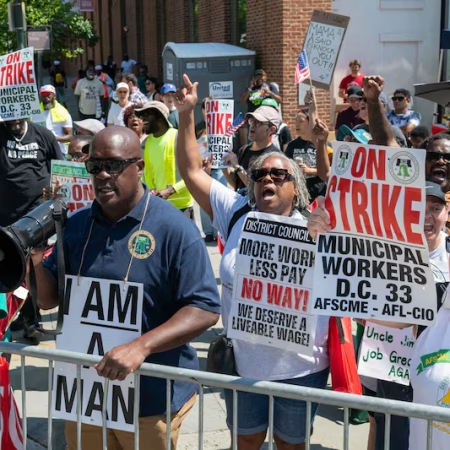
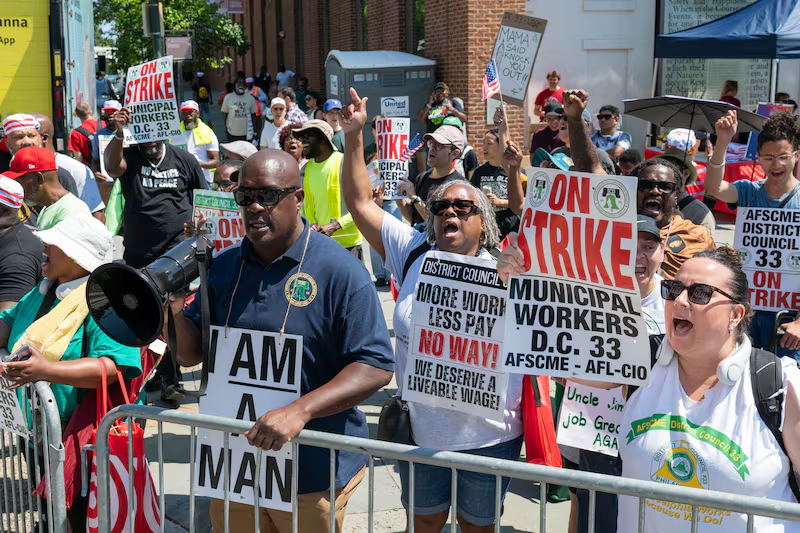
Over 9000 municipal workers covering trash collection, public libraries, street pavers, the waterworks, 911 call operators, crossing guards, mechanics, and many other services for the city of Philadelphia are on strike. They are represented by AFSME District Council 33 (DC 33), the city’s largest municipal union and one that includes a mainly Black membership.
The strike began at midnight on Tuesday, July 1, as negotiations between the union and the city fell through. Since the start of the strike, the workers have assembled picket lines at City Hall, the Municipal Services Building, and many other sites across Philadelphia. Most public libraries, recreation centers, and swimming pools have closed, and trash is piling up while daily temperatures hover close to 90 degrees.
On June 30, a day before the strike began, hundreds of members of various city unions and other supporters rallied outside City Hall to express solidarity with DC 33 and to explain the major demands of the union. More rallies have taken place during the week as other unions, such as the Philadelphia Federation of Teachers and the Teamsters, have expressed solidarity with the strikers. The DC 33 workers have been joined in solidarity by some workers from AFSME DC 47, including people who work at the Free Library of Philadelphia and museums in the city. DC 47’s contract also expired on July 1, but unfortunately, the union officials refused to take an immediate strike vote and agreed to a 14-day contract extension. A simultaneous DC 47 walkout would have greatly bolstered the strike of their siblings at DC 33.
Workers’ Voice members visited some of the picket lines in the city. The biggest grievance of the workers is pay, and several DC 33 members told Workers’ Voice that they must rely on food stamps to get by. DC 33 had been asking for an 8% yearly wage increase, but during negotiations, they lowered their demands to a 5% increase for every year of a three-year contract. Besides wages, the 2025 contract demands of the union lay out a number of other needs, including guarantees for the health plan, pandemic pay, cost of living adjustments, and changes to sick leave rules, among other demands.
“I’ve had several conversations with other city workers telling them that you don’t need to do any work you aren’t supposed to,” one worker told this reporter. He was referencing how the city is pressuring other city workers to do scab work, by “helping” to pick up trash that DC 33 members will not while they are on strike.
“You have to stand with all 10 toes for your rights. You have rights!” he said. When asked how they feel about the strike, he replied, “I feel confident in my union siblings, and we have each other’s backs.” Others whom we interviewed claimed that they were getting significant support from Philadelphia residents, as evidenced by the large pile of water bottles, soda, meals, and snacks that supporters had left next to the picket line.
Mayor Parker plays hardball
Mayor Cherelle Parker, a machine Democrat who touts herself as “pro-labor” but squarely aligns herself with the big business interests of the city, was able to obtain court injunctions to force some strikers back to work. She has openly enticed other union members to walk through the picket lines.
In a speech on July 3, Mayor Parker blamed the union for refusing her administration’s offer on wages. She went on to boast that the city’s “best offer” would amount to the largest contract given to the union in 30 years. The statement neglected to acknowledge the fact that the union had given up sizable concessions to previous administrations. This included the multi-year wage freeze and large pension concessions that the union agreed to in 1992.
Parker lamented that the city had already given DC 33 “the best offer on the table,” with a “historic wage increase” that would amount to a “13% raise over four years.” Her claim, while meager in itself, apparently included the 5% raise that the workers gained last year after the the DC 33 leadership had agreed to Parker’s request for a one-year contract extension. For the new contract, the city has been offering annual raises of merely 2.75%, 3%, and 3% over the course of three years.
DC 33 President Greg Boulware answered Parker by pointing out that last year’s 5% “wasn’t given to us. We fought for it!” In a July 5 interview with radio WURD, he said, “Our men and women earned that 5%. That 5% is now done and over with. It’s a wrap.”
Tragically, the city’s “best offer” today of less than 3% a year isn’t the same as offering a living wage. The city’s proposed raises fail to match the cost of living in the city or the rate of inflation. DC 33 is the city’s lowest paid bargaining unit; many of the workers receive no more than $46,000 a year. In comparable U.S. cities, sanitation workers have higher wages than in Philly, which more closely match the cost of living in those cities. A study by MIT backs up this conclusion, finding that DC 33 workers make $2000 below a living yearly wage for Philadelphia residents. Moreover, most economists project a steep rise in inflation later this year, due in part to Trump’s tariff policies.
The issue of real wages and inflation is a continually important one, one that other striking workers of Philadelphia had noted in their own struggles. In April, UNITE HERE Local 274 workers won a victory on this question (at least $20 an hour now; $24 by 2029) with a tentative settlement covering all three sports stadiums.
July 4 celebration: Artists’ protest as workers rally
Philadelphia’s’ Independence Day celebrations this year included the July 4 parade and the so-called “Wawa Welcome America” concert and fireworks show. DC 33 held pickets and rallies near both events, with workers chanting “DC! 33!” “No contract, no peace!” and “Don’t like the smell? Blame Cheryl!” In heartening actions, rapper/actor LL Cool J and singer Jasmine Sullivan publicly declared ahead of the concert that they were canceling their shows in solidarity with DC 33.
That afternoon, library, museum, and clerical workers gathered for a rally at the entrance to the Welcome America concert and close to the central branch of Philadelphia’s Free Library system. The crowd included both DC 33 and other workers and had the support of the local DSA chapter.
Several activists with the Free Mumia campaign, including Pam Africa, visited the rally to show solidarity with the strikers. Mumia Abu-Jamal is a writer, journalist and political prisoner whose false conviction of murder has been repeatedly upheld by the DA, despite evidence of his innocence. Pam Africa took a phone call from Mumia, who from prison, spoke with words of encouragement to the strikers, at one point exclaiming, “This is beautiful, beautiful, beautiful!”
One worker at the rally mentioned the problem of real wages, emphasizing that Parker’s offer does not match inflation. Another participant, a labor historian, spoke about the militant 1938 strike of sanitation workers, which helped to form the precursor to DC 33. That strike gathered working-class support throughout the city and caused Philadelphia’s capitalist politicians to buckle to the workers’ demands.
The person with the mic went around interviewing several workers. They approached a woman passing by in a car and asked about her thoughts on the strike. “Keep on fighting!” was her response.
On July 7, a week into the strike, American Federation of State, County and Municipal Employees national president Lee Saunders spoke at a DC 33 press conference and rally at the site where two picketers were struck by a vehicle last week. “You’re trying to make a decent living with good benefits and good pay, while you are providing essential services to the citizens of Philadelphia,” Saunders said to a crowd of striking workers. “You are the everyday heroes, and everyday heroes must be treated with respect and dignity—and that means money.” Since the city is not budging from what it offered at the start of the strike, and refuses to sit down in protracted negotiations, Boulware has announced that the union will be seeking an unfair labor practices injunction against Parker’s administration.
Photo: Kaiden J. Yu / The Philadelphia Inquirer
-
On the U.S.-Israeli war against Iran and its consequences


By INTERNATIONAL SECRETARIAT of the INTERNATIONAL WORKERS LEAGUE -FOURTH INTERNATIONAL
A truce imposed by Trump has interrupted the United States and Israeli war against Iran. It is time to assess the situation and its ramifications.
The truce was imposed after the United States heavily bombed Iran’s nuclear facilities with 125 aircraft, dropping the world’s largest non-nuclear bombs. As part of a brutal attack, planned well in advance, Israel assassinated a significant part of Iran’s military leadership, carried out intense daily air strikes against nuclear facilities, destroyed much of Iran’s air defense system and part of its defensive and offensive missiles, and attacked major cities, demolishing homes, infrastructure, and hospitals.
Iran responded by launching some 650 missiles at Israel, reaching its territory for the first time in various cities, without causing significant military losses, but partially overcoming the Zionist air defense. It was the second time (the first being Oct. 7 with the Hamas attack) that Israel’s “invincible” defenses have been defeated in this period.
An imperialist-Zionist offensive… but Iran has not been defeated
The truce was imposed in a situation where the imperialists and Zionists were on the offensive and Iran on the defensive. U.S. imperialism and the Israeli government have been strengthened by having carried out a brutal attack, suffering few losses, and a signing truce that has prevented the political consequences of the attrition of a longer war from affecting Trump and Netanyahu.
European imperialists generally supported the U.S. attack on Iran, or at most limited itself to proposing diplomatic solutions.
But Iran has not been defeated. Neither the United States nor Israel succeeded in imposing their two objectives: to destroy Iran’s nuclear potential and to overthrow the Ayatollah regime. And Iran managed to hit Israeli territory with its missiles, in a much more intense manner than in the attacks of April 2024.
The conflict is far from resolved. There may be new attacks or developments in the U.S.-Iran negotiations, with a return to the Abraham Accords and the economic and political relations between Arab countries and Israel, and a new plan for Gaza. It remains to be seen to what extent Iran will be able to rearm itself. This is a complex process, without a predetermined result.
But it can already be said that this war has exacerbated the existing economic, political, and military polarization in the world, will deepen the crisis of the world order, and will tend to radicalize the class struggle.
Israel’s attack on Iran is an extended continuation of its offensive against Gaza.
Netanyahu broke the truce agreement in Gaza last March, reoccupied the Philadelphi and Netzarin corridors, and advanced with his plan to exterminate and expel the Palestinians from Gaza, destroying house by house and decreeing the evacuation of entire regions, particularly in the north.
So far, there are no signs that he will be able to carry out Trump’s plan to expel the Palestinians from Gaza, due to enormous international opposition and opposition among the countries of the region. But Netanyahu may try to place Zionist settlements within the territory of Gaza.
Alongside this, the largest attack on the West Bank in decades is unfolding, with the expulsion of 40,000 Palestinians and the occupation and destruction of historical refugee camps, as part of a plan to annex the region to Israel.
The Israeli genocide has killed at least 60,000 Palestinians (some estimates put the figure at 100,000), destroyed almost all infrastructure and more than 90% of homes. Israel is now using hunger as a weapon of war, with food distribution within Gaza under its military control. Nearly 600 Palestinians have been killed in food distribution lines, murdered by Israeli soldiers.
Despite this, it cannot declare victory. It has failed to destroy Hamas or rescue the hostages and is embroiled in a grueling war with no end in sight. Hamas not only remains intact, but has recruited more militants.
The Israeli offensive led to historic international isolation for Zionism. Never in history has there been such repudiation of Israel in the world. These are contradictory parts of the same whole: the Israeli genocidal offensive and its isolation from the masses around the world.
4- Zionism won a military victory against Hezbollah, killing Nasrallah and many of its leaders, as well as destroying between 70 and 80% of its arsenal. Since then, a new Lebanese government, aligned with US imperialism, is rebuilding the state, imposing its control over the country and reducing Hezbollah’s influence.
This organization, while maintaining its political base, is transforming itself into a regime party, more suited to elections and less militarily structured. Since the Israeli attack, there have been virtually no major attacks by Hezbollah against Israel, which was even more astounding during the Israeli-U.S. war against Iran. Hezbollah simply did not react militarily to imperialism’s attack on Iran.
The overthrow of Assad in Syria was a victory for the mass movement against a hated dictatorship and accomplice of Israel. However, the evolution of these processes is strongly conditioned by their leadership. The Al-Sharaa government seeks to rebuild the Syrian state, recomposing a Bonapartist regime in alliance with U.S. imperialism and regional powers such as Turkiye and Saudi Arabia, without confronting Israel.
Although the Syrian process has the potential to stimulate new processes of struggle in the region, Assad’s fall weakened Iran’s support in the region. This weakening of the so-called “Axis of Resistance,” together with the internal political crisis in Israel caused by the wear and tear of a year and nine months of continuous war, were the basis for Israel’s attack on Iran.
Israel’s internal situation and its relationship to the attack
Israel is an enclave of imperialism, a nuclear power financed and armed by the US. But it is undergoing important processes of transformation.
As a result of its constant military confrontations, there is an exodus of sectors of the liberal middle class and an influx of settlers—mostly of far-right or directly fascist ideology—who occupy the West Bank settlements. This is leading to a broadening and radicalization of support for Zionist genocide among its base.
On the other hand, there is a significant internal political crisis caused by fatigue after almost two years of war in Gaza, allegations of corruption and other charges against Netanyahu.
There have been significant mass mobilizations against Netanyahu by a sector of the population dissatisfied with the continuation of the war and the failure to return the hostages. This has led to political polarization against the other sector of the extreme right, Netanyahu’s base, which supports the continuation of the war at any cost.
The far-right government is facing multiple crises. One of them has to do with ultra-Orthodox Jews who are exempt from compulsory military service despite living in a militarized society during wartime. This exemption was challenged by the courts, but the parties that represent the ultra-Orthodox are threatening to leave the Netanyahu government if it is removed, which could also lead to its downfall. Its electoral prestige was at an all-time low before the war against Iran. The attack on Iran was an attempt to escape its internal crisis, and it has succeeded.
Netanyahu enjoyed popular support, even with a significant portion of the Israeli population living in bunkers for more than a week. This prestige was enhanced by the brutal U.S. attack. Polls indicate that there was 83% support for the attacks.
This can be explained by the country’s enclave character, built on the exploitation and oppression of the Palestinians. In addition, the Israeli people have been convinced for decades of the “nuclear threat from Iran.” So the propaganda of “destroying Iran’s nuclear potential” spread by Netanyahu has gained enormous support. The result is a political and military strengthening of Netanyahu, who has regained his popularity, albeit temporarily.
The permanent Zionist counterrevolution
The other motive for the attack on Iran is the Greater Israel project, expanding its borders and consolidating broader imperialist military control across the Middle East.
Israel has never before launched a similar attack against Iran. It is thus resuming, to a greater extent, its role as an imperialist enclave and enforcer in the Middle East, reinforcing its presence in Lebanon, Syria, and Gaza and threatening the entire Middle East with its air power. This project may or may not reach its full conclusion in the midst of the crisis of the world order and the turbulent situation in the region.
Netanyahu’s logic is that of a permanent counterrevolution, a continuous war to try to establish regional military hegemony that does not translate into stabilization in the region. He is unable to defeat his enemies, he is widening social and political polarization, increasing the potential for a new Arab Spring, and tending to generate more and more internal attrition in Israel.
Once again, there is a huge contradiction between Israel’s increased military weight and the widening of internal political contradictions throughout the region.
Now, Netanyahu is refocusing his offensive on Gaza, continuing the genocide. This will once again lead to increased international erosion and pro-Palestinian mobilizations around the world, although there is a possibility of resuming negotiations with Saudi Arabia to reach an agreement on Gaza.
The Iranian dictatorship
The Iranian regime is a bourgeois dictatorship in the form of a theocratic regime. In Iran, a revolution overthrew the monarchy of Shah Mohammad Reza Pahlavi, a direct ally of U.S. imperialism, in 1979.
With the complicity and betrayal of the Iranian Communist Party (particularly its Tudeh faction), which had influence among the working class, the Shiite ayatollahs, representing a layer of local bourgeoisie, managed to destroy the organs of dual power and defeat the revolution.
From then on, this bourgeoisie grew by controlling the state apparatus and established a bourgeois dictatorship, harshly repressing strikes and the struggle of women, who were severely oppressed by the Islamic theocracy.
Women were at the forefront of the struggle against the theocratic dictatorship, in a movement rooted in the social conditions of the country, in teachers’ strikes, in Kurdish mobilizations, and in urban youth protests. The slogan “Woman, Life, Freedom” appeared on the streets of Iran with enormous force in 2022.
The Iranian dictatorship uses forces such as the Revolutionary Guard and militias such as the Basij (a paramilitary force directly linked to the Revolutionary Guard) to repress street demonstrations, strikes, and the women’s struggle.
At the regional level, the Ayatollah regime has maintained independence from U.S. imperialism since its inception, but later relied on Russian and Chinese imperialism.
It is the center of the so-called “Axis of Resistance” against Israeli domination, which included Hezbollah, Shiite militias in Iraq, the Assad regime, and the Houthis in Yemen, but it has not confronted Israel throughout the genocide in Gaza, reacting only to its direct attacks against Iran itself.
The Iranian theocratic regime played a directly counterrevolutionary role in supporting the Assad government during the mass uprising against the Syrian dictatorship.
Despite the internal erosion of the Iranian regime, as a by-product of the economic crisis, mass poverty, and oppression of women, the US and Israeli attack appears to have provoked a reaction of national unity, although the Islamic Republic also took advantage of the war to imprison 700 innocent opposition activists who were not pro-imperialist. But our sense that the feeling of national unity against the military aggression suffered predominates.
Despite being weakened by the attacks, Iran maintains its nuclear capacity and emerges from this war with a regime strengthened by having faced much more powerful enemies in military terms without surrendering and having hit Israeli territory with its missiles.
We support the defense of Iran, independent of the dictatorship of the ayatollahs
In this period of war, we are on the side of Iran against its imperialist attackers, without giving the slightest political support to the bourgeois dictatorship of the ayatollahs, which represses the working people, brutally oppresses women and youth, and uses the confrontation with imperialism to justify its own internal dictatorship. We defend the most complete political independence from the Iranian regime.
We reject the false dichotomy between imperialism and the Iranian theocracy that is the position of Stalinist parties and their political campism.
The argument long used by imperialist propaganda for the attack that “Iran cannot have nuclear weapons” is a cynical expression of imperialist arrogance. The United States, the imperialist country with the largest nuclear arsenal, allied with Israel (another nuclear power), demands exclusivity in its power to destroy.
We are against all nuclear weapons because they can render the planet uninhabitable and destroy humanity. Even more so in the current situation of environmental crisis. And we do not want these weapons in the hands of bourgeois governments, which means under the control of the world bourgeoisie.
But at the same time, the defense of their exclusive right to possess nuclear weapons is a brutal expression of imperialist dominion. We defend Iran’s right to defend itself, including by possessing those same nuclear weapons.
We defend the broadest freedom for trade unions and workers’ organizations in Iran to fight against imperialist aggression, as well as against dictatorship.
The struggle against Israeli-U.S. aggression must serve to advance the independent organization of the Iranian, Palestinian, Lebanese, and world working class, as part of a strategy of permanent revolution and break with all capitalist and fundamentalist projects.
The important role of Trump
U.S. imperialism remains hegemonic, but Trump recognizes its current decline and is moving amid the crisis of the world order to rebuild US hegemony to previous levels.
He is seeking actions that reduce U.S. military presence and spending where it is not in his interest, while at the same time rebuilding its hegemony.
Trump attempted an agreement with Putin to end the war in Ukraine, imposing a colonial agreement on Zelensky and leaving European imperialism to bear the costs of military support for Ukraine. So far, this has not worked because the war in Ukraine continues. In the war against Iran, it was different. Trump and Netanyahu grew stronger together.
U.S. imperialism and the Israeli government acted in unison throughout. This does not mean that there are no political differences or divergent interests between these two far-right governments, as demonstrated by Trump’s recent trip to the Middle East, with the suspension of sanctions against the new Syrian government and the agreement with the Houthis.
But in that war, they acted together. From Israel’s attack plan, drawn up well in advance with US intelligence, to the timing of the attack, to Israeli defense infrastructure, the supply of weapons, and the provision of political support.
There was an initial moment of diplomacy, in which Trump tried to impose an agreement on Iran that would prevent its nuclear development. Faced with the stalemate in the negotiations, he helped prepare and support Israel’s brutal attack on Iran and, in the face of Iranian resistance, he doubled down on the military option with a direct U.S. attack, even more brutal than the Israeli one.
Despite his military superiority, Trump did not want to go ahead with the war, for several reasons. First, because of the serious political consequences that this would entail, with mobilizations already planned around the world. Trump has already faced two huge mobilizations against him internally: on April 5 and the No Kings demonstrations in June. There is a growing political crisis in the country over attacks on immigrants, which could be linked to the pro-Palestinian demonstrations.
Beyond that, there is the crisis within his Republican base, due to the contradiction between his military actions versus his “America First” plan and his commitment not to get involved in new wars. There was also concern about protecting Israel in a situation that promised to become more complicated if the war continued.
It therefore seems that his plan is for Israel to be, more than ever, his political and military representative in the region, without direct U.S. military involvement, which would be in line with Netanyahu’s expansionist plan in the Middle East. This does not change U.S. imperialist strategy and hegemony in the region or its military presence, but it would give Zionism a more important role.
With his temporary strengthening, Trump managed to impose an increase in the military budget at the NATO summit, with the almost complete submission of European imperialism.
The inaction of Russian and Chinese imperialism
The war of the United States and Israel against Iran has also shown how Chinese and Russian imperialism are reacting.
It is widely known that China has been Iran’s main economic partner since 2007, being its most important buyer of oil and helping the country escape the economic blockade imposed by US imperialism.
It is also well known that Russian imperialism is Iran’s main arms supplier, and that Iran helped Russian imperialism in the invasion of Ukraine with a massive supply of drones until Russia began to manufacture them.
For this reason, there were expectations in progressive sectors around the world that China and Russia would support Iran. However, the imperialist character of these countries and their specific characteristics in the current phase of the crisis of the world order pointed to passivity. Both Russia and China limited themselves to diplomatic condemnation of Israel, without taking any concrete action in support of Iran.
China is an emerging imperialist power with extensive interests in the Middle East. It is not only Iran’s main trading partner, but also Israel’s, with trade far exceeding even that of the United States. It is also the main trading partner of Saudi Arabia and several other countries in the region. Its interest is in the stability of the region, that is, counterrevolutionary stability.
Chinese imperialism has done nothing concrete in relation to Palestine, nothing concrete in relation to Iran. Putin is focused on his own war in Ukraine. He has no interest or conditions to get involved in another conflict in the Middle East.
This had already been expressed in his inaction in the face of Assad’s fall in Syria. And now it has become even clearer with his lack of response to the U.S. bombing of Iran. Putin not only prioritizes his war against Ukraine, but also his relations with Trump in order to win that war. In the words of one activist: “Putin traded Iran for Ukraine.”
Russia and China share the same position as other imperialist countries in opposing Iran’s development of nuclear weapons. After the U.S. and Israeli military aggression, Putin is pressuring Iran not to leave the International Atomic Energy Agency and to commit to not developing nuclear weapons.
The crisis of the world order created by the rise of Chinese and Russian imperialism is going through increasingly turbulent processes. And it is still in the early stages of shaping a new world order. Both defend their political and economic interests around the world, but they have priority areas of military conflict, with Russia in Ukraine (and parts of Africa) and China with Taiwan.
War further polarizes the class struggle internationally
It is almost certain that, even with the truce, the current polarization of the class struggle at the global level will increase and lead to a sharpening of the class struggle.
Let’s look at the dynamics in the Middle East. The most independent reports—and the US intelligence services themselves—refute Trump’s claims that “they have destroyed Iran’s nuclear potential.” Nor is the reality as portrayed by the Iranian regime, which claims that there has been virtually no damage. According to the most reliable independent information, Iran’s nuclear program has been delayed, but not destroyed.
The other objective, to overthrow the regime, has not advanced at all. On the contrary, the effect achieved has been to generate a feeling of national unity around the Ayatollahs’ regime, due to imperialist aggression. The truce allows Iran to savor a draw which, given US and Israeli military superiority, is a significant achievement.
Israel failed to defeat Hamas or rescue the hostages in Gaza. Nor did it impose its objectives on Iran. Its military offensive and genocide in Gaza have provoked a degree of mass repudiation of Zionism unprecedented in history. An interesting poll on the subject indicates this:

Another indication was the result in the Democratic Party primaries for the New York elections, in which Zohran Mamdani, a pro-Palestinian immigrant, defeated the party establishment candidate Andrew Cuomo. This has never happened in the U.S., especially in a city as important as New York.
Pro-Palestinian mobilizations had gained momentum in recent weeks, with the return of mass demonstrations in several European countries. Added to this was the impact of the detention and hijacking of the Freedom Flotilla and the repression that prevented the Global March on Gaza, in which there was significant participation by militants Fabio Bosco and Herbert Claros of the PSTU and the IWL. As soon as news of the attack broke, acts of condemnation began to be organized around the world. The truce halted these mobilizations, but the tendency for anti-Zionist mobilizations to expand remains, further polarizing the global situation.
It is possible to defeat imperialism and Zionism
It is possible to defeat the alliance of imperialism with the genocidal Zionism of Israel if the military resistance in Palestine and Iran is combined with mobilizations around the world. Imperialist military superiority has already been proven on other occasions to be defeatable, as in Vietnam, Iraq, and Afghanistan.
Pro-Palestinian mobilizations in the United States and other imperialist countries can be combined with national issues (such as the struggle in defense of immigrants in the United States) and play a central role in this process.
The hatred of Israel among the Arab masses can turn against regimes that support the United States and Israel, such as Egypt, Jordan, and Saudi Arabia, in a new Arab Spring. Only in this way can the enormous political support of the Arab masses for the Palestinians be transformed into effective military support for the struggle in Gaza, in a united front of the masses of these countries against Zionist genocide.
The enormous anger accumulated in the West Bank and in the 1948 territories could generate a third intifada that would shake the Palestinian territories and join the struggles in Gaza.
• For the defeat of U.S. imperialism and Israel!
• For the victory of Iran against the U.S. and Zionist attack!
• For the victory of Palestine against Zionist genocide! For the defeat of Israel!
• Boycott and break all economic and political relations with Israel!
• For a new Arab Spring that will bring down the regimes in the region that are subjugated to imperialism, such as Egypt and Jordan, and make military support for the Palestinian resistance possible!
• No political confidence in the regime of the ayatollahs! All our support for the struggles of workers and women against the Iranian bourgeois dictatorship! In defense of democratic freedoms within Iran!
• For the unity of the national liberation struggles of Palestine, Ukraine, and Iran against the Zionists and imperialists.
• For the destruction of the State of Israel! Free Palestine, from the river to the sea!
-
NATO summit: No to the imperialist rearmament plan!


By EUROPEAN SECRETARIAT of the INTERNATIONAL WORKERS LEAGUE-FOURTH INTERNATIONAL
At last week’s NATO summit, leaders of imperialist countries committed to huge military spending increases, with unanimous pledges to increase military spending by two to five fold. This unprecedented appropriation of spending for imperialist armies is criminal in its implied, inevitable deprivation of funding for human needs—instead setting the scene for military confrontation on a global scale.
We reprint this article from the IWL written shortly before the summit. The statement anticipated its decisions, identifying the march towards military funding as imperialist leaders tripped over themselves to lavish Trump with praise.
We write this statement while we are witnessing the conflict between Iran and Israel, parallel to the continued Israeli brutal genocide in Gaza while the European governments hide their complicity with the Zionist entity, with crocodile tears and lukewarm and hypocritical denouncements. A genocide with which Israel has not managed to defeat the Palestinian resistance and which has reactivated international solidarity, as we saw in the last mobilizations that took place all over the world.
In this context, a new NATO summit will be held in The Hague on June 24 and 25. A summit at which European governments will commit themselves to a sharp increase in their military budget.
A brutal increase in military spending to 5% of GDP
The most important point on the agenda will be the U.S. demand to European partners to increase military spending up to 5% of their GDP, so that Trump can concentrate his forces against China in the Indo-Pacific, knowing that, at least for the coming period, European governments will continue to massively purchase American armaments.
Let us remember that Putin’s invasion of Ukraine gave NATO the conditions to try to regain a social credibility it had lost and to strengthen itself with the entry of Sweden and Finland, countries bordering Russia and historically neutral. Likewise, Putin provided the perfect excuse for European imperialism to increase its defense budgets. Germany thus initiated a militaristic turn unprecedented since the Second World War (23.2% increase between 2023 and 2024). The same can be said of the other countries.
In the heat of this continued increase in the military budget, governments have campaigned to convince us of the priority of “helping Ukraine” (although they only sent weapons in dribs and drabs and largely obsolete) and “defending our democratic values and becoming independent from the US defense umbrella.” This, in addition to the promise to create jobs in the military sector. A militaristic path that will mean deep cuts in social spending and higher taxes for the working class.
A rearmament plan at the service of its economic and imperialist objectives
This summit is being held within the framework of the European rearmament plan (ReArm Europe) approved in March by the EU, with 150,000 million Euros (SAFE) in military credits to governments and the forecast of spending 800,000 million more in the next four years at the expense of the different budgets of each country.
This is a rearmament that has nothing to do with guaranteeing our security nor with the defense of democracy and peace as they say. Even if Russia were to enter the Baltic countries or if the US were to occupy Greenland, NATO would not intervene. The real reason is the attempt of the European bourgeoisie to use public funds to regain economic dynamism and profits through a kind of military Keynesianism, which mainly favors the military industry.
In relation to the so-called “European army,” it would consist of yet another attack by French and German imperialism on the sovereignty of the peripheral countries of Europe, who lack a base due to the fragmentation into different States with different interests and the very existential crisis of the EU, which the extreme right wants to reduce to its minimum expression.
On the Israeli attack on Iran
Depending on how the conflict develops, the war between Israel and Iran will also have to occupy part of the agenda of this meeting. NATO Secretary General Mark Rutte said he was “concerned” and stated that “it is crucial to work towards a de-escalation of the situation.” However, the US remains and will remain unconditionally on Israel’s side and European imperialisms continue to support Israel’s “right to defense.”
For our part, we repudiate this new aggression of the Zionist State against Iran and support its counterattack on Israeli territory. We do so because it is an expression of the struggle of the peoples of the region attacked by the military enclave of imperialism that is the State of Israel, which can only maintain itself as such with permanent military offensives. We are in the military camp of Iran, while maintaining our total political independence from this bourgeois dictatorship.
What interests are therefore at stake in this new NATO meeting and what is the way out that we advocate?
It is important to note that the increase in military spending is not confined to Europe. Globally, military spending reached a whopping $2.8 trillion in 2024, up 9.4 compared to 2023. All NATO member countries increased it their spending.
Along with this, we are witnessing the highest numbers of wars since World War II, with Ukraine and Gaza at the forefront, developing with new technologies such as drones that are transforming military clashes.
The backdrop to this arms race is the rivalry between the U.S. as a hegemonic imperialism whose military supremacy remains unquestioned and China as an emerging imperialist power, which disputes its hegemony in Asia and in strategic sectors of the world economy.
It is this dispute (in which the EU is trapped) that explains the change of the Trump administration in its foreign policy and its military strategy and, in particular, the U.S.’s turn towards Putin to seek to procure an agreement at the cost of the sovereignty of Ukraine, its wealth and its territorial integrity, also bypassing the main European powers.
Inter-bourgeois rivalries, in full swing, are expressed today in the military field in the multiplication of military agreements and alliances. From the enlargement and reinforcement of NATO, the OCX (Shanghai Cooperation Agreement) or the AUKUS (Australia, United Kingdom and USA). Likewise, in the growth and proliferation in recent decades of private military companies, subcontracted by the States to serve the imperialist objectives of their own multinationals, in different parts of the world.
All this is also a source of internal tensions, divisions and even uncertainty as to what should be the objective and the future of the Atlantic organization. Under its apparent unity under the boot of the USA, the clash of interests between the different imperialist countries continues. In the EU, Germany is rearming itself in alliance with French imperialism, dragging along other countries, seeking a semblance of independence in the face of the inter-imperialist conflict between China and the US.
That is to say, basically, the European rearmament plan responds to the struggle of its bourgeoisie to defend its piece of the ever-shrinking pie of world profits. As for the military support to Ukraine, it is equally at the service of maintaining its imperialist objectives. After three years of Putin’s invasion and following the Minerals Deal between Trump and Zelenski, the EU is trying not to be left out of the game in the plundering of Ukraine.
The real objective of the European NATO powers is to continue to play a relevant role at the international level and to intervene in conflicts outside the EU if necessary, when the interests of their multinationals are threatened. In parallel, they are stepping up xenophobic and racist measures against migrants in Europe, with expulsions, thousands drowned at sea and the establishment of deportation camps outside EU borders, while continuing to plunder semi-colonial countries. The rearmament also goes hand in hand with a strong regression in the already very lukewarm environmental measures, while the social majority suffers the increasingly evident consequences of climate change.
We can therefore expect nothing from this new summit of thugs created by the US after World War II and which has a record of military aggressions, occupations and crimes.
From the IWL, we will continue to denounce that the working class and the peoples of Europe and of the whole world, will not be safe or protected by increased militarization; we will be more threatened by the military alliance.
• We denounce a European military rearmament that is leading to further indebtedness of the countries and that will result in more and more social cuts and more misery for the population!
• We demand an increase in the budget to deal with the environmental catastrophe underway, to guarantee education, health and decent public services and more investment in public housing within the reach of all!
• We demand nuclear disarmament and the destruction of weapons of mass destruction that threaten the existence of humanity and life on the planet!
• Dissolution of NATO and all military alliances and pacts and the dismantling of its military bases abroad!
• Stop imperialist interventions!
• Immediate rupture of military, commercial and diplomatic relations with the genocidal state of Israel! No to the false solution of the two States! Long live the Palestinian resistance, for a Palestine free from the river to the sea!
• Our unconditional support and solidarity with the Ukrainian people and their right to defend themselves against Putin’s invasion! Out with Russian troops and US and EU hands from Ukraine!
• We advocate the dissolution of professional armies and repressive corps or growing private armies and their replacement by an army based on the principle of the people in arms!
The only road to peace is socialism
Our demand for the dissolution of NATO is part of our principled opposition to all imperialist blocs and our active support for all the struggles of the workers and peoples; as in the case of the Palestinian and Ukrainian resistance which, despite Zelensky’s capitulationist leadership, has been waging a three and a half year war of national liberation against Russian imperialist aggression. On that terrain, we fight to build an independent working-class camp to fight for a revolutionary socialist program.
In the face of increasing expressions of capitalist barbarism we need to transform the growing indignation and rage we feel into a social war against our real class enemies.
It is important not to forget that left organizations that today rightly protest against the increase of military spending, helped the strengthening of NATO by supporting or joining the governments of the day, which increased the defense budget. Like Podemos in Spain during the first coalition government of Sanchez, or Portugal, or the PCP and the Left Bloc during their support to the PS governments, in the Geringonça.
Maximum unity of action against the rearmament plan of the imperialist countries is necessary, but it is equally important to have a debate on what is the strategy to continue the struggle against capitalism. This requires combating the ideas promoted by false pacifism, class collaboration and all forms of reformism without reform, which tell us that world peace and prosperity are possible under this decaying imperialist system. There is no possibility of achieving a firm, lasting and democratic peace without a revolutionary movement to overthrow it and open the road to the seizure of power by the working class and to socialism.
Photo: Alex Brandon / AP