-
UPSURGE IN BOLIVIA: United Left Platform webinar on June 26


Upsurge in Bolivia: What It Means for the Fight Against MAGA and U.S. Imperialism
Jun 26, 2026 8:00 PM -
Workers’ Voice newspaper: June-July edition

Trump continues his assault on working and oppressed people: From the attack on voting rights to the environmental impact of the war on Iran to abortion rights to the struggles of immigrant meatpacking workers on the picket line, this edition is filled with insightful views on how working people are confronting the horrors of capitalism under the management of the Trump administration. Also in this issue read about migrant workers in Africa, the struggle against data centers, and the meaning of recent elections in Hungary.
The June-July 2026 edition of our newspaper is available in print and online as a pdf. Read the latest issue of our newspaper today with a free pdf download! As always, we appreciate any donations to help with the cost of printing.
Click on the image to read the paper or message us to get a hard copy:

-
University of Pittsburgh SJP wins reinstatement


By CARLOS SAPIR
On Thursday, Aug. 27, the ban against Students for Justice in Palestine (SJP) at the University of Pittsburgh was lifted by a federal judge, who ruled that their right to freedom of speech had been violated by the university. Reinstatement was won thanks to determined organizing by the students and faculty, who rallied university, labor, and community organizations to their public defense.
This victory follows the February 2024 victory for a civil liberties defense campaign at Ohio State University, where the Central Ohio Revolutionary Socialists were briefly banned for organizing pro-Palestine events, winning reinstatement after a public pressure campaign. Despite the many draconian efforts by universities to limit or suppress speech on campus, these rights are still within our grasp, and provide a valuable platform to win a broader audience for solidarity with Palestine.
What happened in Pittsburgh?
Students for Justice in Palestine at the University of Pittsburgh has been hounded by university administrators for all of its protest activities opposing the ongoing genocide in Palestine. In addition to hostile communications from the university, it has been harassed by Zionist groups, which publicly threatened it with violence during the 2024 Israeli invasion of Lebanon (threats that Democratic Senator John Fetterman said he approved of).
In December 2024, during finals week, SJP students organized a group study-in at Hillman Library on campus. For several consecutive days, students wearing keffiyehs held space in the ground floor of the library, while university administrators and police periodically threatened the students and demanded that they disperse on vague disciplinary grounds. The students, flanked by supporting faculty, insisted that the administrators specify the exact university policies that they were supposedly in violation of, and complied with demands to erase messaging on communal white boards. The students were referred to an opaque internal disciplinary process, while being continuously menaced about repercussions for further political activity.
The students were not deterred. They published an open letter calling on the university to drop the charges against them, with the signed backing of 70 university and community organizations. The university responded by officially suspending SJP, accusing it of tampering with the disciplinary process for sending the open letter to the disciplinary review board.
Student organizers brought the core questions of the moment to the student body as a whole, proposing three ballot measures in the March 2025 student government elections that directly related to their political fight:
- Should the Student Code of Conduct be amended to ensure that, at all Hearings, one or more students serve as additional Hearing Officers or as members of a Hearing Board?
- Should the University of Pittsburgh disclose the contents of its investment portfolio and undergo a yearly, public auditing process to ensure that University operations are transparent and accountable?
- Should the University of Pittsburgh divest all financial holdings, if any, from weapons manufacturers arming Israel?”
All three measures passed with high turnout, alongside a fourth measure to phase out single-use plastics. Thousands of students voiced their support for divestment from Israel, for the financial transparency to allow such divestment to occur, and for greater student control over student disciplinary processes—a key, historical, and democratic demand of student movements around the world.
The students and faculty also contacted legal support, with the ACLU agreeing to file suit pro bono in federal court. The faculty union, United Steel Workers Local 1088, organized a rally aligning with the April 17 national day of action for higher education, tying together the questions of federal attacks on university budgets, academic freedom, and diversity programs to the censorship of Palestine by the university. They also demanded answers from the university about its treatment of SJP in meetings about university policy in the wake of the federal government’s assault on university funding and political speech.
Meanwhile, the internal disciplinary process meandered forward through additional hearings, with the university ultimately retracting its charges in relation to the December library study-in, but sustaining the suspension.
In August, students went into the preliminary hearing surrounded by a crowd of supporters. After a few hours of deliberations in the federal courtroom, the judge published an injunction stating that the students’ rights to speech had been violated by the university, a government entity, that their suspension during the early-semester recruitment period constituted irreparable harm to them, and that reinstating SJP would benefit the public “by increasing the level of association and speech on campus.”
We can fight—and win
Campuses are important fields of political activity: nowhere else in society are so many people actively forming and rebuilding their political understanding of the world. Students’ ties to their communities back home, as well as their position as new workers entering the workforce, make it possible for them to organize and influence political activity beyond the campus itself. And the universities are also often the largest employers in the cities where they exist, often deeply embedded in local health-care services. Maintaining a foothold on these campuses is important for social movements and socialist organizations, and also provides access to resources made available to student groups.
The democratic rights that we have today, like freedom of speech, are the product of centuries of class struggle. Contrary to the ruling-class ideological perspective that these rights are protected by virtue of being enshrined in law, we know from experience that these rights must be continually fought for, demanded, and protected.
Winning reinstatement for SJP at the University of Pittsburgh, much like it was for Central Ohio Revolutionary Socialists at Ohio State University, meant months of political organizing and action, to push support for the case as widely as possible. In the process, these student groups were able to demonstrate the links between the oppression of Palestinian people by Israel and the repression of free speech at home, winning ever-broader layers of people to support Palestine and other liberation struggles. These fights do not distract from each other, but rather complement each other and allow for the movement as a whole to advance politically toward defeating the ruling-class agenda both in Palestine and North America.
Photo: Police at the University of Pittsburgh attack pro-Palestinian student protesters near their encampment on June 3, 2024. (Quinn Glabicki / Public Source)
-
Israel prepares to expel Palestinians amid international condemnation


By FABIO BOSCO
Unified Socialist Workers’ Party (PSTU), Brazil
On March 1, 2025, according to Israel’s Channel 13, the government had decided to block humanitarian aid from entering Gaza to force the Palestinian resistance to surrender. The State of Israel had decided to use starvation as a weapon of war on a large scale.
On the 18th, shortly thereafter, Israel broke the ceasefire, invaded, and seized 75% of Gaza. They carried out indiscriminate bombings of schools, hospitals, and homes. Four hundred Palestinians died in the first few days alone.
In April, Israel excluded United Nations (UN) agencies and non-governmental organizations (NGOs) from humanitarian aid distribution and hired GHF to distribute food in Gaza. GHF and the Israeli army turned the six distribution points into death traps.
By August 17, Israel had killed 1,938 Palestinians and wounded another 14,420 in food line attacks. Additionally, according to the Gaza Ministry of Health, the Zionist state has starved 258 Palestinians, including 110 children.
They are preparing a brutal forced diaspora
Simultaneously, Israel has contacted other countries to persuade them to accept Palestinians expelled from Gaza. In addition to negotiating with Sudan, South Sudan, and Somaliland, Israel is negotiating with Prime Minister Abdul Hamid Dbeibah of western Libya. Dbeibah would accept hundreds of thousands of Palestinians in exchange for the release of $30 billion that has been blocked abroad since 2011.
Israel is also negotiating with General Khalifa Haftar, who dominates eastern Libya, to accept Palestinians in exchange for a greater share of the country’s oil production.
In the West Bank, Israel is preparing to annex the entire territory. It has armed 700,000 Israeli settlers to attack and expel Palestinians together with the army. Additionally, Israel has taken over the area known as “E1,” which divides the West Bank into north and south and separates it from Al-Quds/Jerusalem.
According to Finance Minister Bezalel Smotrich, the goal is to bury the two-state solution—and the idea of a Palestinian state—once and for all.
The dispute over control of the region
Israel also seeks to establish itself as the sole regional power. It currently occupies Lebanese and Syrian territories, regularly attacks Yemen, and is preparing new attacks against Iran. Its plans are advancing in Lebanon, where the new president and prime ministe—allies of the United States and Saudi Arabia—were elected and are pressuring Hezbollah to surrender.
In Syria, the Zionist plan to divide the country was facilitated by the Sweida massacre, in which interim government forces executed hundreds of Druze and pushed them to Israel’s side, fueling toxic divisions between religious communities—contrary to the goals of the revolution.
In Yemen, the Houthis (Ansar Allah) are strengthening their control of commercial traffic in the Bab al-Mandeb Strait in the Red Sea, as well as their ability to paralyze Saudi Arabia’s oil production, as they did in 2019.
In Iran, a new nuclear agreement is being negotiated with the United States. At the same time, however, the production of defensive weapons, particularly ballistic missiles that have successfully penetrated Israel’s air defenses, is resuming. Additionally, the reconstruction of its nuclear program is underway.

U.S. support for ethnic cleansing
None of these Israeli plans would be possible without U.S. support. The U.S. supplies 70% of the weapons used by Israel. The U.S. also provides political and diplomatic cover for the genocide in Gaza.
For example, Trump imposed sanctions on Francesca Albanese, the UN rapporteur for the Palestinian territories, as well as on two judges and two prosecutors of the International Criminal Court (ICC). This paralyzed the Tribunal and the International Court of Justice. He did all this to protect Zionist criminals.
Trump’s policy directly benefits the U.S. arms and oil industries. Additionally, Trump has strengthened his relationship with Christian Zionists who support his “Make America Great Again” (MAGA) movement.
Neither European imperialism nor the BRICS are alternatives
While U.S. imperialism openly supports genocide, European imperialism seeks another way to support Israel.
In September, France and Saudi Arabia sponsored a UN conference to recognize a “Palestinian state.” However, this “Palestinian state” would be formed on the condition of the Palestinian Resistance’s surrender and would be demilitarized to guarantee Israel’s “security.”
The Palestinian National Authority (PNA) participated in the conference and advocated for the disarmament of Hamas and the Palestinian resistance.
In turn, British imperialism pledged to support this French policy if Israel did not mitigate the genocide in Gaza. Neither, however, spoke about what would really be necessary: a military embargo and the severing of trade and diplomatic relations with Israel.
German Chancellor Friedrich Merz announced a partial arms embargo but stopped short of taking further action. These misleading announcements seek to “distance” responsibility for the genocide and appease the massive wave of pro-Palestinian protests in Europe.
Unfortunately, the situation is no different among the BRICS alliance, initially formed by Brazil, Russia, India, China, and South Africa, and now including several North African countries, such as Egypt and Ethiopia, as well as Middle Eastern countries, such as Iran, the United Arab Emirates, and Saudi Arabia.
India is an unconditional ally of Israel. China is Israel’s primary export market. Russia is a historic ally of Israel and a supplier of oil to its war machine. Brazil and South Africa have protested the genocide but continue to export oil and coal to Israel, respectively.
Hamas supports a ceasefire without surrender
After 22 months of unequal struggle against the Zionist genocidal forces, the Palestinian Resistance in Gaza, led by Hamas, is weakened. Nevertheless, Hamas refuses to surrender or disarm, nor will they accept the Israeli occupation of Gaza.
Conversely, Hamas supports the proposal for a 60-day ceasefire with a comprehensive prisoner exchange and the withdrawal of Israeli troops from Gaza.
Historical experience supports the Palestinians’ need for continued resistance. Disarmament has always led to the massacre of Palestinians, as in 1982 in the Sabra and Shatila refugee camps in Lebanon.
An extraordinary wave of international solidarity
The genocide in Gaza has been condemned by people around the world. Public opinion polls indicate the highest level of support for Palestinians ever recorded. This rejection of genocide is evident in various acts of solidarity, including marches that bring together thousands of people, as well as protests at universities, cultural events, and sporting events.
Links between the struggles in Palestine and Ukraine have also begun to emerge. In Kyiv, left-wing activists demonstrated in support of Palestine in front of the Holodomor Memorial, which is dedicated to the millions of people who died of starvation in Ukraine in the 1930s due to Stalin’s policies.
What has not yet happened on a large scale is the necessary unity among workers to stop the export of military equipment to Israel.
Protests in Israel and their limitations
Last week, hundreds of thousands of Israelis protested, demanding a ceasefire and prisoner exchange. Hundreds of ultra-Orthodox Jews also protested compulsory military service for believers.
These protests are important because they pressure Benjamin Netanyahu’s government to accept the ceasefire. However, it is important to understand their limitations. The vast majority of Israeli Jews support expelling Palestinians from Gaza and colonizing the West Bank.
The prolonged genocide is impacting the already-in-recession economy and affecting the lives of Israelis who do not want to be killed in Gaza by the Palestinian resistance. Additionally, Israel’s international image has been severely damaged.
The majority of the Israeli Jewish population, including the working class, is not allied with the Palestinians. On the contrary, they benefit from the theft of Palestinian land and homes. Because of these material benefits, Israeli Jewish workers support the Zionist enterprise, which goes against the interests of Palestinians and workers around the world.
Only demonstrations by Palestinians of 1948—Palestinians living in the territories captured in 1948 on which the State of Israel was formed—mainly in the city of Umm al-Fahm, demand an end to the genocide in solidarity with their brothers and sisters in Gaza.
Unconditional support for the Palestinian resistance! Let us strengthen international solidarity!
The PSTU unconditionally supports the Palestinian Resistance. While we do not have a programmatic agreement with Hamas, Islamic Jihad, or the Popular Front for the Liberation of Palestine (PFLP), we stand firm against Israeli genocide.
We support the Palestinian Resistance’s decision not to surrender its weapons and to continue its actions against the Israeli army, however limited they may be.
While the Palestinian resistance plays its role in the struggle, the working class and youth around the world must also play theirs.
In Arab countries, a new “Arab Spring” is needed to overthrow collaborationist regimes. In other countries, we must mobilize to force governments to sever trade and diplomatic relations with Israel. We must involve the working class in direct action, such as boycotting the shipment of weapons and other goods to Israel.
We will build the road to the liberation of Palestine, from the river to the sea, and to the end of the racist state of Israel in the heat of the struggle against genocide. This is the only solution for peace in the Middle East.
-
Trump escalates police state measures

By JOHN LESLIE
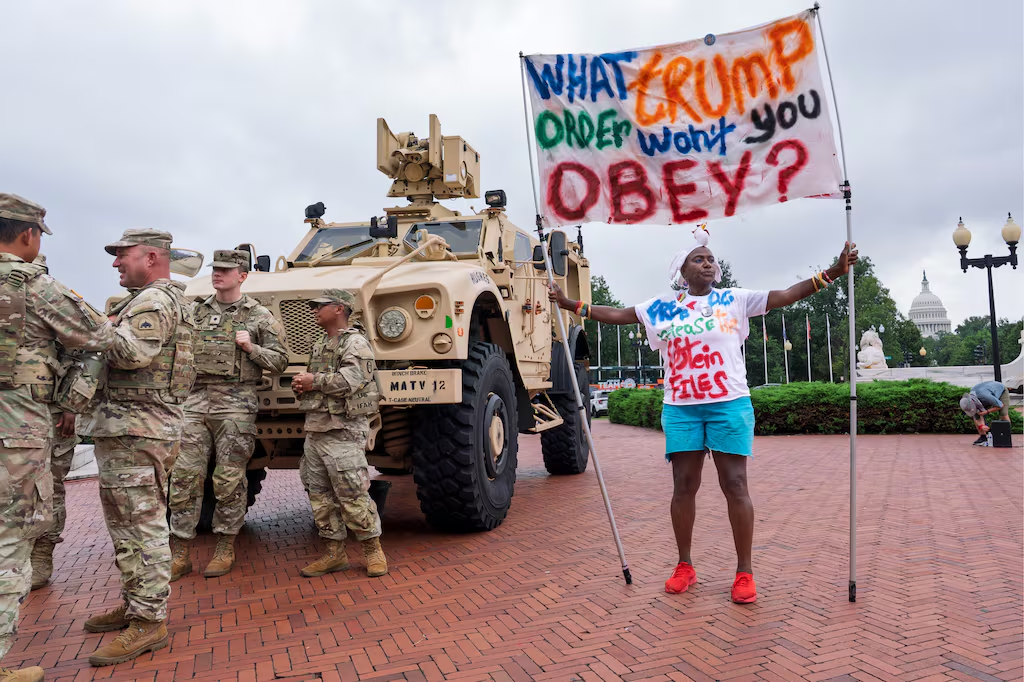
In the midst of the military occupation of Washington, D.C., Trump issued another Executive Order (EO) that further escalates the use of the military against domestic civilian populations. Particularly alarming is the creation of a “standing National Guard quick reaction force,” which could be deployed nationally at the order of the president. Since the deployment of National Guard troops to D.C., Trump has been threatening to send troops to Oakland, Baltimore, and Chicago, all cities with Black mayors, based on erroneous claims of a “crime emergency.”
During the EO signing ceremony on Aug. 25, Trump told the press that “a lot of people are saying, ‘Maybe we like a dictator.’” He quickly followed this remark by assuring the reporters, “I’m not a dictator. I’m a man with great common sense.” However, at a cabinet meeting the next day, Trump again referred to the term “dictator” while denying that there might be any limitations on his “right” to send troops to Chicago: “Not that I don’t have … the right to do anything I want to do. I’m the president of the United States.’“
All of this comes in the context of the massive expansion of ICE, Trump’s unaccountable political police, coupled with the construction of prison camps intended for the detention of immigrant workers. As we wrote previously, “Trump has taken the tools given to him by past administrations and directed them into a mass deportation regime using a myriad of federal agencies, including the FBI, ATF, and the Postal Inspection Service to augment ICE and Border Patrol efforts.”
What is in the new EO?
- Using the pretext of a so-called “crime emergency,” the EO creates a specialized D.C. National Guard Unit: “The Secretary of Defense shall, subject to the availability of appropriations and applicable law, immediately create and begin training, manning, hiring, and equipping a specialized unit within the District of Columbia National Guard, subject to activation under Title 32 of the United States Code, that is dedicated to ensuring public safety and order in the Nation’s capital.” This D.C. unit, along with state National Guard units nationwide, “will be trained to assist federal, state, and local law enforcement in quelling civil disturbances.”
- Additionally, “the Secretary of Defense shall designate an appropriate number of each State’s trained National Guard members to be reasonably available for rapid mobilization for such purposes. In addition, the Secretary of Defense shall ensure the availability of a standing National Guard quick reaction force that shall be resourced, trained, and available for rapid nationwide deployment.
- The EO also directs the National Park Service to increase the size of the DC Federal Park Police.
- The EO includes a crackdown on DC public housing, directing the Secretary of Housing and Urban Development (HUD) to investigate violations and “include consideration of the provisions of such agreements that require housing providers to maintain safe, decent, and sanitary conditions or to restrict tenants who engage in criminal activity that threatens health, safety, and the right to peaceful enjoyment for other tenants, including engaging in drug distribution, violent criminal activity, and domestic violence.”
- The EO also gives the Attorney General the right to review D.C. Metro Police General Orders and to request that the mayor make “updates and modifications to such orders as the Attorney General determines are necessary to address the crime emergency and ensure public order and safety.”
Writer Hamilton Nolan explains, “This executive order is meant to create a standing military force that will go wherever Donald Trump tells them to go and do what he tells them to do. It is meant to smooth over any bureaucratic, legalistic, or technical objections to this sort of dictatorial use of force. It is meant to see to it that Donald Trump can point to any city and say ‘Send in the troops’ and have that happen, notwithstanding the opposition of any governors or mayors or disgruntled military officers or stray courts.”
Fake crime claims
Despite Trump’s claims, violent crime rates have declined since a spike during the COVID pandemic, with homicide rates down significantly—a 14.9% drop from 2023 to 2024. Homicides, aggravated assaults, sexual assaults, robberies, and motor vehicle thefts have all shown significant declines from their peaks at the tail-end of the pandemic.
Trump’s verbal assault on Washington, D.C., calling the city dirty, crime-infested, and dangerous, is in line with conservative talking points that vilify urban areas. According to Trump, the situation in D.C. is “becoming a situation of complete and total lawlessness, and we’re getting rid of the slums, too. … I know it’s not politically correct. You’ll say, ‘Oh, so terrible.’ No, we’re getting rid of the slums where they live.”
According to The Hill, “Violent crime was recorded at 926 per 100,000 in the nation’s capital, which is governed by Mayor Muriel Bowser (D). Officials said violent crime is down by 27 percent and at a 30-year low after reaching all-time highs during the pandemic.” In contrast, a “fact” sheet issued by the White House claims that “the local D.C. government has lost control of public safety in the city,” with a “violent crime rate that is higher than some of the most dangerous places in the world.”
Here comes the police state
Civil libertarians and community activists are rightly concerned about this unnecessary and dangerous use of the military in U.S. cities. Retired Maj. Gen. Randy Manner spoke out against this new development, saying, “The administration is trying to desensitize the American people to get used to American armed soldiers in combat vehicles patrolling the streets of America.”
Trump’s use of the military for domestic policing violates the Posse Comitatus Act of 1878, which limits the use of the military for domestic policing. Since taking office, Trump has dramatically increased the size and scope of ICE. A previous Trump EO, Strengthening and Unleashing America’s Law Enforcement to Pursue Criminals and Protect Innocent Citizens, further militarizes local and state police forces, providing more excess military equipment to police and shielding them from accountability. Trump’s desire to use the police and military against his perceived enemies poses a very real danger to oppressed nationalities, opponents of state repression, and the unions.
Trump is creating the framework for an integrated, unaccountable, and loyal police and military force capable of waging a campaign of domestic counter-insurgency and repression on a national scale—a repression that would be unprecedented in the US. Writing in The New York Times, Ezra Klein wrote, “… that’s the other picture I see—the one that keeps coming into clear focus. Not Trump cleaning up crisis or disorder, but Trump creating crisis and disorder so he can build what he has wanted to build: an authoritarian state, a military or a paramilitary that answers only to him—that puts him in total control.”
Klein continued, “ICE and U.S. Customs and Border Protection have long been the most rogue, renegade and certainly pro-Trump police agencies in the federal government. So I think Trump sees those two as the most loyal to him. Also, obviously, the mass deportations are going to ensure that those two agencies remain relevant throughout his administration.” So, what is to stop Trump, or a successor, from using ICE and National Guard quick reaction forces, in conjunction with local police, against police brutality protesters, Palestine Solidarity activists, or against labor strikes?
Fighting back
Building a fightback against Trump also raises the question of the Democratic Party. The Democratic establishment has been a weak and tepid “opposition” to Trump’s all-out assault on democracy, unions, immigrants, LGBTQ people, and women’s rights. One only has to watch the nauseating attacks on the unhoused and trans people by politicians like Gavin Newsom to know that the Democrats are just another set of enforcers for capitalism.
Lawsuits and politicians won’t save us. The power is in our hands through working-class methods of struggle like strikes, mass action protests, boycotts, and independent political campaigns.
Stopping Trump’s authoritarian ambitions will require a united fightback on multiple fronts. The democratic mass mobilization of all sectors of society—youth, oppressed nationalities, and the unions in particular—is an urgent task. This must be a combined struggle for democratic rights and due process, against legal ethnic cleansing under the guise of immigration control, for the abolition of ICE, and in defense of the working class. There must be a united and vocal rejection of authoritarianism.
Photo: J. Scott Applewhite / AP
-
Pennsylvania transit cuts: An attack on working people
By B. COOPER
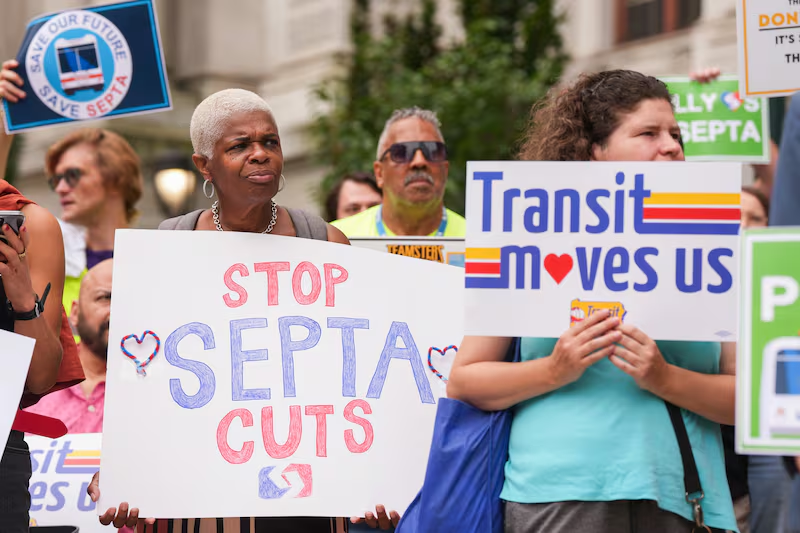
As of this writing, the Pennsylvania Senate has failed to pass a budget that would fund public transit, including SEPTA, a system that serves 800,000 people a day in the greater Philadelphia region. This funding was needed to get the faltering public transportation company out of a crippling $213 million deficit.
Unfortunately, SEPTA (South East Pennsylvania Transit Authority) decided—in light of its long-standing fiscal “death spiral”—to dramatically reduce service and raise rates. The first round of cuts went into effect on Sunday Aug. 24. At least 50 bus lines will be cut entirely, and most rail lines will halve their services. Eventually, several major regional rail lines will be eliminated, while the others will stop running after 9 p.m. And basic fares are rising to $2.90 for a single ride.
This is a major setback for the quality of life of hundreds of thousands of working people in Philadelphia and the greater region—including New Jersey and Delaware. Public transit cuts will also affect Pittsburgh and Harrisburg, and an Amtrak connection between New York City, Philadelphia, and Harrisburg. All of this means a severe increase of travel expenses for poor and middle-class people. It will also mean a massive increase in emissions of carbon and particulate matter due to the estimated daily addition of some 275,000 cars on the road (to say nothing of congestion).
This is occurring in a time when the nation spends almost $1 trillion dollars on its military annually, $175 billion on terrorizing and imprisoning immigrants in concentration camps, and hundreds of millions more on so-called “AI data centers” that drink up and poison the water of nearby communities.
SEPTA’s budget problem
SEPTA officials have complained for years of their fiscal “death spiral,” which has steadily placed limits on services. Unfortunately, they put the blame for this on the consumer, i.e., the working-class rider, rather than the capitalist government.
In 1961 the Southern Pennsylvania Transportation Compact ended the messy privatized system and combined several companies into a single network, which was reorganized as SEPTA in 1964. Several regional rail lines were cut in the process, but this was seen as a temporary measure pending electrification of the entire system. At the same time, plans were laid for a large expansion of the city’s subways, though most of the plans for expansion were never carried out.
In general, the formation of the publicly owned system was a step forward in improving the quality of life for working people. But SEPTA was handicapped by inconsistent funding. There was never a secure guarantee of funds from the state or federal government, with the can being eternally kicked down the road by both Republicans and Democrats.
Since SEPTA does not get regular, guaranteed financial support from the state or federal governments, a huge portion of its funding comes from fares. SEPTA—like all public transportation networks since the COVID-19 pandemic—has seen a drop in the number of people using its services, which creates a “spiral” in which the remaining customers need to pay more to keep the whole thing going.
At the same time, SEPTA has been seeing greater numbers of people not paying—creating a point of contention between riders and bus drivers that has been an unnecessary source of conflict. In late 2024, the Transport Workers United Local 234 threatened to strike over pay and, critically, safety on the job.
Today, SEPTA’s budget shortage cannot be fixed with fare hikes alone, and according to Pennsylvania state law (to rub salt into the wound), cannot be fixed by municipal taxation either. The average Pennsylvania family will pay 12% of its income in state and local taxes while the wealthiest only pay 6.2%.
Why is there an attack on public transit?
Reporting by outlets including the Philadelphia Inquirer, City-cast Philly, and Philly Voice have detailed information on many of the specifics of the budget wrangling between the two capitalist parties in the Pennsylvania Senate. People might think that there isn’t money available to consistently fund SEPTA (and other needed public services!). However, an examination of the budgeting decisions of the state and federal government reveal a different story, one of ideological motivation rather than economic realities.
The Republicans, who have had the majority in the state Senate for over 30 years, mainly because of gerrymandering, have a brutal “free market” fundamentalism that scorns the public good. Across the country, their party has done everything possible to sabotage or stonewall progress in public services such as health care, schools, and housing. The Trump-influenced Republican Party is also trying to curry favor with rural and small-town white voters by saying that their tax dollars shouldn’t go to “crime ridden” Democratic-run cities.
The Republican strategy of long-term destruction of public transit is on full display with their most recent budget proposal, in which $1 billion would be sapped from the Public Transportation Trust Fund, a fund that, according to SEPTA, is needed for maintenance and future capital improvements to the system at large.
Both parties uphold capitalism and its for-profit exploitation of labor, as well as the U.S. imperialist mission abroad. But whereas the Democratic Party tends to put itself forward as representing the “rational” and “fair” policies of U.S. capitalism, the Republican Party, especially under Trump, has more openly embraced racist and exclusionary myths in order to justify merciless exploitation. Of course, cuts to social services, including public transit, do not benefit rural whites or small businesses at all, who will be harmed by the negative impact to the economy of many of Trump’s policies. Trumpism can only benefit the very wealthy.
State and national budgets
Of course, $213 million is not a lot of money when speaking of the budget. This is easy to see when we examine the so-called Big Beautiful Bill passed recently as the crown jewel of Trump’s policies. The bill includes among many other provisions a $145 billion increase in annual military spending, money that even the Pentagon admits it can’t keep track of. This brings the net annual waste on the military to almost $1 trillion.
The so-called “beautiful” bill also increased ICE agent hiring by a whopping $8 billion, and allocates $45 billion for the building of new “detention centers.” This is alongside an obscene $50 billion allocation for border security and border wall construction. Even the money spent to build “shelters” for apprehended immigrant children, $3 billion, is 15 times the amount of money that would be needed to end SEPTA’s deficit.
Looking at the Pennsylvania state budget doesn’t look much better. For example, Pennsylvania’s 2024-25 budget allocated $2.7 billion to “corrections,” i.e., the racist mass incarceration system, and another $1.3 billion to the state police. By comparison, a measly $234 million—or less than one-fifth of the police budget—was given to environmental protection.
Whom does this budget serve? On a federal or state level, priority is clearly given to maintaining the oppressive organs of government over and above the actual needs of the working or middle classes, such as affordable housing, transportation, and clean air and water.
Public transportation must be funded!
When we compare the public transportation networks of the United States to other developed nations—even ones that are much poorer than the U.S.—we see abject failure. Public transit in nations such as Belgium, Austria, and Germany are much more robust, have much greater daily capacity, and are supported by consistent funding. Whatever other flaws these capitalist governments may have, public transit is supported as a basis for civil society.
Public transportation should not be a cost hoisted onto working people. Public transportation should be seen as a necessity. Moreover, it must be dramatically expanded if we want civilization to survive climate change. Such an expansion would provide mass employment. Philadelphia, for example, was once a major manufacturing hub for the construction of train and subway cars, before the industry was eclipsed by the auto manufacturers who lobbied the government to expand asphalt roads for cars.
Paying for the expanded system of mass transit could also be accomplished by raising taxes on the wealthiest and on corporations. Zohran Mamdani’s NYC primary campaign gained a lot of popularity among his working-class base by promising free buses funded partly by fining the slumlords and raising taxes on the wealthiest.
The U.S. has more than ample resources to provide for the common good. But the current government loyally serves only a privileged minority. The structure of government is designed to keep the capitalist owners of industry, high tech, and finance in control while marginalizing the bottom 90% of people and making their needs irrelevant to government policy.
Working people need a political movement independent of the Democrats and Republicans, based on the unions and other working-class organizations. It must fight uncompromisingly at the ballot box, in the streets, and at workplaces to defeat this reactionary regime. Only a workers’ government led by working-class leaders, backed by a democratic mass movement and democratic trade unions, could create a budget that actually fulfills the needs of working people, protects the environment, and ends support for war and genocide.
Fund mass transportation! Full mass transit within and between our towns and cities!
For free buses and subways! Make the rich pay! Make corporations pay!
Dismantle the military industrial complex! Tear down the walls! Close the prisons and camps!
End all support to Israel. Use the money instead to fund schools, trains, and health care!
For a democratic and fighting labor movement! For workers’ control of industry, transport, and the banks!
Photo: Jessica Griffin / The Philadelphia Inquirer
-
Free Kilmar Abrego Garcia!


By ERWIN FREED and AVA FAHY
Kilmar Abrego Garcia—a union sheet-metal worker, husband and father, and member of the immigrant advocacy group CASA—was finally released from a Tennessee jail on Friday, Aug. 22. Unfortunately, he was re-detained three days later, on the morning of Aug. 25, during an ICE “check-in.” A press conference organized by CASA brought hundreds of supporters to rally outside the ICE field office in Baltimore as he arrived for his “check-in” appointment.
Abrego Garcia’s release from prison and his subsequent re-detention marks a crucial but unresolved point in the movement against the ongoing crack-down on immigrants and civil liberties. The movement to free Abrego Garcia has shown that all of the Trump administration’s lies and slanders against him are baseless. It should be obvious that there is no “legal” justification for his continued detention. However, the movement cannot let down its guard; it must mobilize support against a new maneuver by the administration, which has led to the re-detention of Abrego Garcia.
As Abrego Garcia’s lawyers have pointed out, the departments of Justice and Homeland Security are working in “lockstep” to try to coerce him to plead guilty to bogus “human trafficking charges” in exchange for deportation to a “safe” country, where he would be given asylum. The federal government gave Abrego Garcia an ultimatum: If he did not plead guilty on Aug. 25 and accept deportation to Costa Rica, the government threatened to deport him to Uganda—a country where he does not speak the language and where he would be more vulnerable to human rights abuses.
It is obvious that the government was attempting to coerce Abrego Garcia into relinquishing his civil rights to due process in immigration proceedings. Abrego-Garcia bravely declined the terms of the ultimatum and peacefully accepted his re-detention, which was expected, at his ICE “check-in.” He was sent to a detention center in Virginia. A federal judge in Maryland has temporarily blocked Abrego Garcia’s deportation until at least after his evidentiary hearing takes place on Aug. 27.
Immigration policy analysts like Aaron Reichlin-Melnick speculate that if the U.S. government were to send him to Uganda, that country would then deport Abrego Garcia to El Salvador, where he would face threats of violence, and where it would technically be illegal for the United States to send him directly. Of course, the U.S. government already did just that when they sent Abrego Garcia, along with over 280 other detainees, to the CECOT torture center in El Salvador in mid-March.
Often left out of news reports on this situation is the fact that rapprochement between the United States and Nayib Bukele’s regime in El Salvador began during the Biden administration. In 2023, senior Biden officials began laundering Salvadoran President Bukele’s image and “courting” the hyper-corrupt, hyper-carceral regime. An article in The Dial reported that in September 2023, Biden’s Secretary of Homeland Security, “[Alejandro] Mayorkas … applauded [El Salvador’s] state-of-exception arrests—whose victims are people like Juan Saúl Castillo Alberto, an employee of the Salvadoran public works agency who was arbitrarily detained and starved in prison. He died at age 32.” When Bukele accepted re-election the next summer, Mayorkas led a high-level diplomatic delegation to the country.
The kidnapping and the “case” against Kilmar
Quotations without attribution refer to this court filing: https://storage.courtlistener.com/recap/gov.uscourts.mdd.578815/gov.uscourts.mdd.578815.1.0.pdf
ICE and the entire federal government held Abrego Garcia behind bars since March 12. On that day, after working a full shift as an apprentice sheet metal worker, ICE HSI agents pulled over his car. Abrego Garcia had just picked up his son from his grandmother’s house, and the pair were on their way home. ICE agents told him only that his “status was changed,” while arresting him and threatening to send his son to Child Protective Services if his wife did not show up to the scene fast enough.
Born in the capital city, San Salvador, Kilmar Abrego Garcia fled the country at age 16 after years of being targeted by the Mara 18. The gang extorted his mother’s pupusa stand and threatened to kill Kilmar and his brothers if they didn’t join Mara 18. A U.S. immigration judge found Abrego Garcia’s story credible enough to grant him “withholding of removal” status, legally preventing the government from deporting him to El Salvador under the terms of the United Nations’ Convention Against Torture. Such relief is only granted to individuals who face a “clear probability of future persecution.”.
During his first evening in ICE detention, Abrego-Garcia spoke with his wife. He told her that he had been questioned about gang affiliations, repeatedly stated he had none, and “that he had been told that he would go before an immigration judge and then be released.” After his initial detention, Abrego-Garcia was moved to “various detention facilities around the country.” Along the way, he urgently told his wife that “El Salvador was asking for him.” As she desperately attempted to explain that “he had won protection from being removed to El Salvador” to ICE officials and agents, no one responded.
In a call at around 11 a.m. on March 15, Abrego Garcia “relayed that he was told that he was being deported to El Salvador. With a sense of urgency, he asked his wife to contact his mother so their family could get him from ‘CECOT,’ as that is where he was told they were sending him.” CECOT is a 40,000-bed concentration camp where physical, psychological, and sexual abuse of detainees are all institutionally supported.
Unfortunately, Abrego Garcia had been told the truth. At least 280 people, including him, were sent to CECOT as part of a psychological warfare operation meant to instill fear in immigrant communities.
Abrego Garcia, along with the rest of the people sent to CECOT, was horribly beaten and subjected to torture. Most of the people sent to CECOT, estimated at around 250, were Venezuelan men. While the Trump administration claimed they were members of the Venezuelan gang, ”Tren de Aragua,” even those charges were made up. Tren de Aragua barely exists in the United States, and the administration has not presented any evidence showing that any of the people deported to CECOT were gang members.
Instead, the deportation flights were riddled with alleged “administrative errors.” They included at least seven women, who were mistakenly sent to CECOT (an all-men’s prison) and, by the government’s own admission of error, Kilmar Abrego Garcia. In 2019, an immigration judge ordered a stay of removal for Abrego Garcia, specifically barring the government from deporting him to El Salvador.
Ever since news of the CECOT deportations, solidarity with the deportees and disgust with the Trump administration’s crimes has largely congealed into the demand “Free Kilmar Abrego Garcia and all CECOT detainees.” All over the country, pictures of Abrego Garcia have flooded mass demonstrations against the anti-immigrant crackdown and general repression unleashed by the government. Everything the Feds do to try to justify targeting Abrego Garcia further exposes the arbitrary unlawfulness of not only immigration enforcement, but capitalist policing generally.
Kilmar Abrego Garcia had three main points of contact with law enforcement, all of which ended with him being allowed to remain in his community, and none of which resulted in his being charged with any crime.
The first was in 2019. At that time, Kilmar was detained along with other day laborers waiting for work. They were detained by a corrupt cop, Ivan Mendez, who weeks later would plead guilty to being a “John” and providing information to “commercial sex workers.” The “evidence” that Abrego Garcia was a member of the MS-13 criminal gang was based on the words of a still unnamed “criminal informant” in a “gang field survey” sheet filled out by Mendez. The “gang field survey” was so broad as to be meaningless, and was outlawed by the state of Maryland shortly after Abrego Garcia’s initial detention. Similarly, the informant claimed that Abrego Garcia was part of an MS-13 “clique” located in New York, a state the government has never shown him to have had any connection with. During this period, from March 8 to Oct. 10, 2019, Abrego-Garcia was held in ICE detention. He had been immediately handed off to ICE by local police following his detention, although during his final hearing in this episode, he was neither convicted nor charged with any crimes.
The second contact with law enforcement were two reported domestic disputes, one in 2019 and one in 2020, when Abrego Garcia’s wife called the police during arguments. No charges were filed, and the couple appears to have had success with the help of a counselor. Jennifer Vasquez Sura, Kilmar’s wife, has directly blamed Abrego Garcia’s uncharacteristically aggressive behavior during this period on the trauma of having been placed in ICE detention.
The third was a brief traffic stop by the Tennessee Highway Patrol on Dec. 1, 2022. According to the government’s own account, Abrego Garcia was allegedly pulled over for “speeding” and not “maintaining” lanes. In the vehicle were “eight other individuals” whom Abrego Garcia told police he was bringing from Texas to Maryland “to perform construction work.” Abrego Garcia was let go with a warning, and no incident report was filed. However, the details of the traffic stop somehow ended up in the files of the “Combined Intelligence Unit” (CIU) of the ICE Enforcement and Removal Operations bureau.
From a quick review of documents, it is not clear what the CIU is. In any case, that unit’s report, combined with the word of a federal informant, Jose Ramon Hernandez Reyes, appear to be the basis of the White House’s insistence that Abrego Garcia is a “suspected human trafficker.” In actual fact, the informant in this case had previously been convicted of human trafficking and was the owner of the van Abrego Garcia was driving. Now, the Justice Department and DHS appear to be leveraging Reyes’ extensive criminal record to coerce him into painting Abrego Garcia as some sort of “human smuggling” kingpin.
It is apparent that none of these interactions with police give credence to any of the White House’s claims. There is no evidence that he is a member of MS-13, there is no evidence that he is a serial “wife beater,” and there is no evidence that he participated in “human trafficking,” as any reasonable person would understand it. On the last point, whatever status the people in his car might have had on Dec. 1, 2022, the federal government is now going out of its way to drop similar charges against Jose Ramon Hernandez Reyes, as well as charges for randomly shooting guns and other crimes, in order to receive testimony backing up their narrative demonizing Abrego Garcia.
Migrants are not political pawns! End ICE and CECOT terror! Hands off Kilmar Abrego-Garcia!
While tens of thousands of Salvadoran men languish in CECOT and other torture camps, almost 300 deportees sent from the United States were ultimately traded in order to release 10 “political” prisoners from Venezuelan jails. That list inexplicably includes Dahud Hanid Ortiz, who was convicted in Venezuela for a triple homicide carried out in Spain.
The CECOT negotiations are emblematic of the U.S. ruling class’s apparent emerging strategy towards brute force “negotiations” and the use of working people and media spectacle to orchestrate “foreign policy.” Trump’s second term has already become defined by making big pronouncements, followed by small “victories” claimed by the attention hungry press core. Along the way, the administration is willing to destroy countless peoples’ lives through arbitrary behavior meant to put targeted communities in a state of “shock and awe” and creating the general fear that speaking out will leave one behind bars.
Kilmar Abrego Garcia’s months-long ICE odyssey spans probably a half dozen states, multiple countries, and even multiple detention centers within El Salvador. He has been villainized and publicly slandered at every opportunity by the highest “authorities” in the United States. Attempts to deport him also show the weakness of the MAGA movement’s attempts to carry out “mass deportations” and to win popular support for their plans. Instead, “Hands off Abrego Garcia!” became a rallying point and unifying call for millions of people, who poured out in the streets to stand against the Trump administration.
Particularly now, as Abrego Garcia is once again incarcerated for the “crime” of moving across borders, the fight to defend him and end this petulant witch-hunt deserves support from all who care about democratic rights and understand that every successful step made in empowering and expanding the detention-deportation machine is also a successful rollback of everyone’s civil liberties.
There is no time to waste! “Keep Kilmar Abrego Garcia Home” must be the message on every shop floor, in every community space, and at every mobilization for working people and civil liberties.
Photo: Kilmar Abrego Garcia speaks to supporters outside his ICE “check-in” on Aug. 25. (Elizabeth Frantz / Reuters)
-
Free Catalina ‘Xóchitl’ Santiago!


By JOHN LESLIE
Immigrant Justice activists and their allies are demanding the release of Catalina “Xóchitl” Santiago, a respected community organizer and Deferred Action for Childhood Arrivals (DACA) recipient. Xóchitl was seized by Border Patrol agents at the El Paso airport on Sunday, Aug. 3, while she was traveling for work. Agents disregarded her legal status under DACA and placed her in detention. DACA recipients are supposed to be both authorized to work and protected from deportation.

Catalina “Xóchitl” Santiago The government has falsely claimed that Xóchitl was picked up because of criminal charges from 2020. Her attorney, Norma Islas, has issued a statement refuting this allegation, which points out: “Despite repeated false claims by the Department of Homeland Security (DHS) to the public, media, and members of Congress about pending criminal charges, none exist.”
DHS and the FBI are constantly making up and framing Black and Brown people for crimes. The Trump administration continues to peddle the lie that Kilmar Abrego-Garcia is an “MS-13 member,” despite no evidence other than a meaningless “gang checklist” and the word of a crooked cop’s informant. Mahmoud Khalil, Rumeysa Ozturk, and others faced ICE arrest purely because they advocated for Palestine. In virtually every press release with immigration arrest statistics, ICE purposefully hides and obfuscates criminal charges. The most up-to-date statistics show that the vast majority of immigrants picked up by the Feds since Trump took office have been accused of no crimes, other than “breaking” immigration laws.
Xóchitl was born in Mexico and came to the U.S. as the child of farmworkers. As an adult, she has dedicated herself to winning equal rights and dignity for immigrant workers and their families, organizing in New Jersey, Pennsylvania, and Massachusetts. Most recently, Catalina has been working in El Paso, helping women in the community through La Mujer Obrera. At a vigil organized by supporters in Philadelphia, a friend and fellow organizer, Evan Feldberg-Bannatyne, talked about their work fighting for the right of immigrant workers to obtain drivers licenses. Supporters in Philadelphia, Chicago, and El Paso held vigils demanding Santiago’s release, with more planned in other cities.
At the Philadelphia vigil, a friend, Frangi Pozo, read a message from Xóchitl: “Today marks one week of not being able to see the sunset every evening, of not being able to feel the warmth of the land, of not being able to sprout seeds or hear the elders and children laugh. It has been a week full of histories of strife rooted in forced immigration and to come face-to-face with the criminalization of the immigrant. Getting to see the guts of the for-profit prison system that scrutinizes every move we make, that locks us far away from our loved ones. Where the lights are on day and night. Where every evening dinner is a frozen ham and cheese sandwich, crackers, and orange juice.” Catalina goes on to describe medical neglect of pregnant women, racist and homophobic behavior of guards, and inhuman living conditions.
The National Network for the Rights of Immigrants and Refugees (NNIRR) stated:
“This is not an isolated incident. Catalina is part of a worrying and growing trend in which immigrants with legal residence are detained without cause, which constitutes a violation of their rights and a direct threat to community leadership.
“Catalina is a pillar of her community: a talented narrator, a passionate advocate and a tireless advocate for women, the elderly and children. Educates young people about plant medicine and environmental management, grows community gardens and sows knowledge, hope and resilience wherever she goes. Their detention is not only unfair, but a flagrant abuse of power against those who seek and build justice in their communities.”
What you can do:
- Spread the word about Catalina’s case in your union, community organization, or campus organization. Ask them to issue resolutions demanding her freedom now.
- Follow the Free Cata “Xóchitl” Santiago Now! Instagram page for updates and actions.
- Sign the petition, Free Xóchitl! Community Organizer and DACA Recipient Detained at Texas Airport
- Donate to Free Xóchitl: Support DACA recipient detained by ICE
It’s clear that Catalina “Xóchitl” Santiago has been targeted as a challenge to DACA and as a threat to immigrant rights organizers from the racist Trump regime. The entire Immigrant Justice movement must stand up with one voice and say Free Xóchitl! Free all detainees immediately! Stop the racist ICE raids! Abolish ICE, Trump’s political police.
Photo: Protest in El Paso, Texas, on Aug. 6. (Jeff Abbott / El Paso Times)
-
Hospitals shut the door on trans youth


BY ROSA AURELIA
On Thursday, July 24, Yale Medicine and Yale New Haven Health announced that they would be ending their surgical (and medication based) gender-affirming health care for patients under the age of 19. This decision came immediately after Connecticut Children’s Medical said it would do the same. These developments have grave implications for trans people and their allies in the state of Connecticut. As clinics close their doors, the clients of the ones that remain will experience longer and longer wait lists, and this fact will inevitably lead to the (preventable) death of the state’s most marginalized youth.
This calculated move on behalf of the liberal establishment, however, does represent an opportunity for us to assess the strategies that the ruling class is employing in their continued gutting of essential social and medical services—which impacts all working-class Americans. Furthermore, these attacks give the class an opportunity to identify its antagonists, and to fight back against them with the power of a mass movement to protect trans youth that unites with medical workers struggling against neoliberal austerity measures.
In order to understand these attacks and how to fight back, we must look to the national and international context in which Connecticut hospitals have caved to anti-trans right-wing pressures, then speculate as to the possible responses of the trans liberation movement, as well as plan how revolutionists should meet this incredibly determinant moment in this arena of the class struggle.
The motives and strategies of the anti-trans reaction
From Brazil to Britain and from Hungary to China, we’re seeing the agents of capital adhere to anti-trans sentiment because it aids in their goals of dividing the working class along gender lines and because it diverts responses to crises of capitalism onto the already marginalized Queer community.
Strategically, the ruling class can repurpose sentiments of discontent toward the liberal education and health care systems to scapegoat trans people for the failures incurred by decades of neo-liberal policies. This strategy is especially effective on people who know intimately the state of the gutted social services, but who see no class independent alternatives in their elections.
The right’s playbook is rather easy to grasp. In the U.S. we have seen Attorney General Pam Bondi announce that she will be going after these industries for “defrauding” the American people. This framing allows the administration to appear as if it is fighting against the interests of the “elite.”
The Justice Department has also sent subpoenas to about 20 medical providers demanding that they turn over to the government sensitive records about their young transgender patients—including dates of birth, Social Security numbers, and addresses—as well as billing documents, communications with drug manufacturers, etc., going back to January 2020. Bondi said last month that the Justice Department is attempting to hold accountable for their actions “medical professionals and organizations that mutilated children in the service of a warped ideology.”
In addition, Robert Kennedy Jr.’s Department of Health & Human Services sent a letter in April to state Medicaid directors, urging them to “strictly limit” their services for gender-affirming care. Three days later, the department issued a form for whistleblowers to report to the government their “complaints” against providers of such services as long as they have a “good-faith belief” that the medical practitioners “violate professional or clinical standards.” In describing these standards, the document references Trump’s anti-trans Executive Order 14187, titled, “Protecting Children from Chemical and Surgical Mutilation.”
Meanwhile, the Federal Trade Commission (FTC), which is the big bourgeoisie in their governmental guise, is going after “gender ideology” by attacking the rights of clinics and doctors, as well as by holding what amounts to an anti-trans rally (Baum, 2025). What we are witnessing is a paradigm shift in corporate oversight of medical practices, and it shows how the right aims to prosecute their offensive against trans people. There is no doubt that the same strategies employed now against trans people will be used to enforce abortion bans in the future.
Though this strategy plays into the working class’s distrust of the health insurance industry and the medical industrial complex, it cannot actually solve the problem that workers are saddled with enormous medical debt, paying an arm and a leg for insurance, and unable to access the services they need.
Indeed, the right’s characterizations of trans health care prey upon very real and valid distrust of the establishment’s failing health-care system. However, these narratives effectively conceal the fact that Queer people are far more likely than their cis-hetero counterparts, to experience the marginalization that leads to difficulties in accessing health care. And further, these challenges are exponentially intensified for those already facing poverty, racism, ableism, and sexism.
There is a crisis in the U.S. health-care system, and the resulting lack of health care is disproportionately felt by the most oppressed. Yet the right wing claims that it is the “transgender industrial complex,” and not their $880 million in cuts to Medicare, that further debilitate our health-care system. These right-wing narratives are codified by the FTC, the office of the AG, and especially by the Supreme Court’s recent decision in United States v. Skrmetti to uphold Tennessee’s ban on gender-affirming care. And now we see that through these actions they are successfully pressuring supposedly “blue state” liberals in the upper echelons of the medical industry to make the very destructive decision to abandon trans youth entirely.
Nationally, we are only going to see this crisis for trans people worsen as surveillance of health-care providers increases, and as the FBI goes after providers who stand up to these pressures. Though they may start with providers and clinicians, this will no doubt expand to trans people themselves; as we saw earlier this year, they have already removed the language barring the FBI from surveilling people purely based on their gender identity.
This form of domestic spying is merely the first step along a path toward the expansion of the medical surveillance apparatus. This surveillance will allow the ruling class to police all bodies, and especially those of pregnant people by monitoring things like their health app data and period tracking apps.
Our strategy for the fightback
Obviously, such grave circumstances can be very scary, and demoralizing, for the trans community. Trans people might be tempted to respond to the increased surveillance and unavailability of gender-affirming care by moving into underground networks. But these strategies, especially if they manifest in underground Hormone Replacement Therapy (HRT) distribution networks, will have an enormous potential to be infiltrated by police or the FBI. In that way, they could kettle trans people and put them in a position to be further repressed.
To defend ourselves, we need public solidarity that prevents the government from isolating and attacking us as criminalized individuals. Out of these decisive moments, workers and oppressed people could build a broad and strong mass movement that can defend trans lives by taking up the struggle to advance the rights of women, Queer people and the particularly vulnerable trans community.
Building robust and effective defense campaigns can be aided when the trans community participates in other movement spaces, such as within the immigrant rights movement, the climate movement, the Palestinian solidarity movement—and in the unions. Campaigns organized by unionized workers might eventually be able to put credible strike action on the table, which could shift the balance of power in our fight.
Additionally, we advise allies of the trans liberation movement against actions that aim to “raise awareness” of our plight through escalatory, performative, and adventurist confrontations with police and the National Guard. These actions risk alienating the movement from its potential allies. Those who put forward such plans lack a complete understanding of the only force that has the potential to make meaningful advances toward liberation, that is the force of the united working class.
The mass action of the working class is enormously powerful. For example, it was only when Black Lives Matter protesters started raising the slogan “Black Trans Lives Matter” that we saw the conservatively led Supreme Court issue an opinion that protected LGBTQ workers from being fired based on their sexual or gender orientation. In 2020 the ruling class felt threatened by workers uniting to defend Black trans bodies, so they conceded Bostock v. Clayton County. But today they feel less of an immediate threat—so we get Skrmetti. The difference between the Court that made that ruling and the one we see today is the strength of our solidarity.
To build such solidarity we must follow the example set by protesters outside of NYU Langone Health in New York and in Michigan earlier this year, where trans activists united with hospital workers to oppose concessions on trans health care that had been made by liberal health-care industry executives. When these forces united, we saw that they won their respective battles, effectively setting back the right-wing anti-trans movement. And when California’s Kaiser Permanente said it would stop providing surgical care to treat gender dysphoria in people under 19, the largest nurses’ union in the nation stood up to condemn those actions. These examples of solidarity need to be repeated at every hospital and clinic across the country. We know such solidarity is possible because as trans people we don’t just want to fight for trans health care; we want to fight for all health care, and the rights of all health-care workers.
It is necessary for all social activists to help build a mass movement of workers and the oppressed that could bring together health-care workers’ unions and their allies within the trans community. When such a movement takes to the streets with slogans as strong as “Black Trans Lives Matter,” we will be able to go beyond defending the most basic gender-affirming health-care for minors and fight for full liberation.
Sources
Baum, S. (July 10, 2025). “Trump’s FTC lays the groundwork to charge GAC providers with ‘fraud.’” https://www.erininthemorning.com/p/trumps-ftc-lays-the-groundwork-to
Maroney, E. (2025a). “The Anti-Trans Witch Hunt.” Spectre, (11). The Anti-trans Witch Hunt Spectre: A Marxist Journal. https://spectrejournal.com › the-anti-trans-witch-hunt
Maroney, E. (2025b, Jan. 30). “Trump, the right, and the broader anti-trans reaction.” Tempest. https://tempestmag.org/2025/01/trump-the-right-and-the-broader-anti-trans-reaction/
Photo: Emma Williams / Austin Monthly
-
The mirage of European ‘Recognition for a Palestinian state’


By JAMES MARKIN
With the crisis in Gaza caused by the Israeli military’s genocidal onslaught becoming increasingly dire, Israel’s diplomatic standing globally has continued to disintegrate under the pressure from public pressure and social movements across the globe. Nowhere has this been more apparent than in Europe which was once one of the friendliest regions in the world for Israel.
After almost two years of genocidal war, the European public has become increasingly firm in demonstrating its displeasure with European governments’ closeness with Israel. This June, for example, tens of thousands marched against Israel in Europe. In Berlin alone, on June 23, 50,000 marched against the genocide. In August, huge demonstrations were carried out in other European cities like Amsterdam, Madrid, and Geneva.
These protests are significant because they show the outrage of the European working class despite increasingly aggressive repression by European governments in an attempt to destroy the Palestine solidarity movement. For example, at demonstrations in support of the banned group Palestine Action in London, this month, hundreds of protesters were arrested. Similar arrests and police violence against protesters in Germany has become a common occurrence over the last year, according to reporting in the independent outlet Unicorn Riot.
Now, amidst rising reports of starvation and killings at food distribution centers, many European governments have begun to take action to show the public their desire for a “diplomatic solution” in Gaza. Israeli announcements of plans to take over Gaza City and to build another 3400 housing units in the West Bank increased their concerns. In response to news of Israeli actions in Gaza and the West Bank, the Italian defense minister, Guido Crosetto, publicly mused about the possibility of sanctions. Belgian Prime Minister Bart De Wever had already made similar threats in July along with a push for the EU to take action against Israel. Spain has made a similar push at the EU level. At the same time, the Irish Dáil (Parliament) is preparing to pass the long-awaited Occupied Territories Bill, which would make it illegal to import goods from Israeli settlements into Ireland. Most shockingly, German Chancellor Mertz, a close ally of Netanyahu, has announced that Germany will no longer be approving the sale of “offensive weapons” to Israel in the wake of the new plan. However, Mertz also said that Germany’s basic approach towards Israel has not changed, and it seems clear that Germany still plans to back Israel, although maybe not as much as before.
The most highly touted action taken by European states recently has been the move to formally recognize a Palestinian state. France, Malta, and Portugal, as well as non-European allies Australia and Canada, have announced that they plan to formally take this step at a UN meeting in September.
French plans to “recognize a Palestinian state” and push for a two-state “solution” are no better and are merely cover for a different imperialist plan for Palestine. The documents put forward by France and its allies clearly outline a plan, not for Palestinian sovereignty, but instead for a “demilitarized” Palestinian puppet state
This is clear in the French and Saudi joint statement on the recognition of a Palestinian state that was released on July 29. While the statement does condemn Israeli crimes that it says “long since ceased to have any military or political justification,” it also calls for Middle Eastern states to normalize relations with Israel and to recognize it. In a further statement at the United Nations on the same day, France made clear what political resolution they support in their “recognition” when they stated: “Governance, law enforcement and security across all Palestinian territory must lie solely with the Palestinian Authority, with appropriate international support. We welcomed the ‘One State, One Government, One Law, One Gun’ policy of the Palestinian Authority and pledged our support to its implementation including through the necessary DDR [Disarmament, Demobilization, and Reintegration] process that should be completed within an agreed mechanism with international partners and a set timeframe.”
The most despicable moment in this charade occurred when British Prime Minister Keir Starmer joined the chorus, saying that he would recognize Palestine in September as well, although he made the recognition contingent on an ultimatum to Israel. Starmer stated that his recognition will occur “unless the Israeli government takes substantive steps to end the appalling situation in Gaza, agree to a ceasefire, and commit to a long-term, sustainable peace, reviving the prospect of a two-state solution.” Making the recognition of the independence of an oppressed nation contingent on the behavior of their genocidal oppressor is obviously abhorrent, although not shocking when coming from Starmer and the British government.
A plain reading of their statements show that France, Britain and the European imperialists don’t want to create a Palestinian state that truly represents the will of the Palestinian people but rather they want to empower a regime akin to that of the historic Norwegian prime minister, Vidkun Quisling. Quisling, who was the head of the officially independent Norwegian state, in reality was merely the face of the Nazi occupation of the country. Similarly, the Franco-Saudi push for “recognition” of a Palestinian state repeatedly calls for the disarmament and dissolution of all armed forces in Gaza to be replaced by the leadership of the Palestinian Authority, which receives its funding and marching orders from the State of Israel.
The reality is that there is no possibility of an independent and sovereign Palestinian state as long as the Israeli Defense Force remains a heavily armed proxy for U.S. imperialism. The truth of the two-state “solution” is that any “independent” Palestinian state, even if it is not disarmed and directly controlled by Israel, would be completely under its dominance. This is clear from the recent political histories of other neighboring counties, like Lebanon and Syria, which have been totally shaped by Israeli military interference.
The only solution that will allow sovereign Palestinian, Lebanese, and Syrian states is the destruction of the IDF and ultimately the State of Israel, from which it operates. In its place instead must be created a democratic Palestine with equal rights for those of all religious, ethnic, and cultural backgrounds.
-
What’s at stake with Trump’s attacks on federal workers?


By ERNIE GOTTA
Unionized federal employees are facing a real crisis due to serious attacks by the Trump administration. These attacks threaten the very existence of federal unions and collective bargaining rights that provide good wages and working conditions. This threat should put all union workers on notice.
Why does Trump need to smash the federal employee unions? The American Federation of Government Employees (AFGE) alone represents over 820,000 workers in nearly every agency of the federal and D.C. governments, spread across 900 local unions. AFGE and other unions that organize federal workers represent a massive obstacle to the anti-worker/pro-corporate project being carried out by Trump that was first outlined by the Heritage Foundation in Project 2025 and is being realized with Executive Order 14251.
What does Project 2025 recommend? It proposes to eliminate 1 million federal jobs, privatize federal agencies, make deep cuts to federal worker pay and benefits, and discriminate against people of color and LGBTQIA+ people. But in order to do this they have to smash the federal employees’ unions. The Trump administration often keeps these Reduction in Forces (RIF) notices secret. Some agencies have made cuts by incentivizing departures or natural attrition. The State, Veteran Affairs, Education, and HHS departments are all moving forward with mass layoffs. The total number of agencies that will be impacted is unclear but ranges from between 40 to 70 RIF actions that will impact 17 to 19 agencies.
Deep attacks
Citing Executive Order 14251, the Department of Veterans Affairs (VA) has moved forward with terminating the collective bargaining agreement (CBA) of the majority of union members in the department. In a press release on Aug. 6, VA Secretary Doug Collins said, “Too often, unions that represent VA employees fight against the best interests of Veterans while protecting and rewarding bad workers. We’re making sure VA resources and employees are singularly focused on the job we were sent here to do: providing top-notch care and service to those who wore the uniform.”
AFGE President Everett Kelley responded, “The real reason Collins wants AFGE out of the VA is because we have opposed the Trump administration’s plan to dismantle veteran health care through the cutting of 83,000 jobs, successfully fought against the disastrous and anti-veteran recommendations … that would have shut down several rural VA hospitals and clinics, and consistently educated the American people about how private, for-profit veteran health care is more expensive and results in worse outcomes for veterans,”
Billionaire Secretary of Education Linda McMahon has put the Department of Education on the chopping block. While she wants to completely dismantle the department, the Supreme Court has cleared the way for the Trump administration to slash 1400 jobs, or nearly half of the workforce. AFGE Local 252 President Sheria Smith responded in a statement on the union’s website, “Let’s be clear, despite this decision, the Department of Education has a choice—a choice to recommit to providing critical services for the American people and reject political agendas. The agency doesn’t have to move forward with this callous act of eliminating services and terminating dedicated workers.”
On July 15, the U.S. Department of Health and Human Services (HHS), headed by conspiracy theorist Robert F. Kennedy Jr., is planning a new round of layoffs on top of the 10,000 workers who lost their jobs on April 1. In total, HHS is planning to lay off some 20,000 workers. According to The Guardian, nearly 3000 positions at the State Department have been eliminated through layoffs and voluntary departures this year. More than 250,000 federal employees overall have already left government service via early retirements or buyouts.
What are the union attacks about?
These attacks are not about curbing government spending. The Trump administration is lavishing huge amounts of money on war, deportations, and policing. The government is setting itself to spend loads of cash through Trump’s “Big Beautiful Bill.” The bill shells out $150 billion, giving ICE a larger budget than most of the world’s militaries. Mike Winters of CNBC reports, “President Donald Trump’s “big beautiful” tax-and-spending bill, which he signed into law on July 4, is forecast to increase federal deficits by at least $3.4 trillion over the next decade, according to the Congressional Budget Office. That’s on top of the gross federal debt, which has climbed to more than $36 trillion, up from about $23 trillion in early 2020—an increase of over 50% in just five years, driven by pandemic relief, rising entitlement costs and persistent deficit spending.”
Taking away the CBA will allow government agencies to more easily fire or lay off workers, slash wages, and cut benefits. The attacks on the federal unions can serve as an opening volley that will provide the bosses an opportunity to go after state and private sector workers in order to maximize profits for the capitalist class. How can trade unionists stop this process?
The way forward for federal workers
The AFGE and other unions are relying on Democrats and a capitalist court system to fairly address their grievances. Historically, the Democrats and U.S. court system have often ruled in favor of the corporate bosses. Courts have levied injunctions against picketing workers, arbitrated in favor of the bosses over unjust firings, and much more.
Democrats continue to tell unions to focus on legislation or trust in the courts. While the unions exhaust the path through the courts, they also have a responsibility to wage a mass struggle in the streets. Why are there no picket lines, strikes, fundraising, education, and mass marches? Why have the AFGE and the AFL-CIO not made a call for every union worker to go into the streets to oppose the Trump’s attacks?
Today more than ever we need fighting and democratic trade unions that uplift the voices of rank-and-file workers, break their reliance on Democrats and the courts, and build an independent working-class movement. We need a movement that is able to link the attacks on federal workers with the broader social struggles and win over industrial, logistics, and other workers in the private sector that can have a big impact by shutting down capitalist profits at the point of production.
Photo: Workers rally outside the U.S. Capitol. (Josh Morgan / USA Today)
-
Trump-Putin ‘peace’ summit was a farce


By CARLOS SAPIR
On Aug. 15, two war criminals met in Anchorage. Each flew about eight hours to arrive in the Alaskan city, exchange pleasantries, speak briefly in private, and then hold a joint press conference where nothing of substance was said. While these two imperialists dined together and did banal publicity stops, Ukrainians continue to fight on the front against the invasion, determined to preserve their independence.
A publicity tour for fake peace
With much fanfare and little new to show for it, it is clear that the ultimate purpose of this summit was for Putin and his entourage to flex Russia’s diplomatic clout and recite their self-serving pablum about “denazifying” Ukraine with the smiling endorsement of the U.S. president (for his part, Trump likely expects that this will help pressure Zelensky into making more economic concessions).
Like countless imperialists before them, from Kissinger to Woodrow Wilson to Hitler, Trump and Putin take great pains to present themselves as men of peace. Standing in front of a facade emblazoned with the words “Pursuing Peace,” Trump and Putin get to pretend that what they are doing is solving a thorny problem, when in reality they are working to subjugate Ukraine and clear the way to launch the next war of their choosing.
But even as Putin and his allies like Viktor Orbán try to project that the war is already as good as over, reality is not quite so accommodating. Even the location of the summit betrays this: more typical and convenient U.S.-Russia summit locations like Iceland, Finland, or the capital cities of the U.S. and Russia themselves are off-limits due to European countries and Canada having closed off their airspace to Russian planes. Meanwhile, Ukrainian drones and cyberattacks have forced airports in European Russia to repeatedly shut down for extended periods of time. Even in Anchorage, where Trump rolled out the red carpet, hundreds of protesters also showed up to greet Putin with a sea of Ukrainian flags.
Following the summit, Trump went on to meet with Zelensky and EU leaders, making murky promises to them while siding with Putin’s demand that Ukraine make territorial concessions “for peace.” Of course, this proposal is a farce, as there is no peace for Ukrainians for as long as their country remains occupied by an imperialist power.
Trump vaguely promised U.S.-backed security commitments for Ukraine, a phrase that should cause deja vu and skepticism among Ukrainians following the proceedings: After all, the U.S., Russia and Britain promised the same thing in 1994 when they signed the Budapest Memorandum, promising to guarantee Ukraine’s independence in exchange for Ukraine giving up its nuclear weapon arsenal, at the time second in size only to those of the U.S. and Russia themselves. Ukraine committed to its promises; the imperialist states did not.
Ukraine deserves self-determination, NATO’s imperialists have given it debt
Since the beginning of the war, Ukraine has been desperate to arm itself in order to fend off the invasion. Rather than dedicating its domestic production to the war effort and nationalizing Russian assets in Ukraine—which even now are still owned by and generate profits for Putin’s bourgeois allies—Ukraine’s government chose to pander to NATO’s imperialists and accept their impositions of debt, austerity budgets, and profit-driven production in the name of “fiscal responsibility.” Almost immediately after taking office, Trump went and further extorted a mineral resources deal from Zelensky.
Debts and one-sided trade deals imposed on Ukraine while it is under the duress of an invasion are the essence of imperialist politics. They are morally unjustifiable, and must be denounced. The cancellation of all these debts and deals benefitting the U.S. and other imperialist states and their banks would only barely begin to address the injustices committed.
At the same time, international worker to worker solidarity can help mitigate the shortfalls that Ukraine’s neoliberal government won’t address. While modest for now, efforts like the Ukraine Solidarity Network’s current medical equipment fundraiser for Ukrainian nurses’ union Be Like Us both provide direct aid to workers standing up to the Russian invasion and build the international political ties needed for Ukrainian workers to decisively confront their own government, to be able to fight for an independence that actually means something to working-class people.
As demonstrated by the anti-corruption protests last month, Ukrainians, hardened by the war, are more than willing to stand up to their own government and force concessions when it tries to strip away their rights.
Trump and Putin have the time and resources to put on a show in Alaska and pretend that Ukraine doesn’t exist. But they have not been able to actually make Ukrainians disappear, or to make them abandon the fight that began with marches in the streets against Putin’s lackey Poroshenko, and which continues more than a decade later in the trenches fighting against Russia’s mercenaries.
*****
Support Ukrainian Workers!
The Ukraine Solidarity Network, a national network of organizations and individual activists in the US, has embarked on a fundraiser to raise $38,000 for the Ukrainian nurses union. The union, Be Like We Are! (Будь як ми!), is trying to raise the funds for the purchase of two medical diagnostic machines in partnership with the Ukrainian-American nonprofit, Kryla. This campaign is a vitally important opportunity to build real worker-to-worker solidarity with the Ukrainian working class. In this time of war, while Russian imperialism is ruthlessly bombing civilians, our solidarity takes on critical importance.
Resources:
GoFundMe: https://www.gofundme.com/f/support-krylas-lifechanging-mission
Donate to Support Ukrainian Nurses! on the USN site: https://www.ukrainesolidaritynetwork.us/donate-to-support-ukrainian-nurses/ This includes downloadable literature and social media cards.
Photo: Trump’s and Putin’s chummy arrival at Anchorage airport. (Andrew Caballero-Reynolds / AFP / Getty Images)