-
Workers’ Voice newspaper: June-July edition

Trump continues his assault on working and oppressed people: From the attack on voting rights to the environmental impact of the war on Iran to abortion rights to the struggles of immigrant meatpacking workers on the picket line, this edition is filled with insightful views on how working people are confronting the horrors of capitalism under the management of the Trump administration. Also in this issue read about migrant workers in Africa, the struggle against data centers, and the meaning of recent elections in Hungary.
The June-July 2026 edition of our newspaper is available in print and online as a pdf. Read the latest issue of our newspaper today with a free pdf download! As always, we appreciate any donations to help with the cost of printing.
Click on the image to read the paper or message us to get a hard copy:

-
United Left Platform: In solidarity with Minnesota & Michigan activists facing repression


The United Left Platform and its constituent organizations (Workers Voice, Solidarity, Tempest, Speak Out Socialists, International Marxist Humanist Organization, Socialist Horizon) stand in solidarity with workers, activists and organizers in Minneapolis and Michigan facing egregious state repression for protesting the ICE occupation of the Twin Cities and the genocide in Gaza.
Fifteen activists and organizers in Minnesota involved with the city-wide protests against the ICE occupation of Minneapolis and St. Paul—including the murder of Alex Pretti and Renee Goode—are facing new federal indictments. The charges are a massive escalation against the right to protest in the United States. While no charges have been brought against the state murderers of Pretti and Goode, long-standing community activists face potential long-term prison sentences for standing with their community to defend it from state violence.
In Michigan, eight pro-Palestinian activists have been indicted, charged with conspiring to run a criminal intimidation campaign against University of Michigan officials while protesting the genocide in Gaza. As reported by the Guardian newspaper, the indictment “appears to be among the more aggressive prosecutorial actions taken by the federal government against pro-Paletistinian activists.” (See Pro-Palestinian activists accused of intimidation campaign against University of Michigan officials.)
These indictments represent an attempt to shut down all opposition to the current U.S. state’s attacks on workers, students, immigrants, and the oppressed. The ULP also underscores what has been written about the Minnesota case by the labor group Workers Resist:
“These prosecutions must be viewed not simply as cases against fifteen individuals, but as an attack on the broader movement that emerged to defend immigrant communities and resist authoritarian policies. If the government succeeds in establishing that organizing, coordinating, and mobilizing communities in defense of their neighbors can be treated as criminal conduct, the implications will extend far beyond these defendants” (Workers Resist Statement on the Federal Indictments of Anti-ICE Activists).
The United Left Platform supports all efforts to defend the Minnesota Fifteen and the Michigan Eight. The ULP and its member groups stand in a tradition of organized self-defense that has been used historically by the U.S. Left when the state seeks to repress dissent, silence opposition, and criminalize free speech and protest. The ULP has actively supported the Committee to Defend Tom Alter, which has publicly defended Alter, a tenured university professor fired for speaking at a Socialism conference.
We call on activists, trade unionists, students, organizers and people everywhere to condemn these attacks on free speech and to defend the right of people everywhere to organize and defend themselves. An injury to one is an injury to all.
Photo: Minneapolis / ANSA
-
Bolivia: Who should hold power?


By MAURICE
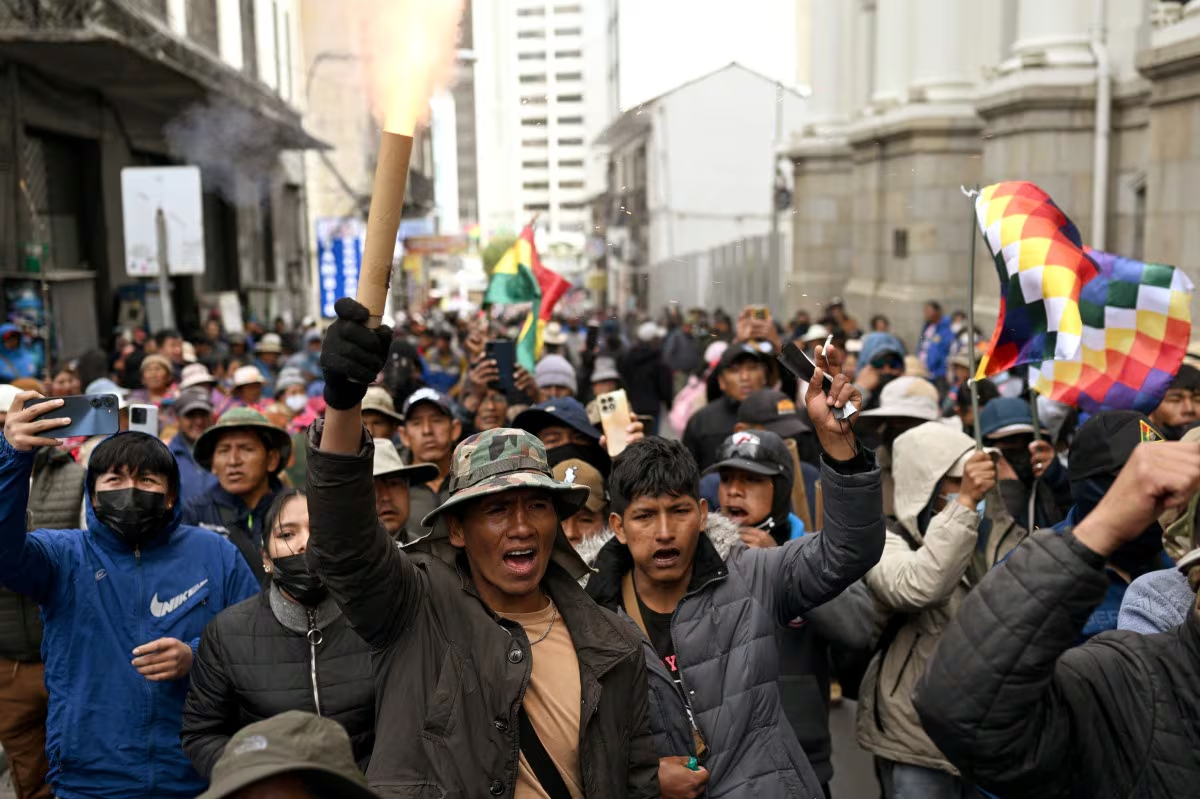
After six weeks of protests, workers, peasants, and popular organizations continue to maintain blockades across Bolivia and to challenge the rule of Rodrigo Paz’s government. Repression has intensified, with trade-union leaders kidnapped in the streets, and at least 360 people still detained by police. What began as a severe economic crisis has turned into a political crisis that brings back an old question in Bolivian history: who should hold power in the country?
*****
For many weeks, Bolivia has been experiencing a national wave of mobilizations that combines road blockades, strikes, popular assemblies, and cabildos—open meetings in which unions, communities, and social organizations discuss and vote on the direction of the struggle.
The trigger was the shortage of fuel, long lines at gas stations, rising food prices, and the deterioration of living conditions. Very quickly, however, economic demands gave way to an open political crisis. In May, peasant and Indigenous activists marched to La Paz, successfully raising demands for the repeal of Law 1720, which would have increased the commodification of small land parcels—to the benefit of large agribusiness. Since then, demonstrators have raised the slogan “Out with Paz.”
Well over 100 blockades were raised in different regions of the country; close to 50 reportedly remain active as this article is being written. There are also mass demonstrations, especially in the major cities of El Alto and La Paz, the seat of the Bolivian government. Despite arrests, repression, and the recent enactment of the repressive State of Exception law, demonstrators have not retreated. Three ministers have already left the government amid the deepening crisis.
What is at stake is not only Rodrigo Paz’s continuation in the presidency. The crisis calls into question the ability of the political regime to contain or neutralize a mobilization that continues to grow.
Who is in the streets?
For workers and activists in the United States, the Bolivian experience offers an important example of how a mass movement led by organizations connected to the working class can gain a real capacity to influence the direction of national politics. The strength of the mobilizations lies both in their breadth and in their level of organization.
Workers organized in the Bolivian Workers’ Center (COB), miners, peasants (i.e., the La Paz Campesino Federation and other groups), Indigenous communities, neighborhood organizations such as FEJUVE (the Federation of Neighborhood Councils of El Alto), transport workers, and teachers make up the core of the movement. Standing out among them is the Túpac Katari Federation, one of the main organizations of the Aymara Indigenous peasantry and historically influential in mobilizations across the Bolivian highlands. Among the most active and prominent sectors are the Ponchos Rojos, an Aymara Indigenous organization historically linked to peasant struggles and community self-defense in the highlands.
The mobilizations have raised demands that focus on the fight against the effects of the economic crisis and the defense of democratic freedoms, including the right to protest. Among Indigenous and peasant organizations, opposition is also gaining weight against the conversion of small agrarian property into medium-sized property and against the advance of the commodification of land and the country’s strategic resources.
Assemblies and cabildos bring together hundreds and, in some cases, thousands of participants. The blockades operate in rotating shifts, and important decisions are submitted to votes at the rank-and-file level. This grassroots democracy is decisive toward preventing negotiations from above the organizations from emptying the movement of its strength. According to reports from leaders and activists in Bolivia, who were interviewed by Workers’ Voice last week, proposals to negotiate with the government were even rejected by the demonstrators themselves.
Nevertheless, on June 17, the COB entered direct negotiations with President Paz and other government officials. The union federation presented a list of eight demands, including a commitment not to privatize nationalized industry and to safeguard the “right to mobilize.” At the same time, the COB dropped from its demands the call for Paz to resign. After about four hours of talks, the meeting adjourned with no agreement in place—and the blockades remained in place.
The memory of 1952 and the role of the blockades
The authority of the COB has deep roots in the Bolivian Revolution of 1952. In that process, workers, and especially miners, defeated sectors of the old army, organized workers’ militias, and pushed forward the nationalization of the mines. For a period, the COB came to function as an embryo of workers’ power as an alternative to the military junta that was in power.
The revolution was eventually contained after the reformist Movimiento Nacionalista Revolucionario (MNR) took power, the army was reorganized, and the militias were disarmed. Even so, the memory of that process remains alive and helps explain the political weight the federation still holds today.
The current crisis has also brought back into focus the role of El Alto, a working-class and majority-Indigenous city of nearly one million inhabitants, located above La Paz. Some of the most important blockades are taking place on the routes between the two cities. Others are spread throughout the interior, interrupting the circulation of fuel, food, and goods.
By conditioning the supply and daily functioning of the country, these mobilizations bring back an old question in Bolivian politics: The capacity of popular organizations to directly influence national economic life reopens the dispute over who exercises real authority in the country.
The dynamics of the mobilizations also appear to be moving beyond the influence of MAS (Movement Toward Socialism), the party led by Evo Morales. Although he remains an influential figure, Evo has defended an institutional and negotiated solution to the crisis (see his position in this YouTube interview).
This position expresses the historical limits of the MAS project, which administered the Bolivian capitalist state for nearly two decades without breaking with the national bourgeoisie, multinational corporations, or the country’s economic dependency, and which today seeks a negotiated solution to the crisis within the framework of the regime.
The United States, lithium, and inter-imperialist rivalry
Bolivia is part of the Lithium Triangle, alongside Argentina and Chile, a region that concentrates some of the world’s largest resources of this strategic mineral, as well as other resources coveted by the great powers.
Control over these resources has become an object of dispute between the United States, China, and Russia. Under MAS governments, especially under Luis Arce, Bolivia deepened lithium agreements with Chinese and Russian companies. The Rodrigo Paz government, meanwhile, seeks to strengthen relations with Washington and expand openness to foreign capital.
Among union leaders and activists, there is strong distrust regarding the role of the United States in Bolivia, reinforced by a recent statement (see link) of support from Washington for the Rodrigo Paz government and by the long history of U.S. influence in Bolivian politics.
Elon Musk’s statements in 2020, when he said that the United States could “coup whoever we want” during a discussion about Bolivia and its lithium resources, illustrate the tensions and interests involved in the international dispute over the country’s strategic resources.
For U.S. workers and trade unionists, solidarity with the Bolivian struggle means following the situation in the country, strengthening ties with organizations such as the COB, and denouncing any attempt at U.S. intervention.
Who controls the Bolivian state?
Despite the strength of the mobilizations, the government maintains control over the main instruments of state repression. There are, for now, no public signs of relevant divisions in the armed forces or the police, despite demonstrators’ appeals for armed sectors to break with the government and support the mobilizations. This limits, at least for now, the ability of the mobilizations to transform their social strength into an effective alternative power.
Congress recently approved the repeal of Law 1341, which regulated states of exception. With this, it opened the way for the Executive to resort to exceptional measures amid the growth of the mobilizations, while arrests and persecution of union, peasant, and Indigenous leaders increase.
This is one of the main contradictions of the current situation. On one side, there is a mass movement with a strong presence of workers, peasants, and popular organizations. On the other, there is a state repressive apparatus that remains unified and under government control.
Bolivia has already gone through major crises in recent decades, from the Gas War in 2003 to the 2019 coup. The current mobilization is part of this tradition of intense class struggle. What remains open is whether this energy will be channeled into an institutional solution or whether it will open space for alternative forms of power.
In any scenario, the question of power has returned to the center of Bolivian politics.
Who should govern the country?
From the standpoint of workers and popular sectors, a way out of the crisis depends on strengthening and centralizing the forces that today sustain the Bolivian struggle. Given its historical weight, national presence, and mobilizing capacity, the COB should take up the task of unifying workers, peasants, Indigenous peoples, and popular organizations around an independent political alternative, based on mass mobilization, grassroots democracy, and no confidence in the Rodrigo Paz government, the traditional right wing, or the limits of the project represented by MAS.
The answer to the crisis will not come from agreements among sectors of the political and economic elite, but from the ability of mass organizations to dispute power in the country. For this reason, one of the central tasks posed by the current situation is to strengthen the COB and the popular organizations as the embryo of an alternative power of Bolivia’s workers, peasants, and Indigenous peoples.
-
The World Cup of chauvinism


By CARLOS SAPIR
Despite its long history of blatant corruption and general disdain for human rights, FIFA seems set to outdo itself this month, kowtowing to Trump and pretending that all is well, even as the U.S. government directly interferes with World Cup proceedings, in addition to more generally completely undermining any spirit of fraternity or internationalism that global sporting events are supposed to inspire. The World Cup may be one of the most beloved sporting events the world over, but the contours of its organization and presentation are firmly dominated by the priorities of capital and imperialism. Consequently, the World Cup is now Exhibit A of the fragmenting post-World War II liberal order that is crumbling under the weight of economic and political pressure.
The ugly business of the beautiful game
Long before this latest World Cup, FIFA has been practically synonymous with corruption and a craven, capitalist drive for profit at all costs. This is now the third World Cup in a row to be explicitly overshadowed by concerns about its hosts’ flagrant lack of care for human rights and/or the sovereignty of other nations, with Qatar’s use of slave labor for stadium construction and Russia’s then-relatively-small-scale seizure of Crimea from Ukraine raising concerns about their suitability. And of course, the rot runs much deeper than just the choice of who gets to host the World Cup, with foul play running from match-fixing to doping at some of soccer’s most legendary clubs.
Soccer under FIFA’s global reign is capitalist big business, and like all capitalist big business, it prioritizes profits for the owners at the expense of both the athletes who do the work of playing the game, and the general public that hopes to follow their exploits.
Nevertheless, there is something to be said about the degree to which this current World Cup’s scandals fly in the face of the message it is supposed to be sending to its audience. Soccer may be administered as a big business, but its international appeal rests on its accessibility, with generations of working-class and poor children needing only a single ball and something to serve as a goal post marker to be able to play it on the street. Many of soccer’s most famous legends, including Pele and Maradona among others, themselves grew up in poverty, and celebrated their origins even after gaining world fame.
While brutal, corrupt, and a site of abuse, the international club system is also seen as a ticket to a better life by economically disenfranchised youth around the world. The World Cup itself typically gives the people of its participating nations an opportunity to root for their countries and enjoy a global spotlight that otherwise is rarely extended to non-imperialist countries. The Trump administration’s open disdain for these countries’ participation, together with their broader anti-immigrant, nativist policies, are a slap in the face for most of the World Cup’s audience.
Whose idea was this anyway?
There is a further absurdity, of course, which is that this year’s World Cup was supposed to be unprecedentedly internationalist, with Mexico, Canada, and the U.S. making a joint bid to host the tournament between the three countries. Despite originally being a project proposed by Trump during his first administration (the bid was filed in 2017), the international hosting now comes into direct contradiction with Trump’s policies of border militarization (Trump probably didn’t imagine he would be in office in 2026 at the time).
Where prior scandal-ridden hosts have gone above and beyond to ensure that the business of the tournament itself proceeded unimpeded, waiving immigration processes, toning down on virulent domestic propaganda, and allowing visiting fans a lot of leeway, the U.S. seems intent on making this World Cup as unwelcoming as possible. Whether it’s long queues at the border crossing, unexplained visa cancellations, or interference with fan ticket allocations, the priority here is “America First.”
Perhaps the most egregious example of this so far is the refusal to allow entry for Omar Artan, an award-winning referee from Somalia who was supposed to help adjudicate the tournament. As a decorated referee widely seen as representing not just Somalia but all of Africa, Artan can credibly claim to be one of the most trusted people in the whole world, but that did not save him from being subjected to 11 hours of grilling by U.S. border guards, and ultimately deportation on nebulous charges of affiliation with terrorist groups. The response of FIFA leadership was to tell the world to “chill.”
Of course, FIFA has been more than willing to respond with punitive measures against unsatisfactory hosts when it is the rich and powerful complaining: in 2023, FIFA banned Indonesia from hosting tournaments in response to the Bali Province governor’s decision to refuse to provide lodging to a team representing Israel. FIFA is thus perfectly capable of reorganizing events in order to switch hosts and allow participants’ participation, as long as it’s for the benefit of an apartheid-state client of imperialism.
The U.S. co-hosts, for their part, have worked to enable the exceptionalist stance of the United States, and have done little to respond to its flagrant disrespect for everyone interested in the tournament. Not that many U.S. residents will be attending the matches either, with eye-watering ticket prices starting above $1000 and running far higher; news reports note that thousands of tickets remain unsold and expected tourism booms are failing to materialize. While that economic shortfall is already disastrous on its own for the local bourgeoisie, it also points to a broader failure: FIFA may play the role of providing bread and circuses to help mollify the world and distract the working class from its troubles, but what good is a circus we can’t afford to enter, and where the main act of the show is a middle finger to most of the audience?
Meanwhile, more agitational fuel is provided by the spectacle and farce of the obstacles facing the Iranian team’s participation in the tournament while the U.S. has carried out a war of naked aggression against Iran. While the underdog story of traveling against the odds to the heart of the imperialist war machine attacking their country has certainly already won support and sympathy for the Iranian team internationally, this dynamic is likely to encourage many in the U.S. to root for them as a way to express disapproval with the U.S. invasion and Trump’s government more generally (and it bears noting that the further Iran reaches in the tournament, the more logistical and PR headaches there will be for the U.S. government).
While rooting for semicolonial nations to win against the imperial hegemons is a time-honored tradition for leftist sports fans, the general domestic dissatisfaction with Trump and his bellicose patriotism (not to mention the oddly Evangelical Christian branding this year of the United States men’s national soccer team [USMNT]) is likely to push many U.S. residents to root for anyone but their home team. Traveling around the country as the opening matches kicked off on nearly every TV screen, you were more likely to see people sporting Mexico jerseys than U.S. ones, in addition to a sampling of every other competing country to have a local immigrant community; in the San Francisco Bay Area, it was the Jordanian team’s supporters driving a loud, flag-and-keffiyeh-clad motorcade up and down El Camino Real. Even businesses seem to be getting the memo: while Dick’s Sporting Goods was all about the U.S. Olympic teams during the Milan-Cortina Olympics at the beginning of the year, shoppers entering a Dick’s store in the U.S. today are more likely to be greeted by videos building hype for the German, Argentine, or Brazilian national teams, as opposed to the USMNT.
Class struggle continues in extra time
The World Cup and the massive urban construction projects associated with it have also been an important flashpoint for workers fighting against exploitation and tyranny. Service workers at Los Angeles’s SoFi stadium threatened to strike shortly before the beginning of the World Cup, demanding security assurances against ICE and improvements to pay and working conditions. While a tentative agreement was reached on June 9, it specifically includes a provision allowing workers to walk off the job if there is any ICE presence at the stadium during the World Cup; these workers are fighting on the frontlines against Trump’s immigration policies, taking concrete action where FIFA would rather just look the other way. Hotel workers in Philadelphia have made similar demands, while still threatening to strike during the FIFA games if negotiations over a new contract are unsatisfactory.
Social movements in Mexico have used the occasion of the World Cup to draw attention to government negligence and impunity even as the country goes into full-swing axolotlization (bright murals depicting the native axolotl salamander) to make the country more appealing to visitors. Teachers marching to demand repeals of austerity pension programs have been shot at with tear gas; the ammunition may not be as deadly as the bullets that massacred students on the eve of the 1968 Olympics, but it is nevertheless munitions being fired by the same Mexican state and regime, once again lining its weapons against the people.
For true sports internationalism
While the reality of international sports under capitalism is marked by exploitation, injustice and imperialism, there is nevertheless a kernel of internationalist sentiment in organizing a global sporting event that invites the participation of teams from all over the world.
In the past, international working-class organizations organized their own tournaments as an alternative to the capitalist (and in some respects, aristocratic) Olympics and World Cups, with the social-democratic Socialist Workers’ Sports International and the Comintern-led Red Sports International organizing several international sporting events in the 1920s and ’30s to rival the Olympics. While sectarianism limited the reach of these events (and the USSR would discontinue the Red Sports International following the Stalinist purges of the late 1930s), they nevertheless provided a glimpse of an alternative celebration of international sport that centers the working class in clear opposition to the prerogatives of imperialism.
Today, workers’ organizations internationally are in a much weaker position, and generally lack the base of proletarian sports clubs (and/or the Soviet workers’ state) that made these events feasible in interwar Europe. No group today was in a position to convene an alternative World Cup that could credibly challenge the authority and reach of FIFA and its capitalist patrons. Building an international sports culture that truly is of and speaks to the working class requires us to first advance politically and organizationally.
The first step today is to accompany and replicate the organizing being done by the service workers at SoFi stadium and elsewhere, who have stood up to and denounced the myriad injustices of the World Cup, and mustered the power of their class position and organization to refuse the imposition of ICE terror. It is only by building this sort of political power and organization that our class will be able to assert its own vision of sports internationalism, and order FIFA and its Trumps, Blatters, and Infantinos off of the playing field once and for all.
Photo: Allen J. Schaben / Los Angeles Times
-
Bernie Sanders’ meeting with tech CEO sparks discussion on public ownership of AI


For 100% public ownership and workers’ control of AI!
By B. COOPER
The national battle over “AI” is sparking a discussion on public ownership, a discussion that reveals the weakness of Democratic reformers and Republican leaders alike regarding the real needs of U.S. working people in the fight against the tech oiligarchs.
On June 3, an hour-long meeting was held between Vermont Senator Bernie Sanders and OpenAI CEO Sam Altman to discuss the “idea” of transferring a portion of the company to public ownership. The meeting—held at the request of AI capitalist Altman—came after a June 1 post on the senator’s website proposing legislation to give “half of the big A.I. companies” to the public. Friday also saw non-committal comments by President Trump—a well-worn demagogue—expressing “interest” in partial public ownership.
As reported by the Associated Press, Altman (to nobody’s surprise) rejected the idea for 50% ownership, and wouldn’t commit to curbing election spending by AI companies. He wanted merely to promote “the general idea.” Needless to say, the AI hype-mongers, Altman included, have always spoken in abstract terms about AI promoting the “public good” while they rake in billions of profits selling AI tools to the military, the surveillance state, and Israel during its genocidal campaign in Gaza. In the meantime, they are replacing workers with AI agents for social services—robbing people of jobs and quality service.
It is clear as day that the national outrage and growing resistance by working people against AI data centers is exerting pressure on some policymakers, which unelected tech-oligarchs such as Altman feel the need to gesture to. This doesn’t stop Altman from traveling around the country, like a statesman, promoting data centers shoulder-to-shoulder with Democratic lawmakers.
The only solution to society’s problems is 100% public ownership under the democratic control of working people. The capitalist class has no interest in “sharing” power with the people whom they intend to exploit or over the destiny of a planet they intend to exploit.
The weakness of Bernie Sanders
A post on Sanders’ website proposing new legislation hypes up AI as “the most transformative technology in the history of the world,” which will have “unimaginable” consequences. The Senator then poses the rather important question of who will control this technology in the future, to which he gives a confused answer.
Given that the stakes of controlling this “most transformative technology” have been raised to the level of “unimaginable,” one would think that the appropriate response would be an unprecedented systemic change. But Sanders’ proposal is quite modest—a sovereign wealth fund—an idea that barely stretches the already emaciated imagination of a “democratic socialism” that refuses to fully confront the capitalist system.
As explained by Sanders, the sovereign wealth fund would convert half of AI company stocks into U.S. government property. This would presumably give the federal government an equal say at company board meetings about how to deploy AI tech. It would also presumably allow the U.S. government to spend the wealth of these stocks on public programs or even direct Universal Basic Income (UBI) payments.
It is quite telling that “democratic socialism” takes a cue from the tech billionaires themselves, who previously, as Sanders mentions, proposed the ideas of a public wealth fund and direct paychecks to offset the job killing potential of AI. The reason should be obvious. This sector of the capitalist class has a desire to buy off the working masses with a concession that would not fundamentally alter the property relations in which they make profits.
This is made even clearer when Sanders references Alaska’s Sovereign Wealth Fund (SWF), which is based on oil revenue. The Alaskan SWF, while approved in a statewide referendum, does not put Big Oil under democratic control—nor curb it’s worst environmental excesses—but rather appropriates a portion of oil pipeline revenue for public services. Fossil fuel “oiligarchs” can take the hit in profits; from their point of view, it’s the cost of public relations for building their essential infrastructure!
The SWF proposed by Sanders, even if passed, would be toothless so long as Big Oil, weapons makers, and AI capitalists are free to buy politicians via campaign funding. In reality, no government under capitalism, especially not the United States, is totally separate from the capitalist class. Many former CEOs become congressmen or senators, and vice versa. Indeed, so long as capitalism continues to exist, the money-bags will have unlimited means to influence politics and bribe politicians.
What Sanders ignores
The first natural question is: why not just nationalize AI companies? Sanders and other “progressive” Democrats talk about resisting the horrible and “unimaginable” future when the billionaires would control our lives like god-kings. But they are unable to propose the obvious solution—kick them out! Eliminate the possibility of tech dictatorship by the elimination of private property (and private profits) in the industries that are, in truth, the product of the socialized labor of workers and therefore by right should belong to them [1]!
Rather, Sanders protects the interests of the money-bags by promising them continued ownership of half of the wealth! Being in a dominant position, Altman says, “no” naturally, but leaves the door open for more talks.
Even the hypothetical nationalization of AI, in full or in part, is peanuts. One of the major elements of the public outrage over AI data centers is not solely against the technology of AI alone. It is also, and unavoidably, a fight over the land. Without forgetting for a moment the environmental costs of data centers (to air, to water, of CO2 emissions), the only reason why local chambers of commerce (who represent capitalist, not worker, interests) can sneakily introduce data centers over the heads of the local population, or even think of beginning construction without discussion, is because they have the resources—and the right, under capitalism—to freely buy and sell land marked for “development” (read: for private business).
As long as land exists as private property, working people will be forced to resist the greed of the developers. Struggle over the land has always been a big aspect of the class struggle in U.S. history. Recent examples include Indigenous struggles to protect the land from oil guzzling pipelines, the struggle against Cop City (for which activist Tortuguita was murdered in cold blood by Atlanta cops), and struggles by Black workers to resist gentrification and stop pollution in our cities. Working people have also resisted the destruction of wildlife. The struggle to control AI data centers is the latest in a long succession of struggles over the land!
Revolutionary socialism proposes 100% public control of not merely industry, transport, and the banks, but also of the land. Pass all of the SWFs you desire. It will mean nothing so long as the land and the banks are the private property of big business.
AI stocks go public
It was recently reported that Sam Altman has filled an initial public offering. What this means is that OpenAI stock may soon be freely tradable on the open stock market. This move is generally undertaken by a company seeking to expand its profits by allowing a greater layer of investors, of all sizes, to fund the company and in turn partake in its profitability—or collapse. Whatever the future holds, it shows that the OpenAI CEO is not taking Sanders seriously.
Several competitors are also going public on the stock market, including Anthropic and Musk’s SpaceX. The way the SpaceX IPO was structured to both make Musk the first trillionaire and also allow him to retain ownership of about 46% of SpaceX stock while controlling over 80% of votes in the company. Catapulted unto the S&P 500, SpaceX is poised lodge itself into every 401k [2]. Although several observers are questioning the risks of allowing a company with such a huge value to enter the stock market without safeguards, Wall St. regulators won’t impede Musk in his quest to make his numbers go up.
The irony is layered. These companies are already the most heavily invested in to ever take place—all because of the hype for “the most transformative technology in world history,” a claim AI companies feel compelled to make come true (via government policy), to justify the most colossal bubble in world history.
When Senator Sanders proposed that the U.S. government own 50% of AI stocks (Musk would part with merely 20%, BTW), this would be in the context of a capitalist stock market in which stocks obey the law of value, the law that dictates prices in a capitalist economy. Therefore, when a private company goes public on the stock market, this is as democratic as the buying and selling of any other commodity on the capitalist market.
The stock market by its very nature makes the partial owner in a company beholden to the whims of the majority owner, who in turn is driven by the capitalist market to increase the value of the stock. This is precisely the logic at the bottom of the tech-bros rushing AI into everything. Throwing previously unheard of wealth into the open stock market is also part of this same strategy to artificially inflate the value of AI companies.
Putting aside the previously mentioned problems of corruption, implementation, and scope, what should we make of the government owning 50% of the stocks in a project that has been created essentially for private profit? Essentially, social services are being tied to the success or failure of the company. Either you do what you can to keep the stock afloat, i.e., support the unrestricted growth of AI, or you let the stock collapse along with social services.
SWFs don’t give Alaskan or Norwegian working people power over the oil magnates, but rather make their governments beholden to these very same magnates, who can thus be cast as benevolent providers of services while exercising outsized influence on municipal and regional governments. It would be no different with the AI companies, which would be seeking to continually enlarge their profits. An SWF would simply be another lever of capitalist control, not working-class emancipation.
The “democratic socialism” of the Sanders type once again proves itself too narrow. For the working people to control future technologies (and it is they alone who should), the financial sector and all the banks must also be 100% publicly owned and controlled by the workers!
Workers need their own government, one that will mercilessly kick the billionaires to the curb and organize a socialist economy based on common ownership and control of all land, all finances, and all industry. Such a government would have to be truly humanistic at its core, rejecting the dismantling of basic social services and giving jobs to people, not AI agents. This future is quite imaginable when working people fight for it!
For 100% public ownership of all AI! Of the land! Of industry! Of transport! Of the banks! For democratic control of the economy by workers, farmers, Indigenous people, and the community!
For a maximum income—abolish multi-millionaire, billionaire, and trillionaire wealth! Fund Social Security to provide a full livelihood for elders and retirees; free quality health care for all!
Notes:
[1] This is equally true for AI tools, which are powered by the natural intelligence of human workers in the Global South, or so-called “crowdworkers.” Companies like Prolific, Remotetasks, and Qualtrics provide crowdwork as a service via the “gig” economy, although bigger companies like Amazon have in-house crowdwork. Workers in Kenya, India, and Uganda constantly update text and images to correct mistakes in AI training models. These workers are consistently exposed to hate speech, gore, and child abuse content to moderate AI outputs. The job is underpaid with inconsistent hours and no labor protections. This labor goes on invisibly to consumers of AI services in the Global North, and tech companies prefer it that way.
[2] It is a stunning example of capitalist greed how funding retirement has been bound up with the stock market via the 401k system. Meanwhile, other more equitable forms of retirement funding, such as pensions or Social Security, are disappearing or at risk. Our elders deserve better than capitalism.
Photo: OpenAI CEO Sam Altman speaks to reporters in Washington following his meeting with U.S. Senator Bernie Sanders. (AFP / Yonhap)
-
2026 World Cup: Not even FIFA can cover for Trump


While for most people, soccer means passion, emotion, or a sense of belonging, to the people who manage and own soccer, it represents huge profits, political support, and enormous benefits for a select few.
By CRISTIAN VERITE
FIFA, the body that governs soccer worldwide, is about to kick off its latest event, one which, without a doubt, is a cause for great excitement among large segments of the working class and the masses—particularly in the Americas and Europe.
While for most people, soccer means passion, emotion, or a sense of belonging, to the people who manage and own soccer, it represents huge profits, political support, and enormous benefits for a select few.
The Trumpist, xenophobic FIFA
Trump’s goal of hosting the World Cup in the United States dates back to his first term in 2017, when he secured the country’s selection as a host alongside Mexico and Canada. This was not without controversy, as, just as with Qatar’s selection, there were allegations of bribery linked to FIFA.
From then until now, FIFA, led by Gianni Infantino, has functioned practically as a committee devoted to the Trump administration: it awards him prizes for his supposed struggle for world peace and organizes meetings for him with global soccer figures such as Cristiano Ronaldo and Lionel Messi.
Furthermore, FIFA does nothing but endorse the bans Trump imposes on various countries regarding entry into the United States, as has been happening in recent days, just hours before the World Cup begins.
More than 50 countries in Asia and Africa are subject to a visa bond. This means their citizens must pay between $5000 and $13,000 to enter the United States, in addition to undergoing a pre-screening of their social media accounts.
The “party” being prepared by ICE
A few weeks ago, the government announced that security during the World Cup in the stadiums will include, among other agencies, the prominent participation of ICE (Immigration and Customs Enforcement). While it was reported that ICE’s role will be to assist in detecting counterfeit tickets and resale, it would not be surprising if mass deportations for irregular entry end up dominating the World Cup. [Editor’s note: Workers at SoFi stadium in Los Angeles threatened to strike in the event of an ICE presence at the stadium, in addition to making other demands concerning pay and working conditions. As of June 9 they came to a tentative agreement that they have the right to walk off the job if there is ICE presence during the eight scheduled World Cup matches at the stadium.]
However, not even this attempt to downplay ICE’s role manages to improve its image. According to a poll by The Washington Post and the University of Maryland, 65% of respondents oppose ICE’s presence in stadiums during the World Cup. Nearly eight out of 10 African Americans and Hispanics reject the presence of agents from that agency.
Revenue below expectations
Trump had announced with great fanfare that hosting the World Cup would contribute $17.2 billion to the country’s GDP. However, that projection has been falling, and the figures are well below expectations for several reasons.
First, the cost of tickets: They hover around $600 for the group stage and reach up to $13,000 for the final. All signs point to few matches being played in front of a full stadium. Compared to the 2022 Qatar World Cup alone, tickets are seven times more expensive. Additionally, the train ride to MetLife Stadium—where the final will be played—will cost $150, well above the current fare of $12.90.
Second, there is the concern that visiting the United States poses for foreigners. This is not only reflected in the data from this World Cup but also appears to be becoming a trend; in 2025, the United States was the only “major” country to record a sharp drop in tourist arrivals. Furthermore, more than 120 human rights organizations issued a travel advisory for attendees, warning that they could face serious violations of their rights. [Editor’s note: Since initial publication of this story in Spanish, U.S. border control denied entry to award-winning Somali referee Omar Artan, who had been scheduled by FIFA to help run the games.]
Finally, the data is not encouraging for Trump and FIFA. According to Tourism Economics, “80% of hotels in host cities report that demand for accommodations is below expectations.”
The same consulting firm predicts that more than 1.2 million people will arrive in the country for the event, although the latest updates show figures lower than that projection.
Social unrest and the political climate
The World Cup data, the growing rejection of law enforcement, and current protests—such as “No Kings” in the United States and the teachers’ protests in Mexico—indicate that this World Cup is unlikely to curb the discontent with the Trump administration, much less contain social mobilization in the region.
This includes, centrally, the Americas, where growing struggles are unfolding in countries such as Mexico, Bolivia, Colombia, Chile, and Argentina.
-
Bolivia: Paz enacts State of Emergency and intensifies repression

{:en}{:en}

In the face of any attempt to impose an authoritarian solution to the Bolivian crisis, let us respond with more organization, more unity, and more solidarity!
By LENA SOUZA
The passage of the new Law on the Regulation of States of Emergency by Rodrigo Paz’s administration marks an escalation of repression by the State amongst the political and social crisis that is taking place in Bolivia. Although the executive branch has not yet formally ordered the State of Emergency, the approval of a regulation that expands the authority of the Government and the repressive forces is happening amidst a scenario of increasing mass mobilizations, blockades, and protests. The law constitutes a warning/ regarding the direction the government intends to take towards the growing popular discontent. While the legal framework is being prepared for a potential harsher intervention of security forces, union, peasant, and Indigenous leaders are already facing severe persecution and arrests.
The State of Emergency Law: License to kill
Unions, grassroots organizations, Indigenous groups, and numerous defenders of democratic rights agree that the new law represents impunity for crackdowns against protests. The regulation expands the executive branch’s ability to intervene in internal conflicts and modifies the limits that previously regulated the actions of the armed forces and police.
One of the most noticeable differences between the new Law on the Regulation of States of Emergency and the previous Law 1341 is the expansion of powers of the executive branch and the increased safeguards granted to repressive State forces. While the previous law established that the armed forces could only intervene in a complementary role to the police when the latter had been essentially overrun and it maintained individual legal, civil, and administrative liability for its personnel, the new rules incorporate the concept of “sudden operational failure” to justify joint action of the military and police. In addition, Article 26 established that the actions of the armed forces and police during the state of emergency will be presumed to be lawful. Article 27 also guarantees state legal representation to service members that face charges for incidents that may occur during the operations.
For those who are protesting, the law constitutes a veritable “license to kill,” as it prioritizes the defense of order above democratic freedoms and the peoples’ right to protest.
Increased repression and arrest of several leaders
Although the state of emergency has still not been declared, reports regarding political persecution and repression continue to mount. The crackdown has escalated as the government lays the groundwork for an eventual declaration of the state of emergency. According to information released in recent days, at least 365 people were arrested during the more than five weeks of conflict gripping the country.
Among the most recent detentions are that of Justino Apaza, president of the Federación de Juntas Vecinales (FEJUVE, or Federation of Neighborhood Associations), who was kidnapped by hooded men in a vehicle without license plates and sent to pretrial prison based on accusations of terrorism, criminal conspiracy, and public incitement to commit a crime; there was also Bernabé Gutiérrez, leader of the Ponchos Rojos; and the arrest of five national leaders of the COB on June 7th. According to a complaint by the Central Obrera Boliviana (COB, Bolivian Workers’ Union), the leaders were driving on a public road in a private vehicle in the city of El Alto and were intercepted by hooded individuals wearing civilian clothing who were armed and did not identify themselves or show arrest warrants. During the operation, they threw tear gas into the vehicle to force them to get out, and the leaders were subsequently transported to FELCC facilities (the Bolivian National Police).
This policy seeks to create fear in the sectors that are protesting and to undermine mass mobilizing. Thus, the approval of a new state of emergency law is part of a strategy that has already begun to contain the social movement by force.
Paz follows the script of the right wing and Trump
During the passage of the new State of Emergencies Law, President Rodrigo Paz has justified the crackdown with the familiar rhetoric of associating the protests and roadblocks with a network tied to “narco-terrorism.” This is not new rhetoric in Latin America. In the last few years, right-wing governments and the sectors aligned with the foreign policy of the United States have used labels such as “terrorists,” “subversives,” and “narco-terrorists” to discredit and criminalize the social struggles, justify intervention by repressive forces, and to restrict democratic freedoms. By presenting the mobilized/ sectors as a threat to national security, the government wants to de-legitimize the demands that originate from the economic crisis, the deteriorating quality of life, and popular discontent. The supposed fight against drug trafficking, terrorism, or organized crime is constantly used as an argument to increase political, diplomatic, and military interference of the United States in Latin America. In this context, Paz’s speech constitutes an attempt to prepare public opinion for a further escalation of repression, to legitimize the arrests of union leaders, peasants, and Indigenous people, and to convince the population of the need for imperialist interference in the country.
Thus, once again we condemn Lula’s position, who, under the pretext of “respect for democratic institutions and the rule of law,” has sided with the Paz government against the workers’ mobilization.
Freedom for those imprisoned for the struggle! We call for the broadest international solidarity!
The struggle unfolding today in Bolivia transcends national borders. Its outcome will have consequences for all working people, campesinos, and indigenous peoples in Latin America, who face an increasingly aggressive offensive by right-wing governments, large transnational corporations, and imperialism against democratic rights, natural resources, and the living conditions of the poor and working people.
A victory for the popular mobilization in Bolivia would strengthen the struggles of the peoples throughout Latin America against austerity measures, repression, and the plundering of natural resources; while conversely, a defeat would pave the way for new offensives against social and democratic gains across the region.
International solidarity is not only an act to support the Bolivian people, but also a way to defend the common interests of Latin American peoples in the face of imperialist domination and policies that serve the economic elites.
That is why it is essential to build the broadest unity of action in defense of the Bolivian people’s struggle and the freedom for the detained and political persecuted.
We call for international solidarity from trade union federations, peasants’ organizations, indigenous movements, and democratic and human rights organizations throughout Latin America and the world. The defense of democratic freedoms in Bolivia is a cause that concerns all workers and all peoples that face austerity policies, persecution, and the criminalization of protests.
We must promote statements, publicity campaigns, public events, and solidarity actions at Bolivian embassies in different countries to demand the respect of democratic rights and the freedom of all those who have been detained.
History shows that when governments try to resolve social crises through repression, national and international solidarity becomes a fundamental weapon of the people. In the face of any attempt to impose an authoritarian solution to the Bolivian crisis, let us respond with more organization, more unity, and more solidarity.
Immediate release of all those detained for the struggle!
Down with criminalizing social protest!
Long live international solidarity with workers and the people!
All power to the COB!
First published here by the IWL
-
On the U.S. indictment of Raúl Castro

{:en}

By YUSEF RAMIREZ
The United States intensified its aggression against the Cuban people by accusing Raúl Castro of murder. This accusation stems from the shooting down of two U.S. light aircraft in Cuban airspace by the Cuban armed forces in 1996. These planes were operating on behalf of the organization Brothers to the Rescue (BTTR), which flew over Cuban airspace to provoke the government and drop anti-communist propaganda to foment an uprising against the regime.
Brothers to the Rescue emerged from the anti-communist Cuban community in the years following the 1959 Revolution. The Cuban government informed the U.S. military of BTTR’s incursions into Cuban territory, but Washington refused to halt their activities. José Bastos responded to U.S. Federal Aviation Authority’s warnings by stating that he was carrying out “acts of civil disobedience” against the Cuban government.
Although U.S. administrations from Clinton to Trump have condemned the downing of the planes as an unprovoked attack on a civilian aircraft, the reality runs deeper. José Basulto was a CIA operative who, like many others, sought to destabilize and overthrow the Cuban Revolution through propaganda, sabotage, and terrorism. Even though in 2023 the U.S. reclassified Cuba as a state sponsor of terrorism, the reality is the opposite: the U.S. has invaded, sent bacteria, assassinated, bombed, and attempted to eliminate the leaders of the Revolution. José Basulto himself is a veteran of the failed Bay of Pigs invasion of Cuba in 1963, who also participated in the bombing of a Havana hotel in 1962, firing cannons from a motorboat.
This aggression is part of an effort to force regime change in Cuba or to coerce the regime into accepting U.S. hegemony. The U.S. seeks to recolonize Latin America to curb the growth of Chinese imperialism, which continues its economic and diplomatic intervention across the continent. This effort comes because other imperialist powers—primarily Russian and Chinese—have emerged, challenging U.S. hegemony in Eastern Europe, Central Asia, East Asia, and Latin America, a new global reality that is forcing the U.S. to refocus on its historic “backyard.”
Trump is following the same pattern used in preparation for the fall of Nicolás Maduro in Venezuela. Legal charges, economic pressure, and military threats were used to isolate the regime and arrest Maduro with a special forces raid. With the abduction of Nicolás Maduro and the subjugation of the Venezuelan state under Delcy Rodríguez, Trump sent a message to all of Latin America—that the yanks had arrived to put things in order.
With the energy blockade against Cuba, the U.S. is plunging Cubans into a deep crisis, in which water, food, transportation, medical care, and all the essential services that make a society function are in short supply. Since the indictment of Raúl Castro, the U.S. has imposed new sanctions against its tourism industry, all with the aim of strangling the island’s economy and increasing the desperation of the Cuban people.
The military, economic, and political pressure on Cuba indicates that the U.S. aims to bring down or force the Cuban regime to capitulate. On May 14, CIA Director John Ratcliffe made an unprecedented visit to the island, where he bluntly told the Cuban government that the U.S. was willing to ease sanctions and provide economic support if the government made “fundamental changes”—changes that point toward a regime that obeys the orders of U.S. imperialism.
It is no coincidence that the United States is intensifying its attacks on Cuba at this moment. Just before the midterm elections in the U.S.—in which Trump maintains his power as leader of the Republican Party but with waning popular support—Trump aims to bolster his legitimacy with a foreign policy victory against one of U.S. imperialism’s longstanding political enemies. The humiliation the U.S. faces from Iran is driving it to attack Cuba, a weaker country, in order to bolster its image as an imperialist power by bullying a weaker enemy.
The accusation against Raúl Castro is also a concession to the rabid right-wing Cuban community, which has for decades dreamed of returning and reclaiming the properties expropriated by the 1959 revolution. Cuban anti-communism in Florida is closely linked to the MAGA movement, who see in this movement an opportunity to put an end to the Cuban Communist Party and the legacy of the Cuban Revolution.
Furthermore, the attack is not limited to Cuba; the federal government intends to launch investigations against the movement in solidarity with Cuba within the United States. It is part of their authoritarian agenda to silence all dissent, particularly that which upholds the legacy of the Cuban Revolution, international solidarity, and the right of colonized peoples to self-determination.
We socialists in the U.S. have a responsibility to fight against the Trump administration’s attacks on Cuba. We oppose economic sanctions, legal maneuvers against its leaders, and the military blockade, without offering political support to the Cuban regime. Only the Cuban working class, in alliance with workers in the U.S. and Latin America, can offer a dignified, sovereign, and democratic solution for the Cuban people.
Photo: Raúl Castro (AP)
-
CSP-Conlutas fights for the working class & oppressed in Brazil


By COCO SMYTH
 CSP-CONLUTAS, the Centro Sindical e Popular – Coordenação Nacional de Lutas (Labor and Popular Movement Center – National Coordination of Struggles), hosted its 6th Congress from April 18-21 in Sao Paulo, Brazil. CSP-CONLUTAS represents 2 million workers and has dozens of affiliated social movement organizations, along with important participation from the socialist movement in Brazil.
This Congress marked 20 years since the foundation of the federation, when it separated from the Workers’ Party’s (PT) CUT trade-union federation. CSP-CONLUTAS broke from the CUT to build a class-conscious and militant movement independent of the PT during a period of increasing class collaboration and accommodation to capitalism by the leading elements of the PT and the CUT.
I attended the Congress as one of the 36 international delegates who came to observe and support the efforts of CSP-CONLUTAS to build a revolutionary and internationalist labor and social movement formation in Brazil.
The first thing I heard standing in the queue for registration for the Congress on the first day was the sound of musicians playing berimbaus. Grupo Raça e Clase, a CSP-CONLUTAS-affiliated social movement organization that fights for the rights of Black Brazilians, was putting on a capoeira performance led by children and young people. Capoeira, a martial art developed by enslaved Africans in Brazil to resist their oppressors, while adapted into mainstream Brazilian culture in the 20th century, still acts as a symbol of struggle and collective resistance for Afro-Brazilians.
After registration, the proceedings began. Much of the first two days’ agenda focused on discussion of the international political situation from a revolutionary working-class perspective. Dozens of speakers from a variety of affiliated unions and revolutionary organizations put forward and debated perspectives on the state of imperialism, from the decline of U.S. imperialism to the rise of China and Russia. Organizers put forward strong positions in favor of Palestinian liberation and against U.S.-Israeli aggression against Iran and Lebanon, as well as in support of Ukraine’s struggle for self-determination against Russia.
On the first day, a video statement from Mandi Coelho, an organizer with Rebeldia Juventude, the youth wing of the United Socialist Workers’ Party (PSTU), an influential organization within CSP-CONLUTAS, was met with enthusiasm from the 1500 attendees. Coelho was speaking from the Global Sumud Flotilla, which brought together hundreds of activists from across the world to attempt to break the siege on Gaza and bring vital humanitarian aid to Gaza. Chants for a free Palestine resounded while Palestinian flags waved across the packed conference hall. There was no doubt where the organization stood on this and many other vital questions of international politics.
I, along with delegates from 19 other countries, were given the chance to speak in front of the Congress about the conditions and struggles in our countries and the importance of the work of CSP-CONLUTAS. The whole hall listened attentively to the speakers from around the world with the clear recognition that our struggles are interlinked and that we are part of one international movement. The significant time in the Congress dedicated to consideration of the world political situation demonstrated just how central internationalism is to CSP-CONLUTAS — not solely out of moral conviction, but because of the global nature of capitalist exploitation and imperialist oppression and the global nature of the struggle of the working class.
But the Congress wasn’t solely a pep rally or a reaffirmation of principles. Over the course of the four days, delegates spoke passionately about the priorities and orientation of the organization and debated with gusto the strategy and approach of their federation. Among the key debates were the relationship between the social movement and labor affiliate organizations of CSP-CONLUTAS. When it came time to vote, delegates adopted an ambitious program of struggle which included a campaign against the 6×1 (6 days on, 1 day off) workweek in favor of a 4×3 workweek, in contrast to the Lula government’s legislative work in favor of a 5×2 schedule. They also adopted campaigns against the epidemic of femicide in Brazil, as well as in support of the Indigenous struggle, which has heightened in the country in recent years.
By the end of the Congress, CSP-CONLUTAS adopted plans of action and resolutions, including:
- End 6×1 workweek in favor of 4×3
- Reduction of workweek without reduction of pay
- Opposition to Fiscal Framework
- End Privatization and Precarization
- Class independence from the Lula government
- Unify the social and labor movements
- Class-oriented May Day mobilizations
- Resolutions against machismo, LGBT-phobia, racism, and violence against women
- Support for Indigenous struggle
- Support for Palestine and solidarity against imperialism
- Condemnation of the Russian invasion of Ukraine, as well as NATO’s role.
Seeing CSP-CONLUTAS in action
Beyond the Congress hall, I got to see in practice the work of CSP-CONLUTAS. I attended a student-led demonstration at the University of São Paulo (USP) in support of the strike of both students and workers at the university. USP, with 97,000 students, is the largest and one of the most prestigious of Brazil’s universities. Despite this, the situation for students, faculty, and staff are dire. Staff began the strike to fight back against outsourcing, inequality, and poor pay and benefits. The students supported the workers demand while putting forward their own demands for better conditions at the university. The students’ demands included addressing the housing shortage and inadequate scholarships which push thousands of working-class students to the brink trying to complete degrees without funds.
A crowd of students and workers took over the busy streets to advance this struggle. The rally was headed up by a truck with a PA system and a drum corps, which kept up the spirits and energy. CSP-CONLUTAS members and affiliated organizations were visible with their flags among the crowd of nearly 1000 students and university workers. After my brief experience on the demonstration, the strike continued to heat up and widen and is still ongoing.
In the following days, I, along with a number of other international delegates, went to Sao Jose dos Campos, where CSP-CONLUTAS has established a strong base, especially among their traditional base of metalworkers. Early in the morning before the start of their shift, we attended a mass meeting of metalworkers, who were deciding whether or not to accept concessions offered by management to avoid a strike. Thanks to their militant approach and the activity of the workers, the deal offered by management conceded on nearly all of the workers’ fundamental demands, so the deal was voted up with excitement. This meeting was one small window into what can be accomplished when unions have an active rank-and-file membership and leaders who aren’t afraid to take a militant approach in fighting against management.
Later that day, we went to Quilombo Coraçao Valente (Braveheart), a community of about 350 families outside of Jacarei near Sao Jose dos Campos. Community leaders, all women, told us about their years-long fight against the government for their right to live on the land. After seven years of struggle, they finally forced the government to recognize their collective rights to the land. The community is run democratically and seeks to improve the conditions of the residents.
As a self-organized community of the working poor, abandoned and scorned by the government, the town contrasts heavily with the impressive architecture in the rich areas of São Paulo. But the ingenuity and organization of a community banding together to secure their survival was inspiring. We saw modern wells they constructed as well as their system for cultivating produce.
CSP-CONLUTAS, which has a historic base and its headquarters in Sao Jose Dos Campos, has actively supported the struggle of Coração Valente for years. Seeing the efforts of CSP-CONLUTAS to support the variety of labor and social struggles in Brazil really showed how the organization has managed to establish roots within the militant layer of the working class in the country.
Lessons for the United States
For me, the most powerful takeaway from the Congress was the living proof of what is possible when workers are organized on a class independent, militant, and socially conscious basis. In the U.S., the labor movement has faced decline for decades while the social movements, despite the support of millions, are only sporadically organized. At the same time, the lack of a serious political alternative allows the Democratic Party to regularly co-opt and defang our movements—from the top union leaderships down to the consciousness of local activists.
CSP-CONLUTAS, despite the pressures to adapt to the Lula government, has shown the strength of unions and social movements in maintaining total independence from the bourgeoisie and its parties. Without building toward a serious break of our movements from the Democratic Party, the construction of an effective labor movement is impossible, let alone a mass socialist movement capable of winning.
We have no lack of discontent in the United States for our government’s crimes against us and against the people of the world, but we have no significant organizations that are able to channel that energy toward changing society. Seeing the efforts of CSP-CONLUTAS gives proof in practice that we can and must build mass organizations capable of organizing the working class. We must not only organize workers in workplace struggles but also bring in the social movements that confront the oppression that disfigures the lives of millions of workers while dividing us into competing sectors.
Class-independent organization that is geared toward fighting for workers’ interests in all spheres of life is essential to bring the working class into position to win the changes we desperately need. CSP-CONLUTAS proves that internationalism, working-class militancy, and fundamental opposition to oppression present a real alternative to the bourgeois politics on offer within the labor and social movements. A better movement can be built, and it is our duty as militants in the United States to learn from our comrades worldwide about how we can build it.
-
Africa as dumping ground for migrants

{:en}

— A VOICE FOR BLACK LIBERATION —
By BRIAN CRAWFORD
In April the Democratic Republic of Congo began receiving third-country nationals deported from the United States. It is one of many African countries receiving these deportees. The Trump administration has forcibly removed migrants and asylum seekers without informing them of their destination. Mass deportation is attempted through repatriation, and when this is not an option because detainees refuse to be repatriated or their country of origin refuse to receive them, “Asylum Cooperative Agreements” or “third-country” agreements have become the administration’s welcome alternative. For Trump and his band of bigots, no effort can be spared in their accomplishing mass deportation.
The threat of deportation to “third countries” is also used to leverage asylum seekers into relinquishing their rights and leaving the U.S. “voluntarily.” Even when detainees have protective court orders, immigration officials have been non-compliant. The Associated Press documented 250 cases of noncompliance.
The 1951 Refugees Act and the United Nations Convention Against Torture oblige countries to take into consideration the prospect of ill treatment of refugees at the hands of the state receiving them. The protection applies regardless of legal status. It is illegal to send a detainee to a country where they may face human rights abuses. But Trump’s administration is clearly indifferent to legality. Its approach has been to deny individuals the right to due process. They negotiate secret agreements and whisk detainees away on secret flights.
A Senate foreign relations committee found that the Trump administration had sent over $32 million to African countries. These pacts between countries are also known as “safe third-country agreements.” Yet there is nothing “safe” about the countries in question. Eswatini continues to hold 19 men in unlawful detention after they arrived from the U.S. South Sudan is plagued by war and famine, and violence against civilians is rampant. There is also the threat of the war in Sudan encroaching from the north. U.S. officials approached the South Sudanese government to accept eight deportees, with only one originally from South Sudan. In return, the government asked the U.S. to remove visa restrictions and lift sanctions on South Sudanese nationals, according to Politico. The U.S. had revoked visas in April of 2025 after demanding the country accept return of their citizens.
Cameroon received 17 men and women from other African countries. The government detained the 17 and pressured them to return to their native countries. While some of the detainees were ineligible for asylum in the U.S., they were under an order of protection from the courts. The U.S. deported West Africans to Ghana, who later were left stranded in Togo without documentation. The Trump administrations is not particular where they are sent, so long as they no longer reside in the United States.
The administration has resorted to bribery. Eswatini has accepted $5 million to accept deportees, even those designated as “criminals and terrorists.” Equatorial Guinea received $7 million. The Uganda Legal Society is acting on behalf of detainees who have been reduced to “little more than chattel, for the benefit of unnamed interests, on either side of the Atlantic” (“Externalizing Asylum”). The agreement between Uganda and the U.S. does not disclose whether there was any monetary compensation.
Trump’s administration made Rwanda a targeted destination (or dumping ground) for mass deportation. The country agreed to accept 250 deportees. Despite the claims of the previous British government, Rwanda by most accounts is not a safe country. In response to an inquiry regarding the killing of refugees, a Rwandan official stated, “It might have happened, so what?” (Cristiano d’ Orsi, externalizingasylum.info). Security forces act with impunity and opposition forces are crushed. Besides deaths in custody there are forced disappearances and threats to Rwandans living abroad. Yet, Trump’s commitment to the largest mass deportation in U.S. history outweighs concerns for human rights. All deference to civil and human rights are cast aside in accomplishing the administration’s ethnic and racial cleansing.
Like Trump, the Zionist project of ethnic cleansing proceeds apace as well. Netanyahu’s government has proffered multiple African nations as a disposal point for the population of Gaza. Last year, Israel recognized the breakaway state of Somaliland. The motivation was twofold: establishing a foothold in east Africa and resettling Palestinians. Israel also floated the idea of sending the surviving population to Egypt and Sudan.
African is now a dumping site for the refugees of wars, racial and ethnic persecution, climate change, and famine. Conditions in much of the world are contributing to an exodus of biblical proportions worldwide. Meanwhile, rival imperialists continue to exploit Africa’s resources. The wealthy countries are not the solution but the source of the problem.
Where does Africa fit within the world economy? Where it has always been, as a supplier of raw materials. It remains underdeveloped and reliant on extractive industry.
The European and U.S. relationship to the continent is proof of the barbaric nature of capitalism. After hundreds of years of hunting and kidnapping its people and plundering its resources, they now use Africa as a receptacle for the stateless.
Containing the African working class through exploitation, oppression, and the further cultivation of a corrupt bureaucracy is the modus operandi of imperialism. The workers and oppressed of Africa must reject these dehumanizing imperialist deportation treaties and organize against the comprador governments that accept them. Workers of the world must demand an end to the racist and barbaric immigration policies on both sides of the Atlantic.
Photo: Federal agents drag away a man after he went to his immigration hearing in New York City. (Spencer Platt / AFP / Getty Images)
-
Bolivia: Down with President Paz!

By LENA SOUZA
The month-long general strike in Bolivia follows decades of both mass-resistance against neoliberal economic programs, as well as the failure of the reformist politics led by former presidents Morales and Arce.
The background to the current uprising
The deep political and economic crisis and the popular uprising currently unfolding in Bolivia cannot be understood without analyzing the historical cycle that began more than two decades ago. The streets, which today are once again the scene of clashes, have inherited the lessons and contradictions of prior revolutionary processes, such as those of 2003 and 2005, which did not fundamentally transform the structure of the capitalist system or destroy the bourgeois state, but merely resulted in a change in political leadership.
a) The 2003 uprising and the fall of the Sánchez de Lozada government
The year 2003 marked the beginning of a profound crisis of hegemony for the neoliberal model implemented in 1985. Gonzalo Sánchez de Lozada’s (“Goni”) second term began amid a severe fiscal crisis, high unemployment rates, and deep social discontent stemming from the prior privatization of public enterprises. The trigger for the insurrection was the government’s plan to export natural gas to the U.S. and Mexican markets via Chilean ports. The aim was to halt the plundering of strategic resources by transnational corporations (such as the Pacific LNG consortium), which were robbing the Bolivian state by paying royalties of just 18%.
The civilian population saw the export of gas under these conditions as a re-enactment of the historical plundering of Potosí’s silver and tin in the early 20th century. The unifying slogan of the workers’, peasant, and neighborhood movement became the defense and recovery of natural resources for the country’s own industrialization.
The popular uprising adopted radical and communal methods of struggle:
The siege of the cities: Indigenous communities of the Altiplano, led by Felipe Quispe (“El Mallku”), surrounded the entrances to the seat of government by blocking strategic roads, demanding the cancellation of the gas project and the release of detained leaders.
The armed insurrection in El Alto: The city of El Alto, with a population composed mostly of migrants and Aymara people, became the epicenter of the resistance. Organized through the Neighborhood Councils (FEJUVE) and the El Alto Workers’ Federation, thousands of residents brought the city to a standstill with barricades, trenches, and neighborhood watch committees to repel the advance of military armored vehicles.
The response of the Sánchez de Lozada government was to confront the protest militarily, enacting the “Decree of Death” (Supreme Decree 27209), which exempted from criminal liability any military personnel involved in maintaining public order. In October 2003, the army’s attempt to break through neighborhood blockades in El Alto using military convoys loaded with gasoline to supply La Paz triggered the so-called “October Massacre.” Troops used military-grade weapons and snipers against unarmed civilians.
The brutal state repression left more than 60 people dead and at least 400 wounded. But rather than breaking the resistance, the massacre of civilians sparked a wave of national outrage that garnered the active support of La Paz’s middle classes, university students, and professional sectors, all demanding criminal prosecution of the president. With a fragmented cabinet, lacking parliamentary political support, and discredited by international public opinion, Sánchez de Lozada fled by helicopter to the United States on Oct.17, 2003.
Following Goni’s flight, constitutional succession fell to the vice president, historian and journalist Carlos Mesa. In the streets of La Paz and El Alto, the mobilized masses debated whether to move toward a direct seizure of power or allow for an institutional transition.
The Bolivian Workers’ Confederation (COB), led at the time by figures such as Jaime Solares, adopted a stance that proved decisive: it decided to lift the human blockade and the military-popular cordon surrounding the Government Palace. By calling a truce and paving the way for Carlos Mesa’s inauguration, the COB leadership contained the insurrectionary force of the rank and file. This gave the Bolivian bourgeoisie a respite under Mesa’s promise to convene a Constituent Assembly and hold a referendum on gas, diverting the crisis from the streets into institutional channels.
b) The electoral diversion of the process and the election of Evo Morales
The 2003 truce did not resolve the structural demands. In 2005, a new wave of protests against Carlos Mesa (who refused to nationalize hydrocarbons) also forced his resignation. The popular movement demanded total nationalization without compensation and a sovereign Constituent Assembly.
However, the revolutionary energy that threatened to dissolve the bourgeois state was channeled toward the electoral route. The Movement Toward Socialism (MAS), led by coca-planter leader Evo Morales, presented itself as the only viable institutional alternative to pacify the country. In the December 2005 elections, Morales capitalized on the discontent and won with a historic 53.7% of the vote. This electoral victory served as a diversion from the insurrectionary process: the struggle for power in the streets was transformed into the management of the existing state apparatus.
c) The diversion of the insurrectionary process
Once in power, the government of Evo Morales implemented reforms that responded to the pressure of the October 2003 Agenda, achieving economic stability unprecedented in the country’s history.
Nationalization of oil and mining companies: In May 2006, the “nationalization” of hydrocarbons was decreed (Heroes of the Chaco Decree). Through the reestablishment of Yacimientos Petrolíferos Fiscales Bolivianos (YPFB), the state took control of resource ownership and demanded the renegotiation of contracts with multinationals, capturing up to 82% of oil revenues in the largest fields. Similarly, the Bolivian Mining Corporation (COMIBOL) was reactivated, and strategic smelters such as the one in Vinto were reclaimed.
Distribution of oil revenues: The massive inflow of foreign exchange from gas exports (fueled by the commodities boom) was partly allocated to public investment and the creation of universal social benefits. Programs such as the Juancito Pinto Bonus (to reduce school dropout rates), the Juana Azurduy Bonus (for pregnant women), and the Renta Dignidad (an old-age pension) lifted millions of Bolivians out of extreme poverty and stimulated the domestic market.
Despite anti-imperialist rhetoric and the proclamation of the “Plurinational State,” Evo Morales’s government operated as a key factor in social containment. Instead of moving toward the destruction of the landowning and capitalist state, the MAS, in practice, maintained the continuity of dependence and of extractivist capitalism. What Evo Morales’s government did was to take advantage of the commodities boom to capture greater rents and grant welfare concessions to the masses, thereby managing to dampen the class struggle without touching the profits of the landowning oligarchy or transnational corporations.
Independent mobilization by unions and indigenous communities was systematically discouraged or co-opted. Every time the rank and file attempted to push beyond the limits of private property or existing laws, the government used its revolutionary prestige to pacify the conflicts, arguing that “attacking the government was playing into the hands of the right.” In this way, worker participation was subordinated to the state bureaucracy.
d) Evo Morales provided major benefits to landowners and the banking sector
Behind the socialist rhetoric, the MAS administration consolidated the traditional economic power structure, sealing pacts of coexistence with the oligarchy of eastern Bolivia (Santa Cruz) and the financial sector.
Alliance with agribusiness: The government halted radical agrarian reform in the lowlands. Laws such as the Economic-Social Function (FES) Act were relaxed, and there were “pardons” for illegal deforestation, guaranteeing the property rights of large cattle and soybean estates. The use of GMOs was promoted, and agricultural frontiers were expanded through decrees allowing controlled burning, which directly benefited traditional landowners in exchange for political peace.
Record profits for the banking sector: The private financial sector experienced its greatest economic boom. The government guaranteed legal security for private banks, which multiplied their profits year after year thanks to the economy’s liquidity and domestic consumption, without ever facing attempts at nationalization.
e) The MAS government’s attack on the movement against the 2011 pension reform and the handing over of mining areas to transnational corporations
The contradictions of the model erupted when the working class clashed head-on with the interests of the government and its corporate allies.
Pension Conflict (2011–2013): During the regulation of the new Pension Law, the COB and mining sectors took to the streets demanding a pension based on 100% of final wages and a reduction in the retirement age. The government of Evo Morales labeled the protests “coup-mongering” and “selfish,” mobilizing allied sectors to counter the workers’ marches.
Handing over mining to transnational corporations: Despite the rhetoric of nationalization, the Mining and Metallurgy Law consolidated foreign companies’ control (such as Japan’s Sumitomo at the San Cristóbal mine or the U.S.’s Coeur Mining) over the country’s richest deposits. Furthermore, enormous privileges were granted to traditional mining cooperatives—which operate under a logic of private labor exploitation—to the detriment of state-run mining and the environmental rights of local communities.
f) Evo’s decline and the resurgence of the right
Toward the end of the 2010s, the model began to show signs of exhaustion due to the drop in international gas prices. At the same time, Evo Morales’s stubborn insistence on running for reelection indefinitely led to severe political erosion.
His refusal to recognize the result of the February 21, 2016, referendum (21F), in which the majority voted against his new candidacy, undermined his democratic legitimacy and alienated broad sectors of the urban middle classes. This climate of discontent was skillfully capitalized on by traditional right-wing forces and business-led civic committees, which reorganized their forces, using the banner of “defending democracy” to prepare their assault on power.
g) Coup d’état in 2019
The political crisis reached its breaking point in the October 2019 elections. Following allegations of electoral fraud promoted by the Organization of American States (OAS) and the interruption of the quick-count system, the radical right unleashed violent urban mobilizations.
The reactionary insurrection took hold when the Bolivian Police mutinied and the Armed Forces “suggested” the president’s resignation. On Nov. 10, 2019, Evo Morales resigned and went into exile in Mexico (and later in Argentina). Two days later, right-wing Senator Jeanine Áñez assumed the interim presidency in a legislative session without a quorum, inaugurating a military-backed regime that persecuted union leaders and carried out massacres against the popular resistance in Sacaba and Senkata.
h) The defeat of the coup and the rise of Luis Arce
The Áñez regime quickly collapsed due to its violent repression, corruption scandals in the midst of the pandemic, and disastrous economic management. The resistance of the working-class and indigenous grassroots reorganized independently, and in August 2020, through a national road blockade that paralyzed the country, forced the government to set a date for elections.
In October 2020, the MAS returned to power through the ballot box. Luis Arce Catacora, Evo Morales’s former Minister of Economy, won the presidential election with 55.1% of the vote, reflecting the people’s unanimous rejection of the coup-plotting right wing.
i) The government of Luis Arce
The government of Luis Arce took office with the central promise of implementing “economic reconstruction.” As a former Minister of Economy and considered the “architect” of the previous economic boom, his strategy was based on immediately injecting liquidity into the grassroots through the Anti-Hunger Voucher and launching the ambitious Import Substitution Industrialization Model (ISI). This state plan envisioned the construction of more than 150 public industrial plants (biodiesel plants, NPK fertilizer plants, zinc refineries, and lithium and food processing plants) with the aim of processing local raw materials, reducing dependence on foreign manufacturers, and preventing capital flight.
However, the ambitious state industrialization plan ran headlong into the structural and insurmountable limits of Bolivia’s extractivist model. The sustainability of the entire state apparatus and subsidies had historically depended on natural gas exports to Brazil and Argentina. Decades of underinvestment in hydrocarbon exploration led to the critical depletion and decline of gas reserves.
This decline in the country’s main source of revenue triggered a catastrophic domino effect:
The dollar shortage crisis: As gas exports contracted drastically, the flow of foreign exchange that fed the Central Bank’s Net International Reserves (NIR) dried up. This caused a chronic shortage of U.S. dollars in the formal market.
The fuel shortage: Historically, Bolivia has subsidized the price of gasoline and diesel domestically to keep them artificially cheap. Since it did not produce enough crude oil, the government was forced to import increasingly larger volumes of fuel at international prices. With insufficient dollars in the public coffers to pay international suppliers, the state-owned YPFB began to delay payments. This led to a chronic shortage of diesel and gasoline, forcing transporters, agricultural producers, and citizens to wait in kilometer-long lines for days on end at gas stations.
By the end of his term, his government found itself trapped in a dead-end of fiscal deficit and stagflation, leaving a scenario of deep economic vulnerability and social fracture that paved the way for the subsequent turbulent political landscape.
j) Divisions within the MAS
The political cycle of the Movement Toward Socialism (MAS) entered its final phase due to an irreversible internal fracture. The violent struggle for party leadership between the “Evoist” wing (loyal to Evo Morales) and the “Arcist” wing (loyal to President Luis Arce) divided the country’s main social organizations.
Both sides clashed in the courts, at parallel congresses, and through roadblocks in an effort to disqualify one another. The lack of consensus led to the virtual ban on their unified candidacies or calls for abstention. This left the working-class and indigenous base fragmented and without a cohesive political option.
k) The 2025 elections
Against a backdrop marked by the deep crisis of the MAS and a major economic crisis, general elections were held in August 2025. The electoral process was shaped by an open recession that had been dragging on since 2024, triggered by the depletion of international reserves, chronic fuel shortages, and a severe dollar shortage that sent the black market soaring. This collapse demonstrated that the previous boom was nothing more than a period sustained by the commodities boom; as high international prices dissipated, the MAS model laid bare the persistence of the dependent, extractivist, and subordinate capitalism that Morales and Arce had taken it upon themselves to preserve.
In this context, the first round on August 17 gave the lead to Senator Rodrigo Paz Pereira of the Christian Democratic Party (PDC), with 32.1% of the vote, followed by former conservative president Jorge “Tuto” Quiroga of the Freedom and Democracy Alliance (Libre) with 26.8%, consolidating a shift toward the traditional right as a consequence of the government’s deviation from its course and the historic failure of its reformist agenda.
l) Paz’s victory
On October 19, 2025, the presidential runoff was held. Contrary to many initial poll predictions, Rodrigo Paz Pereira (son of former President Jaime Paz Zamora) and his running mate, Edmand Lara, secured victory by winning 54.5% of the vote against Quiroga’s 45.4%.
Paz managed to prevail by moderating his rhetoric in the final campaign stretch to capture the vote of the political center and disenchanted progressives, presenting himself as an institutional alternative in the face of the economic crisis.
The MAS’s traditional voter base crumbled. The electorate, battered by inflation, fuel shortages, and a lack of dollars, harshly punished the party at the polls.
The official MAS-IPSP ticket obtained a historic and marginal 2.48%, and went from holding a majority bloc of 96 assembly members elected in 2020 to retaining a single representative in Parliament following the official 2025 count.
m) Paz’s Measures
Under the slogan of opening up the economy and implementing “capitalism for all,” Rodrigo Paz’s government wasted no time in forging political alliances with international far-right governments, expressing rapid and unconditional support for Donald Trump while swiftly adopting an aggressive package of neoliberal reforms in line with his economic program:
Exchange rate and fiscal adjustment: Creation of an Exchange Rate Stabilization Fund to unify the dollar market, accompanied by a total liberalization of exports and imports along with a tax overhaul to lower corporate taxes.
International opening: An immediate diplomatic shift to strengthen financial and political ties with the United States and international credit agencies.
Structural reforms: Proposals for free-market agrarian reform in productive regions and the proposal of a constitutional reform that the opposition denounced as the beginning of the privatization of strategic natural resources.
Judicial offensive: The announcement of a profound restructuring of the judiciary with direct warnings that leaders of the previous government, especially Evo Morales, would face criminal prosecution.
n) From the isolated struggles of 2025 to the January 2026 rebellion: Paz’s first defeat
Throughout 2025, the resistance of the Bolivian masses against the currency crisis and the recession inherited from 2024 began to manifest itself through a series of isolated, sectoral, and fragmented struggles across the country. Trade union protests against inflation, drivers’ strikes over fuel shortages, teachers’ strikes over funding, and local peasant blockades initially operated in a scattered manner. However, this scenario changed radically with the enactment of the violent neoliberal package of Supreme Decree 5503, which eliminated fuel subsidies, froze public sector wages, cut government spending, and deregulated the economy to open up strategic resources to transnational capital. The decree served as the definitive trigger that unified the accumulated rage of all the exploited masses. Breaking through sectoral isolation and overwhelming their own leaderships, the various sectors in struggle centralized their forces in the great national mobilization of January 2026, which brought more than 500,000 people into the streets and paralyzed the country through blockades and workers’ strikes. This colossal mass direct action dealt the first major defeat to the government of Rodrigo Paz by forcing it to completely repeal the decree.
o) The uprising of May 2026
Social fragmentation was definitively broken in May 2026, converging into a massive nationwide social uprising. The persistent fuel shortages, low wages devoured by inflation, and the resounding rejection of the covert privatization of natural resources united the popular civic committees, independent unions, and rural communities.
The country’s main highways are blocked, paralyzing logistics and cutting off key access routes to the city of La Paz. While President Rodrigo Paz publicly insists that there are “radical groups that do not want to engage in dialogue” and criminalizes the marches, Bolivia’s working class, indigenous peoples, and popular sectors have once again taken up their historic methods of direct action, opening a new chapter of confrontation in the streets that recalls the insurrectionary days of 2003 and threatens the stability of the new capitalist regime.
OUT WITH RODRIGO PAZ! BUILD A REVOLUTIONARY ALTERNATIVE FOR THE COUNTRY!
The scenario of confrontation that is currently paralyzing Bolivia marks the definitive exhaustion of reformist illusions. Historical experience has shown that governments of class conciliation, such as those of Evo Morales and Luis Arce, constituted a strategic deception for the working class: changing the political leadership of the bourgeois state without fundamentally transforming the socioeconomic system only served to breathe new life into the landowning bourgeoisie and transnational corporations and facilitate the subsequent return of brutal neoliberal plans like that of Rodrigo Paz.
The lessons learned leave an irrefutable lesson for the sectors in struggle: the masses only triumph when they unify their scattered demands in the streets, overwhelm the union bureaucracies, and rely exclusively on their own strength in an independent manner. Therefore, the task at hand in the face of the current nationwide upheaval is not to negotiate crumbs or new institutional pacts, but, as the fighters have already stated, to overthrow the starvation government of Paz.
At the same time, it is essential to build our own revolutionary alternative, so that the working class, together with the peasants, indigenous peoples, and popular sectors, can take the reins of the country, resolve the pending democratic and institutional tasks, and found, on the ruins of the bourgeois state, a socialist Bolivia.
First published here by the IWL