

-
Workers’ Voice newspaper: March-April edition

The U.S.-Israel war on Iran is a major escalation in the Middle East that has dangerous implications for working people everywhere. The brutality of the imperialist assault internationally is paired with the attack on civil liberties by the Trump regime inside the U.S. This includes the continued operations of ICE and Border Patrol, the threats to the 2026 mid-term elections, environmental rollbacks that deeply impact the Black community, and unchecked police brutality.
Our editorial in this issue warns us: “There is a great danger of underestimating the determination of the U.S. corporate elite to drive through this effort. We cannot rely on court rulings or upcoming elections to save us. We must organize now, not only for mass demonstrations and community networks against ICE violence, but to find our way to building a new working-class party through which we can organize our political defense on every plane and on every day.”
In this issue we also have articles on the Epstein files and the ruling class, the San Francisco teachers’ strike, and a review of the new album by U2.
The March–April 2026 edition of our newspaper is available in print and online as a pdf. Read the latest issue of our newspaper today with a free pdf download! As always, we appreciate any donations to help with the cost of printing.
Click on the image to read the paper or message us to get a hard copy:

-
Video record of Israeli atrocities: ‘History’s first live-streamed genocide’


By AHA
“Investigating War Crimes in Gaza,” an Al Jazeera TV documentary film, available on YouTube.
There is something peculiar about mass killings; they can be systematic and subtle. It is usually the victims who claim that the mass killings are not random, that there is a pattern to it, and that since there is a systemic targeting of certain groups and identities, the killings amount to genocide. The perpetrators generally contest these claims, while at some point the international arbitrary institutions jump in and decide the matter based on evidence. This has been a general outline of the politics and polarization around mass killings.
Take, for instance, the Armenian genocide of 1914-1917, which coincided with the onset of World War I. Today, the Turkish government acknowledges that the scale of the killings was massive but denies outright that it was genocide. This neatly ties in with what the poet and essayist Peter Balakian has said: “Genocide denial is the last phase of genocide.“
Today, we see an act of genocide once again in progress. This is the genocide that has been taking place in Gaza since at least Oct. 7, 2023. This brutality is raw, naked, and targeted mainly at the civilian population. From Israel’s highest officials down to IDF combatants on the ground, there is a general agreement to wipe out the Palestinian people. And yet, true to the pattern, they try to mask their genocidal violence with the spurious claim that the Israeli military is merely acting in self-defense against the actions of Palestinian “terrorists.” Similarly, the Western powers, led by the U.S., join in the process of denial—as military aid to Israel keeps flowing.
Nevertheless, abundant evidence of Israel’s depredations in Gaza is available for public viewing. Footage of bombings and the targeting of civilian populations has been collected by Al Jazeera TV in its investigative documentary, “Investigating War Crimes in Gaza.” This one-hour and 20-minute documentary is available on YouTube.
The huge quantity of evidence of genocide is in no small part due to the fact that Israeli Defense Forces (IDF) soldiers have recorded it with phone cameras and bragged about it on social media. This has created a new, Internet-enabled window into the systematic dehumanization that is genocide. In the TV film, this is precisely what makes Palestinian novelist Susan Abulhawa describe the assault on Gaza as the “first livestreamed genocide in history.” She goes on to point out that IDF soldiers often accompany the filmed atrocities with catchy music tunes when they post the videos on social media. “Ordinary Israelis see these videos and celebrate the killings,” says Youmna Elsayed, a Palestinian journalist, as the documentary shows hundreds of Israeli citizens dancing and shouting, “May your village burn!”
In the aftermath of Hamas’s attack on Israel on Oct. 7, 2023, Israeli Defense Minister Yoav Gallant appeared in a press conference and announced the imposition of a “complete siege” on Gaza—with no food, water, fuel, or electricity. “Everything closes. We are fighting human animals [author’s italics].”
The intentions of the perpetrators have been very clear. They want to annihilate Gaza and purge it of the last Palestinian—not only through military means but also through starvation and through restricting access to essential materials and basic health care. Most of the hospitals in Gaza have been bombed into rubble.
The documentary pieces together live footage recorded by IDF soldiers that have been put on social media platforms such as TikTok, Facebook, and YouTube. Al Jazeera’s investigative unit has compiled photos and videos taken from more than 2000 social media accounts operated by Israeli soldiers. The videos are interspersed with commentary by independent journalists, human rights activists, and UN peace ambassadors, all of whom describe these atrocities as a blatant violation of international and human rights law.
In one of the videos, for instance, an IDF soldier is seen breaking kitchenware with a huge hammer inside an already destroyed house. In another, a soldier is plundering shops in a civilian neighborhood. One video shows an IDF combatant throwing kisses while a bulldozer in the background razes a house to the ground.
In any relatively “civilized” conflict, at least under international law, a distinction must be made between a war zone and a residential area. ‘This is not personal lack of discipline by the Israeli army, it is institutional lack of discipline,” says Charlie Herbert, a retired major in the British army, as he sifts through the videos on his Mac. Let’s assume for a moment that residential neighborhoods in Gaza are indeed war zones. International law prohibits combatants from carrying any recording devices inside the site of combat. For this simple reason, the Israeli soldiers should be tried under war crimes; but this is not where the story ends.
There is a more insidious way of inflicting pain on Palestinians. A lot of Israeli social media influencers make fun of the victims by filming themselves in costumes that appear to be crude caricatures of “Palestinians.” In one of the videos posted online, an Israeli influencer throws tomato sauce on her face to show how Palestinians are faking their injuries. In the same video, the influencer holds a pumpkin in her lap to suggest how Palestinian mothers are making up dead children. Another Israeli user puts his mouth to a free-flowing tap to mock how Palestinians have lost access to the water. In another video the same user laughs while a light keeps blinking in the background to express his contempt for Palestinians who have been living without electricity. This is nothing but a coarse display of dehumanization of Palestinian lives.
The dehumanization aspect has many layers to it. When, for instance, IDF entered the north of Gaza, they gave five minutes to the residents to evacuate the sector. In the video, children, people with disabilities and women can be seen carrying white flag in their one hand and an ID in the other as they walk out of their homes and into the streets. ‘They [IDF soldiers] make an announcement pointing to the color of shirt someone is wearing and ask them to leave all the rest. They are taken to separate location, where they are stripped naked and then killed,” says Youmna Elsayed, as videos are shown of young men being stripped, beaten, and dragged on the ground.
The United Nations Human Rights Commission makes it very clear that all prisoners shall be treated “with respect due to their inherent dignity and value as human beings.” But this has not been the case with Palestinian detainees. The documentary shows multiple videos in which Palestinian detainees are being abused, paraded naked, and then killed. “A soldier made me lie on my belly; there was a repugnant smell coming out of the decomposed corpse [beneath me],” says Fadi Bakr, a survivor of Israeli detention.
There is a strong gendered dimension to the dehumanization. The documentary shows a whole deluge of videos in which IDF soldiers enter Palestinian homes, take women’s lingerie from closets and drawers, and put it on display. Levi Simone, a British national and a soldier in the Israeli army, can be seen going through a closet and removing women’s underwear. Shay Yifrah, another IDF combatant, is shown standing inside a house wearing women’s underwear over his courier pants and posing for the camera. In one of the photos posted online, Sgt. Liam Levi of the 601 (ASAF) Battalion is seen with a bra wrapped around his chest. This obsession with women’s bodies and private clothing is nothing but a careful technique to humiliate Palestinians and then make a spectacle out of it.
One of the constant cries in Western media outlets, especially The New York Times, has been the treatment and torture of women and the alleged use of ordinary Palestinians as human shields by Hamas. “Investigating War Crimes in Gaza” carefully exposes the reality by showing how both of these crimes have been committed by the Israeli soldiers, and how they have been putting the blame on Hamas to deflect media attention. Hadeel Dadouh, a mother of two, describes the horrific experience of being in an Israeli detention center: “I was beaten regularly and was kicked in the abdomen quite often.” Hadeel was squeezed into the back of a truck along with male prisoners, mostly naked, and her headscarf was removed. As for the use of ordinary people as human shields, the documentary demonstrates beyond doubt that it is the IDF soldiers who have been capturing children and using them for this purpose.
“Investigating War Crimes in Gaza” is a resource for anyone who is interested in investigative journalism, and especially in reporting on war. It is a step-by-step account of the genocide that has been unfolding since the forced displacement of the Palestinian people in 1948 and which attained new heights in the aftermath of Oct. 7, 2023. It carefully rips through a denial regime that is on full display in mainstream Western media by relying on first-hand accounts and on the hundreds of thousands of photos and videos put online by IDF soldiers themselves.
In an age of journalism that is supposedly based on evidence, this documentary relies on firsthand evidence to destroy the myths around Palestinian genocide—a genocide that is different from all the others because much of it has been recorded and livestreamed by the perpetrators. It is therefore hard to deny. The West has spent centuries on “creating a rule-based order, and it has finally been laid bare as a big sham,” says Susan Abulhawa.
The film is dedicated to the memory of the media workers killed by Israel.
-
The P. Diddy scandal: A product of the decline of monopoly capitalism


By HERTZ DIAS*
In hip-hop circles it is often said that rap has won over the market; in reality, the process was the opposite: the capitalist market appropriated rap.
“While stimulating the progressive development of technique, competition gradually consumes, not only the intermediary layers, but itself as well. Over the corpses and the semi-corpses of small and middling capitalists, emerges an ever-decreasing number of ever more powerful capitalist overlords. Thus, out of “honest,” “democratic,” “progressive” competition grows irrevocably “harmful,” “parasitic,” “reactionary” monopoly.” — Leon Trotsky, “Competition and Monopoly”
The scandals involving P. Diddy are among the biggest in the history of the culture industry. The renowned rapper, entrepreneur, and world-renowned music executive has been in prison since Sept. 16. Celebrities such as Rihanna, Jay-Z, Beyoncé, Justin Bieber, Cuba Gooding Jr., and Jennifer Lopez make up the list of those named, as well as artists such as Eminem and 50 Cent making serious allegations against Diddy.
Sean “Diddy” Combs is being charged with sex trafficking, conspiracy, and promoting prostitution. In addition, there are allegations of bribery, drug trafficking, rape, beatings, and even murders of celebrities such as 2Pac [Tupac] Shakur and model and ex-wife Kim Porter. There are also conspiracy theories circulating that attribute the deaths of celebrities such as Michael Jackson to Diddy.
However, few link these scandals to the decadent nature of capitalism and its monopolistic culture industry, which made Diddy one of its leading exponents. This article seeks to show that the monster behind P. Diddy is a product of this monster factory called capitalism, especially monopoly capitalism.
Diddy’s methods are the methods of monopolies
In the hip-hop world it is often said that rap has won over the market, but in reality the process was the opposite: the capitalist market appropriated rap. This process gave rise to huge monopolies, such as Jay-Z’s Roc Nation and P. Diddy’s Bad Boy Records. Jay-Z’s net worth is estimated at $2.5 billion. P. Diddy’s net worth is $600 million.
As mentioned in the epigraph of this text, everything indicates that the development of these monopolies, especially that of P. Diddy, occurred in a pernicious and reactionary manner.
The testimonies of Duane “Keefe D” Davis, arrested on charges of murdering 2Pac in 1996, claim that P. Diddy ordered this death that shook the global hip-hop scene. Keefe D claimed that Diddy offered $1 million for 2Pac’s death and that he said things had to change, even if it meant the death of the rappers.
2Pac was from Death Row Records, the label that released iconic albums such as “Chronic” and “All Eyez On Me.” Meanwhile, Bad Boy Records represented the East Coast of hip-hop. If P. Diddy is accused of having 2Pac murdered, [Death Row Records co-founder] Suge Knight is accused of killing Notorious B.I.G. [Christopher Wallace, aka. “Biggie Smalls”], seven months after 2Pac’s death.
It is clear that P. Diddy used the methods of the big monopolies to eliminate competitors and build his entertainment empire. Diddy’s empire was built on racketeering, sex trafficking, drug trafficking, rape, and murder. The mainstream media sold this as a war between two regions; however, it was a war between two bourgeois empires.
Diddy was not just another Black man who became a bourgeois in the “land of dreams,” but a mega-bourgeois who, like all mega-bourgeois, made the state and bourgeois justice his means of doing business. His influence was never limited to the world of music, it extended to politics and drug trafficking. Donald Trump once said he adored Diddy and considered him a good guy. Diddy also called him a friend.
They lobotomized hip-hop to make it less dangerous
It is important to remember that such monopolies are not built on violence and bribery alone. P. Diddy and others are key parts of the process described by Public Enemy’s Chuck D as lobotomy: the destruction of hip-hop’s historical memory. The influence of “dark money” was essential to lobotomizing hip-hop culture.
Hip-hop was born under the strong influence of Malcolm X and the Black Panthers. 2Pac’s mother, Afeni Shakur, was one of the great women leaders of this movement. After the death of Malcolm X and the physical and political destruction of the Black Panther Party, hip-hop became the common thread of the “black nightmare” that the American bourgeoisie feared so much.
In order to incorporate hip-hop into the monopoly capitalist market, it was necessary to hollow it out politically, to carry out a lobotomy operation that transformed some of its members into mega-bourgeoisie.
Before that, it was the bourgeois youth who listened to rap to understand life beyond the walls of the luxurious condominiums. Today we see favela [Brazilian slum neighborhoods] residents trying to imitate bourgeois lifestyles inspired by the likes of P. Diddy.
It is increasingly common to see favela youths rapping as if they were entrepreneurs without capital or owners of luxury cars without money to take a bus. Machismo and ostentation have replaced class and race hatred. This behavior is a product of the ideology constructed in this process.
In the 1980s and 1990s, Brazil imported hip-hop as an important political and cultural weapon for Black and favela youth. However, from the second half of the 1990s onwards, all the cultural rubbish produced by the completely lobotomized “hip-hop business” came into the country.
What is coming to light in the case of P. Diddy is not a product of the decline of hip-hop. It is a reflection of capitalism in its most decadent phase—monopoly capital—which is the Midas of human decadence, rotting everything it touches.
For the young people who make hip-hop in the quebradas [poor neighborhoods], this can be an interesting moment to reflect on their artistic practices. No one should accept rules in the art world; otherwise, culture ceases to be culture. But much of what is present in today’s hip-hop is not a natural product of the slums. It is an imposition of the worst that the monopolistic culture industry has to offer in the guise of evolution and modernity.
However, if it is not possible for free art to exist under capitalism, it is necessary to destroy this form of social organization in order to give art the wings of freedom.
*Hertz Dias is a member of the Secretariat of Blacks of the Brazilian Unified Socialist Workers Party (PSTU) and vocalist of the rap group Gíria Vermelha.
Article published in www.opiniaosocialista.com.br, 7/10/2024.
-
Please give to the Workers’ Voice fund drive! Final weeks!


In October, Workers’ Voice launched a $14,000 fund drive. By the end of December — thanks to many generous donations — we exceeded the goal! However, it is not too late to participate! We have decided to extend the drive until Jan. 15, in order to provide time beyond the busy holiday season for our website readers and supporters to help out.
We are a relatively new organization, formed two and a half years ago from a fusion that included people from several revolutionary socialist tendencies. Since that time, we have succeeded in consolidating Workers’ Voice in many key sections of the country. Our members participate in, and in some cases have helped to lead, a number of activist movements. Our activity includes union struggles and the movements for Palestine and Ukraine solidarity, reproductive rights, immigrant rights, protecting the climate and environment, LGBTQ+ liberation—and much more.
Recently, for example, our Workers’ Voice branch in the Bay Area helped to build a Palestine Solidarity Convention, which drew over 350 attendees. Similar conferences are planned in Connecticut and other areas. Likewise, Workers’ Voice participated in the creation of the Ukrainian Solidarity Network; together with the Brazilian CSP Conlutas trade-union federation, we raised $11,000 for the Ukrainian mineworkers in Kryvyi Rih.
Workers’ Voice believes no one is “illegal,” and therefore we support undocumented workers. Currently, our West Coast branches are engaged in actions of solidarity with migrant detainees at Mesa Verde and Golden State Annex in their struggle, including hunger strikes, against their conditions.
Since this has been the season for heightened interest in the U.S. elections, we embarked on an educational campaign around the need for working people and their organizations to remain independent of the Democrats and Republicans. In several areas of the country, Workers’ Voice branches organized public forums highlighting the idea that building a labor party would be an important, if not essential, political step for U.S. workers and their struggles. In New York City and San Francisco, for example, worked closely with the Freedom Socialist Party to build forums about the need for a labor party.
Workers’ Voice has ambitious plans to increase our activity and continue our growth. For example, we plan to launch a newly designed website, which will contain many easily accessed departments that include educational materials, archived articles, foundational documents, and links to action campaigns. And we will continue to carry news and analysis from around the world with contributions from activists in the International Workers League.
Along with this, we are constructing a series of audio versions of articles on topical issues, starting with material in the Spanish language.
Our attractive bilingual newspaper, Workers’ Action, continues to improve. This past summer, we increased the frequency of publication, going from a quarterly to a bimonthly schedule. There are new features, such as a regular column by Brian Crawford on issues pertaining to the Black liberation movement and timely “on the picket line” articles by Ernie Gotta that offer insight into the latest developments in the labor movement. We hope to initiate a subscription plan for Workers’ Action, so readers can obtain copies every two months in the mail.
So far this year, we’ve published pamphlets on labor, reproductive rights, and Palestine. Coming soon are new pamphlets on Black liberation, the climate crisis, the far right, and the Queer liberation struggle.
But all of this takes money—which is why we are calling on you, our website readers and supporters, to help out.
Worker’s Voice is a socialist organization that seeks unity of the working class in this country and globally to build a world without war, poverty, and oppression. The world is currently ruled in the interests of the obscenely wealthy and their private-profit system, which is carrying the planet and its peoples to the brink of environmental catastrophe. We work to help bring about an alternative society—one that is governed by and for working people and the oppressed.
Naturally, building a socialist and activist organization requires funding. We do not receive corporate, foundational, or governmental funds; we rely on dues-paying members and our working-class supporters for our financial health. If you believe another world is possible and it can be achieved through the unity and power of the working class, please contribute to Workers’ Voice. Please help us achieve our goals; the drive has been extended until Jan. 15.
You can click on this link to make a donation today:
-
What is Hezbollah?

{:en}

By FABIO BOSCO
The genocidal attacks by the Israeli state against the Lebanese people and the Hezbollah organisation require a deeper analysis of this important group.
Hezbollah is the main bourgeois political party in Lebanon today, with an extensive social welfare network, a militia that is the main military force in the country (larger than even the national army), and solid relations with the Iranian regime.
Its origins lie in 1982, in the midst of the civil war and the invasion of Lebanon by Israeli troops, in the convergence of the political awakening of the Lebanese Shi‘ite community after the Naksa (1967) and the Iranian revolution of 1979.
Two other major historical events shaped Hezbollah: the neoliberal policies of the Lebanese post-civil war (1975-1990) and the intervention in the Syrian revolution (2011-2016).
The Shi’ite awakening
Socially and politically marginalised since the country’s independence and the 1943 National Pact, the Shi’ite community underwent a political awakening after the Naksa—the defeat of the Arab countries that fought Israel in the 1967 Six-Day War. The pan-Arabist (Nasserism, Baathism), Marxist (LCP and others) Palestinian organisations gained much influence among the poorest sectors of the Shi’ite community in southern Lebanon and the Bekaa Valley, to the detriment of the traditional Za’im landowners, the most famous of whom was Kamil As’ad.
In order to combat the growing influence of pan-Arabism and socialism, the Lebanese bourgeoisie, through the state, supported the political and religious leader Musa al-Sadr, who, together with the speaker of parliament Hussein al-Husseini, founded the Mahrumin (‘Dispossessed’) movement and its armed wing, AMAL, in 1974. He appealed to the poorer sections of the Shia community by combining religion, social justice, and anti-communism.
After the “disappearance” of Musa al-Sadr in Libya in 1978 (attributed to the dictator Muammar Gaddafi), the movement established political and financial links with the Syrian regime, which had occupied Lebanon since 1976.
In 1982, the winds of the Iranian revolution caused a split in AMAL, giving rise to the Party of God—Hezbollah. Its political discourse was also directed towards the impoverished Shiite community and its popularity grew through the creation of a large network of social aid, as well as its military actions against the U.S. and French troops running the country in 1983, and the actions against the Israeli occupation.
In this historical moment, the communist organisations led the Lebanese resistance that managed to expel the Israeli troops from the capital and thus increased their influence among the Lebanese people, especially among the Shiite workers and peasants.Hezbollah’s first programme
The “Open Letter to the Oppressed of Lebanon and the World” (Mustadafin in Arabic) of 16 February 1985 presented positions that were strongly anti-imperialist, anti-Zionist, and against the Lebanese extreme right represented by the Phalanges. In the letter, the strategy was to expel the United States, France and Israel from Lebanese soil and to bring the Lebanese Phalangists to justice.
Moreover, they declared as allies all the oppressed people in the world, as well as organisations and individuals who were fighting against the same enemies and had no plans to attack Hezbollah. It also announced to the poor Muslims and Christians of Lebanon that although Hezbollah defends a system of Islamic government, it accepts the democratic sovereign decision of the Lebanese people on the system of government.
The declaration of friendship with other anti-imperialist organisations did not last long. From 1987 onwards, Hezbollah began to fight for the hegemony of the Shi‘ite community by all means against the communists and AMAL. Madhi Amel, the most important Lebanese Marxist intellectual, was assassinated during this period. In the end, the communist organisations were persecuted and marginalised. This anti-communist offensive was also used by the Iranian regime to destroy the influence of different socialist organisations in the Iranian revolution, such as the Tudeh, the People’s Fedaian, the People’s Mujahedin and the Kurdish groups. In 1989, Ayatollah Khomeini ordered the summary trial of some 3,000 arrested communists. AMAL, weakened, survived thanks to an agreement between the Syrian and Iranian regimes.
Hezbollah, on the other hand, stuck to the compromise of not imposing an Islamic system of government against the will of the people, fully adhering to the sectarian regime and seeking, as already described, a broad hegemony among the Shiites and an alliance with the Christian, Sunni and Druze sectors.
End of the civil war and the neo-liberal reconstruction of the country
The Taif Accord of 1989 sealed a deal between the main factions of the Lebanese elite to end the civil war. It divided power equally between the Christian and Muslim forces in parliament and transferred the powers of the presidency to the prime minister’s cabinet. This redistribution of power was particularly beneficial to the Sunni and Shia bourgeoisies.
The reconstruction of the country, devastated by 15 years of civil war, was based on neo-liberal policies such as attracting foreign capital, real estate speculation, privatization, and other free market policies that increased inequality and social exclusion.
At this point, Hezbollah, already the main Shi’ite political party, expanded its social base towards the Shi’ite bourgeoisie (especially those involved in trading activities in Africa) and the Shi’ite middle class, which began to emerge through a greater share of government contracts and reconstruction funds.
Its sources of funding have since diversified. Hezbollah receives money not only from the Iranian regime, but also from the Shia bourgeois and middle classes, and from businesses set up by the party itself in areas such as supermarkets, shops, petrol stations, restaurants, travel agencies and construction companies.
Slowly, a profound change is taking place in the social base and composition of Hezbollah’s leadership, from a party of the poorer strata of the Shia community, led by Shia clerics, to the Shia bourgeoisie, with a growing presence of new cadres educated in the country’s elite universities. At the same time, southern Lebanon is no longer the poorest region of the country, being replaced by the north, around Tripoli and Akkar, where the largest community is Sunni. In Dahieh, impoverished Shi’ite sectors live side by side with a wealthy Shi’ite middle class and its luxury cars.
The tilt towards the interests of the Shia bourgeoisie can be seen in Hezbollah’s intervention in the workers’ movement. The CGTL (General Confederation of Lebanese Workers) played an important role before the civil war in overcoming religious divisions and uniting the workers around their class interests. Hezbollah worked against this class-oriented direction and formed unions and associations on a sectarian basis, trying to divide the Lebanese working class and subordinate the interests of the Shiite workers to the Shi’ite bourgeoisie.
Military support for the Syrian dictatorship and declining popular support
In March 2011, the Syrian working class rose up against the dictatorship of the Assad dynasty as part of a wave of revolutions that swept the MENA countries. The strength of the revolution shattered the dictatorship’s support and split the armed forces. To avoid being overthrown, the Syrian regime called on the support of militias linked to the Iranian regime, including Hezbollah.
These militias have been involved in many massacres against the Syrian people. Hezbollah, previously admired for its struggle against Israel, began to be rejected by the Syrians. In Lebanon, a great questioning of Hezbollah’s participation in the Syrian conflict began, since the maintenance of the militias was always justified by the struggle against the state of Israel, and not by the killing of Arab brothers and sisters. Even more disappointed were the families of the thousands of Hezbollah fighters killed in Syria.
The enormous political discrediting caused by the intervention in Syria was even greater than that caused by previous events, such as the 2005 Lebanese uprising against the presence of Syrian troops in the country—an uprising that Hezbollah opposed. The discrediting of 2005 was partly offset by the Israeli invasion of 2006, in which Hezbollah regained huge popular support.
Hezbollah then acted against the “October Revolution” of 2019, a popular uprising against the deterioration of living standards and the sectarian regime. Its participation in the repression of the movement consolidated its discrediting among the population in general, even if it retains majority support among the Shia community, one of the largest in the country (between 31% and 39% of Lebanese are Shia).
Neither terrorist nor revolutionary
Hezbollah is not a terrorist organisation, as Israel and the Western imperialist countries say. Nor is it a revolutionary organisation. It is a bourgeois political party deeply rooted in the confessional regime of Lebanon and the main representative of the Shi‘ite community, among which it has practically built a Shi‘ite sub-state within the Lebanese state.
It is not correct to say that Hezbollah is simply an arm of Iran in Lebanon. It is a Lebanese political party linked to the interests of the Shiite Lebanese bourgeoisie and also a great ally of the Iranian regime.
The Lebanese working class faces many challenges on the national, regional and international level. The struggle against the neo-liberal policies that have led to the impoverishment of the working class and the struggle for the end of the Lebanese sectarian regime are strategic and will confront the interests of Hezbollah and all other bourgeois political parties in Lebanon.
In this region, the challenge for the Lebanese working class is to unite with the Palestinian, Syrian and other working classes of all Arab countries against the state of Israel and the Arab regimes. In the struggle against Israel, the working class must act together with all the forces that take part in the anti-Zionist struggle, including Hezbollah, always keeping its own independent organisation. In the struggle against the Arab regimes, the working class will find no allies among the bourgeois parties.
Internationally, the working class will have to fight against the imperialist domination, be it the Western, U.S./European imperialism or the new Russian or Chinese imperialism.On the path of struggle for the end of imperialist domination and the liberation of Palestine, the working class must organise itself independently of all bourgeois parties, including Hezbollah, to fight for the power of the working class of each country, towards a socialist federation of Arab countries.
-
Hurricanes Helene and Milton come calling
{:en}
By RICHARD WESLEY
On Thursday, Sept. 26, Hurricane Helene slammed into Florida’s panhandle out of the Gulf of Mexico, causing massive devastation with a powerful storm surge. But Helene’s path of wreckage had only just begun, as it tore through the southern Appalachian Mountains of Georgia, South and North Carolina, and Virginia. The storm dumped record rainfall, and catastrophic flooding wiped out homes and entire communities. Communication systems were disrupted, power was lost, and roadways were washed out, making contact and access next to impossible for some. To date over 250 bodies have been recovered, with many more missing, making this one of the deadliest hurricanes on record.
In the immediate aftermath, there was an outpouring of care and concern, with neighbors overcoming all that separated them, pulling together to provide water, food, and shelter. Volunteers from near and far donated recovery services and money to help the victims. FEMA and the National Guard were mobilized to provide aid and assistance. Politicians, predictably, tried to score points by alternating compassion and blame, setting up photo ops to validate their concern.
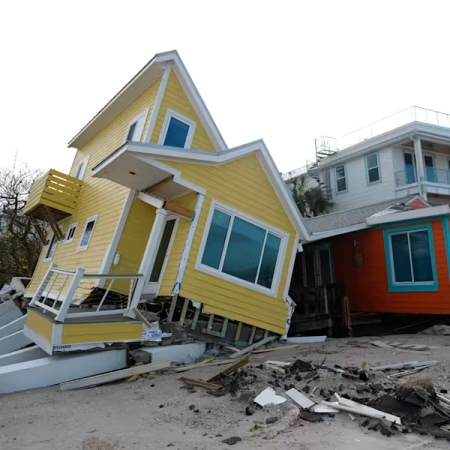
Two weeks later, the potentially even more destructive category 5 Hurricane Milton bore down on Florida’s west coast, ripping through Tampa and Orlando before heading out to the Atlantic. While there was considerably less loss of life, the damage was extensive—flooding communities, smashing residential neighborhoods, and even tearing off the roof of Tropicana Field, home of the Tampa Bay Rays baseball team.
There are serious questions that are seldom asked in the wake of such terrible tragedies. Chief among them is: “How could this happen, and what can be done to prevent it happening again, and again, and again?”
The science is very clear. The growing intensity of hurricanes is the outcome of global climate change. As the atmosphere warms, primarily due to fossil fuel emissions, the oceans absorb the heat. NASA data since 1955 shows that 90% of global warming occurs in the oceans. This also contributes to sea-level rise as warmer water expands. When a tropical depression forms over warm water, clouds absorb the warm water in increasing volume. Citing data from the recent Fifth National Climate Assessment, completed last year, researchers found that the amount of precipitation in the most intense rainstorms has increased by 37% in the southeast since 1958 (see Lucy Dean Stockton and Freddy Brewster in The Lever, Oct. 2, 2024).
In the United States, we have one major political party that is led by a coterie of climate deniers, whose leader proclaims the answer to economic woes as “Drill, baby, drill!” Remarkably, the Republican governor of Florida, Ron DeSantis, signed a bill in May banning the use of the term “climate change” in official documents. He also banned wind turbines offshore and expanded the provisions for natural gas. While surveying the damage from Milton on Oct. 10, DeSantis declared to the media that such hurricanes are “kind of normal” and “to be expected” in Florida, and that climate change had nothing to do with it. This was after a summer in which Florida endured record levels of heat. In fact, the Coral Restoration Foundation recorded in July that coral at Sombrero Reef, off the coast of the Florida Keys, had suffered 100% mortality due to the extreme warmth of the ocean water.
The other major party touts a transition to alternative energy techniques (wind, solar, lithium battery vehicles), while still subsidizing fossil-fuel industries and cutting compromises with their defenders. The topic of climate mitigation has rarely come up in the 2024 campaign by Democrats. That may be because the Biden administration has handed out 1450 new oil and gas licenses, accounting for half the global number, and 20% more licenses than those issued by Donald Trump. Not under consideration is the demand for the payment of reparations for the damages wrought by extractive industries.
Of course, climate mitigation is an extremely complex global problem. The atmosphere and the oceans are no respecter of political boundaries, economic systems, or ideologies. However, the role that profit-driven capitalism has played as the engine of climate change cannot be denied. A week ago, Britain celebrated the closure of its last coal-fueled electrical plant. While this was a welcomed event, the fact remains that the emissions of carbon from the past two centuries of coal-fired energy are still in our atmosphere, and will not be erased for decades to come. The same can be said for all the oil, gas, and methane emissions of the industrial nations for previous centuries.
On the face of it, the biennial COP (Conference of Parties) gatherings might portend the sort of international cooperation that would address these issues. However, they have been over-represented by the fossil-fuel-export nations and their minions, seeking to protect their profits. The next COP is coming up this November in Baku, Azerbaijan—a major exporter of oil and natural gas. It would be a mistake to count on any major climate policy initiatives emerging from Baku. Previous COP events, including the Paris COP 21, have been a venue for promises never kept.
What is needed is less leadership “from above,” and more mass demand “from below.” Without a reversal of the current dynamic of inaction, we can expect a future of more devastation from wildfires, drought, and monster storms.
This struggle will not be easy. Already, the fossil-fuel capitalists and their legislative lackeys are passing and initiating measures to criminalize peaceful protests by climate activists. These laws are frequently written by lobbyists and call for fines—and even imprisonment—for terms up to 10 years. The resolve of the resistance must be strong. Socialists are committed to this struggle and to bringing revolutionary change.
Photo: A house lies toppled by Hurricane Milton in Bradenton Beach on Ana Maria Island, Fla., Oct. 10. (Rebecca Blackwell / AP)
-
Mammoth strike hits Samsung in India


By a CORRESPONDENT IN INDIA of the INTERNATIONAL WORKERS LEAGUE
Since Sept. 9, the workers at the Samsung plant at Sriperambudur, in the Southern Indian state of Tamil Nadu, have been on strike. Over a thousand workers have been on strike demanding increases in pay, among various other demands for improving their work conditions. The intensity and militancy shown in the strike, has been an inspiration. It has been 20 days as of the writing of this article, and the strike has inspired protest actions and solidarity from workers across the industrial belt.
The Samsung plant in the Southern state of Tamil Nadu is one of two factories in India, the other being in Noida in North India. The Sriperambudur factory makes Samsung’s popular television sets, refrigerators, and washing machines, accounting for a third of Samsung’s $12 billion in revenue from India. This enormous revenue is built on the exploitation of the workers at their Indian factories.
Today, the workers at the Tamil Nadu factory have erupted in a strike against the conditions the company has imposed on them. From the get go, the company and state police have attempted to clamp down on the workers; 118 workers on strike had been arrested, but were freed on Sept. 16 in what has become an early victory in their struggle.
Causes of the strike
The immediate causes of the strike are two fold: First, the recognition of the Samsung India Workers Union (SIWU), which has been pending since July of 2023, and an increase in wages—which are barely enough to meet expenses. The highest salary offered by the company stands at a mere 30,000 rupees a month, with the highest possible increment being 3000 rupees a month. Expenses for schooling alone takes out 100,000 rupees annually, leaving two-thirds of a worker’s salary to cover essentials such as food, housing, and electricity. Workers at Samsung barely make enough, even at the highest pay grade, and get caught in a cycle of loans.
As of today, the SIWU membership accounts for a majority of Samsung India’s workforce spread across two major production hubs, numbering about 1500 out of 1723 of Samsung India’s workforce. The SIWU is linked with the national trade-union network CITU, affiliated with the CPIM.
The struggle for recognition forms a long-standing demand of the union, and forms a major part of the strike. While there are laws protecting the right to organize and form trade unions, there is no mandate for companies to recognize trade unions once they are formed. Many companies exploit this loophole, especially foreign corporations operating in India. The strike only grew after the company resorted to coercive tactics, and the mass arrest of 118 workers.
Samsung’s presence in India
South Korean and Japanese capital have a massive presence in India, especially in the manufacturing and electronics sector. Hyundai Motors corners 15% of the passenger car sector in India; LG, a major electronics conglomerate, has 15% share of the smart TV market in India; its competitor Samsung has 16% share. In the refrigerator market, Samsung enjoys a 29% share while its competitor LG controls 30% share. Together, these three large Korean Chaebols control a sizeable sector of India’s electronics and passenger car industries.
The key to Samsung’s influence over the refrigerator and TV market in India is the Sriperumbudur factory in Tamil Nadu, the very factory that is on strike today. The strike’s impact cannot be understated. Despite all attempts to counter the impact of the strike, the production at the plant remains low. Compressor production has dropped by nearly half from 13,800 a day to 8000 units, refrigerator production has fallen from 10,000 units a day to 700 units a day, and washing machine production has declined from 3000 to 1400 units a day. Only one-fifth of the workforce at the Sriperumbudur plant is working.
India presents not just a major market for South Korean companies but also a key production base for South Korean companies. India’s economic growth, fueled by aggressive proletarianization of the countryside and the rise of monopolies at the expense of petty capital, supplies a growing number of proletarians with nothing to sell but their labour power. With China and South East Asia’s workforce aging and wages rising, India is seen as the next most profitable nation for manufacturing.
Under the right-wing government of the BJP, labour laws have been weakened, and conditions are being created for inviting foreign capital in manufacturing. “Make in India” is the slogan to open India’s working class to exploitation at the hands of foreign manufacturing companies. Korean companies like Samsung are keen to cash in on the opportunity given. It is in this context that Samsung has announced the establishment of the world’s largest mobile phone factory in Noida, near Delhi.
While Korean companies profit from liberally exploiting Indian labour, the working class has to face harassment and oppression as their rights are attacked.
Korean capital’s influence over electronics and manufacturing isn’t limited to India, but is felt the world over. Samsung’s global commercial empire is built on the backs of vicious exploitation of its workforce. Just as in India, so too in South Korea, Samsung exploits its workers. They make billions by keeping their workforce on the edge of bankruptcy. Korean workers have risen in revolt against the company in Seoul, the capital of South Korea. The workers at Sriperumbudur have expressed their solidarity with their Korean comrades. The workers of Korea have expressed their solidarity with their Indian comrades.
Korea: Colonialism and war
Korea’s history is one of colonization and conquest. The Japanese were the first to colonize the Korean peninsula, beginning from expanding influence to outright annexing the country. The period of colonization saw the birth of a nascent Korean capitalist class, along with the deep penetration of Japanese capital into all sectors of life and society. The Japanese Empire had brutally smashed the old Confucian isolationist monarchy, and opened up the economy to exploitation, in turn sowing the seeds of a future indigenous capitalist class. It is worth mentioning that Samsung and LG (the two largest conglomerates of Korea) were both established in the colonial period.
With the end of World War II in Asia, a revolutionary process in East Asia had grown in strength, and secured a victory in China at the end of a brutal civil war. The impact of this revolutionary process came to Korea as well. Revolutionaries who had been trained and organized by the fight in China, were ready to bring the revolution to Korea. However, the great powers of the time, particularly the Soviet Union led by Stalin, and the United States, rushed to defeat such a revolution. The politics of the great powers trumped any democratic desire of the Korean people. The Korean revolution would be crushed by the dual power of Stalinism and Imperialism. While Stalin subjected the Korean revolution to the diktats of the Soviet High Command, and their puppet, the United States subjected the Korean people to one of the most brutal right-wing dictatorship of the 1950s.
South Korean capital was saved by bathing the peninsula in blood, as thousands of workers and peasants were massacred, with the full backing of the United States. Meanwhile, the North was organized around the party and it’s leadership of Kim Il Sung, under the model of a bureaucratic dictatorship. The two forces worked in tandem to destroy the potential of a peninsular revolution, and opened the path of war. The Korean War would be devastating, and the final straw that destroyed the possibility of a revolution in Korea and with it a wider East Asian revolution.
The Korean War resulted in a divided peninsula with a self-proclaimed “communist“ North and a capitalist South. The war saw much of the North completely destroyed, and the South suffered under a vicious right-wing dictatorship. The dictatorship sowed the seeds for the future growth of Korean conglomerates, backed liberally by the United States, who now needed a bulwark against the Soviet Union and China. This set-up created the conditions for the meteoric rise of South Korea’s capitalism, which today ranks in sophistication and influence among the most powerful nations in the world. At the heart of this growth, is the conglomerate of Samsung.
Korean chaebols and Korean capitalism
After the war had ended, South Korea was built up as a militarized capitalist dictatorship. The Syngman Rhee dictatorship laid the foundations of the growth of a uniquely Korean style conglomerate structure, the chaebol. The chaebols are conglomerates run by the company’s founder and their family, closely held and well connected with the government apparatus. The control of the chaebols over the South Korean economy is as vast as it is deep. The most powerful of the chaebols is Samsung, whose president is sometimes considered more powerful than the president of the country. Samsung alone accounts for over one-fifth of South Korea’s export revenue of $1.74 trillion. Samsung maintains an expansive global commercial empire, a key part of which is in India.
South Korean capitalists benefited from the dictatorship and the regime that succeeded it. Workers’ rights were crushed, unions were terrorized, and the chaebols were allowed to grow by intensely exploiting their workforce, backed by a dictatorial state that was ready to stamp out any threat of “communism.” The companies were at liberty to set in a toxic work culture, one that continues till today.
Inspired by ruthless managerial techniques of the Japanese Empire, the Korean capitalists of the South installed a system called “gapjil,“ in which workplace management called “gap“ oversaw subordinates called “jil.” The “jil“ must yield to the “gap.” The rigidity and toxicity of the workplace served the interests of the capitalist to rapidly grow their enterprise. Control over the workforce goes hand in hand with keeping wages as low as possible.
The dictatorship ended in 1987, following the July 10 protests. The revolution itself was a democratic revolution, but it could not have been achieved without the militant workers of South Korea. Over 1985 and 1986, workers struck across industries in South Korea. The military dictatorship fell, but the new republic remained in the throes of the Chaebols and capitalists.
Ten years after the July 10 uprising, South Korea saw the largest general strike in the history of the country, this time protesting a new law which made it easier to hire and fire workers and clamp down on labour organization. The new law would also increase the legal work week by 12 hours, allow company to decide and modify work hours, and use scab labour to break strikes. The victory of the strike forced the new republican government to fall back, the Chaebols were defeated.
It improved working conditions greatly and made South Korean workers among the best paid in all of Asia. This defeat was not the end of the Chaebols, their insatiable desire for profit and power saw them leaving the limits of South Korea to set up factories across East and South East Asia. They came to India in 1995 just in time to exploit Indian labour, at a time when it was opening up to foreign capital, and dismantling the old state capitalist structure.
Korean chaebols and especially Samsung maintain a heavy influence over South Korea, and have a commanding presence over its economy. With the 2008 financial crisis, and more recent crises from the COVID pandemic and the Russo-Ukrainian war, the Korean economy is in crisis. As is always the case with capitalist crisis, it is the workers who are made to foot the bill. Workers have returned to striking in protest against low wages that do not keep up with cost of living. Just one month ago, Samsung workers under the National Samsung Electrics Union (NSEU) struck work for four days. Their strike resonated among workers in India as well.
Tamil Nadu’s rise as an industrial center
Tamil Nadu was previously part of Madras state, formed from the Madras presidency of the British Raj. Chennai, previously Madras, was one of the three main urban centers developed by the British Empire. Madras was the key urban and industrial center of Southern India, dominating the economy of South India. After independence, the Indian capitalist class largely focused on the development along the Bombay-Delhi axis, focusing investments in the region around the capital of New Delhi and the financial capital of Bombay (now Mumbai). At the same time, partition and instability led to the decline of the Eastern metropolis of Calcutta (now Kolkata) and the subsequent flight of industrial capital from East to West.
Investments in education in Southern India in the last decades of British rule, as well as during the Nehruvian era, created a base of educated working class in peninsular India. However, with industrial and financial investment concentrated in Western and Northern India, the South largely lagged behind. This was until the 1980s and ’90s, when India began to open up to foreign capital.
The regional bourgeoisie in South India tapped into the opportunity presented by the decline of West Bengal and Eastern India. At the same time, Bombay and Western India was beginning to stagnate as the old industrial centers began to get gutted. Bombay saw its great textile mills close, and industry shifting further into the Maharashtra hinterland. Delhi and North India remained underdeveloped owing to bad infrastructure and bureaucratic influence of the national capital. The South of the country, with its large pool of cheap labour and low rents, coupled with cooperative bourgeois governments ready to curb any working-class militancy, presented a good opportunity for industrial development.
The growth of Southern India coincided with the influx of foreign capital after the liberalizing reforms initiated in 1991. The skilled workforce in Southern India was perfectly poised to supply the labour demands of the IT sector; the growth of the IT sector would then draw in investments in other areas. Chennai (formerly Madras) became a hub for automotive manufacturing, and eventually electronics. Samsung entered the scene in the ’90s and soon built a massive complex in Tamil Nadu’s Sriperumbudur.
The growth of Tamil Nadu as an industrial center could not be achieved without the dual force of heavy proletarianization of the countryside, and a ruthlessly pro-capitalist government which would welcome industry with open arms.
The significance of the strike
Combined with the strike of Samsung workers in Seoul, the strike of the Samsung workers in South Korea challenges the whole system of exploitation that built the Korean chaebols. The wealth and power of Korean capital is fed by the most vicious exploitation of the working class. The Korean workers fought against it to gain benefits, now the Indian working class is fighting.
It is doubly significant that the Indian and Korean workers are in solidarity with one another. The Seoul strike was supported by the SIWU union in India, and the NSEU strike was supported by the workers in India. The tried and tested tactic of the bourgeoisie is divide and rule, the power of transnational corporations is their ability to shift production away from one center to another, where wages are cheaper or workers unorganized.
To challenge this requires solidarity, not just within an industrial sector, but beyond it, across national boundaries. It is only through solidarity that the power of the capitalists can be challenged.
The strike in Samsung challenges the practices of Korean capitalism, and it has aroused the support of workers across the industrial belt. In much the same way, the strike at Honda in Manesar had challenged the exploitative system in Manesar Gurgaon. The workers need and deserve our fullest support !
NATIONALIZE SAMSUNG!
NATIONALIZE ALL FOREIGN ASSETS!
WAGES PEGGED TO INFLATION!
STRICTLY ENFORCE THE 8-HOUR WORKDAY!
Photo: Getty Images
-
Latin American fires: The power of the capitalists must be broken


By LENA SOUZA
As Latin Americans, where statistics show that Catholicism is predominant, it is possible that most of us have heard at some point in our lives that the Bible says that the world will end in fire. Many of us are probably reminded of this when we imagine wildfires and their ferocity.
Reality shows us that the destructive power of fires and their aftermath can put people at risk of losing their lives, but the responsibility is far from being moral, religious, or individual. The explanation for this situation is not based on sins and punishments, as the ideas peddled by the Church and the powerful would have us believe.
Latin America in fire and smoke
Latin America is no longer visible from space. For the last two months, the images we have seen are of a continent full of red dots caused by fire or clouds of smoke covering the ancient and beautiful spatial image of the blue earth.
According to the Brazilian INPE (National Institute of Space Research), the number of fires detected by the reference satellite in Latin America between Jan. 1 and Sept. 20, 2024, totals 380,245 and covers 13 countries (Argentina, Bolivia, Brazil, Chile, Colombia, Ecuador, Guyana, French Guyana, Paraguay, Peru, Suriname, Uruguay and Venezuela). Of these, only Chile, French Guyana, and Uruguay have lower numbers than in 2023.
Brazil leads the statistics with 195,314 wildfires, mostly concentrated in the Amazon and Cerrado biomes. Data from Brazil’s National Confederation of Municipalities (CNM) show that as of Sept. 16, 749 municipalities had declared states of emergency and 11.2 million people have been directly affected. The damage has already reached 1.1 billion reais, which is 33 times more than the damage in 2023. At the same time last year, the drought affected 630,700 people in 120 municipalities[1].
Bolivia is the second country in terms of the number of fires, with 67,620 recorded, according to INPE. The forest fires are devastating the departments of Pando, Beni, and Santa Cruz, all located in the Bolivian Amazon, where most fires have historically occurred. According to a report published by the government on Sept. 19, 3.8 million hectares have been affected, 64 communities, 28 of which are in a state of emergency, and 43,000 people have been directly affected.
In Ecuador, according to the same INPE report, 1267 fires have been detected and the government has declared a state of emergency in 15 provinces. The fires began on Aug. 23 and by Sept. 20 had burned 23,453 hectares of vegetation. Food security is at risk as more than 7,000 crops have been affected, impacting more than 2,800 farmers, almost all of whom have lost their vegetable crops[2].
Peru has also had the highest number of fires in recent years, creating a national emergency where, according to a government report[3], the departments most affected include Cusco, Cajamarca, Huancavelica, Huánuco, and Apurímac, where agricultural activities are most intense. The fires in this country have also caused 165 burn injuries and 18 deaths this year. In addition, more than 2,000 hectares of crops have been affected.
Colombia, Venezuela, Argentina, and Paraguay have also been hit hard by fires. In Colombia, the National Unit for Risk and Disaster Management (UNGRD) reported on Sept. 19 that “during the month of September, there were 249 forest fires in 14 departments: Cundinamarca with 66, Huila with 44 and Tolima with 44 are the most affected. The flames have consumed 23,000 hectares of forest.”[4] In Paraguay, according to the National Forestry Institute (INFONA),[5] more than 181,000 hectares have been destroyed so far in the Chovoreca region (a protected area) and a total of more than 353,000 hectares have been affected throughout the country. In Argentina, the province of Córdoba is currently the most affected, where wildfires have already consumed about 20 houses[6].
We can say that these are the direct effects and consequences of the fires, but there are other far-reaching implications. Wildfires have a direct impact on biodiversity, soil, and air. And if all this didn’t enough attract attention, because it doesn’t directly affect the majority of the population, it is now becoming more visible through the smoke we breathe across the continent, which has already led to the deaths of thousands of people. In addition, the CO2 emitted into the atmosphere is a major contributor to global warming, which will undoubtedly lead to more extreme weather events, which, according to research, is already understood by the majority of the population suffering the consequences.
The causes of the fires
It’s true that droughts have always existed. As the Atlas of Droughts (2018)[7] notes, civilization has experienced famine, migration, and disease due to lack of rain since ancient times. After all, we live on a planet with varying environmental conditions. But humans have adapted to adverse environmental conditions, taking from nature what they need to survive and creating adaptations that have made it possible to grow crops even in arid areas, such as irrigation.
But if humans have been able to create the conditions and technology to cope with adverse situations and even manage to grow crops in drier areas, why have we reached the current state of imbalance?
The problem is that the greed for profit of a very small sector of society, the big billionaires, has pushed the limits of the planet, leading us to the current imbalance, which even the deniers can no longer refute. And in the capitalist system, where profit is central, these same billionaires, with the help of their representatives in governments, are not only doing nothing to reduce the tons of CO2 released into the atmosphere, they are also taking advantage of the climate disasters that affect the poor to make more money.
Extreme weather events, such as the drought in Latin America, have meant more money for those who profit from this irrational system. They have taken advantage of this moment to set fires according to their interests, such as expanding the amount of land for monoculture and cattle ranching in the territories of Indigenous peoples or environmental conservation areas.
The reality that is becoming more and more apparent in all the countries that are suffering from fires is that most of them are being caused by a sector of the wealthy class that exploits natural resources in a totally irresponsible way. And moreover, they are doing so with the full support of the governments in power, whether they are right wing, center, or so-called “progressive” left. The deforestation and destruction of ecosystems for cattle ranching, monocultures, and mineral exploitation has been the hallmark of recent decades in Latin America.
The deepening of capitalist exploitation demands more and more raw materials and energy, increasing the pressure on natural resources, and Latin America is one of the continents where this extraction has intensified in recent decades. At the beginning of the 21st century, the so-called neo-extractivism—a new phase of extractivism that Latin American countries had already experienced at other times—opened the door to the unbridled exploitation of the continent’s resources, mainly by the imperialist transnationals, and was encouraged by all the governments in power. The high international prices of primary products even helped the “progressives” to create the illusion among workers and poor people that it was now our turn.
But the privileged were always the rich (imperialist businessmen and their national partners) who got richer. And the cycle of wealth concentration continues as our natural resources are plundered, our labor is exploited, and most of what goes into the public coffers through taxes is returned, with increases, to the same rich people through tax breaks, soft loans, and other means. Governments distribute the crumbs to the poor through various bonuses and poverty grants to ensure that they remain in power. These same governments are the ones that allocate part of the resources for the police and military forces to repress the Indigenous peoples, small farmers, and social movements that question the handing over of our resources and the invasion of our lands by big business. Meanwhile, they turn a blind eye to the practices of the same people who use fire to justify invading Indigenous territories and protected areas to expand their businesses.
In Brazil, the country with the largest land area, it is clear, as Jeferson Choma says: “Satellite images are the best proof that the fires indicate the opening of new agricultural frontiers for the model of capitalist agriculture called agribusiness”[8].
The director of IPAM (Instituto de Pesquisa Ambiental da Amazônia) in Brazil says that “most of these fires have criminal origins. One of the most common cases is cattle ranchers who use fires to clear pastures. Normally, this traditional practice is only allowed with prior authorization from the state where the land is located. The current crisis has led to its absolute prohibition throughout the country. It is perhaps the least respected law in Brazil,” adds IPAM’s scientific director.[9] Faced with this situation, the Lula government’s only response in recent days has been to impose tiny fines that don’t even touch the pockets of the big landowners.
But this conclusion is not limited to Brazil. In other countries, the interest of sectors linked to agribusiness and mining is also evident, as they take advantage of the fires to expand their business areas, even entering Indigenous and ecologically protected lands.
In Paraguay, according to a report by the Amotocodie Initiative, after a fire was started by a farmer: “It took only ten days for the Garaigosode territory to be almost completely consumed. The indigenous property lost 14,200 hectares of fields and forest. (The) Cerro Chovoreca Natural Monument, a refuge for wildlife and isolated Ayoreo families, (lost) 3,900 hectares”[10].
In Bolivia, the statistics leave no doubt: the departments where the fires have destroyed the most are Beni and Santa Cruz, located in the Bolivian Amazon. “In Beni, 54% of the total area burned annually in Bolivia was recorded between 2001 and 2020, according to the Forest Fire Risk Monitoring and Early Warning System. In Santa Cruz, 38% of the hectares were consumed by flames.” “Proof of this is that in the 2024 season, at least 3.8 million hectares were burned in Bolivia. Of these, 2.3 million were pastures and 1.5 million were forests”[11].
We all know that the increase in greenhouse gas emissions is causing global warming, which is responsible for the climate imbalance of the planet. And this conclusion is not new, but the great leaders of the planet, the imperialist countries that are the main representatives of the wealthy class that dominates decision-making, have done nothing to solve the problem. After summits and summits, agendas and agendas, commitments and commitments, the situation has only worsened, because it’s all bullshit to fool the majority of us, the poor and working class, who are suffering the consequences in ever greater numbers.
Meanwhile, the governments in power in Latin America continue to weaken environmental laws and give in to pressure from big business, as in Peru with the Forestry Law[12], in Ecuador with the government’s failure to respect the results of the consultation on the Yasuní Park[13], and so many other examples in all countries that it would be impossible to list them in a single article.
We must take to the streets
We must take to the streets and organize from below to demand that the governments immediately allocate resources to fight the fires that are raging. And we must also demand the strengthening of environmental laws, which in recent years have been made more flexible or eliminated by all the governments in order to privilege the big and rich businessmen in the different countries.
In recent weeks, we have seen several demonstrations in different countries, such as in Peru, where the people have demanded that the Dina government cancel the new Forestry Law, approved in December 2023, which opens the door to deforestation. In Brazil, the people are demanding that Lula stop financing agribusiness and begin to expropriate it. In Ecuador, the social movement demands that the Noboa government respect the decision of the Yasuni popular consultation.
We must expand the mobilizations throughout the continent, holding united days of struggle to strengthen our fight to defend the Amazon and the different biomes that we must preserve, as well as to guarantee the continued rights of Indigenous peoples to their territories, and the quality of life of all of us who need clean air to breathe.
We must break the power of the capitalists
But we must also think of our future and that of coming generations. As the lyrics of a Brazilian song[14] say, in nature “there is no sin, no forgiveness.” We cannot believe, as the Church does, that environmental catastrophes such as forest fires are the work of a superior being to punish us for our sins, because reality shows us that they are the work and responsibility of a social class that grows richer every year by exploiting nature and our labor. And we must realize that there is no forgiveness in nature either, because it charges for its destruction and the bill goes to the poorest. It is our class, the poor and the working class, who are confronted every day with polluted air, who die of respiratory diseases, who are left homeless and without land to cultivate, who pay more for food, and suffer a long list of all the consequences we face from the environmental destruction caused by the capitalist system.
Not to mention that young people, children and new generations are already living and will continue to live in environmental barbarism, as all scientific predictions indicate.
That’s why, if we want to save our home, our planet, we have to put an end to the capitalist system and build a society that lives respectfully with nature. And this society can only be a society that does not revolve around exploitation and profit, but rather provides for the needs of human beings in an egalitarian and supportive way and in accordance with the limits of nature. That’s why we advocate a socialist society. Only in such a society, in which the workers and the poor rule, can we impose the will of the majority.
Notes
[1] CNM Portal – Study updated by CNM shows that more than 11 million people have been directly affected by the fires – National Confederation of Municipalities
[2] Unexpected national blackout: Gobierno no ha pronunciado cuál fue la causa | Televistazo 7 PM #ENVIVO (youtube.com)
[3] INDECI emphasizes the importance of the joint work of the three levels of government in the face of forest fires – Noticias – Instituto Nacional de Defensa Civil – Plataforma del Estado Peruano (www.gob.pe)
[4] UNGRD proposes to fight fire with fire, what is the new strategy? (gestiondelriesgo.gov.co)
[5] Statistical data on forest fires during the first weeks of September – National Forestry Institute (infona.gov.py)
[6] https://www.infobae.com/sociedad/2024/09/21/incendios-y-drama-en-cordoba-las-llamas-alcanzaron-a-varias-casas-en-capilla-del-monte-hay-evacuados-y-un-detenido/
[7] Atlas de Sequías de América Latina y el Caribe; 2018 (lapismet.com.br)
[8] All over Brazil, climate barbarism is knocking at the door | Opinião SocialistaOpinião Socialista (opiniaosocialista.com.br)
[9] What is known about the wave of fires in Brazil (uol.com.br)
[10] Análisis de los incendios en Chovoreca, septiembre 2024 – Iniciativa Amotocodie (iniciativa-amotocodie.org)
[11] Why do forest fires devastate Brazil and Bolivia every year? – Medio Ambiente (france24.com)
[12] Peruvian government seeks to implement changes to forestry law while ignoring formal calls to repeal it (mongabay.com)
[13] President Noboa’s new decree fails to resolve uncertainty over fulfillment of Yasuní consultation in Ecuador (mongabay.com)
[14] Caetano Veloso – Alguém Cantando (youtube.com) -
El Salvador: ‘Time has come to build the political instrument of the working class’


By WORKING CLASS PLATFORM ( Plataforma de la Clase Trabajadora)
This statement reflects the views of Working Class Platform, the Salvadoran section of the International Workers League – Fourth International.
El Salvador is experiencing its darkest moment in recent history. It seems that the cycle is repeating itself and authoritarianism has come to us again. We find ourselves living under a dictatorship, which contradictorily has popular support. But at the same time, its measures are leading us into ever more difficult circumstances: hunger, pain, death and repression are undoubtedly our destiny. Facing such a situation, sectors of the revolutionary vanguard cannot remain indifferent, and we must move from a defensive to an offensive position, and assume the tasks of the historical moment in which we are living.
El Salvador needs to put an end to capitalism and its submission to imperialism
Our country is a semi-colony of the U.S. empire because, although we are not Puerto Rico, in practice there are characteristics of our country that have consolidated a relationship of direct dependence on U.S. imperialism:
- Dollarized economy: We have neither our own currency nor our own monetary policy; we depend totally on the ups and downs of the dollar in the world economy. In addition, the whole economic apparatus is set up for the benefit of those who use the dollar to do their business.
- Free Trade Agreement: This annexationist trade policy makes our trade balance tilt unfavorably towards U.S. production but also defines percentages of our production destined exclusively to the U.S., without obtaining fair compensation for them. This increasingly weakens our public finances, turning our territory into a tax haven for the production of goods at low cost without recognizing the value of our labor force.
- Migration/Remittances:The United States is the recipient of the highest percentage of Salvadorans who migrate (for whatever reason), providing them labor, but also making the Salvadoran economy depend on the remittances that our compatriots send. This also facilitates the consumerist mentality that benefits the empire so much, disintegrating our families and taking away our main resource, our people.
- Gringo military and police enclave:It is no secret that the ILEA (International Law Enforcement Academy) operates in our country, in which police personnel from Central America and the broader Latin American region are trained. We have also ceded sovereignty by allowing the installation of an air base in Comalapa where the United States has two parallel runways, which are large enough for any type of military aircraft to operate on them. This is located near San Salvador, on the Pacific coast and at a strategic point that allows for control of the Gulf of Fonseca, the triple border between Honduras, El Salvador and Nicaragua.
The structures outlined above are a function of the fourteen families that have mutated into large business groups that own the country and part of Latin America: Poma Group, Simán Group, Quiroz Group, Agrisal Group, Calleja Group, Kriete Group, and which today operate under the shelter and complicity of the transnational bourgeoisie. With the control of the state apparatus, the Bukele Group, these families that are no longer fourteen, yet they are increasingly profiting within the capitalist framework that permits the extraction of local wealth, control of the state apparatus and corruption, and clearly identified monopolies. At the same time, they are also maintaining national business through both internal and external debt.
Confronted with this reality, the creation of a bourgeois nationalism is not enough. This was the mirage that Bukele awakened at the beginning. Likewise, the creation of a welfare state that the “left” FMLN (Farabundo Martí National Liberation Front) bet on in the laying of its foundations was not enough, much less the voracious neoliberalism of the right-wing ARENA (Nationalist Republican Alliance) party.
It is necessary to break with capitalism and its guarantees that the wealth produced by the working class (in a broad sense) always goes to the owners of the means of production, and in the case of El Salvador, the business groups (families) mentioned above. This rupture must occur at both the economic level with all imperialism (American, Chinese, European, etc.) and also, at the political level, mainly with the country of the North American empire. This is necessary because nothing that has been done so far, from the military and “democratic” governments, has solved the problems of the people in El Salvador: poverty continues to affect a high percentage of the population, unemployment continues to affect the ability of working people to provide for themselves and their families, pushing people to migrate, disintegrating families and society itself, and creating breeding grounds for violence and increasing inequality.
- Arena, FMLN and Bukele demonstrate that they are not an alternative
The working class has already lived through the experience of ARENA in power for 20 long years, the FMLN for 10 years, and now Bukele for 5 years.
ARENA ruled the country at its ease for two decades, implementing the neoliberal model that only deepened the problems of El Salvador. Then the FMLN ruled for a decade, blaming its failings on its lack of power to implement the necessary social transformations. However, the truth is that it merely sold a leftist discourse and it did not break with the neoliberalism that ARENA implemented. Further, the FMLN betrayed the people who trusted in the change that were promised, and it dismantled the social organization that allowed people to make demands for much-needed changes. And as if that were not enough, it also became embroiled in two corruption cases that have taken their toll, turning the party into a minimal political force and a negligible element in the broader social struggle.
Nayib Bukele is currently enjoying his illegitimate and unconstitutional second term, and has already demonstrated that his economic policies are not at all contrary to imperialism. Although he speaks of sovereignty in his speeches, and has even publically distanced himself from imperialism, in practice it is clear that his priority is to facilitate business and attract investors to continue plundering and destroying the few resources the country has.
And while his security policy appears to be an enormous success, it lacks solidity, and is reactionary and will prove ultimately ephemeral because instead of fighting the causes and roots of violence, that is to say migration, inequality, poverty, family, social disintegration, and a lack of opportunities for all, it has opted for the iron fist. Although it has brought Bukele electoral gains, it lacks both soundness and the possibility of continuity beyond the period of the current regime. Unfortunately, violence will resurface, either in the form of gangs or in another form. In summary, Bukele is only building a dictatorship through the persecution and criminalization of those who do not think like him while he concentrates more and more power and enriches his family/business group.
- The only way out for El Salvador is the struggle for socialism
This socialist solution consists of putting all the wealth that is produced in the hands of the working class. This is only possible by expropriating the bourgeoisie from the control of the means of production, establishing a democratically planned economy, which produces what the people decide and need for their development, and the monopoly on foreign trade. This is only possible in the framework of the struggle for socialism in Central America, in which the bourgeois states are overthrown and transformed into New Workers’ States, based on workers’ and people’s councils. The reorientation of international relations will also be necessary, including their replacement by those that benefit the country, instead of plundering it.
At this point it is important to differentiate what we are talking about with respect to the histories of Cuba, Venezuela, Nicaragua, and China. Although they call themselves communist or socialist, in practice and in the background they are capitalist states. It is enough to review what has been said so far regarding the planned economy, the establishment of relations free from plunder, and putting the people and not business at the center, to understand clearly the difference between them and our socialist vision. In the case of the above countries, their main economic resources are in the hands of the national and foreign bourgeoisie, so that the wealth produced is not at the service of the people. In addition, their main leaders are new bourgeoisie.
This solution that we propose must be done with Central American unity. Our countries were born as one: a great Central American nation that, separated by selfish interests, has made us believe that the paths forward are also separate. However, the truth is that we share much more than what they have said separates us. Moreover, in the global concert of nations, it is impossible to carry out the proposed transformations alone and in isolation. And the fact is that, just as capitalism is global, the solution must also be global, and in our case, it begins with Socialist Central America.
This solution is only possible strategically if the struggle for socialism in El Salvador and Central America is linked to the struggle for world socialism.
- This is only possible through a revolutionary solution
We cannot achieve this task through the means offered by bourgeois democracy, that is, through elections that only serve as a release valve in a cyclical manner over time. Electoralism makes the people place their yearnings and hopes for change in electoral cycles that only deceive them and keep them in submission in favor of a capitalist state. It is important to defend bourgeois elections as spaces to denounce the excesses of corrupt politicians, but as a class we must defend our own methods and mechanisms, our own State and our own institutions.
The Bukele regime is the best example of why we cannot trust bourgeois institutions that are genuflecting to the ruler of the day. However, it is important to clarify that although we tend to associate REVOLUTION with WAR OR ARMED RESISTANCE, we have to say that the method for today is not guerrilla warfare. Rather, we call for the insurrection of the masses to overthrow the government and take power, knowing that the guerrilla is only one tactic among others. For us, the strategy is the seizure of power by the working masses, so it is not a task for a privileged group, but for all working people.
- We need a political instrument
None of this is possible without a political instrument of the working class in the broad sense, meaning a party that is for those of us who have only our labor power to survive, and who live from the labor of our efforts. It must be independent of the bourgeoisie and belong to our own class. This political instrument has not yet existed in our country. We have not yet had an instrument not centered on elections, but rather on the struggles of the working people, whose main task is to confront the framework of the Bukele dictatorship, and to win over the people to the struggle for a revolutionary and socialist way out.
The second task of the political instrument is to educate the masses in the socialist and revolutionary program so that they can fulfill their role in the struggle for power.
Therefore, this instrument must have certain characteristics. It must be:
- Internationalist, because it understands that the triumph of the revolution is not possible individually and in isolation.
- Classist, because there is no room for the bourgeoisie or oppressors, it fights against all types of oppression and is constituted by the best elements of the working class.
- Conspiratorial, because we face a dictatorial, repressive and murderous regime.
- Democratically centralized, because its decisions are widely discussed and constructed by all and once voted, they are also respected by all, even by those who were in the minority when voting.
- Self-financed, it will depend on the resources of the working class itself and not on any bourgeoisie, nor on any mechanism that may or may not want to influence the decisions in a different way than the one decided by the people.
- Combative, because it is forged and built in the struggles of the working class.
The first task of this organization is to elaborate the transitional program for the socialist revolution in El Salvador, which starts from the needs of the masses to elaborate a set of democratic, economic, and socialist demands to win the vanguard and the Salvadoran people to the struggle for socialism and revolution. We must provide the class with a revolutionary leadership, which cannot be improvised, it must be built beforehand.
“For us it is not a question of reforming private property, but of abolishing it; it is not a question of alleviating class antagonisms, but of abolishing classes; it is not a question of improving the existing society, but of establishing a new one.”
— Karl Marx & Friedrich Engels, Circular to the League of Communists, 1850.
San Salvador, September 15, 2024
-
Brazil: Launch of Peoples’ Summit marks beginning of G20 protests


By CSP-CONLUTAS, Brazil
Different social movements and working class organizations, among them CSP-Conlutas [a Brazilian trade-union federation], gathered on Saturday, Sept. 14, for the launching of the Peoples’ Summit in front of the G20. The event was held in Rio de Janeiro, on the Via Apia da Rocinha, and marks the beginning of mobilizations that will take place in the capital of Rio de Janeiro until the Nineteenth G20 Summit, which is scheduled for Nov. 18 and 19.
The Peoples’ Summit is an autonomous and independent activity that takes place in opposition and parallel to the G20 program (an event that brings together heads of state of the world’s major economies). Among the issues to be discussed at the Peoples’ Summit are the social inequality and environmental destruction promoted by capitalism around the world, the anti-racist struggle, and the need for international solidarity with the Palestinian cause.
“We are gathered here to make clear our position of Out with the G20!” stated Júlio Condaque, of the CSP-Conlutas National Executive, during his participation in the opening of the launch. “The purpose of the mobilization is so that we can maintain independence from governments and bosses. Only our organized struggle will guarantee what the people need. Here in Rocinha, it will be the struggle of the residents that will guarantee basic sanitation. Let’s fight together until November,” he concluded.
About the G20
The G20 emerged in 1999 as an initiative to stabilize the world economy in the face of the crises of capitalism. After the 2008 crisis, it gained relevance by grouping more countries, in relation to the so-called G7, which gathers the main world powers. Despite presenting itself as an event concerned with social and environmental issues, the austerity plans of the International Monetary Fund and the World Bank dictate the agenda, as well as new attacks on workers.
The Peoples’ Summit
The Peoples’ Summit will be held from Nov. 16 to 18, in Rio de Janeiro, with the participation of the CSP-Conlutas and the International Trade Union Network of Solidarity and Struggles.
The initiative seeks to mobilize organizations and encourage protests against the G20. The CSP-Conlutas will have a tent at the site and will defend the actions of the entities independently before the governments. It will also count on the participation of other Brazilian and international organizations that will hold protests at Brazilian embassies in other countries.
The participation and organization in the demonstrations against the G20 was the subject of a resolution approved at the last meeting of the National Coordination of our Central, in July.
Article published in www.opiniaosocialista.com.br, 16/9/2024.
-
The legal lynching of Marcellus Williams


The execution of Williams was one more example of racist state terror
By JOHN KIRKLAND
Despite pleas and evidence of possible innocence, the state of Missouri opted to murder Marcellus “Khaliifah” Williams. Williams, who languished on death row for 23 years, maintained that he was innocent of the 1998 murder of Felicia Gayle. In the lead-up to the Sept. 24 execution, thousands, including the original prosecutor in the case and the victim’s family, called for the state to commute the sentence to life without parole. Opponents of the execution cast doubt on the DNA evidence in the case and made claims of racial bias in jury selection at Williams’ original trial.
According to Al Jazeera, “Lawyers argued that there was no forensic evidence connecting Williams to the crime scene and that the murder weapon had been mishandled, casting doubt on the DNA evidence. Testing showed that DNA on the knife belonged to members of the prosecutors’ office who handled it without gloves after the original crime lab tests.”
The jury in the trial had 11 white members and one Black member. Racist exclusions of Black people from juries in capital cases remains common. A study by the Equal Justice Initiative found that “racially biased use of peremptory strikes and illegal racial discrimination in jury selection remains widespread, particularly in serious criminal cases and capital cases. Hundreds of people of color called for jury service have been illegally excluded from juries after prosecutors asserted pretextual reasons to justify their removal.”
Both the Missouri Supreme Court and the U.S. Supreme Court denied petitions for a stay of execution, and Gov. Mike Parson denied Williams’ final appeal for clemency. Williams’ reported last words were, “All praise be to Allah in every situation!”
Williams’ attorney, Tricia Rojo Bushnell, told CNN, “They will do it even though the prosecutor doesn’t want him to be executed, the jurors who sentenced him to death don’t want him executed, and the victims themselves don’t want him to be executed. We have a system that values finality over fairness, and this is the result that we will get from that.”
Candidate Kamala Harris remained silent on the death penalty and the execution of Williams despite her former position in opposition to the death penalty. As San Francisco district attorney, Harris made the controversial decision in 2004 not to seek the death sentence for a gang member for the murder of a police officer. However, speaking out now would hurt her effort to run for the White House as a “tough on crime” prosecutor.
The Williams case is just one of a number of executions in the U.S. Nineteen people have been executed so far this year—almost all of them in Southern states—and at least three more executions are scheduled to take place by the end of 2024. The federal government and 27 states still maintain the death penalty, but federal executions were paused by the incoming Biden administration after the Trump administration carried out 13 executions in its last six months in office. In 2020, Biden campaigned on abolition of the death penalty at the federal level and promised to push for states to follow suit. In office, however, Biden has made no real moves to do away with the practice permanently. In 2024, the Democrats dropped abolition of the death penalty from their platform.
In the last 25 years, there has been a decline in the number of executions. According to The New York Times, “There were 85 executions in 2000 but only 24 last year (2023) and 13 so far this year, all carried out in only seven states: Alabama, Florida, Georgia, Missouri, Oklahoma, Texas and Utah.” In part the fewer number of executions flows from controversies over the method of execution by lethal injection following a number of botched executions.
As of 2021, 2382 prisoners in the U.S. were under sentence of death. Of those sentenced, 97.9 percent were male, and around 40 percent of them were Black. More than 1400 executions have been carried out in the U.S. since 1976, when the death penalty was ruled constitutional.
Sold as more “humane,” lethal injection has proven to be less humane than promised. Currently, three major pharmaceutical companies have voiced their refusal to sell the drugs needed for executions for that purpose. Additionally, health care professionals have expressed ethical objections to participating in the practice. In January 2024, the state of Alabama executed Kenneth Smith through nitrogen gas hypoxia, in which he “thrashed violently on the gurney.”
This was two years after Smith survived a botched execution by lethal injection. Following Smith’s execution, the state Attorney General Steve Marshall claimed that nitrogen gas was an “effective and humane method of execution.”
Following Smith’s execution, Volker Turk, the U.N. High Commissioner for Human Rights said, “I deeply regret the execution of Kenneth Eugene Smith in Alabama despite serious concerns this novel and untested method of suffocation by nitrogen gas may amount to torture, or cruel, inhuman or degrading treatment.” Nevertheless, less than two weeks ago, on Sept. 24—the same day that Williams was killed—Alabama used nitrogen hypoxia to execute a second man, Alan Eugene Miller.
Lynching, mass incarceration, and police murder
Legal executions by the state, carried out disproportionately against poor working-class whites and Black and Brown people, is an instrument of race and class terror. Certainly, the death penalty is applied disproportionately to Black defendants, and the likelihood of a death sentence increases in instances where a Black defendant stands accused of killing a white victim. “More than 75% of death row defendants who have been executed were sentenced to death for killing white victims, even though in society as a whole about half of all homicide victims are African American” (deathpenaltyinfo.org).

The era of legal lynching on state and federal death rows has supplanted the Jim Crow era of widespread extralegal lynchings, which claimed thousands of victims. According to records kept by the NAACP, 4743 lynchings took place in this country between 1882 and 1968. These acts of violence and murder were carried out mainly by white mobs in order to terrorize and control Black people, mostly in the South. Many people were lynched without being accused of a crime; it was frequently carried out for mere slights such as speaking to a white person without showing the customary amount of “respect.” Lynchings were often performed as public rituals and celebrations. Photos of lynchings were sold as souvenir postcards.
Nationwide campaigns against public lynchings, and the eventual rise of the civil rights movement, led to a decline in their number; 1952 was the first year without a single public lynching being recorded. However, the practice has not stopped. Lynchings are still carried out by individuals or groups acting as vigilantes or by police—sometimes acting in public and with assumed impunity, such as with the murder of George Floyd in 2020. For the most part, however, these racist extralegal killings have now been removed from the streets in order to take place behind prison walls and under the guise of the institutionalized “legal justice” system.
Abolish the racist death penalty!
The death penalty is a barbaric, racist, and unnecessary practice that must be abolished. As it exists today, similarly to the Jim Crow era, it seems mainly calculated to satisfy the bloodlust of white supremacist politicians intent on terrorizing Black people.
The death penalty is only part of the oppressive set-up at the disposal of the capitalist state. Police and prosecutors are key to the maintenance of the regime of mass incarceration that targets and imprisons Black and Brown people at a disproportionate rate. The regime of mass incarceration holds nearly 2 million people in America’s gulags. More than six million people, more than were enslaved in the pre-Civil War South, are either in prison or under the supervision of the criminal “justice” system. The Prison Policy Initiative states that “the U.S. doesn’t have one criminal legal system; instead, we have thousands of federal, state, local, and tribal systems. Together, these systems hold over 1.9 million people in 1,566 state prisons, 98 federal prisons, 3,116 local jails, 1,323 juvenile correctional facilities, 142 immigration detention facilities, and 80 Indian country jails, as well as in military prisons, civil commitment centers, state psychiatric hospitals, and prisons in the U.S. territories—at a system-wide cost of at least $182 billion each year.”
One in 10 Black men in their 30s are in prison or jail every day. The “racial disparities are particularly stark for Black Americans, who make up 35% of the prison and jail populations but only 14% of all U.S residents. The same is true for women, whose incarceration rates have for decades risen faster than men’s, and who are often behind bars because of financial obstacles such as an inability to pay bail.”
It’s time to abolish the current prison system. All non-violent offenders should be released immediately, their records expunged, and alternatives to incarceration put in place—alternatives that emphasize treatment, education, and rehabilitation. Crime under capitalism is primarily the result of a system that distributes wealth to the richest and leaves the poor and oppressed to scramble to survive. Under capitalism, the state serves to keep the oppressed and exploited in check by any means necessary.


