

-
Workers’ Voice newspaper: March-April edition

The U.S.-Israel war on Iran is a major escalation in the Middle East that has dangerous implications for working people everywhere. The brutality of the imperialist assault internationally is paired with the attack on civil liberties by the Trump regime inside the U.S. This includes the continued operations of ICE and Border Patrol, the threats to the 2026 mid-term elections, environmental rollbacks that deeply impact the Black community, and unchecked police brutality.
Our editorial in this issue warns us: “There is a great danger of underestimating the determination of the U.S. corporate elite to drive through this effort. We cannot rely on court rulings or upcoming elections to save us. We must organize now, not only for mass demonstrations and community networks against ICE violence, but to find our way to building a new working-class party through which we can organize our political defense on every plane and on every day.”
In this issue we also have articles on the Epstein files and the ruling class, the San Francisco teachers’ strike, and a review of the new album by U2.
The March–April 2026 edition of our newspaper is available in print and online as a pdf. Read the latest issue of our newspaper today with a free pdf download! As always, we appreciate any donations to help with the cost of printing.
Click on the image to read the paper or message us to get a hard copy:

-
How can we defend ourselves from repression under the Trump administration?


By MICHAEL SCHREIBER
Since we are still weeks away from Donald Trump’s second ascension to the White House, it is difficult to gauge the degree to which Trump will succeed in fulfilling the pledges he made to the MAGA faithful to inaugurate a new deregulated, high-tariff, corporation-friendly, and immigrant-bashing “golden age” in America. It is evident, however, that an attack on human rights will be high on his administration’s agenda.
As political protest activities accelerate—such as a resurgence of the Palestine solidarity movement or climate activists taking to the streets to resist putting Trump’s “drill, baby, drill” directive into action—we can expect that the government will try to come down heavily on civil liberties, especially the rights of free speech and assembly.
Trump has promised that the new administration’s first major crackdown will be against immigrants and asylum seekers. Trump has said that he would start, on day one, to deport immigrants who have been convicted of crimes. After that, his administration would move methodically toward deporting the remainder of the 12 million undocumented immigrants who are living in the United States—plus many immigrants who currently have legal standing to live and work here. Plans are already in the works to expand holding facilities (concentration camps) to house the huge mass of people who are waiting to be deported.
Trump has said that he would use the National Guard or even the Army to help in the immigrant round-ups. The GOP 2024 election platform envisioned “moving thousands of troops currently stationed overseas” to the U.S.-Mexican border to stem the entry of migrants.
But other sectors of the population are also in danger. Quite a few of the sycophants and lawyers whom Trump has presented as candidates for cabinet posts and other positions have revealed in their statements the plans of the incoming administration to seek retribution against its perceived “enemies.” For example, Kash Patel, Trump’s pick for FBI director, listed in his conspiracy-mongering book, “Government Gangsters,” a number of people whom he considered integral to the so-called “deep state,” and thus subject to prosecution. And Trump himself has named many high-level politicians (mostly Democrats) and government employees as targets to be “locked up.”
It’s probable that much of this venom was merely election-season tinder meant to fire up the MAGA crowd. Yet, thousands of federal workers and scientists are liable to be purged as the Trump appointees “clean house.” Some 50,000 unionized federal employees face losing their jobs.
The threat against left activists
The threat by the Trump administration against working-class and leftist political organizations and activity should be taken even more seriously. There is no doubt that Trump and company would like to cripple the ability of such groups to mobilize people in the streets. In that effort, they would be continuing the repressive policies that were encouraged under Biden and the Democrats, especially against Palestinian solidarity protesters. In the past year, the false charges of “antisemitism” were lodged against anti-Zionist protests, encampments, and statements, which led to a wave of McCarthyite-type witch hunts at many universities.
For example, according to a report in Jewish Currents magazine (Dec. 20, 2024), thousands of files recently released under the Freedom of Information Act revealed that the FBI aided the Yale [University] Police Department last spring in spying on pro-Palestine students and disrupting their protest activities on campus. The YPD monitored students’ social media and email posts, and traced their whereabouts with surveillance cameras and drones. These tactics were repeated at other universities, often again with the aid of the FBI.
The Trump White House will no doubt try to extend and enlarge this wave of repression—if it can get away with it. Trump’s determination to clamp down on political protests could be seen in July, for example, when he railed against Palestine solidarity demonstrations, and declared on Fox News that those who burn or tromp on the American flag should get a one-year jail sentence.
During Trump’s first administration, when millions were in the streets to protest police brutality after George Floyd’s murder, the president told his military aides that he wanted to employ the Insurrection Action of 1807 to mobilize Army or National Guard troops against protesters. He asked Joint Chiefs of Staff chairman Mark A. Miley about dealing with demonstrators in the streets of Minneapolis: “Can’t you just shoot them? Just shoot them in the legs or something?” When his advisors pushed back, Trump reportedly became enraged and called the military leaders “losers.”
Yet Trump rolled out the same scenario more recently, on Oct. 13, when Fox News asked him whether he thought there could be violence on election day. He answered the question by blasting what he called the “enemy from within” and went on to say: “We have some very bad people. We have some sick people, radical left lunatics. And I think they’re the big—and it should be very easily handled by, if necessary, by National Guard, or if really necessary, by the military, because they can’t let that happen.”
“Marching Toward Violence”
Trump’s return to political power has energized groups on the far right. The president-elect has expressed a willingness to pardon the leaders of two rightist militia groups, the Proud Boys and the Oath Keepers, who had been convicted of criminal activity during the Jan. 6, 2021, riot at the Capitol. Moreover, some right-wing groups, because of their influence on the government and the media, have the power to threaten our democratic rights, including the ability of political dissidents to build their movements without interference by the state.
A particularly pernicious example of right-wing propaganda is the 151-page tract titled “Marching Toward Violence,” published online in early November by a so-called think tank called the Capital Research Center (CRC). The sensationalized document purports to be an exposé of over 150 organizations that may have a relationship to the Palestine solidarity movement in the United States.
The Capital Research Center is a reactionary group that has acted as an adversary toward a number of environmental campaigns and struggles for workers’ rights; it has also railed against issues such as alleged “political correctness” on college campuses. The CRC was founded in 1984 by Willa Johnson, former senior vice president of the Heritage Foundation. The latter group authored the Project 2025 plan, which provided a drastic right-wing-oriented scenario for actions to be taken by the new Trump administration.
As author of its “Marching Toward Violence” folio, the CRC chose Ryan Mauro, a frequent commentator on Fox News and a professor at the “Christ-centered” Regent University, who claims a background in Islamic and “counter-extremist” investigations. As it turned out, Mauro produced a very sloppily researched paper for the CRC. Nevertheless, despite his inability to provide convincing evidence, Mauro boldly insisted in his document that the Palestine movement contains at its heart “militant elements that are pushing it toward … property destruction and violence properly described as domestic terrorism.”
The document declares that many of the groups on its list, even if they are not engaged in terrorist acts themselves, are nevertheless “pro-terrorism.” Mauro justifies the usage of that term because the groups supposedly function in the long run as “recruiters” to terrorism, or are somehow “associated with terrorist groups.” In the outer circles of its “pro-terrorist” category, the document places such well-known organizations as the National Lawyers Guild, the Democratic Socialists of America, the Northern California Islamic Council, American-Arab Anti-Discrimination Committee, Center for Constitutional Rights, and the Muslim Alliance of North America.
There is little doubt that Mauro and the CRC, by smearing the Palestine solidarity movement and a broad constellation of antiwar, civil liberties, and socialist organizations with charges of “terrorism” and “violence,” hope to affect the ability of those groups to build their events and to grow. The document recommends remedies such as charging “offenders” under racketeering laws (a method that is already being used against Cop City protesters in Atlanta) and stripping nonprofit status from some groups.
There is a danger that the distribution of “Marching Toward Violence” and similar conspiracy-mongering screeds could help foster a climate of fear in the U.S. population. Similarly to what took place during the McCarthy period of the early 1950s, we could again see the growth of an atmosphere in which potential supporters of progressive causes choose to stay away from movement activities to avoid being targeted by police and other government agencies. Such tracts also present the danger of inviting retaliatory violence by far-right and fascist vigilantes against the groups that were named.
Part II: Looking to history
A brief review of history can be instructive in determining how to defend ourselves from government and right-wing attacks. Throughout the 20th century, left, labor, Black, Native American, and antiwar organizations were attacked by police forces and the FBI or by fascist organizations that often operated with the collusion of state authorities. Police orchestrated or helped to cover up the assassinations of prominent Black leaders—like Medgar Evers, Malcolm X, Fred Hampton, and Mark Clark—while many more activists were arrested and sent to prison on trumped-up charges.
The socialist movement was one of the prime targets of government disruption efforts. But on a great many occasions, the movement was able to respond in accord with a long and tested policy of defense work. We will outline some of their methods below.
Basic principles of defense in the working-class movement were honed in the campaigns of organizations such as the International Labor Defense (which was established by the Communist Party in its earliest years). James P. Cannon was the national secretary of the ILD, and a core of the people who participated in the defense organization, such as Rose Karsner, later formed the first cadre of the Trotskyist group in the U.S., the Communist League of America.
In his book, “The First Ten Years of American Communism,” James P. Cannon wrote that he had worked out the plans to establish the ILD when he was a delegate to the Comintern in Moscow in 1925 and was in conversation with Big Bill Haywood, a leader of the Industrial Workers of the World (IWW). Cannon wrote that he and Haywood conceived of the ILD “as a non-partisan body which would defend any member of the working-class movement, regardless of his opinion or affiliation, if he came under persecution by capitalist law.” In other words, they worked in accord with the old IWW slogan, “An injury to one is an injury to all.”
Another principle adopted by the ILD was the idea that to be most effective, defense efforts required the construction of a broad united front of all workers’ organizations and other groups interested in defending civil liberties.
Cannon pointed out in the “First Ten Years” book that at the beginning of the ILD’s work there were 106 class-war prisoners in the United States—scores of members of the IWW, a group of AFL coal miners in West Virginia, and so on. Cannon said that their only crime was being strike leaders or organizers—and not one of them was a member of the Communist Party. “But we defended them all!”
The most famous case taken on by the ILD was the defense of Nicola Sacco and Bartolomeo Vanzetti, two Italian immigrants and anarchists who, despite weak evidence, had been convicted in 1921 of murdering two bank employees during a robbery in Massachusetts. As court appeals dragged on, the newly formed ILD became involved in raising money and other support activities on behalf of the defendants’ defense committee. By 1927, the year that Sacco and Vanzetti were executed, large demonstrations in their behalf had taken place in cities throughout the United States and on every continent of the world. According to Cannon, the ILD “was the organizing center” of this worldwide activity.
Defense campaigns by U.S. Trotskyists
By 1927, tragically, Communist Parties around the world had come under the sway of the conservative bureaucracy in the Soviet Union that was headed by Joseph Stalin. In the United States, Cannon and other members were summarily expelled from the Communist Party because of their support to the ideas of Leon Trotsky—who was fighting the bureaucracy and advocated a return to the revolutionary principles of Lenin and the Bolsheviks.
As the “Left Opposition” (Trotskyists) began to organize themselves into an independent grouping in the United States—soon named the Communist League of America—they had to confront Stalinist hoodlums, whom the CP had sent out to break up their meetings and to assault sellers of The Militant newspaper in the streets. The CLA was able once again to employ the technique of building a broad and united defense. A range of trade unionists, radicals, and people who wished to support the rights of the Trotskyists to speak were recruited into Workers Defense Guards to protect the meetings. In time, the Stalinists became convinced that their violent attacks were counterproductive and stopped them.
In the ensuing years, Trotskyists in the United States became heavily engaged in the defense of Leon Trotsky himself—who had been reviled by Stalin and his followers. The Stalinists invented the lie that Trotsky was a counter-revolutionary, a pro-fascist, working hand in hand with Hitler to disrupt the international working-class movement. They insisted that Trotsky and his cothinkers deserved to be hunted down and eliminated—even murdered.
In 1937, the Trotskyists in this country—then gathered inside the Socialist Party—were instrumental in helping to convene a Commission of Inquiry, headed by the liberal philosopher John Dewey and including other well-known exponents of civil liberties. The commission set about to analyze the “evidence” against Trotsky and his son Leon Sedov that the Stalinists had compiled in the infamous Moscow Trials. After sifting through the facts of the case—including undertaking an extensive examination of Trotsky in Mexico—the commission decided that the Moscow Trials were frame-up proceedings, and that Trotsky and Sedov were not guilty of the charges lodged against them.
As World War II got underway, the Trotskyist movement in the United States—now constituted as the Socialist Workers Party—became embroiled in its own defense, when 17 of the party’s top leaders—together with leaders of the militant Teamsters local in Minneapolis—were indicted under the Smith Act for opposing Roosevelt’s imperialist war policies and for allegedly “conspiring to overthrow the government by force and violence.” Once again, the party sought to build a broad united defense against the false charges; novelist James T. Farrell agreed to head up the defense committee. In the end, the SWP leaders and their Teamster codefendants received relatively light sentences—16 months in a federal prison.
The Stalinists, to their detriment, had refused to defend them and cheered on the prosecution. Seven years later, when the CP was itself caught by the Smith Act and other tools of the witch hunt led by Senator Joe McCarthy, the SWP offered to help build a united front in its defense. However, the CP foolishly refused the offer.
During the war, the bureaucratic leadership of the unions had cemented ties with Roosevelt’s and Truman’s Democratic Party. As repression mounted in the years that followed, the labor leaders’ refusal to encourage working-class independence from the capitalist parties weakened the trade-union movement in defending itself against the Taft-Hartley Act of 1947 and other reactionary laws.
Many SWP comrades lost their jobs during the red-baiting scare of the period—just for expressing their ideas. Cannon mentioned in his book, “The First Ten Years of American Communism,” the case of a disabled veteran of the Second World War, James Kutcher, who had been dismissed from his job as a clerk at the Veterans Administration in 1948 because he was a member of the Socialist Workers Party. Cannon commented that, unfortunately, “because of the attitude of the Stalinists as well as for other considerations, it would be utopian to hope for an all-inclusive united front” in defense of Kutcher. But nevertheless, he urged the trade unions and anti-Stalinist political organizations to join together to protest the prosecution. Cannon pointed out that this would be primarily “for the sake of free speech, for those democratic rights which the labor movement has dearly won and badly needs for its informed and conscious struggle to reach higher ground.” After an eight-year fight, largely as a result of the vigorous efforts of the Kutcher Civil Rights Defense Committee, Kutcher won his case, returned to his job, and was awarded back pay.
Kutcher wrote in the book about his ordeal, “The Case of the Legless Veteran,” “Our victory, partial though it was, also heartened and gave ammunition to those who had not been directly victimized themselves but wanted to stop the repression. It tended to undermine the morale and self-confidence of at least some of the witch-hunters and their followers or dupes. And it had a healthy impact on the great mass of the people who stood in the middle and had not actively committed themselves to either side, whose support both sides were trying to win.”
In 1962—the time of the “Cuban Missile Crisis”—three students at the University of Indiana in Bloomington, who had helped to organize a chapter of the Young Socialist Alliance (YSA) on campus, were indicted for “subversion” under the Indiana Anti-Communism Act. Their only “crimes” were their beliefs and the fact that they and other YSA members had dared to undertake political activities in accordance with those beliefs. The YSA, together with members of the Fair Play for Cuba local chapter, had helped to build an “Ad Hoc Committee to Oppose U.S. Aggression,” which initiated a small march on campus in defense of revolutionary Cuba. The marchers were accosted by a right-wing mob numbering in the hundreds, while the police stood idly by.
The indicted YSA members—Ralph Levitt, James Bingham, and Tom Morgan, known as the Bloomington Three—faced a possible prison term of one to three years in prison. However, due in large part to the actions of the Committee to Aid the Bloomington Students (CABS), their case received national support. CABS was guided by the Socialist Workers Party, with which the YSA was in political solidarity. The Bloomington Three went on speaking tours to over 100 campuses. By 1965, over 1300 faculty members at 95 colleges had become sponsors of the defense committee. Even The New York Times covered the case and labeled the prosecution a threat to free speech.
Within a few years, the Bloomington case began to unravel. In 1964, a county judge declared the Indiana anti-subversion law unconstitutional. A year later, the state Supreme Court reinstated the indictments, but the prosecutor soon withdrew the charges and resigned his office.
Throughout the 1960s and ’70s, on a number of occasions, bookstores and offices of the Socialist Workers Party were bombed, raided, and shot up by fascist groups—often abetted or protected by the police. These attacks happened in Los Angeles, Chicago, Houston, and elsewhere. In some cases, members who were the victims of violence were arrested or persecuted, while the far-right thugs who attacked them went free. At the same time, the cops and FBI burglarized and planted microphones in SWP headquarters, stole the party’s files, and wiretapped its phones.
But the SWP continued to fight back. After a 13-year fight, in 1986, it even won a major court case against infiltration and disruption by the government’s COINTELPRO spy activities.
Part III: Characteristics of an effective defense policy
Of course, defense committees such as the International Labor Defense and its descendants come into play only in the special circumstances of an attack by the state on individuals or organizations of the working class. Yet activists need to be conscious of our defense policies in all of our activities. We need to prepare in advance for increased incidents of spying, arrests, or even violent attacks.
Socialist defense policy acknowledges as its foundation the Marxist understanding of class struggle: The capitalist class exploits the working class, and therefore, the interests of the two classes are antagonistic and in the long run, cannot be reconciled. And it also includes the Marxist view of the state as primarily a vehicle of force (and often violence) within the class struggle. Keeping the working class in check is one of the basic roles of the capitalist state.
This in turn should lead to the understanding that it can be counter-productive and even suicidal to depend on the capitalist state to act against its own class interests in order to defend the working class and its organizations. Judges are not going to rule in our favor just because it coincides with the correct legal or constitutional procedure, and state prosecutors are not going to withdraw their charges because it can be clearly demonstrated that we are innocent. Of course, from time to time, political defendants have indeed won their cases in court. However, it is generally essential to have a defense committee working independently of the legal team to gather mass support for the accused.
How can we build a defense campaign that can reach the masses? As mentioned above, our defense policy recognizes, as in the time of Cannon’s International Labor Defense, the need for non-sectarian solidarity, the idea of strengthening our forces by building a broad united front of all who agree on the basic need for defense and to protect civil rights. A large and well-organized defense coalition—which strives to include leaders and constituencies beyond its own ranks, such as in the trade-union movement or church and community organizations, or even well-known academics, musicians, and writers—can have the ability to reach out to large sectors of working people and their allies and help to set them into motion.
Of course, liberals and non-Marxist civil rights supporters might not understand the reluctance of socialists to rely on methods such as appealing to supposedly sympathetic politicians for favors, or trusting the police to reform themselves and thus become a benefit to society. But these forces can be included within a larger defense coalition. Regardless of differences in political doctrine or other matters, anyone who is willing to aid the defense effort should be welcomed.
Defense activity also involves the need to work to expand and protect our civil liberties within capitalist society; defense work gets a lot easier if one can refer to a range of civil rights that are contained in the law books and still protected to some degree. The right to assembly, free speech, to join trade unions, etc. are important acquisitions of the working class, which were achieved by past struggles, But without continued struggle to maintain these rights, the ruling class will try to whittle away at them. Moreover, the importance of civil liberties are readily accepted by most working people and other sectors of the population of this country, and defense cases can appeal to broad layers by referring to these rights.
Success in attracting wide support centers to a large degree on the defense committee striving to show clearly that the people being defended are victims, not perpetrators, and that it is the state, cops, prosecution, etc. who are acting in an unjust and indefensible manner.
In this respect, successful defense work includes a process that is analogous—at least in many respects—to the methods used by socialists to approach the masses in political work and help guide them into action. How are these methods put into practice? For one thing, in our literature and slogans, we can attempt to make the demands and goals of our movement appear readily understandable, logical, and even necessary to many working people. There is additional value in framing the demands in a way that aids people in seeing how the particular struggle fits into a much larger picture of society, of which they too are a part.
This practice also includes the use of what are often called “defensive formulations” within our slogans and demands. These formulations should try to demonstrate that:
1) Our forces are acting in a perfectly reasonable manner to achieve these necessary demands, whereas our opponents (the state, the boss, etc.) are the ones that are unfair, unjust, or even violent.
2) We stand for the defense of democracy and civil liberties against forces (like the cops) who infringe on these rights.
3) We never advocate violence, but if violence is used against us, we might be justifiably compelled to defend ourselves.
Such defensive formulations can be used in a strike situation or in any kind of struggle. And in defense cases, likewise, their use can help to reach a broader audience among workers, the oppressed, and their allies by approaching these forces at their level of understanding and interests in order to point the way forward and help them to see why it is important for them to become involved.
In contrast, calls such as “no free speech for racists” or “smash the fascists” are far less attractive or even repulsive to most working people, or students, because they seem to argue for intolerance or even violence. Instead of taking advantage of an opportunity to educate people about how the fascists work to destroy our democratic rights, such slogans can allow the fascists to appear as the victims of a movement that wants to limit free speech.
When confronted with mobilizations by racists and fascists, our movement has recommended the tactic of counter-mobilization. That is, rather than physically blocking the fascists—or trying to get the authorities or university administration to ban their ability to meet or speak—we could strive to build a large and visible rally that would dwarf the reactionary forces. At the rally, we could then make our own anti-racist views known to the public and the media.
Perhaps the most notable use of this tactic took place in February 1939, when the Nazi-like Silver Shirts held a large assembly at Madison Square Garden. In response, the Socialist Workers Party was key in building a mass rally of workers in the streets outside the auditorium. The counter-protest grew to about 100,000—five times the size of the fascist rally—and the SWP led the march that followed. Unfortunately, the peaceful march was attacked by cops on horseback, and the workers were forced to defend themselves.
A more recent use of the counter-mobilization tactic took place in Boston in August 2017. A week after the notorious white-supremacist “Unite the Right” rally in Charlottesville, Va., at which counter-protester Heather Heyer was murdered, a spectrum of right-wing groups organized a march and rally on Boston Common. It was met by a mobilization of over 40,000 protesters (according to the police), which far outnumbered the rightists. Protesters chanted slogans such as “Black lives matter” and “No Trump, no KKK, no racist USA!”
In summary, Workers’ Voice, like our predecessors in the socialist movement, puts defense work toward the forefront of our activities. We stand for solidarity with all trade-union and political movement activists who have been victimized, while building independent and broad defense committees. At the same time, we point out the need to carry out activities in an open and democratic manner, with tactics and demands that are readily understandable to working people. These methods can help to make our movements more resistant to attacks by the government, the bosses, and the far right.
Photo: Police attack Palestine protest at Emory University last April. ((Elijah Nouvelage / AFP / Getty Images)
-
Labor Roundup: S.F. hotel workers and Starbucks workers strike

{:en}
By ERNIE GOTTA
Photo from UNITE HERE Local 2 on X – Striking hotel workers Hotel workers strike to save their health care
Some 1500 union hotel workers, members of Unite Here Local 2, have won a new contract with Marriott-owned locations in the Bay Area that affected more than 27 percent of hotels. The contract was ratified with 99.8 percent approval and ended a three- month long strike. The new four-year contract covers around 2000 Marriott workers. It preserves the current affordable union health-care plan, which covers workers and their families; provides strong wage increases throughout the life of the contract; and creates new protections against understaffing.Since Labor Day more than 10,000 hotel workers across the U.S. have been on strike. Hotel workers are fighting to reverse the cuts that were made by hotels at the start of the pandemic, when the vast majority of the 300,000 UNITE HERE members across the U.S. had been laid off. Today, workers in the hotel industry are still fighting for compensation that will allow them to work only one job. The reality is that many work two or three jobs. The hotels want union members to give even more concessions to maintain the bosses’ profits. In San Francisco, hotel workers marched through the city raising their demands in the streets, highlighting the urgent need to maintain affordable healthcare. Jorge, a 35-year banquet houseman at the Marriot Marquis, said, “I’m on strike for my son who has autism. He’s 16 years old and needs regular doctor visits. Even if we get a wage increase without health insurance then all my money will go toward health,care.”The struggle continues for 1,000 hotel workers at Hilton and Hyatt locations in the Bay Area who remain on strike. For workers like Geraldine, a Hilton housekeeper, the fight to stop the bosses from gutting their healthcare is crucial. Unite Here Local 2 posted on X that Geraldine’s son’s vision was saved thanks to her union health insurance.Starbucks workers strike for a contract

Photo from Starbucks Workers United on X – SBWU on strike in Seattle Starbucks workers, like workers at Amazon, are leading a dynamic organizing effort and are demanding that Starbucks come to the negotiating table in good faith. Currently, Starbucks Workers United (SBWU) says that the company has hundreds of unresolved unfair labor practice charges.Silvia Baldwin, a Philadelphia barista and bargaining delegate, said in SBWU statement, “It’s time to finalize a foundational framework that includes meaningful investments in baristas and to resolve unfair labor practice charges. Starbucks can’t get back on track as a company until it finalizes a fair contract that invests in its workforce. Right now, I’m making $16.50 an hour. Meanwhile, Brian Niccol’s compensation package is worth $57,000 an hour. The company just announced I’m only getting a 2.5% raise next year, $0.40 an hour, which is hardly anything. It’s one Starbucks drink per week. Starbucks needs to invest in the baristas who make Starbucks run.”Silvia is part of a growing movement that includes 11,000 organized Starbucks workers from 525 stores in 45 states. Core issues for these workers include respect, living wages, racial and gender equity, and fair scheduling. Strike locations started in Los Angeles, Seattle, and Chicago but are quickly expanding to include more locations like Columbus, Pittsburgh, and Denver.SBWU wants your help. They write, “Striking baristas are asking allies to join us in action by hosting small flyering events at not-yet-union stores near them between Friday, Dec. 20 and Tuesday, Dec. 24. You only need 1-3 people per event—so if your group typically turns out more, we’d love for you to volunteer to cover multiple stores to increase the amount of locations we’re able to cover.” Sign up here: https://docs.google.com/forms/d/e/1FAIpQLScWofV8Wh_vnhf_mOFgG84GPXB8O26sCviGa5D_yIDiUbgm0g/viewformAll out! Join the picket lines!
Workers in hotels and Starbucks, alongside the Amazon strike, point the way forward for the U.S. working class. Withholding our labor is the main power workers have to win demands from the bosses. Workers’ Voice stands in solidarity with all of these struggles and encourages our readers to join these picket lines! -
Amazon workers strike before the holidays!


By ERNIE GOTTA
Two arrests were made on the picket line outside Amazon DB4 distribution center in Maspeth, Queens. Amazon delivery driver Jogernsyn Cardenas was detained after trying to stop his delivery truck and join the picket line. Cardenas is one of the rank-and-file leaders of the organizing efforts at Amazon. Tony Rosario, a veteran Teamster staff organizer and participant in the 1997 UPS strike, was also arrested.
The arrests highlight larger issues of repression and exploitation by the Jeff Besoz-owned company. Wages, health care, workload, and quality of life are just a few of the reasons Amazon workers organized by the Teamsters union are going out on strike. Instead of allowing workers to express themselves and stop delivery trucks from moving, police stepped in to defend the profits of the company.
Amazon is the second-largest corporation on the Fortune 500 list. Despite being worth more than $2 trillion, the company fails to pay its workers enough to make ends meet. The Teamsters are targeting 1000 locations during the holiday season with an Unfair Labor Practice (ULP) strike to put pressure on Amazon to come to the table and negotiate with facilities like JFK8 in Staten Island, N.Y. that voted for the union back in 2022. Initial actions are taking place at Amazon facilities like DBK4 in New York City, DGT8 in Atlanta; DFX4, DAX5, and DAX8 in Southern California; DCK6 in San Francisco, and DIL7 in Skokie, Ill. More locations will have mass pickets and more workers will be walking off the job in the coming days, possibly creating logistical nightmares during the peak season.
A Dec. 19 press release by the Teamsters quotes Gabriel Irizarry, a driver at DIL7 in Skokie, Ill., “Amazon is one of the biggest, richest corporations in the world. They talk a big game about taking care of their workers, but when it comes down to it, Amazon does not respect us and our right to negotiate for better working conditions and wages. We can’t even afford to pay our bills.”
We encourage everyone to attend picket lines, make donations, or join a phone banking session to turn out workers for the strike. Solidarity with Amazon workers everywhere!
Photo: Berlinertageszeitung.de
-
The health insurance crisis: You can’t assassinate a social system
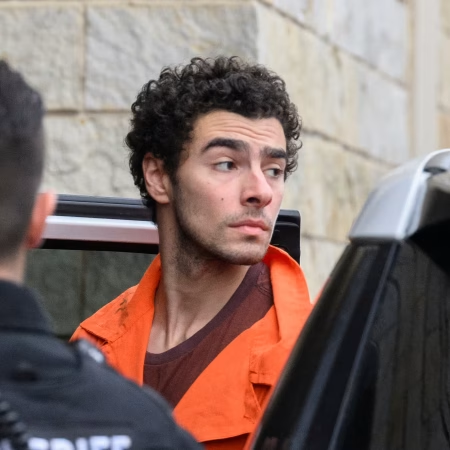

By JOHN KIRKLAND
Following the Dec. 4 murder of health insurance CEO Brian Thompson, social media was overwhelmed by a tidal wave of anger against corporate power, and particularly against the health insurance industry. Thompson, CEO of UnitedHealthCare (UHC) was on his way to speak to investors when a person walked up and shot him from behind. The words “deny,” “defend” and “depose” inscribed on bullet casings recovered by police at the scene sparked speculation that the killing was motivated by anger over a denied claim. The words may be an allusion to the 2010 book on the insurance industry titled “Delay, Deny, Defend: Why Insurance Companies Don’t Pay Claims and What You Can Do About It.”
The shooter achieved a sort of folk hero status over the following days, at least in some quarters. Many social media posts celebrated the death of someone whom people see as responsible for heading a company that puts profits above human lives. The announcement of Thompson’s death on the corporate Facebook page was inundated with comments like “My empathy is out of network” and “I’m sorry, prior authorization is required for thoughts and prayers” from people who have suffered at the hands of the insurance giant. Comments were quickly shut down but, according to al-Jazeera, people “continued to post more than 77,000 laughing emoji reactions.” Wanted posters appeared in Manhattan featuring the faces of health insurance executives.
The ruling-class reaction to the murder of Thompson was swift. Pennsylvania Governor Josh Shapiro stated: “In America, we do not kill people in cold blood to resolve policy differences or express a viewpoint” while condemning the online comments celebrating Mangione. Online posters quickly replied with pictures of Shapiro signing bombs in Ukraine. The New York Times columnist Bret Stevens published an essay titled “Brian Thompson, not Luigi Mangione, is the real working-class hero,” in which he highlighted Thompson’s origins in the Midwest with a beautician mother and a father who worked in a grain storage facility. What Stevens misses is that Thompson’s career has been built on denying health care to people like his parents so that investors can line their pockets. Shapiro, Stevens, and The Times have all spent the last 15 months cheerleading Israel’s genocidal war in Gaza.
On Dec. 9, the alleged shooter, Luigi Mangione, was arrested in Altoona, Pa. He allegedly had the gun and fake IDs in his possession. On Dec. 19, the suspect was extradited to New York, where he faces numerous charges, including first-degree murder and “terrorism.” He also faces federal murder and firearms charges, as well as state charges in Pennsylvania.
Mangione, 26, the son of a wealthy Maryland family, graduated from a private high school and attended the University of Pennsylvania, an Ivy League school. According to the Crooks and Liars site, “Mangione has retweeted Tucker Carlson and was an Elon Musk and Peter Thiel stan, but also had an ‘ill will toward corporate America.’”
Of course, some right-wing commentators have quoted from the eclectic musings in Mangione’s papers and online posts in order to try to show that they reflect a “far-left” orientation. The right is eager to twist the available evidence in order to portray Mangione as a “left-wing terrorist.” Fox News contributor Joe Concha wrote that “I think this encapsulates the far left’s worldview: If you run a company that isn’t to their liking, you deserve to die.”
Mangione’s hand-written “manifesto”, published by Ken Klippenstein, lays out his alleged motivations: “Frankly, these parasites simply had it coming. A reminder: the U.S. has the #1 most expensive healthcare system in the world, yet we rank roughly #42 in life expectancy. United is the [indecipherable] largest company in the U.S. by market cap, behind only Apple, Google, Walmart. It has grown and grown, but as our life expectancy? No the reality is, these [indecipherable] have simply gotten too powerful, and they continue to abuse our country for immense profit because the American public has allowed them to get away with it. Obviously, the problem is more complex, but I do not have space, and frankly I do not pretend to be the most qualified person to lay out the full argument.”
The truth is that these insurance companies hold the power of life and death over working-class people. Yes, the United States has the most expensive health-care system in the world. The U.S. spent $12,555 per capita on health care. Health-care costs were 17% of GDP in 2022, up from 5% in 1962. Life expectancy in the US was 49th out of 204 countries and is expected to fall to 66th by 2050. According to CNN, “Life expectancy in the US is expected to increase from 78.3 years in 2022 to 80.4 years in 2050.”
The CEO of UHC’s parent company, Andrew Witty, stated that “we guard against the pressures that exist for unsafe care or for unnecessary care to be delivered in a way which makes the whole system too complex and ultimately unsustainable. So, we’re going to continue to make that case.” In other words, the company will continue to prioritize stockholders over patients.
In denial
Health insurance profits have soared as denial rates have gone up. UHC, which is the largest health insurance company in the country, raked in $6 billion in profits during the last quarter alone. At the same time, it has the highest denial rate of any health insurance company at 32%. PBS reported in 2023 that “companies appear increasingly likely to employ computer algorithms or people with little relevant experience to issue rapid-fire denials of claims—sometimes bundles at a time—without reviewing the patient’s medical chart. A job title at one company was ‘denial nurse.’”
PBS continues, “Companies in 2021 nonetheless denied, on average, 17% of claims. One insurer denied 49% of claims in 2021; another’s turndowns hit an astonishing 80% in 2020. Despite the potentially dire impact that denials have on patients’ health or finances, data shows that people appeal only once in every 500 cases” (https://www.pbs.org/newshour/health/analysis-health-insurance-claim-denials-are-on-the-rise-to-the-detriment-of-patients). While this practice increases profits substantially, denied or delayed treatment results in tens of thousands of deaths annually.
One insurance giant, Anthem Blue Cross Blue Shield, had announced its intent to “deny any claims for anesthesia services that exceeded specific time limits set for surgeries and procedures.” In the wake of the assassination of Brian Thompson, the company reversed course and tried to claim there had been no such policy.
And in debt
Medical debt is the leading cause of bankruptcy in the U.S.. Sixty percent of personal bankruptcies, more than 650,000 annually, are attributed to medical debt. More than 3 million people in the U.S. have medical debt of more than $10,000 and 25% have medical debt of $5000 or more. Some 100 million people in the U.S. have medical debt.
About one-third of GoFundMe campaigns, more than 250,000 annually, are for medical expenses and raise roughly $650 million. The Affordable Care Act (ACA) enacted under Obama was supposed to help alleviate medical debt and bankruptcy, but one study found that “despite gains in coverage and access to care from the ACA, our findings suggest that it did not change the proportion of bankruptcies with medical causes. That’s not surprising because the chronically poor—the group most affected by the ACA’s coverage expansion—have reduced access to credit, have few assets (such as a home) to protect, and face particular difficulty in securing the legal help needed to navigate formal bankruptcy proceedings” (https://pmc.ncbi.nlm.nih.gov/articles/PMC6366487/).
The murder of Brian Thompson is the “chickens come home to roost” for our ruling class’s failure to enact real health-care reform. Before the ACA, there was a robust movement for single-payer health care. Obamacare was a tepid half measure designed to short circuit that movement and preserve the money and power of the health insurance companies. During the recent presidential campaign, neither Trump nor Harris highlighted health-care system reform. During his previous term, Trump tried and failed to repeal the ACA. In the 2024 campaign, Trump claimed that he had saved the program while in office.
Is shooting a CEO a strategy for social change?
In some respects, Luigi Mangione’s action is reminiscent of Herschel Grynszpan’s assassination of Nazi diplomat Ernst vom Rath in November 1938 in Paris. Grynszpan, a Jewish expat who had been raised in Weimar Germany, was in France with an expired Polish passport and German travel papers. He is alleged to have told French police on his arrest, “Being a Jew is not a crime. I am not a dog. I have a right to live, and the Jewish people have a right to exist on this earth. Wherever I have been, I have been chased like an animal.” The Nazis used Grynszpan’s action as a pretext for Kristallnacht, a pogrom aimed at Germany’s Jewish community. More than 30,000 Jews were arrested and put in concentration camps.
In 1939, Trotsky expressed understanding of Grynszpan’s motivations, but pointed out, “We Marxists consider the tactic of individual terror inexpedient in the tasks of the liberating struggle of the proletariat as well as oppressed nationalities. A single isolated hero cannot replace the masses. But we understand only too clearly the inevitability of such convulsive acts of despair and vengeance. All our emotions, all our sympathies are with the self-sacrificing avengers even though they have been unable to discover the correct road.”
Trotsky concluded by calling on “all those capable of self-sacrifice in the struggle against despotism and bestiality: Seek another road! Not the lone avenger but only a great revolutionary mass movement can free the oppressed, a movement that will leave no remnant of the entire structure of class exploitation, national oppression, and racial persecution” (https://www.marxists.org/archive/trotsky/1939/xx/grnszpan.htm).
The U.S. health-care system is badly broken and needs to be completely changed to serve the needs of the majority. We need a mass working-class-led movement for nationalization of the health-care industry under workers’ and community control. The infrastructure already exists in hospitals, clinics, and urgent-care facilities. There should also be a free program to train thousands of health-care professionals, from nurses to PAs to doctors.
Neither of the capitalist political parties can resolve this crisis. They only serve the interests of the rich, and not those of the oppressed and exploited. Working people need a party of our own that will fight every day for our interests.
- Health care is a human right! It should be free for all.
- Nationalize the health-care system and the pharmaceutical corporations; place them under workers’ and community control and run them as a public service. Health care must include dental, vision, and mental care.
- Fully fund women’s reproductive health care and care for LGBTQ and trans people.
- Slash the military budget to pay for these items.
Photo: Luigi Mangioni. (Jeff Swensen / Getty Images)
-
Preparing the fight against Donald Trump’s immigration policy

{:en}

By CARLOS SAPIR
While the exact details of Trump’s plans for his second administration remain unclear, one of the key rhetorical points of his campaign was a widespread—a vicious rhetorical assault against immigrants. According to Trump’s campaign, those of politicians close to him, and even some of their opponents running as Democrats, immigrants today represent a literal military “invasion,” as well as supposedly threatening to destroy the economy and drown the U.S. in drugs, sex trafficking, and other crimes.
Of course, this “invasion” does not exist; immigrants do not cause crime, and rather than hurting the economy, they are a vital pillar of the U.S. working class. But the fact that Trump’s accusations against immigrants are lies does not change the reality that he is repeatedly and publicly promising to use all of the resources of the state to carry out mass deportations. Whether or not he manages to deploy even the military to this end, we must prepare to face these potentially massive attacks against our communities.
While the threats facing us are significant, there is a long history of community-based and union-based organizing to protect undocumented immigrants in this country, a history that includes Trump’s first term in addition to other administrations.
Throughout his first term, Trump’s brazen attacks against immigrants were met with outpourings of massive solidarity, not only from the immigrant communities that to a great extent led and bore the brunt of this struggle, but from the broader population as well, with moments such as the attempted Muslim ban leading to spontaneous mass mobilizations that occupied airports. Rapid response networks were formed and grew throughout the country, providing immediate support to immigrants in need as well as scaffolding for further political organizing.
Perhaps the most significant moment of the U.S. immigrant rights’ movement, however, was the mass mobilizations of the “Day Without an Immigrant,” on May 1, 2006. In response to similar demonization by the Bush administration (itself building on border militarization policies greatly expanded by Bill Clinton), millions of people took to the streets and demonstrated the size and power of the working immigrant community. Not only did these mobilizations put a halt to reactionary policies and rhetoric, they revitalized the entirety of the workers’ movement. After decades of anti-communist suppression, May Day once again returned to its birthplace in the U.S. labor movement as a day of celebration, solidarity, and struggle, and has been annually recognized by unions and other working-class organizations since then.
Now is the time to concretely discuss how we will defend ourselves, our coworkers, and our neighbors. In labor unions, we need to prepare ourselves to respond against raids that attack our workplaces. This is a vital task not only to defend immigrants, but also for unions to be able to function: A union that cannot defend its members from arbitrary deportation is not going to be able to credibly defend any of its members when facing the bosses.
Solidarity resolutions can help to educate coworkers about the importance of this fight, and can also provide a basis for rallying the unions toward further political action in defense of immigrants. In tandem with this organizing, we need to form and strengthen community rapid-response groups that keep a lookout for ICE activity, provide aid to those targeted, and allow people to live with a measure of security.
By turning out dozens to hundreds of people to rally in front of attempted anti-immigrant attacks, we can protect our communities against raids. By proactively organizing large protests to demand an end to deportations and full rights for all workers, we go on the offensive and demonstrate the economic and political weight that immigrants actually have as the backbone of the economy. We demonstrate that these are our communities that the government is attacking, and we will not let our communities be torn apart without a fight.
It is also distinctly possible that the next wave of attacks against immigrants may target communities that have not faced as much persecution in the 21st century. Chinese immigrants in particular are already being demonized as supposed “foreign agents” by Trump as part of a bipartisan march towards possible war with China. Existing immigrant rights’ networks need to expand their reach and form ties with every immigrant community in order to strengthen ourselves and prepare for the possible threats to come.
While there are significant obstacles ahead and lots of work to do, these challenges have been surmounted in the past and can be beaten again. Both the U.S. labor movement and the international workers’ movement would be nowhere if not for the tireless contributions of immigrant workers from all over the world—working, organizing, and struggling under conditions of fierce state repression and anti-immigrant xenophobia. We now face a terrible threat against our existence once again. But by successfully mobilizing on a mass basis, with the support of our unions and the broader layer of people who are willing to stand up and confront racist attacks against innocent people, we can not only beat back these attacks but at the same time build a movement ready to wield its power and fight for political change.
-
Free Leonard Peltier!


By AVA FAHEY
On Sunday, Dec. 8, President Joe Biden issued a full and unconditional pardon for his son Hunter, sparing the younger Biden of up to 25 years in prison for six felony charges and multiple misdemeanors related to gun law violations and tax evasion. President Biden had previously stated, multiple times and in no uncertain terms, that he would not pardon his son, a controversial public figure perhaps best-known for his high-profile struggles with drug addiction. Biden’s decision was unquestionably motivated by personal prejudice. Hunter Biden has never spent a night in prison, and now, he probably never will.
The same cannot be said for the longest-serving political prisoner in U.S. history, Leonard Peltier. Despite calls for clemency from public figures as diverse as Nelson Mandela, the Dalai Lama, and Mother Teresa, not to mention multiple bodies of the United Nations and the original prosecutor of his case, Peltier has served almost 50 years in federal prison for a crime he maintains he did not commit. Biden has the executive power to issue a pardon for Peltier, or at the very least to commute his sentence—and yet, he has not responded to the Peltier defense committee’s impassioned pleas.
Leonard Peltier is in dangerously poor health. Despite being eligible for age and illness-related compassionate release, Peltier’s parole was again denied in July 2024. Peltier will be eligible for a parole hearing again in 2039, when he is 94, but considering his health, age, and the disastrous outcomes faced by the elderly and incarcerated, Peltier hardly has the time to spare.
Peltier, who recently marked his 80th birthday in maximum security prison, was hospitalized in October for the second time this year due to ongoing chronic health problems. Peltier has a potentially fatal heart condition, in addition to long COVID, kidney disease, Type II diabetes, degenerative joint disease, and vision loss. Each of these health conditions requires ongoing medical care, which, according to Peltier’s lawyers, the Bureau of Prisons has not provided. Peltier uses a walker, but he needs a wheelchair, which the prison will not provide. He has not been allowed to see a dentist in over 10 years. The Bureau of Prisons offered Peltier a CPAP machine for his sleep apnea, but the machine is rendered useless by the fact that Leonard’s cell has no electrical outlet to power it on.
Peltier desperately needs to be released. His initial imprisonment for political reasons was inhumane in 1976, and it grows more inhumane every year as his health continues to fail. He is an Indigenous elder and a movement elder and his continued imprisonment has profound negative effects on both his tribal communities and on the Indigenous liberation movement as a whole. Even so, Leonard Peltier’s life story, his movement work, and his immense bravery and perseverance are a guiding light for organizers and activists worldwide.
Leonard’s youth
Peltier, who is of Lakota, Dakota, and Anishinaabe ancestry, grew up on the Turtle Mountain Reservation of the Turtle Mountain Band of Chippewa (Mikinaakwajiw-ininiwag), of which he is an enrolled member. Six-by-12-miles in area, the Turtle Mountain Reservation is all that remains of millions of acres that the U.S. government seized and coerced from the Ojibwe people. When his grandfather died, the Bureau of Indian Affairs deemed his grandmother unfit to raise Leonard and his sisters alone and forcibly removed them to the Wahpeton Indian School, where he remained from when he was nine to when he was 12. In 2021, Peltier testified to his experience: “It was hell.”
Peltier is a survivor of the boarding school system that President Biden recently formally acknowledged and “apologized” for. Biden’s apology contained no promise of reparations for relatives of the nearly 1000 children killed by the boarding school system, nor for the Indigenous elders who survived the boarding school system, nor their descendants who continue to face the ongoing negative effects of this deliberate act of cultural genocide (see the NDN Collective’s recent press release). At Wahpeton, as at other boarding schools, white teachers buzzed off Indigenous children’s hair, physically assaulted them, sprayed them with insecticide under the flimsy pretense of disease prevention, and forced them to speak English—preventing them from speaking the languages they spoke at home. The motto of the first Native boarding schools might be applied to all that followed: “Kill the Indian, Save the man.”
And yet, like many boarding school survivors, Peltier worked hard to preserve his Indigenous identity. “We spoke our language. We sang our songs. And we prayed in our languages, all in secret. In secret, behind the gym. We called ourselves the Resisters, after the famous French Resistance.” Leonard attempted, unsuccessfully, to escape; he would not leave the school until he graduated.
When Peltier returned to Turtle Mountain, the federal government was beginning the 1956 Indian Relocation Act. It was led by Dillon S. Myer, who had recently spearheaded the U.S. policy of Japanese internment. Billed as a vocational training program, the Bureau of Indian Affairs (BIA) encouraged Indigenous people to obtain vocational training for jobs that did not exist in the rural communities where the majority of Indigenous people lived.
Concurrent with a federal campaign of termination that dissolved treaties, dismantled tribal governments, and eliminated reservations, the BIA offered seemingly generous subsidies to Indigenous people for relocation to urban areas. A former BIA commissioner called the program “a one-way ticket from rural to urban poverty.” Beyond failing to lift Indigenous people out of poverty, the program represented an undeniable attempt on the part of the federal government to assimilate Indigenous people into white U.S. culture. This was not a side effect of the program: it was the goal.
Although the policies of termination and relocation were unsuccessful in attaining its full objectives of assimilation, the policies did fundamentally change Indigenous ways of life. The BIA attempted to terminate the Turtle Mountain Chippewa by ramping up police brutality (Peltier’s cousin was beaten by a BIA officer so badly she suffered a miscarriage) and refusing food to those uninterested in relocating. At 14, Peltier left for the West Coast, where he eventually became something of a community leader among urban Indigenous people. By the age of 20, Peltier was a part owner of an auto shop, the second floor of which he used as a halfway house for recovering alcoholics and ex-convicts in his community who were struggling to find work. It was here that Peltier first became involved with the American Indian Movement (AIM).
AIM
AIM began as an urban Indigenous activist group in Minneapolis, organizing urban Anishinaabe who had been displaced there by termination and relocation. Over the next few years, AIM grew in popularity, in large part thanks to several well-executed and well-publicized protest actions. In 1969, AIM members were among the participants of a takeover of Alcatraz led by the Indians of All Tribes. Alcatraz was not then a tourist destination but rather abandoned federal property. The 1868 Treaty of Fort Laramie, signed between the US federal government and the Arapaho, Yanktonai, Oglala, Minniconjou, and Brule nations, stipulated that all abandoned federal land would be returned to Indigenous people. According to the terms of the 1868 treaty, AIM’s Alcatraz occupation was entirely legal.
Led by UC Berkeley student organizers Richard Oakes, who was Mohawk, and LaNada Means, who is Shoshone-Bannock, the occupiers were well organized, setting up a school on the island and voting collectively on all major decisions. Over 10,000 Indigenous people visited the Alcatraz occupation over its 19 months of existence, as well as a number of white sympathizers (who were, humorously, required to register with the “Bureau of Caucasian Affairs” the occupiers created). Despite the occupation’s legality according to the preexisting treaty, the federal government progressively shut off the island’s electricity, phone lines, and water supply, and eventually removed the final protesters by force in 1971.
In the fall of 1972, AIM organized its most ambitious event to date, the Trail of Broken Treaties and Pan American Native Quest for Justice. Caravans departed from the West Coast, headed to Washington, D.C., to deliver their 20-point list of demands, including legal recognition of treaties, new treaty-making processes, the return of millions of acres of land to Indigenous nations, the repeal of the termination act, and religious freedom. Peltier was present on the Trail of Broken Treaties, serving as a part of the caravan’s security detail. Stopping at reservations along the way, the Trail of Broken Treaties grew from three initial caravans to a line of cars four miles long. They made appointments for AIM representatives to meet with the BIA, the Department of Labor, and the Department of Commerce upon their arrival. On Nov. 2, the caravans arrived in the capital, to find that all of their appointments had been cancelled without notice, and that the churches who had agreed to feed and house the protesters had reneged on their agreement. The BIA, who normally secured accommodations for Indigenous delegations to Washington, refused to help.
Around 400 protesters from as many as 250 different Indigenous nations gathered outside the BIA headquarters to demand accommodations and a meeting. With nowhere to spend the night, the group made a spontaneous decision to occupy the BIA facilities. They occupied the BIA for six days, in the process seizing hundreds of pages of classified documents related to Indigenous affairs. They received messages of support from the Irish Republican Army and the Black Panther Party, and hundreds of non-Indigenous supporters formed a human barricade around the BIA offices. Over six days, the AIM protesters and the federal government engaged in negotiations, eventually culminating with AIM agreeing to leave the BIA offices on the condition that a task force, made up of AIM leaders and Nixon aides, to consider AIM’s 20-point list of demands.
Unfortunately, the results of the task force were less than ideal. Several months later, the task force announced they would officially reject all of the 20 points. Moreover, the occupation earned AIM increased negative attention from the federal government, and marked, if not the beginning, at least the escalation of the FBI’s protracted campaign to destroy AIM by infiltration, surveillance, and extrajudicial and at times paramilitary violence against its members.
AIM, alongside myriad left groupings and Black liberation organizations, was targeted by the FBI’s mid-20th-century Counter Intelligence Program (COINTELPRO). COINTELPRO’s stated goals were to “expose, disrupt, misdirect, discredit, or otherwise neutralize” people and organizations that the FBI deemed “enemies of the state.” Many tactics—mostly, if not entirely, illegal—were employed so as to “neutralize” politically active persons by making them incapable of engaging in political activity. For many, that meant incarceration; virtually every AIM leader has been incarcerated in state or federal prison at one point.
Other tactics included sending derogatory and often untrue information to people’s families and comrades, intimidating them, and sending death threats. The FBI often framed up their political targets as being police informants, which isolated important political leaders from comrades they had done no wrong against and also created an environment of fear in organizations. In 2019, a former FBI agent admitted that the FBI “wanted them to kill each other, as we were in a war against AIM.”
Wounded Knee II
On Feb. 12, 1972, a group of white settlers in a South Dakota town just off the reservation abducted, sexually assaulted, and beat an Oglala elder, Raymond Yellow Thunder, to death. The killing was random, unprovoked, premeditated, and motivated by racial hatred; eyewitnesses heard the four men who were responsible talking about “busting an Indian” earlier that night. Yellow Thunder’s killers were the first white men arrested, tried, and convicted for killing an Indigenous person in South Dakota history. Only two of the four served jail time, and neither served more than five years.
Not long after Yellow Thunder’s murder, a new president was elected to the Pine Ridge Tribal Council. Dick Wilson, a former bootlegger, was deeply corrupt and placed hundreds of his friends and relatives on the tribal payroll, awarding them salaries of $15,000 when the average annual income on Pine Ridge barely cleared $800. A Catholic of partial European descent, Wilson’s politics were assimilationist, prejudiced against full-blooded Indigenous people, and openly hostile to efforts at cultural preservation from Pine Ridge traditionalists who taught and lived by the traditional Oglala ways. With funds freely given by the BIA and FBI, Wilson formed a private police force, perhaps better described as a militia, which he proudly called the GOON Squad (Guardians Of the Oglala Nation).
Wilson made an enemy of AIM when AIM attempted to host a victory celebration after the Trail of Broken Treaties on the Pine Ridge Reservation and, in response, Wilson called a state of emergency and banned AIM from gathering on the land. He removed members of the tribal council who were known to be AIM sympathizers, even respected elders. Moreover, he called for outside support from U.S. marshals, effectively militarizing the reservation. The GOONs openly antagonized and intimidated AIM sympathizers and Oglala traditionalists by beating them, shooting at them, and burning down their homes.
Tensions rose further when on Jan. 21, 1973, Wesley Bad Heart Bull, an Oglala man, was stabbed to death by a white man named Darld Schmitz, who was charged only with involuntary manslaughter. Convincing evidence exists that the killing was deliberate, unprovoked, premeditated, and motivated by racial hatred: Schmitz was heard earlier that night stating that he was “going to kill him an Indian.”
Sarah Bad Heart Bull, Wesley’s mother, reached out to AIM to ask for their help in responding to the outrageously lenient charge. AIM organized a caravan of Indigenous activists to travel to the Custer County courthouse, where Schmitz was being tried, to demand first-degree murder charges. About 200 people showed up in the middle of a blizzard on Feb. 6, 1973.
Despite the fact that it was a public building, only five AIM representatives were allowed inside to plead their case. They failed. The AIM representatives returned to the crowd waiting outside to report that the county would not budge, whereupon Sarah Bad Heart Bull began verbally accosting a state trooper. The state trooper shoved Sarah down the stairs of the county courthouse, and the crowd erupted. Law enforcement turned smoke bombs, tear gas, and firehoses on the crowd of protesters. In response, the Indigenous protesters fought back against police brutality, throwing Molotov cocktails and attacking the infrastructure, eventually burning down the local chamber of commerce. In an absurd miscarriage of justice, 37 Oglala and Indigenous AIM activists were arrested and served sentences for charges related to the spontaneous courthouse uprising. Sarah Bad Heart Bull, Wesley’s mother, served six months on riot charges. Her son’s killer was acquitted by an all-white jury.
After the courthouse uprising, the federal government intensified its covert assault on AIM and Indigenous activists in Pine Ridge. They stationed 80 U.S. marshals, 50 BIA officials, and multiple FBI agents on Pine Ridge, working alongside Wilson’s GOONs. In response to the militarization of their reservation, and after failed efforts by the Oglala Sioux Civil Rights Organization to impeach Dick Wilson, a number of Oglala contacted AIM for help in fighting back. Utilizing the occupation tactics that AIM had come to be known for, on Feb. 27, 1973, a group of approximately 200 Oglala and AIM activists took over Wounded Knee, the same site where, on Dec. 29,1890, the U.S. Army slaughtered nearly 300 unarmed Miniconjou and Hunkpapa Lakota.
Were it not for the disproportionate repressive tactics used by the federal government, the events at Wounded Knee may not have escalated into the 71-day occupation and standoff that occurred. Said Madonna Thunder Hawk, an Oohenumpa Lakota woman and AIM medic at Wounded Knee, “Our plan wasn’t to have a stand-off with the Feds. We were asked to come to the Pine Ridge community gathering to hear the people’s grievances. We were surrounded at Wounded Knee by the Feds.”
Surrounded they were. In less than a day, the federal government set up roadblocks preventing food and supplies from reaching the activists. Free speech was restricted as journalists were banned from entering Wounded Knee. Over the next two and a half months, federal forces fired over 130,000 rounds of ammunition.AIM and Oglala activists entered negotiations with the White House. They demanded the abolition of the present tribal council headed by the tyrannical Wilson and the reinstitution of the 1868 Fort Laramie Treaty and traditional Oglala Lakota government. On March 11, they declared the Oglala nation’s independence as a sovereign nation. Over the 71 days, AIM and the federal government traded fire, leading to the paralysis of U.S. Marshal Lloyd Grimm and the deaths of Frank Clearwater (Cherokee) and Lawrence “Buddy” Lamont (Oglala). Ray Robinson, a Black civil rights activist who joined the occupation, disappeared and was later declared legally dead.
After the death of Lamont, who was shot through the heart after being forced from his bunker by tear gas, tribal elders called for an end to the occupation. On May 5, 1973, the sides reached an agreement to disengage and three days later, on May 8, AIM members and Oglala evacuated Wounded Knee.
Standoff
The ensuing FBI campaign against AIM activists and sympathizers on Pine Ridge over next three years would be referred to as a “Reign of Terror.” Funded by the federal government, Wilson’s GOON squad engaged in a protracted campaign of violence against anybody thought to be an AIM supporter. At least 64 Oglala people and AIM organizers were murdered in cases that have never been formally solved, with some estimates counting the total number of dead at 300—bringing the annual murder rate on Pine Ridge to over 17 times the national average. Hundreds more were brutally beaten and harassed.
Peltier, along with about a dozen other AIM activists, returned to the reservation to offer protection to traditionalist Oglala and AIM sympathizers. They set up camp on the Jumping Bull ranch, inhabited mostly by families, children, and elders who lived by traditional Oglala ways.
On June 25, 1975, FBI agents Jack Coler and Ronald Williams arrived at Pine Ridge in search of a 19-year-old named Jimmy Eagle, whom they suspected of stealing a pair of cowboy boots. The residents told Coler and Williams they had not seen Eagle. The next day, the agents returned. In plainclothes and in an unmarked car, they drove onto the Jumping Bull ranch in pursuit of Eagle.
A woman whose children were playing outside heard what she thought were fireworks, and looked outside to see two white strangers removing gun cases from the trunk of their car. She screamed out, and a shootout ensued between the FBI agents and Jumping Bull residents defending themselves and their families. The FBI agents called for backup, and within minutes, Jumping Bull Ranch was surrounded by SWAT teams, FBI agents, BIA police, and GOONs.
With this backup, the FBI agents went from house to house, breaking down doors, ransacking personal belongings, and threatening Jumping Bull residents with automatic weapons. Some Oglala and AIM activists returned fire. When the smoke cleared, Agents Coler and Williams lay dead, shot in the head at point-blank range. Coeur d’Alene AIM activist Joseph Stuntz Killsright, too, was shot in the head at point-blank range. His death has never been investigated.
The rest of the AIM activists barely escaped with their lives, and most of them went underground. Peltier fled to Canada, recognizing he had no chance at a fair trial. With Peltier fleeing, the FBI launched one of their most extensive manhunts to date.
No fair trial
The FBI investigation into Coler’s and Williams’ deaths was unconstitutional from its outset; a U.S. Civil Rights Commission report revealed that searches were conducted without warrants and numerous individuals were detained without cause for questioning. Four AIM leaders were indicted for the deaths of the federal agents: Alongside Peltier, there was Dino Butler, Bob Robideau, and Jimmy Eagle. At Butler and Robideau’s trial, the jury found that the two were justified in returning fire, considering not only the unprovoked FBI gunfire that day on Jumping Bull but also the larger atmosphere of the Pine Ridge Reign of Terror that had targeted AIM activists for the past three years. They were found innocent.
Enraged, the FBI dropped charges against Eagle so that, according to their own memos, “the full prosecutive weight of the federal government could be directed against Leonard Peltier.” The effort expended on these two agents’ murders stands in stark comparison to the complete lack of investigation into the dozens of murders under the Reign of Terror.
Peltier fled to Canada. The FBI apprehended and extradited him with affidavits from an alleged former girlfriend, Myrtle Poor Bear, stating she had witnessed him shooting the agents. But not only was Poor Bear not present at the shootout, she had never met Peltier in her life. Poor Bear later recanted and testified that the FBI coerced her affidavits by threatening to kill her and her family. They showed her postmortem pictures of Anna Mae Aquash, a murdered Mi’kmaq AIM activist, and implied that Poor Bear might suffer a similar fate if she would not testify.
Peltier was given a different judge than Butler and Robideau, one who made rulings against Peltier’s defense team. Myrtle Poor Bear was banned from testifying about the coercion of her affidavit. Three other young Indigenous people were coerced into testifying against Peltier after being terrorized by FBI agents. Testimony about the Pine Ridge reign of terror was restricted. Ballistics reports that indicated Peltier’s guilt were included in the trial, while conflicting ballistics reports that indicated his innocence were exclude. Not one witness was able to testify that they saw Peltier kill the two agents.
In pre-trial, one juror openly admitted that she was “so prejudiced against Indians,” and yet, she was still placed on the jury by Peltier’s incompetent defense. The jury, surrounded by U.S. Marshals who had convinced them that AIM was a threat to their safety, convicted Peltier for two life sentences.
On appeal, the appellate court was forced to change its theory that Peltier had personally shot and killed the agents, due to an overwhelming lack of evidence. Instead, they theorized that Peltier had aided and abetted their killers. When asked whom Peltier aided and abetted, prosecutor Lynn Crooks stated, “Perhaps aiding and abetting himself.” One cannot aid and abet oneself in a crime, and neither could Peltier have aided and abetted Butler and Robideau, who were found not guilty. Peltier was, officially, found guilty of murder because he was an Indigenous person present with a gun on Pine Ridge on June 26, 1975.
The FBI has successfully opposed every one of Peltier’s attempts at clemency or parole. In 2000, President Bill Clinton announced he would consider pardoning Peltier before leaving office. Hundreds of federal agents marched in front of the White House to oppose Peltier’s release. The governor of South Dakota, Bill Janklow, made a private visit to the White House to beg Clinton not to pardon Peltier. (In 1983, Janklow unsuccessfully sued Peter Matthiessen, author of “In the Spirit of Crazy Horse,” the definitive book on Peltier’s case, for $24 million. Janklow’s suit took issue with Matthiessen’s reporting of credible rape allegations against Janklow by Jancita Eagle Deer, a young Brulé Lakota woman who died mysteriously in 1975, not long after she had testified.)
A former FBI agent who worked on Peltier’s case has gone on public record to state that the federal agency has been motivated by personal vendetta to prevent Peltier’s release for decades now. “Retribution seems to have emerged as the primary if not sole reason for continuing … an emotion-driven ‘FBI Family’ vendetta.”
Life as a political prisoner
In his years in prison, Peltier has remained a productive organizer for Indigenous rights in the U.S. He has donated many of his paintings to human rights organizations for charitable auctions. He established a scholarship program for Indigenous students at NYU law school. He has helped to create a reservation health-care delivery system and a reservation vocational training program. In 1999, he wrote a book, titled “Prison Writings: My Life is My Sundance.” In 2004, he ran for U.S. president as the candidate of the Peace and Freedom Party, and in 2020, he ran for vice-president as the candidate of the Party for Socialism and Liberation.
Peltier’s family has suffered tremendously from their relative’s incarceration. Chauncey Peltier, Leonard’s son, was only 10 when Leonard was convicted. He describes his family’s perennial struggles to pay his father’s legal bills and make up for lost income he would have been earning for their family. Peltier’s daughter, Marquetta Shields-Peltier, describes how Peltier’s imprisonment has set their family adrift. “Because of the situation, we grew apart from each other, not knowing each other,” she explained. “It just doesn’t feel like it’s a family to me. That had an impact on my mental health.”
Peltier spends most of his time in solitary confinement. He is incarcerated in USP Coleman I, located inside FCC Coleman. FCC Coleman is known as exceptionally repressive and authoritarian even within the already repressive and authoritarian federal prison system. Since the beginning of the COVID-19 pandemic, FCC Coleman has been in a state of constant lockdown. During lockdown periods, prisoners are not allowed recreation and are forced to spend 24 hours a day in isolation in their cell.
Peltier told Truthout that “being in such a small space at my age is not … pleasant to have to go through. It is like torture. Your body gets to hurting from lack of exercise and movement.” He has not been allowed regular meetings with his legal counsel. Peltier is a talented painter but has not been allowed access to his painting materials for several months now. Peltier has maintained his innocence for the entire length of his conviction. He and his defense committee ask for total clemency in his case.
Said Peltier in a public statement in February 2024: “Time has become so twisted with these lockdowns that night blurs into day, a miasma of time that has no sense to it. All hours are the small hours of the night. Life itself is suspended. We wait for a brief glimpse of what life looks like. We exist in cold, filthy cells, and we wait. The voices of those murdered on Pine Ridge Reservation are a constant echo in my mind.”
Release all political prisoners!
Complete self-determination for Indigenous nations! Reparations for settler-colonial oppression!
Abolish the police!
LAND BACK!
You can write to Leonard Peltier here:
LEONARD PELTIER #89637-132
USP COLEMAN I
P.O. BOX 1033
COLEMAN, FL 33521Painting by Leonard Peltier. Image source:
https://leonardpeltiermatters.com/Sources
Click to access 2021-07-28-Clemency-Petition-FINAL.pdf
• https://www.sdhspress.com/journal/south-dakota-history-29-3/spontaneous-combustion-prelude-to-wounded-knee-1973/vol-29-no-3-spontaneous-combustion.pdf
• https://law.yale.edu/yls-today/news/un-body-finds-activists-detention-arbitrary-case-filed-lowenstein-clinic#:~:text=U.N.-,Body%20Finds%20Activist’s%20Detention%20%E2%80%9CArbitrary%E2%80%9D%20in%20Case%20Filed%20by%20Lowenstein,the%20U.S.%20government%20since%201977.
• https://socxfbi.org/common/Uploaded%20files/SFSA/Scoop%20Links/Letter_from_Director_Wray_3.25.2022.pdf
• https://www.theguardian.com/us-news/2023/jan/18/leonard-peltier-clemency-fbi-agent-coleen-rowley
• https://www.apmreports.org/episode/2019/11/01/uprooted-the-1950s-plan-to-erase-indian-country
• https://www.whoisleonardpeltier.info/LEGAL/WAR.htm
• https://www.nativetimes.com/life/22-education/2024-around-the-campfire-in-memory-of-raymond-yellow-thunder?tmpl=component
• https://jacobin.com/2023/03/leonard-peltier-american-indian-movement-political-prisoner-pine-ridge-fbi
• https://unlhistory.unl.edu/exhibits/show/unl-aim/unl-aim
• https://www.aljazeera.com/opinions/2019/11/20/the-occupation-of-alcatraz-was-a-victory-for-Indigenous-people
• https://www.zinnedproject.org/news/tdih/alcatraz-occupation/
• https://aadl.org/aa_sun_19721201_p015-trail_of_broken_treaties
• https://boundarystones.weta.org/2021/10/29/remembering-american-indian-movements-occupation-bureau-indian-affairs
• https://www.nps.gov/articles/000/trail-of-broken-treaties.htm
• https://www.whoisleonardpeltier.info/home/background/cointelpro/
• https://www.aljazeera.com/features/longform/2024/7/10/last-chance-activist-leonard-peltiers-family-reflects-on-life-in-prison
• https://truthout.org/articles/inside-the-high-security-black-site-where-leonard-peltier-is-incarcerated/ -
Ukraine Solidarity Network: Celebrate the Syrian people’s victory!


Syrians living in Greece gather in Syntagma square after Syrian rebels announced that they have ousted President Bashar al-Assad in Syria, in Athens, Greece, December 8, 2024. REUTERS/Louiza Vradi Statement by the Ukraine Solidarity Network
THE UKRAINE SOLIDARITY Network (U.S.) wholeheartedly celebrates the liberation of Syria and its people from the half-century murderous Assad family tyranny. Like so many others, we are profoundly inspired by the scenes of people celebrating in the streets, the return of refugees who had fled their country to save their lives, and prisoners’ mass release from the regime’s incarceration and torture centers.
Ukraine’s resistance to Russia’s annexationist invasion was a key factor aiding the Syrian people in overthrowing the Assad dictatorship. The Putin regime has also been a pillar of support for Assad’s military machine. Even as the Syrian regime was collapsing, Russia carried out terror bombing of Aleppo and other cities reminiscent of its bombing of Ukraine’s civilian population.
Like the Ukrainian resistance, the struggles of the Palestinian and Georgian peoples have in their own ways contributed to Syria’s enormous victory.
We are disgusted but unsurprised by U.S. president Biden and the State Department’s proclamation of support while United States imperialism continues to supply military support for Israel’s genocide in Gaza, bombing of Lebanon and land grabs in the West Bank.
The United States, the largest and most destructive imperial power in the Middle East, has no intention of leaving its own military bases in Eastern Syria and indeed, continues bombing raids in that country.
Israel has now extended its savage offensive by a land grab extending its occupation beyond the Golan heights while using its air force to bomb Syrian military depots to deprive the new government of weapons (under the guise of destroying chemical weapons that it never destroyed while Assad ruled Syria).
Ukraine and Syria, vastly different in many respects, have both been devastated by war and face massive tasks of economic and social reconstruction. In solidarity with Ukraine’s people and progressive political forces, USN has demanded cancellation of Ukraine’s foreign debts. Similarly, today we demand international aid to Syria for its humanitarian and economic needs – with no strings attached, and free of repayment obligations. All sanctions imposed on Syria by western governments must be immediately lifted and progressive movements in every country must raise that demand.
Today, above all, Syria’s freedom from Assad’s rule is a giant leap toward a democratic future, free of religious-sectarian conflict and with respect for the rights of all its people.
To the extent that Assad’s downfall weakens Russia’s imperial power, it aids Ukraine’s struggle for survival and is all the more welcome. Perhaps it may also revitalize the struggles of the “Arab Spring” which have undergone such brutal repression over the past decade. But first and foremost this is the Syrian people’s victory, and they deserve congratulation and, above all, solidarity on the part of all international progressive and left movements. -
{:en}Syrian Revolution Topples Dictatorship After 13 Years

{:en}

By FABIO BOSCO
SAO PAULO—On Dec. 8, the dictator Bashar el-Assad and his family fled to Moscow. The fall of the dictatorship was celebrated throughout the country and by Syrian refugee communities across the world. Many Palestinians in Gaza and Al-Quds (Jerusalem) also celebrated the fall of the dictator, as did the Lebanese population in Trablous (Tripoli), Lebanon’s second largest city. The Syrian revolution has shown that tyrannies are not eternal and the working class must fight to overthrow them.
The Assad dictatorship lasted 54 years and was based on the repression, torture, and murder of any and all dissenters. This hated regime has murdered more than half a million Syrians since the beginning of the revolution 13 years ago.
In recent years, the country has been plunged into an economic depression in which 90% of the population lives in poverty, and under constant and humiliating harassment from militias linked to the regime and those aligned with the Iranian regime.
This combination of brutal repression and misery has undermined the social foundations of the regime among the Christian, Alawite and Druze population, known as “minorities.” The majority of the Syrian population is Sunni, and has been against the regime since the beginning of the revolution in 2011.
The offensive by rebel groups led by HTS (Hayat Tahrir al-Sham) in Aleppo sparked the popular uprising and led to the overthrow of the Syrian dictatorship. This triumph is seen with sympathy by working people throughout the Arab world who also live under tyranny.
A military offensive in the midst of a popular uprisingIt is estimated that the rebels launched the offensive with around 20,000 fighters from Idlib, in the north of the country. Most of them are young adults whose families have been driven out by Assad’s criminal bombardments over the past 13 years. This majority are linked to the interests of the refugee families in returning to their homes, and not to the sectarian ideologies of the leaders.
As they took each city, the rebels opened jails and prisons and freed thousands of political prisoners, positioned themselves against any retaliation against the minorities (Christians, Alawites, Druze and Kurds), and sought to reestablish the supply of bread and electricity and to create some kind of administration. Behaving this way, they gained a lot of popularity and new supporters, strengthening ties with popular interests.
In the south of the country, there was a different development. In the absence of an organized and armed group, the population revived experiments in self-organization, seized police stations and checkpoints, and marched towards Damascus, liberating Deraa, Suweida, and Quneitra until reaching Daraya, in the south of the capital.
To the east, a Syrian militia aligned with the Jordanian regime took Tadmor (Palmyra) as official forces fled. Soldiers throughout the country exchanged their uniforms for civilian clothes.
This mix of rebel militias and popular uprising with elements of self-organization imposed a series of democratic freedoms, the release of political prisoners, the return of refugees, and guarantees for minority communities, which are important achievements that, for the moment, make it difficult for HTS to succeed in a Bonapartist turn.
However, every democratic achievement is always threatened by regression within the capitalist system, especially considering that the main rebel group is HTS, which, in addition to defending a capitalist market economic model, has an autocratic heritage.
Regional and international powers with AssadAfter Assad’s fall, several countries issued statements criticizing the old regime which they did not want to see defeated.
From the beginning of the offensive on Aleppo, from Washington to Moscow, no imperialist country wanted Assad to fall. The United States and its Arab League allies pressured the Syrian regime to distance itself from Iran. They considered Assad’s permanence as a guarantee against any popular revolution that could destabilize American interests as well as those of other regimes in the region.
The State of Israel also preferred Assad to remain, as far as it was a weak government that had never fired a shot at Israel and was distancing itself from the Iranian regime due to pressure coming from the Arab League. That is why Israel moved troops to the border with Syria and, after Assad’s fall, bombed Syrian ammunition depots and intelligence centers to prevent the new regime from having access to these weapons.
Only three countries gave some kind of support to the offensive. The Turkish regime gave the green light for the offensive to begin, which was expected to take some rural areas of Aleppo. Qatar always maintained some material support. The Ukrainian regime has passed on know-how for the manufacture of low-cost drones, according to information spread by the Ukrainian press.
Compromise between the ancient regime and the rebel forces
The advance of the rebel forces and the popular uprisings determined that the end of the Assad regime was very close. Thus, in Doha, Qatar, representatives of the Russian, Iranian, and Turkish regimes met on Dec. 7 and agreed on the “end of hostilities” and “dialogue between the government and the legitimate opposition.” (1)
In practice, that meant sending the dictator Assad into exile in Russia, and keeping the Assadist Prime Minister al-Jalali in charge of guiding the soldiers on the end of “hostilities” and maintaining the functioning of the state apparatus.
The president of the Syrian National Coalition (SNC), Hadi al-Bahra, explained that a peaceful transition was negotiated, with the formation of a transitional government to draft a new constitution and call free elections within 18 months. (2) In addition, al-Bahra spoke of national unity, including all segments and ethnicities. Regarding the Kurdish-led SDF, al-Bahra stated that they must break with the PKK in order to join the “national dialogue.”
Transition without justice or sovereignty is a denial of the objectives of the revolutionThe proposals made explicit by al-Bahra seek to limit the achievements of the revolution.
The release of political prisoners, and democratic freedoms that guarantee the safe return of refugees, and security guarantees for religious minorities (which must be guaranteed on the coastal provinces where rebel militias are heading) are important but insufficient steps.
On the one hand, al-Bahra’s proposals maintain the institutions of the old regime, in particular the 18 secret services responsible for 54 years of brutal repression. The leaders of these prisons, torture, and extermination centers fled in the face of the advance of the revolution. But these secret services must be dismantled, their leaders arrested, and their files handed over to human rights organizations and the forces of the revolution, so that they can investigate all the crimes of the dictatorship.
On the other hand, they are seeking to establish a transitional government to draft a new constitution without any popular participation. The prime minister of the transitional government will be Al-Bashir, one of the members of the HTS government in Idlib.
A transitional government should be formed exclusively by forces of the revolution to call, within a short period of time, free elections for a free and sovereign Constituent Assembly, to which power should be handed over.
Nothing was said about the immediate withdrawal of all foreign military forces (900 U.S. military advisers and contractors in the northeast of the country, Russian military bases on the coast, Turkish troops on the northern border, and Israeli troops in the Golan Heights).
Nothing was said about the millionaires, such as Rami Makhlouf, who became rich thanks to the brutal repression against the Syrian people. It is necessary to nationalize the assets of these millionaires and put them to the service of the reconstruction of the country.
The Kurdish people’s right to self-determination was denied and transformed into a demand for a political break with the PKK (the Kurdish party operating in Bakur—areas with a Kurdish majority in Turkey). Worse still, the forces of Jeish al-Wattani (the National Army, aligned with the Turkish regime) have advanced towards Manbij and are signaling a new advance towards Raqqa, besieging the Kurdish population in Rojava.
The Palestinian issueThe fight against genocide in Gaza and the West Bank is at the center of global attention. HTS gave political support to the action of the Palestinian resistance led by Hamas on Oct. 7, 2023.
The Syrians held several demonstrations in solidarity with the Palestinians in the rebel province of Idlib, governed by HTS. In other parts of Syria, there were no demonstrations because they were prohibited by the Assad dictatorship.
Hamas released an official statement welcoming the new Syrian regime. Between 2011 and 2014, Hamas supported the Syrian revolution, which is why it had to move its headquarters from Damascus to Doha.
The Zionist state has advanced further into Syrian territory, in addition to bombing weapons depots and intelligence headquarters in order to weaken the new government.
So far, neither al-Joulani nor al-Bahra have expressed support for the Palestinians in ending the genocide in Gaza and the West Bank, nor have they taken any action against the Israeli bombings and invasions, repeating the behavior of Bashar el Assad.
It is necessary for the new transitional government to announce its unconditional support for the Palestinian resistance and take all possible measures to stop the Zionist advance.
We need a workers’ revolutionary partySince the beginning of the Syrian revolution in 2011, the Syrian Communist Party (whether the wing led by Khaled Bakdash, the wing led by Youssef Faisal, or even the Popular Will Party led by Kadri Jamil) has always sided with the Syrian dictatorship, securing ministerial posts in the government and slandering the forces of the revolution.
In the history of Syria, there have been important efforts to form true revolutionary Marxist parties, such as the Communist Labor Party (which had a strong Trotskyist wing led by the revolutionary Munif Mulhem, who was held in prison in abject conditions for 16 years, from 1981 to 1997), as well as the Palestinian revolutionary Salameh Keilah (imprisoned and tortured by the Syrian dictatorship for eight years) who formed the Syrian Left Coalition at the beginning of the revolution in 2011. However, these organizations were unable to survive the repression of the dictatorial regime.
The different wings of the Syrian Communist Party have not released any official position regarding the end of the dictatorship, which they have always supported. But the general secretary of the Communist Party of Turkey (TKP) denounced the Arab revolutions as part of imperialist plans, and defended the Assad dictatorship for having led the resistance against these plans as well as the jihadist threat, together with Russia and Iran.
These left-wing sectors, particularly those of Stalinist origin, defend the Assad regime, just as they defend other dictatorial capitalist regimes such as the Chinese, Russian, Iranian, Cuban, and Venezuelan regimes. In practice, these sectors trade the socialist perspective of class struggle for the perspective of progressive imperialist camps, which has nothing to do with Marxism or with the defense of the interests of the working class.
A revolutionary position begins with the recognition of the victory of the masses that is represented by the fall of the dictatorship. But it is only complete with a policy of class independence and the struggle for workers’ power and socialism.
The victory of the Syrian revolution will only continue with the formation of a revolutionary party that rejects conciliation with the old regime, promotes the formation of workers’ and popular councils in all neighborhoods and cities, demands the immediate withdrawal of all foreign military forces, stands for the nationalization of the assets of millionaires, defends the right of self-determination of the Kurds, and stands for unconditional solidarity with the Palestinian people. -
Oakland Education Assoc. expresses solidarity with detained immigrant workers


This past November, the Oakland Education Association, a union which represents schoolteachers in Alameda County, Calif. approved a solidarity statement recognizing the horrific conditions faced by immigrants in detention centers across California, the courageous struggle led by the immigrant community, and that this struggle is directly tied to the living and working conditions of OEA members and the communities that they serve and form part of. Solidarity statements such as this can serve as the basis for further organizing, providing principles to rally around and an opening for political discussions among coworkers that can pave the way for concrete action.
We reprint the OEA’s statement below:
Therefore Be It Resolved, the Oakland Education Association expresses its support and solidarity with the struggle of immigrant workers detained at the Mesa Verde and Golden State Annex detention centers in Kern County and Desert View Annex detention center in Adelanto, California.Therefore, OEA recognizes that 10% of OUSD’s student body are newcomer students who have arrived in the US within the last 3 years. Many of these students were detained or have family members who were detained in immigrant detention centers.
Therefore, OEA supports the multiple protest actions such as the labor and hunger strike that have been taking place over the last few months in these detention centers by the immigrant population detained by ICE and held in private prisons run by the GEO Group, the second largest private prison company in the world. Our support is based on the fact that we consider their demands to be just and part of the struggle of the American working class and as such we make them our own:
- No to the $1 dollar a day wage. Yes to a minimum wage for detained immigrant and incarcerated workers.
- Yes to decent and basic medical services for detainees.
- Yes to safe food and drinking water.
- No to solitary confinement and repression by ICE and GEO officers.
- Yes to the right to free phone calls to their lawyers and family members.
- No to sexual harassment at security screenings by GEO officers.
Therefore, OEA demands that ICE terminate their contract with the GEO Group who run the Mesa Verde and Golden State Annex detention centers in Kern County and Desert View Annex detention center in Adelanto, California.
Be It Finally Resolved, OEA stands in solidarity with the struggle of the immigrant worker community and particularly with the labor and hunger strike actions carried out by immigrant workers in detention centers in California.
Photo: Getty Images
-
Georgian Dream gets a rude awakening


By CARLOS SAPIR
The bourgeois government of the country Georgia faces a crisis of legitimacy. Caught in the middle of growing conflict between imperialist powers, parliamentary elections have ended with pro-EU politicians and election officials denouncing the process as a sham. Mass protests have broken out as student organizations have gone on strike, and even some universities and civil society institutions have withdrawn their support from the new government. While EU integration will almost certainly mean the further subjugation of Georgia’s economic and political life to the whims of the EU’s bourgeoisie, the prospects for Georgian workers under Georgian Dream’s rule are little better, and it is right for them to rebel against a capitalist regime that has imposed austerity and treated community environmentalist groups like domestic terrorists.
What happened in the election?
Official election results published by the Central Election Commission (CEC) in late October give the ruling Georgian Dream party 54.8% of the vote, with the rest divided between various coalitions of pro-EU parties that make up an opposition. These results would represent a small decline in GD’s share of government, but still a ruling majority in Parliament. Opposition politicians, including the sitting president, Salome Zourabichvili, have claimed that these results are rigged, citing reports from European election observers that attested evidence of ballot stuffing and intimidation. Tbilisi courts dismissed lawsuits challenging the results as groundless, and the CEC moved to officially certify the results on Nov. 19. A member of an opposition party on the CEC, however, denounced the results and doused the chair of the commission with black paint.
Throughout this process, there have been significant demonstrations called by both the opposition parties and grassroots organizations. Tens of thousands of protesters took to the streets, strikes broke out at universities, and were met with violent police repression. This simmering situation exploded following a series of events on Nov. 28. On the same day, Prime Minister Irakli Kobakhidze convened his new government, the EU approved a resolution to demand an investigation into the Georgian election, and Kobakhidze unilaterally announced that Georgian accession into the EU was to be halted until 2028, with similar bans on EU funding for the government, accusing the EU of blackmail against Georgia. While the Georgian opposition has long accused Georgian Dream of opposing accession into the EU, this is the first time that GD has taken such an overtly anti-EU position, having officially supported EU integration for over a decade.
In response to these announcements, a new wave of protests, strikes, and resignations rocked Georgia. Strikes spread to grade schools, several universities closed outright, and hundreds of government employees and officials have resigned. Meanwhile, the police response has become more violent, with 224 arrested as unarmed protesters set off fireworks and dodged tear gas and riot police.
What happened to Georgian Dream?
Once upon a time (2012, to be precise), it was Georgian Dream that was calling for street protests and democracy. At the time, Georgian Dream was affiliated with the pro-EU, center-left “Party of European Socialists,” together with the German SDP and the British Labour Party, and it railed against the corruption and subservience of Prime Minister Mikheil Saakashvili, affiliated with the UNM, which now leads the opposition. With vague gestures towards reform, the party promised EU and NATO integration, peaceful detente with Russia, and a heavily privatized market economy.
As we noted in June of this year, Georgian Dream’s political shift has partly come in response to renewed imperialist competition in the wake of the COVID-19 pandemic and Russia’s invasion of Ukraine, leading imperialist powers—and particularly China and the EU—to try to secure new east-west trade routes through the Caucasus. In these circumstances, GD has pivoted away from seeking European integration and has sought out more Chinese and Russian backing. Throughout this process, the party has remained firmly under the control of its founder, Bidzina Ivanishvili, a billionaire who directly owns a substantial portion of Georgia’s economy. The pivot has also been accompanied by a reactionary turn on questions of oppression: Following the electoral successes of far-right figures in the European Parliament and member states, GD hitched its wagon to the horses of social conservatism and Queerphobia; would-be democrats and reformers are no longer welcome in GD.
The only consistent element of GD’s political approach is its defense of capitalist interests, especially those that align with Ivanishvili. Whether it pivots to the EU, to Russia, or attempts to simply consolidate its own grip over society, it will do so by selling out Georgian workers and scapegoating the oppressed.
Meanwhile, in Abkhazia
While unrest swept Georgia throughout November, anti-government protests also took place in Abkhazia, protesting pro-Russian policies approved by the breakaway region’s president, Aslan Bzhania. Bzhania was forced to resign by opposition protests that seized bridges, government buildings, and drove a truck through the gates of the presidential palace. While protesters did not call for Abkhazia to cut ties with Russia (which has military bases on Abkhazian territory and is its main economic tie to the outside world) or for reintegration with Georgia, they denounced the adoption of agreements that would pave the way for wealthy Russians to purchase real estate.
Russian dominion over Abkhazia (and South Ossetia), as well as popular discontent with it, is particularly significant in a context where the Georgian Dream government appears to be trying to reach some form of rapprochement and reintegration with the governments of the breakaway regions under the aegis of Russia’s blessing. Representatives from Abkhazia are expected to participate in the formal election of Georgia’s president in December, as part of an electoral college that otherwise largely consists of MPs and other representatives of territories. The bourgeois governments of Georgia and its breakaway regions will try to haggle their subjugation to one imperialist power or another; no autonomy or freedom can be expected for as long as Georgia and its regions are led by bourgeois parties trying to grift their way into imperialism’s good graces.
The EU does not defend democracy and Russia does not provide security
The EU’s actions have not helped the cause of democracy in Georgia, they have set it back by subordinating the question of democracy in Georgia to accession into the EU. EU integration will mean the increased domination of Georgian political and economic life by unaccountable imperialist overlords, as has occurred with Greece, Portugal, and other small Eurozone economies. The EU cannot pretend to be a neutral observer in global politics. But the total rebuffing of calls for accountability and transparency by the Georgian government is an equal admission of guilt; it is clear that Georgians already live in a political system where they do not have a voice and where decisions are made by unaccountable technocrats.
The situation in Georgia is one of acute political crisis for its ruling class: The pro-EU and pro-U.S. faction of the bourgeoisie has decided that it will rather risk a constitutional crisis, an interruption of the capitalist economy, and potential foreign intervention than to allow its rival, relatively pro-Russian and pro-Chinese faction to consolidate power. This faction has similarly decided that it would rather risk the same crisis than loosen its grip over political power. In such a situation, trade unions, social movements, and socialists cannot just sit on the sidelines and let the capitalists decide the fate of the country. All who side with true democracy, working-class power, and liberation need to support mass protests and articulate slogans that demand not only democratic accountability but also international independence and economic relief for the masses.
Such movements are not foreign or extinct in Georgia. Recent protests have challenged the devastation caused by U.S.-owned Georgian Manganese, and thousands mobilized in 2021 to stop the construction of the Norwegian-Turkish-backed Namakhvani Hydropower Plant, which would have had devastating environmental circumstances and sold off energy at humiliating rates. Striking workers have fought for their dignity against the designs of European companies while anti-eviction organizers fight against the UK-owned Bank of Georgia. Mobilizing and organizing such forces into a united struggle for democracy and against austerity provides the best opportunity for challenging the capitalist status quo in Georgia in over a decade. The capitalists have fallen out with each other and called the legitimacy of the existing order to question; now is the time to strike.
Photo: Protesters in Tbilisi carry the Georgian flag. (Zurab Tsertsvadze / AP)


