

-
Workers’ Voice newspaper: March-April edition

The U.S.-Israel war on Iran is a major escalation in the Middle East that has dangerous implications for working people everywhere. The brutality of the imperialist assault internationally is paired with the attack on civil liberties by the Trump regime inside the U.S. This includes the continued operations of ICE and Border Patrol, the threats to the 2026 mid-term elections, environmental rollbacks that deeply impact the Black community, and unchecked police brutality.
Our editorial in this issue warns us: “There is a great danger of underestimating the determination of the U.S. corporate elite to drive through this effort. We cannot rely on court rulings or upcoming elections to save us. We must organize now, not only for mass demonstrations and community networks against ICE violence, but to find our way to building a new working-class party through which we can organize our political defense on every plane and on every day.”
In this issue we also have articles on the Epstein files and the ruling class, the San Francisco teachers’ strike, and a review of the new album by U2.
The March–April 2026 edition of our newspaper is available in print and online as a pdf. Read the latest issue of our newspaper today with a free pdf download! As always, we appreciate any donations to help with the cost of printing.
Click on the image to read the paper or message us to get a hard copy:

-
Podcast: Solidarity Without Exception (Ukraine)


Solidarity Without Exception is a new podcast series, produced by the Real News Network in partnership with the Ukraine Solidarity Network. It is hosted by Ukraine Solidarity Network activists Blanca Missé and Ashley Smith. Missé is also a member of Workers’ Voice, and Smith is a member of the Tempest Collective. You can listen to the first two programs of this series:
Episode 0: ‘How the wars in Ukraine and Gaza blew up the old world order’
Episode 1: ‘The war in Ukraine: An internationalist, working-class approach’
Click on the link: -
Trump’s campaign against DEI: A bid to reinforce white supremacy


By BRIAN CRAWFORD
Donald Trump has returned to power, and the far right is confident that he will surpass what he carried out during his first term. The administration is prepared and motivated; armed with the Heritage Foundation’s Project 2025 as its program, it is primed to do damage. Consistent with the right-wing strategy in legal battles and legislation, it uses the language of civil rights to fight civil rights.
A major component of the plan is the firing of government employees and rooting out all vestiges of Diversity, Equity and Inclusion (DEI). The Foundation describes DEI as anti-American. This runs deep within the administration. Secretary of State Marco Rubio snubbed the G20 hosted by South Africa because it highlighted “DEI and climate change.” These concepts are considered anti-American by the administration.
Contextually, the moment is defined by the right wing forces seeking to revoke the progressive trend brought about by the Black Lives Matter protests in 2020. This administration and its supporters regard even the word “progress” as a vulgarity. Recent Supreme Court rulings have only encouraged the right. The effects of these efforts will have serious consequences for Black workers and students.
Supreme Court decision
In 2023 the conservative Supreme Court ruled in separate cases involving the admissions practices of Harvard and the University of North Carolina that the schools discriminated against Asian students. Henry Blum, the attorney behind the suit, after failing to win a case with white plaintiffs, used Asians instead. While the right wing argues that Black people are admitted based on race and therefore undeserving, Black students admitted to Harvard university graduated at a rate of 96% in 2021. The most significant example of preferences in colleges are for children of alumni; 40% of white students were admitted to Harvard as a result of legacies.
The cases involving Harvard and University of North Carolina are notable as they set legal precedence, and the right wasted no time in proceeding to the next phase. Immediately after the ruling, attention turned to the workplace.
Attorney generals from several states sent letters threatening companies with legal actions if their hiring practices were consistent with DEI. Missouri Attorney General Andrew Bailey sued Starbucks in federal court charging discrimination based on race and sex in making the workforce “more female and less white.” Bailey’s legal action is in defense of “disadvantaged” whites. Would the lawsuit have been filed if Starbuck’s workforce was 90% white male?
Destruction of Black working class
Black people make up a significant part of the public-sector workforce and 20% of the federal workforce, including 20% of Health and Human Services and 24% of the Veterans Administration. In the Education Department, which is targeted for abolition, African Americans are 30%. The slash and burn method will disproportionately affect Black workers. As one federal employee explained to NBC News: “Black people not only benefited from what they call DEI now, but the original affirmative action programs and the veteran preferences. … That combination helped a lot of people get a foothold in the civil service.”
In the colorblind society of the right, blindness to discrimination past and present is key. The administration has endorsed the program to reinstitute full-throated white supremacy by demolishing every bit of progress in the last century.
The right’s multi-pronged attacks are possible only because of demobilization and retreat. Democrats, for their part, are opening confirming their irrelevance. Rather than expressing support for groups organizing opposition, House minority leaders Hakeem Jefferies merely expresses “frustration.”
Affirmative action or DEI programs only exist because of the rising tide of Black struggle. They are concessions made by the ruling class. Affirmative Action was a result of the Civil Rights and Black Power movements of the 1960s. The programs were deployed to hopefully lower the temperature of the times, but they worked in tandem with more repression. Although progress was made, oppression persisted. Richard Nixon’s chief of staff H.R. Haldeman was explicit in “The Haldeman Diaries”: “The whole problem is the Blacks.”
A system was devised to address this specific group without appearing to be focused on them. “War on crime” meant a war on the Black community. Incarceration rates skyrocketed, with drug laws that decimated communities. The ruling class preferred to create a state of despair as opposed to a state of revolutionary fervor.
A new movement required a counter-offensive by the right. Momentum had gathered with the election of Donald Trump as a president with aggressive and openly racist expressions. Constant police violence toward the Black community was encapsulated in the nine-minute video of George Floyd’s murder by Minneapolis officers. Across the country in major cities and suburbs, a multi-racial movement grew and even spread to other countries. While police violence and murder were the catalyst, demands went beyond addressing police brutality. Recognition that racial oppression is systemic was a challenge that once again terrified the ruling class. Many companies instituted or enhanced DEI programs and made them public. Meanwhile, the right was engaging in a counter-offensive of legislation, propaganda, and violence.
No one should be under the impression that Affirmative Action and DEI are the solution to inequality in regard to the Black community or other groups. But gains must be defended, and we must continue to make demands and not allow for a right-wing offensive to draw concessions from us.
According to U.S. Labor Department statistics, DEI has primarily benefited white women and households. So the idea that Black people are taking jobs from whites is just a myth. Moreover, the greatest recipients of preferences in U.S. colleges and universities are children of alumni, who are overwhelmingly white and well off.
Right-wing arguments that DEI programs cause racial tension—rather than the machinations of the state—are also a myth. Portrayals of African Americans as violent criminals, feeding fears long cultivated in white America, is a part of state propaganda.
Socialism as a project is constructed by a unified working class, but this cannot be achieved by negating the struggles against oppression. Just as here can be no acceptance of retreat in the class struggle, there must be no retreat in the fight against white supremacy and for Black liberation.
Photo: Getty Images
-
DeepSeek causes historic drop in shares of big tech rivals


By MARCEL WANDO
A Chinese startup launched an efficient artificial intelligence model that has sent tech giants’ stocks tumbling. What does this mean from a socialist perspective?
DeepSeek, a Chinese artificial intelligence startup, recently launched an open source AI model that rivals the developments of U.S. technology giants and uses significantly fewer resources. This innovation triggered a historic stock market crash, with Nvidia, a leading supplier of AI chips, losing $589 billion in market value on a single day, Jan. 27, 2025. To put this in perspective, this loss exceeds the gross domestic product of countries such as Portugal or New Zealand.
In addition to Nvidia, other U.S. tech giants such as Alphabet (Google’s parent company) and Microsoft also saw significant drops in their stock prices, reflecting investor concerns about the ability of U.S. companies to maintain their hegemony in AI in the face of Chinese advances.
These astronomical numbers are staggering, but what is really going on? In reality, it is nothing more than a speculative market correction in the face of a technological advance, which has exposed some of the contradictions of contemporary capitalism. But to understand this, we first need to know the facts.
The fluctuation of Nvidia stock
Nvidia is listed on the stock exchange under the ticker NVDA, with 24.68 billion shares in circulation. Each share was sold for $148 before the crash and now sells for $122. This fluctuation is the basis for calculating the 17% devaluation. However, 12 months earlier the value was $60.
The total mass of the nominal value of this capital rose from $1.48 trillion to $3.65 trillion and then fell to $3.01 trillion. That is, it rose by $2.17 trillion in 12 months and fell by $600 billion in one day. It is this last episode that everyone is discussing.
Since shares are securities that represent a fraction of a company’s capital stock, these figures would lead us to believe that the company’s capital has fluctuated by the same amount. That is not the case.
Speculation
The stock price is not necessarily the value of the company, but what investors think it will be worth in the future. For example, if a mining company exhausts the mineral reserves it has been exploring, its shares are worth nothing. At most, it is worth the sale price of its assets.
Now, let’s say that a year before the reserves are exhausted, the president of the company announces that he has found a new, purer reserve that will yield twice as much profit. Then he adds the caveat that the company will not be able to exploit it for another year. In this case, the stock immediately doubles in value because people are confident that the company will be worth twice as much next year.
Nvidia, in turn, is a hardware supplier for training and running AI models. In December 2024, the company had a 90% share of the market for GPUs, a fundamental product for the whole new Industry 4.0, but it is also active in the production of DPUs, CPUs, AI software and programming, and automotive chips. As there is speculation that this sector will grow significantly in the coming years, Nvidia was thought to be at the heart of this growth, becoming an almost absolute monopoly in the production of these goods.
Nvidia’s real capital
The difference between the stock price and the real size of a company is well known in financial markets. The earnings reports themselves do the math for us. This is the book value, the book of the company. It is the value of the company’s assets (real estate, machinery, stocks, cash, etc.) minus the value of its liabilities (loans, quotas, bonds, etc.).
The company has total assets of $96.01 billion and total liabilities of $30.11 billion, resulting in a book value of $65.9 billion. The book value per share is $2.69. This is 45 times lower than the share price after the drop on Jan. 27 (TradingView).
Another way to estimate the real capital of the company is based on its annual revenue. In 2022, the company had revenues of $26.9 billion, while in 2023 they were $60.9 billion.
According to Greg Wu, a specialist in the semiconductor industry, the manufacturing time for chips varies depending on the technology used. In an interview with the Financial Times, he explained: “Typically, the whole process takes about 100 days on average. For 8-inch wafers, it takes between 10 and 15 weeks. For the most advanced technology nodes, it can take up to 120 or 150 days” (Financial Times).
This means that the capital installed in the factory allows between 2 and 3 production cycles per year. This means that for an annual income of 60 billion, the capital in motion is half or even a third of that figure. But let’s be generous and consider that the 60 billion is the value of real capital. It is also far from the value of the company after the loss on Jan. 27.
The BET of the stock market
Investors had high expectations for Nvidia, with revenues expected to grow by 265% in 2022 and 126% in 2023. For those who work, it’s as if their salary were to double or triple every year. This type of increase leads people to think: if this continues, where will I be in 10 years? On the basis of this speculation, the number of sales of shares in relation to their real value is determined. Before Jan. 27, it was estimated at 55 times, after that at 45 times.
These investors are nothing more than gamblers. Those who believe the company will grow buy shares. Those who believe the opposite do other things that make them money when the stock goes down (such as short selling). They even bet on what other speculators will speculate.
Therefore, the real value of the company does not change at all with this oscillation of the financial market. Production does not increase when stock prices rise, nor does it decrease when they fall. This is precisely because these prices are hyperinflated by financial speculation. Those who lose and those who gain from the fluctuations are the speculators. And, of course, the small investors are the ones who suffer the most because they don’t have the behind-the-scenes information that the big guys have.
The DeepSeek “bomb”
DeepSeek is a Chinese artificial intelligence (AI) company founded in November 2023. On Jan. 20, it launched the DeepSeek-R1 model, which rivals advanced models such as OpenAI’s GPT-4, but at a significantly lower cost.
While companies like U.S.-based OpenAI spent about $100 million to train their models in 2023, DeepSeek claims to have trained DeepSeek-R1 for about $6 million, using about 2,000 Nvidia H800 GPUs, as opposed to the 16,000 GPUs typically used by Western competitors (The New York Times).
In addition to the cost of training, there is also a difference in the cost of operating this AI. When processing a given message, ChatGPT can cost about $0.0675 per 500-word response, while DeepSeek performs the same task for about $0.015, making it 4.5 times cheaper. It is estimated that operating costs are lower due to a strategy of selecting only the relevant parameters for each response, rather than all at once (Creolestudios).
In addition, the company has kept its codes open, which means they are not an industry secret. This not only reduces mistrust about the veracity of its claims, but also forces competing companies to adopt its model. The significantly lower training costs allow for more competitors, which, combined with the lower operating costs, causes prices to fall. This creates a tendency towards capital depreciation for companies operating in this sector.
Frustrated expectations
Stock market investors expected Nvidia’s capital to be 55 times larger in the future than it is today. After the “bomb,” these expectations were somewhat frustrated, and now it is expected to be “only” 45 times larger. Stock-market fluctuations like this are very common. In this case, it is only the magnitude of the fluctuation that has attracted attention, not the mechanism of the process. So this is not just a problem for Nvidia or the big tech companies, but a structural feature of financialized capitalism.
But this also shows that this is not a coup by the “Chinese communists” against U.S. imperialism. Nor is it an act of resistance by an “open source movement”. These are typical financial market movements, problems that are inherent to the capital market. It is an intrinsic effect of the anarchy of the capitalist market, it does not come from outside it.
The need for new capital
But in explaining the decline in stocks, we still need to explain why they were so high in the first place. Why are technology stocks priced so much higher than their real value?
It is normal for new sectors of the economy to be highly valued relative to traditional sectors that have already consolidated in the market. After all, the traditional sectors have already occupied their entire market, have fully developed their technological potential, and have a stabilized level of profitability. Only in the new sectors of the economy is there a new opportunity for growth.
Traditional sectors can even regain their value if they discover new markets, develop a disruptive technology, or create a new product. But these companies tend to grow not by expanding production or productivity, but by absorbing, merging or bankrupting their competitors.
Since the 2008 crisis, the world economy has been moving sideways or backwards. In the last decade, the growth of the traditional branches of capital has stagnated. More than ever, the bourgeoisie needs emerging capital companies like Nvidia.
The race for AI
In addition to Nvidia, there are dozens, if not hundreds, of other companies that are considered venture capital. They are in different fields, such as technology, finance, commerce, health, energy, mobility, infrastructure, education, media, etc. In general, they belong to the so-called Industry 4.0. The development of these technologies is the biggest hope the current imperialist bourgeoisie has to getting out of this recession. One of them is the Generative Artificial Intelligence.
The race for supremacy in artificial intelligence has intensified in recent years, with massive investments by corporations and governments. In the United States, the Trump administration recently announced the Stargate project, a public-private partnership that will invest up to $500 billion in AI infrastructure and includes companies such as OpenAI, SoftBank, and Oracle.
This massive investment not only drives research and technological development, but also creates a mystique around artificial intelligence. Presented as an inevitable solution to economic crises and an engine of unstoppable progress, AI is often treated as an autonomous phenomenon, detached from the relations of production and control exercised by big capital. This narrative obscures the fact that its advance is directly linked to the logic of profit and exploitation, further consolidating the dominance of large corporations over strategic sectors of the economy.
An uncertain future
At this point, everyone is wondering if the valuations of the future markets are still very wrong or if they will finally adjust to the value that will actually be realized. Will these companies really reach trillion-dollar market capitalizations? Will it be born as a monopoly or will it be a broad market? Will the companies that dominate the sector be American? Today’s doubts are even greater than before Jan. 27, and the future is no longer the same.
Under capitalism, the future is always uncertain and chaotic. The lack of economic planning leads to the subjugation of humanity to the designs of an impersonal market. Optimistic investors are left with hope, pessimists with despair.
And what is there for a worker in this system? If they work, they support the profits of all these shareholders with their sweat, blood and tears. If they manage to invest a little, they either make mediocre profits when everything is going well, or they are robbed by the big investors when these crises occur. That is, unless they are unemployed or their country is at war, which is even worse.
Financial capitalism gambles with the future of humanity at the casino of speculation. Overcoming it is not a moral choice or a political preference, but a historical necessity to make a more predictable and prosperous future possible. Socialism is the only means we have at our disposal to put technology and the economy under the rational control of the working class as a whole, so that the economy serves humanity, instead of workers serving at the casino of speculators.
-
Solidarity with Prof. Joseph Daher!


Against the arbitrary decision of the UNIL rectorate, solidarity with our colleague Prof. Joseph Daher
Workers’ Voice expresses our solidarity with Joseph Daher, who is facing dismissal from his job as a visiting professor at the University of Lausanne (UNIL), in Switzerland, because of his activism and writings on behalf of Palestine. A message and petition from his colleagues follows:
We offer our support and full solidarity to our colleague Prof. Joseph Daher, victim of an arbitrary procedure on the part of the UNIL rectorate: the alleged non-renewal of his contract (signed in May 2024) as a Visiting Professor for the spring semester 2025. This sudden, unjustified and unfounded position deprives his students of his teaching at UNIL, despite the fact that his seminar course entitled “History of International Relations Post-1945” has been on the syllabus for months. Students working on their masters dissertations under his supervision have also been deprived of his supervision overnight, which is intolerable.
This arbitrary procedure, which also deprives our colleague of the financial resources associated with his commitment, follows months of relentlessness against Joseph Daher by UNIL management. Prof. Daher was the subject of an administrative investigation for the loan of his “campus card”, a minor irregularity of which many colleagues are certainly “guilty” and which in no way justifies the brutal and totally disproportionate reaction of the UNIL management. As part of this investigation, the UNIL rectorate refused our colleague all of his requests to establish the truth about the situation and, more broadly, any means of defending himself, with an eagerness that no one knows it to have.
Such administrative relentlessness is a source of concern for all other employees of the institution because no one is safe. This is all the more worrying since the UNIL management has, at the same time, provided no protection to Prof. Daher against the smear campaign he has been subjected to for several months in the French- and German-speaking Swiss press in connection with his defence of fundamental rights and his commitment to supporting the demands of UNIL students mobilized for the Palestinian cause. In addition, UNIL’s management has repeatedly failed in its duty of functional protection towards one of its employees, refusing to respond to requests from journalists and the media. This breach of the obligation to protect the personality of one of its employees cannot be justified by the fact that he expressed himself on the basis of personal opinions, given the nature of his qualifications and his expertise in the fields in which he expressed himself.
Prof. Joseph Daher is an internationally recognized scholar of Middle Eastern political history. The author of several books on Middle Eastern societies, he holds two doctorates (one in political science from UNIL, the other in development sciences from London’s renowned School of Oriental and African Studies). He has taught at several European universities (Ghent and Paris-Dauphine) and for several years was visiting professor at the prestigious European University Institute in Florence. He is also involved in numerous study and consultancy missions for various international organizations (UNESCWA Beirut, UNICEF, etc.), NGOs (Impact) and research institutes (Asfari Institute at the American University of Beirut, Friedrich-Ebert-Stiftung, Fondation pour la recherche stratégique, Paris; Clingendael Institute, Holland). His expertise is regularly sought by the international media. The UNIL management should have, at the very least, recalled Mr. Daher’s qualifications (his area of expertise) and his status (Doctor and visiting Professor at the UNIL) when asked about him by the press.
The sidelining of the Prof. Daher is part of a wider political context of pressure and repression against scientists involved in the question of Palestine (as has been the case on other topics in the past). The chronology of events clearly indicates this, particularly in relation to the occupation of the Géopolis building last May by students demanding transparency on partnerships with universities in Israel and the suspension of these agreements in the name of the precautionary principle.
The political reprisals and procedural arbitrariness to which Prof. Daher is subjected are unsustainable for our institution and our university community. We are in fact facing a serious violation of the fundamental principles of academic freedom and freedom of expression, principles which are under threat, as warned by the UN Special Rapporteur on the Right to Education, Farida Shaheen, in her report “Principles for the implementation of the right to academic freedom.”
These arbitrary measures also run counter to the five values enshrined in UNIL’s charter: critical knowledge, autonomy, universality, civic commitment and recognition of individuals. The sidelining of Prof. Daher and depriving him of the right to defend himself constitutes the completion of the denial of his fundamental rights. This way of acting should worry all employees of the UNIL.
We are outraged by these developments at our university. The measures taken by UNIL’s management join the long series of national and international attacks on the freedom to think, teach, research and learn that have affected and continue to affect teachers, researchers and students. They threaten the fundamental democratic rights of all, while discrediting an institution that exists only through the members who make it up, and that belongs no more to those who run it for a time than to the vital forces that make it up.
As a result, we demand the immediate reinstatement of our colleague Joseph Daher to his teaching and duties within the Faculty of Social and Political Sciences, so that the integrity, honor and reputation of our university may be preserved.
Please sign the petition here.
-
What’s behind Trump’s attack on ‘DEI’?

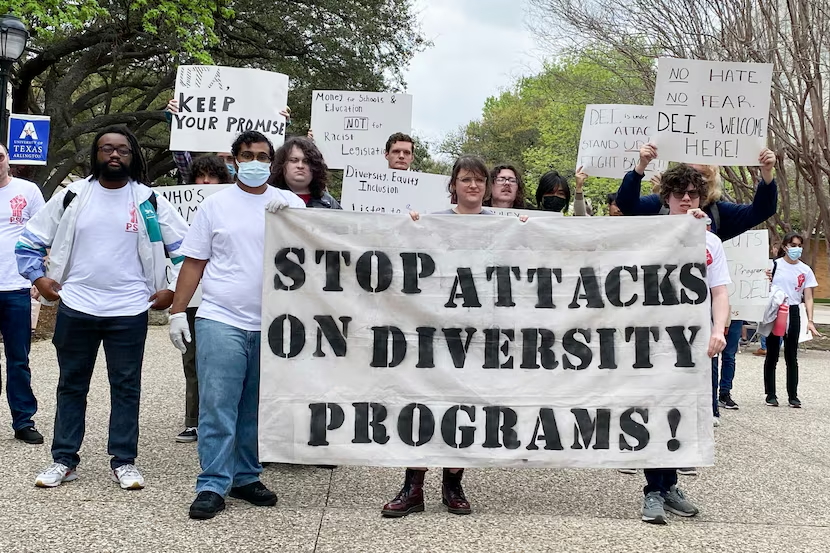
By ERWIN FREED
The first weeks of Donald Trump’s presidency has seen a barrage of spectacles pointing toward some of the fault lines in the capitalism of today’s global order. Trump, Musk, and their coterie of apparatchiks are quickly using their control of the executive branch to blame every catastrophe on “DEI,” “woke,” and “transgender ideology.” In their hands, the sins of U.S. imperialism have become the fault of trans, Latino, and Black communities and their alleged allies in the state, universities, non-profits, and media.
The MAGA regime counterposes the alleged excesses of “the left” to an eternal “common sense” that they claim to possess. Under the guise of fighting Marxist equity, transgenderism, and Green New Deal social engineering,” they are carrying out a massive series of attacks on the basic protections that workers and oppressed people have won through struggle. The attacks are unilateral and unaccountable even by the mostly fake norms of bourgeois democracy.
The Trump-Musk-Vought triumvirate is simply shifting blame for the U.S. imperial decline and the harsh realities for oppressed and working people here away from the capitalist ruling class and onto the shoulders of the most victimized people—most openly, the trans and immigrant communities. While corporate DEI programs are themselves largely a fig-leaf covering the reality of ongoing workplace and social discrimination, the Trump administration’s attacks on the concept are nothing but a screen to usher in austerity and deepen oppression.
MAGA is using its attacks on “DEI” to rationalize censorship, cover up corruption, and discipline the state bureaucracy. Using Steve Bannon’s strategy of “flooding the zone,” the far-right forces that have coalesced in the Trump administration are using the “Department of Government Efficiency” (DOGE) to create or deepen the connection between “woke” ideology and “wasteful spending” in the popular imagination. Under this smokescreen, they are putting everything from school funding to Medicaid on the chopping block. The offensive against “DEI,” along with a constant flood of posts and claims that DOGE is cutting “wasteful” spending, sets the stage for more “traditional” corporate demands. This includes adding work requirements to welfare eligibility that could cut benefits to over 21 million people.
The failure of the Democratic Party to mount a visible or effective opposition suggests that they can imagine later benefiting from the strengthened executive state and corporate control of its most ideological apparatuses—education, police, etc. As celebrity billionaire Mark Cuban pointed out in a post on X, the Democratic Party agrees with the economic, if not the ideological, basis for the mass layoff program, “cutting the deficit.”
“Common sense” and the right-wing onslaught
The concept of “common sense” is one of the most nefarious weapons in big capital’s propaganda tool kit. Donald Trump has declared his regime the “common sense” presidency. Marxists have, since Marx, explained over and over how evoking “common sense” is a method for transmitting the “ruling ideas” in a certain historical moment from the ideas of the ruling class.
What does it mean when Trump and his press secretary, Karoline Leavitt, say that the people who disagree with them lack “common sense?” They are raising their personal understanding, and by extension the understanding of their class, to represent “Truth.”
In the case of racism and job discrimination, their “common sense” is that the “most qualified person should get the job.” Leavitt was very explicit in this during a discussion on FAA “DEI” policies that she alleged led to the tragic collision between a Blackhawk helicopter and passenger airliner in DC on Jan. 31. In that briefing, she said directly that a pre-hiring questionnaire that asks questions about “skin color” was responsible for the crash.
This is a worthwhile case study in image and reality in the “DEI” fight. What Leavitt is referring to is known as the “Biological Questionnaire,” an additional application requirement added to FAA applications in 2014. That questionnaire was implemented not specifically to hire more Black people, but rather out of a recognition that the standardized test used for recruitment effectively prioritized applicants who attended university or college-based Air Traffic-Collegiate Training Initiative programs. These programs, a study found, are not only virtually all white and male, but also have a high drop-out rate by the few matriculated Black students.
The purpose of the poorly named “Biological Questionnaire” (BQ) was to give more hiring opportunities to students from other “applicant pools,” which includes veterans and already active air traffic control workers. These alternate pools are disproportionately Black and include more women. The BQ simply added weight to high-scoring applicants from these less “elite” pools in order to attempt to redress the social discrimination. It is no accident that the people shelling out money to attend full-time Collegiate Training Initiatives are generally white, or that qualified Black applicants’ experience came from learning on the job and self-study.
But the “common sense” perspective of the white ruling class does not see the actually existing racism in society as a serious problem. They benefit from maintaining it. “Common sense” preference for whites also has the effect of stoking fears within the white working class and petty bourgeoisie that, until now, their jobs have not been “protected” from competition with equally qualified Black and Latino workers.
In reality, while claiming “race-blindness” and preaching meritocracy, the Army, Navy, Space Force, and Air Force are already signaling a massive curtailment of elite Black engineers in the military. The Defense Department stopped a longstanding practice of sending high-level recruiters to the Black Engineer of the Year Awards and banned currently enlisted soldiers and officers from attending in uniform. A Military.com article quotes one general as saying that ending the practice is “f—ing racist. … For the Army now, it’s ‘Blacks need not apply,’ and it breaks my heart.”
Similarly, the attack on trans people at the level of the president and his cronies also strategically attempts to use “common sense” to justify a regime of terror and dehumanization on trans communities. Underlying the ruling-class notion of “common sense” is the projection that their understanding of the world is both true, and more or less, eternal.
The war over “common sense” has become effective for the far right partly because of the fact that the Democratic Party and its connected non-profit apparatuses basically agree with the principles. While the Democratic Party has given superficial support to corporate DEI principles and allowed the expansion of trans rights on a largely local basis, this political party of the bosses has never given full-throated support to effective affirmative action measures in any arena of social life and has worked systematically to dampen struggles to apply the principle. It is also important to recognize that the Democrats have made it plain through five decades of refusing to codify abortion access into law that they see questions of social oppression as negotiating tools they can use in parliamentary maneuvers.
“DEI” programs themselves were largely implemented as a means of giving the illusion of progress in the wake of mass struggles like the Michael Brown and George Floyd uprisings. They have done very little to actually benefit Black, Queer, and other oppressed workers. As Keeanga-Yamahtta Taylor pointed out in a recent New Yorker article: “Numerous studies have shown that most of the benefits of D.E.I. have accrued to white women. A report on board diversity from the consulting firm Deloitte and the Alliance for Board Diversity found that “white women made the largest percentage increase in board seats gained in both the Fortune 100 and Fortune 500.” According to recent data by the job-search site Zippia, more than 75 percent of “chief diversity officers” are white, and more than half of them are white women.”
In attacking “DEI” programs, the MAGA crowd has identified an impossible fight for the Democratic Party. On the one hand, the right is using “DEI” as a stand in for Black, Queer, immigrant, and other oppressed peoples—as well as the idea of climate change. The Democratic Party’s “base” supports defending oppressed communities. On the other hand, actually existing “DEI” is generally a management-driven, top-down, and mostly ineffectual hand-out to professional white women. The Democratic Party attempted to craft their own “common sense” around “DEI” as a solution to race and gender inequality at the expense of embracing grassroots mobilization to defend and expand rights and social integration.
An important element of the “common sense” maneuver is that whether or not politicians and the rich “really believe” what they are saying does not really matter. Nancy Mace, one of the most vicious anti-trans attack dogs, said in 2023, “I’m pro-transgender rights. I’m pro-LGBTQ. Just don’t go to the extreme with our kids.” Peter Thiel, who aggressively opposed gay marriage, is himself gay and married his long term partner Matt Danzeisen in 2017. This is all to point out the cynicism and opportunism of these politicians and “powerful” people. They do not necessarily share the “common sense,” but they do understand the strategic purposes for base-building and developing scapegoats. These activities help consolidate their power at the expense of working-class oppressed people, while also helping develop and maintain loyalty networks based explicitly on racial and gender-based exclusion.
Republican “common sense” rhetoric has much in common with Nazi and McCarthyite obsessions with “deviants” and “subversives.” The point is to draw clear lines within the current racist social structure and state that they are not only natural but also necessary for a functioning society. Another function is manufacturing or escalating fear based on the apprehensions of the white ruling class into broader social circles, including Black and Latino communities. In short, it is an attempt to utilize the rhetoric of “wokeness run amok” to divide and conquer oppressed sectors.
These elements are represented perhaps most starkly in the growing right-wing censorship in schools and libraries. Workers in these institutions are expected to carry out the line of erasing Black, Queer, women’s, immigrant, and all potentially “subversive” histories and topics or risk losing their jobs. This is a critical touchpoint for the fightback against censorship and the onslaught attempting to rewrite and cover-up history. Librarians and education workers are and can lead the whole working class in a mass movement against censorship and in defense of free speech.
Liberal-socialist “left” runs cover for racism and transmisogyny
One of the most blatant recent examples of the liberal press soft-peddling the Trump administration’s attack on anti-discrimination and affirmative action efforts was a Feb. 6 New York Times article titled “As Trump Attacks D.E.I., Some on the Left Approve.” The article uses Jacobin founder Bhaskar Sankara to counterpose fighting oppression to trade-union struggles, citing the case of Costco. The article goes on to say that the strongest method for overcoming racial prejudice is unionization, which is in some ways obviously true. However, Sankara and the article both simply accept Trump’s attack on “DEI” at face value. Sankara is quoted as saying, “I am definitely happy this stuff is buried for now.”
This view misses the forest for the trees, and is ultimately chauvinist. They are in line with the Times’s longstanding editorial policy of dehumanizing trans people. The Gay and Lesbian Alliance Against Defamation and trans activists have been pointing this out for years, to no avail. In any case, as opposed to Sankara, corporate “DEI” programs are not the real target of the attack, although capital is happy to give up the cover of social progress.
Many liberal mainstream journalists have adopted the narrative that Trumpism is a reaction to “wokeism” gone too far. One article in Foreign Affairs lays this out in a way that is also endemic in The Times, Washington Post, Wall Street Journal, etc.: “By delegitimizing traditional values in favor of ‘wokeness’ and cancel culture, progressive movements have alienated voters for whom religion, family, and national patriotism have provided a stable compass in a complex, chaotic world. At the same time, facing growing economic insecurity, many in lower income groups, or those, like white male citizens, who may feel stigmatized by liberal universalism, have found it easy to blame social ills on migrants, open borders, and the privileges that progressive governments have granted to a broadening array of minority groups. In short, progressives have offered moral constraints without problem solving—in response to which populist leaders offer problem solving without moral constraints.”
These claims are provided, as always, with no evidence. The Democratic Party certainly did not “go woke.” Biden carried out major rollbacks of trans youth health care, and the party embraced everything from fossil fuel companies to outright billionaires.
A somewhat bizarre article from the Revolutionary Communists of America (RCA, formerly Socialist Revolution / International Marxist Tendency) puts forward a similar “class first” perspective on social struggle. While the general conclusion of the article is correct—that the Democratic Party (and Republican Party, a la Marco Rubio) uses women, Queer, and non-white candidates as a means of distracting from and papering over their pro-business policies—the larger point about the massive attack on genuine gains that were won through immense, often armed, struggle by Black workers is nowhere to be seen. Instead, the article claims that “as the right sometimes says, ‘woke is broke.’”
The RCA’s embrace of the right’s rhetoric on “anti-wokeness” is especially confounding given the specific history of the term “woke.” That word has a long history in African American Vernacular English, with roots in the Marcus Garvey movement. As Vox points out, Leadbelly, the famous working-class blues musician, used the lyric “stay woke” in his 1938 song “Scottsboro Boys”; in an interview about the song, he said that Black people “best stay woke, keep their eyes open.” That article traces other examples of the term over the last 100 years. “Woke” ideology is, historically, recognition by Black people and allies of the need to be vigilant against white supremacy.
Underneath the polemic against the Democratic Party’s obvious cynicism and hypocrisy is an implicit rejection of political demands based on race, gender, and sexuality. This is, again, chauvinist. Worse, the RCA appears to be separating the struggle against political oppression from workplace exploitation. This is a ridiculous distortion of Marxism. The exploitation of working people is enhanced and deepened through racial and gender oppression. To abandon the struggles for integration and self-determination is to abandon the class struggle.
U.S. capitalists, and Trump, made fortunes on segregation
While virtually the entire ruling class and their political representatives gained their wealth and power at least in part from the racist social order, it is worth acknowledging that Donald Trump and Jared Kushner—Donald Trump’s son-in-law—have all benefited personally through systems of racial apartheid.
Fred Trump, Donald Trump’s father, and Joseph Kushner, Jared’s grandfather, both made their major business “breakthroughs” directly from segregated housing policy implemented after World War II. Kushner made the Faustian bargain with U.S. imperialism and, along with the rest of his family, moved full force into the Democratic Party machines of New York and New Jersey. Equally important, the Kushners developed a plethora of personal, political, and business links in Israel and with U.S.-based Zionist organizations.
For his part, Fred Trump was arrested while participating in a Klan riot in 1927. The Trump Organization was brought to court in the 1970s for actively discriminating against potential Black tenants. Ultimately, through political connections, an aggressive legal campaign directed by Roy Cohn—the notorious Mafia fixer, anti-Communist witch hunter, and friend of FBI director Hoover—and a fundamentally ineffectual bureaucracy, Donald Trump’s first official foray into the politics of landlordism resulted in a slap on the wrist. In a larger sense, Trump was rewarded by these same political networks with illogical tax-abatements on future development projects.
The real affirmative action that exists in the United States is the system of privileges giving white people, and particularly rich white men, preferential status in “opportunity,” to maintain their decision-making power as a whole. This system of privileges is what Trump, Musk, and all of their corporate backers aim to codify through the various pronouncements, executive orders, and mass media propaganda campaigns against “DEI.”
One example of the general principle of “developing” marginalized communities being warped by this political background was the 2017 “Quality Opportunity Zone” initiative put into law by Trump. That project was ostensibly meant to provide investment to underserved communities and increase access to affordable housing and better public infrastructure. Instead, it has turned into a driver of gentrification and handouts. The “benefits” of jobs and new buildings are largely going to people outside of the communities the program was sold as “helping.” Landlords, property developers, and banks got the largest piece of the pie through massive tax breaks in the zones.
Again on propaganda
The strategy of creating a moral panic based on buzzwords and dog whistles to justify seemingly unrelated political maneuvers is not new. However, it is useful to look at the particular individuals creating and shaping these narratives. Look, for example, at Chris Rufo, a right-wing intellectual and provocateur. Rufo is currently head of the Manhattan Institute for Policy Research, a far-right think tank co-founded by Reagan’s CIA director William Casey, and America Studios, a propaganda production company. His efforts are funded largely by openly far-right foundations and individuals, but also include the top tier of capital like Blackrock, Vanguard, and Charles Schwab.
Rufo is credited with identifying and pushing the right’s completely asinine obsession with “critical race theory” in schools and government. Like similar operatives, Rufo engages in personal attacks, saying in his own words that he hired a researcher to find “sensational, scandalous, and shocking illustrations” of Kamala Harris’ “record” on DEI.
Rufo’s writings and public comments have been particularly influential with the Trump team. He was also a major figure promoting the complete lie that Haitian immigrants in Ohio were “eating pets,” offering $5000 to anyone who could provide evidence. This fabricated and debunked racist slander against Haitians was echoed by both Trump and Vice President J.D. Vance.
Figures like Rufo play an important role in crafting “common sense” through utilizing social media, press contacts, and public figures—as well as dark-money-funded “grassroots” campaigns—to highlight their particular focus for the moment and create the illusion that it is both real and important. They use mass surveillance tools like those developed by Cambridge Analytica to identify the best pressure points to push on in order to maximize confusion and categorical, one-sided thinking.
Affirmative action in history
The history of the United States is the history of preferential policies for whites at the expense of everyone else. From the maintenance of racial slavery in the Constitution to de jure and de facto bans on Black people in jobs and housing, anti-Black racism and pro-white laws and practices were and are the basic principles of the “Republic.” Also baked into the Constitution are separate and unequal conditions for Indigenous communities, codifying the ideology justifying the theft of all Native controlled lands.
Black, Latino,Queer, Indigenous, and immigrant workers are forced into the worst paid, most precarious, most dangerous, and most essential jobs. The old adage of “last hired, first fired” remains true for Black and other oppressed workers. This is the general “economic” base of oppression. Under the leadership of all federal governments since Lyndon B. Johnson, the state has erected a massive system of surveillance, militarized policing, and prisons to maintain this social order. An important aspect of these coercive measures is that they are fundamentally a system of control for the most exploited and central workers within the entire U.S. political economy and social reproduction. Two obvious examples are the general lack of protections for agricultural and domestic workers.
The idea of “preferential” policies meant to address segregation and Black oppression has a long history. All positive developments on this front have been the result of the self-activity of Black people in the United States. All have been viciously attacked by the white ruling class and their racist foot soldiers.
An important historic touchstone was the Freedmen’s Bureau, established during Radical Reconstruction. In a classic article, W.E.B. Du Bois describes how “the government of the unreconstructed South was … put very largely in the hands of the Freedmen’s Bureau.” Although always partial and ultimately defeated, the work of the Freedmen’s Bureau included opening new lands to Black occupancy, forced hiring of Black workers, massive expansion of education in Southern Black communities, and defending voting rights for Black men. All of this was done effectively through military occupation of Southern states.
Radical Reconstruction gave way, through betrayal by Northern capital and indifference or outright rejection by the white working class and middle class, to an era of all-out, state-backed Klan terrorism against the Southern Black population. Lynchings were a regular occurrence and were often attended by thousands of jubilant white Southerners, including children. In the North, sundown towns, police and white racist violence against Black people, and overt segregation in jobs—including union apprenticeships, housing, and town codes—were the order of the day.
The growth of Black nationalist sentiment and organizing, independent Black mobilizations around the country and in the labor movement, buttressed by a growing U.S. economy and Black sacrifices in various imperialist wars, began to force shifts in the government and public sentiment. Ceding to pressure from threats like A. Philip Randolph’s proposed 1941 March on Washington, the F.D.R. administration made small concessions like the formal ban on discrimination in the armed forces.
In reality, racial discrimination and segregation remained the law of the land at all levels. As Richard Rothstein and Mehrsa Baradaran have respectively documented in “The Color of Law” and “The Color of Money,” legal, informal, and structural restraints against Black people benefiting from the so-called “American Dream” remained official policy of the federal and state governments through the 1960s and often much later.
After decades of partial gains towards “merit-based” integration, civil rights and Black power activists began putting forward a vision of what would now be called affirmative action. In 1962, the Congress of Racial Equality (CORE) national office sent a directive to local CORE units. That directive demanded that CORE members and collaborators make “very specific demands which far exceed tokenism.” One official recognized that “[we] used to talk simply of merit employment… Now, National CORE is talking in terms of ‘compensatory’ hiring. We are approaching employers with the proposition that they have effectively excluded Negroes from their work force for a long time and that they now have a responsibility and obligation to make up for their past sins” (quotes taken from “The Pursuit of Fairness: A History of Affirmative Action,” Terry Anderson, 76).
The main “success” story for the movement lay in federal and state government jobs. As Nancy MacLean has documented in “Democracy in Chains,” sections of the ruling class—including the Koch and Coors dynasties—began immediately organizing a long-term legal and extra-legal strategy to undo these very modest victories. Such is the origin of the modern “school choice” movement, for example.
Affirmative action gains were always partial and limited. A tension always exists between the idea of “equal opportunity/non-discrimination” and affirmative action. Whereas “equal opportunity” measures ban explicit discrimination based on race, gender, sexual orientation, religion, etc., affirmative action explicitly prioritizes bringing demographics in a particular sector (housing, a workplace, an industry, etc) to be representative of the population as a whole.
Against the turn
Our response must be full-throated defense and a fight to expand, not demolish, the social gains won through historic struggles. Elite-run DEI programs were themselves meant to be a bulwark against working-class struggle. On the one hand, by acknowledging the existence of structural inequality, they were designed to provide a release valve for anger against the racist and sexist system. On the other hand, the programs were usually received as a management strategy foisted upon workers as job requirements. Thus, they were sometimes viewed as a potential threat to one’s livelihood. And as an alienated mode of education, they failed to seriously advance the cause of women, LGBT+ people, and racialized employees.
These sorts of corporate and foundation-funded programs are not the way to defeat oppression in U.S. society. Instead, as has been the case throughout the entire history of this country, the real way to make change is through independent organization rooted in Black, Queer, Indigenous, and other oppressed communities.
There is a need to build the struggle against these frontal attacks on the working class that is separate from the ruling-class maneuvers that use our rights as pawns in their game. Mass meetings countering book banning and reactionary education curriculums can develop into movement organizations. Mobilizations in defense of trans health care, as are happening in New York City, can connect with trade unions, Black community and immigrant organizations, and other progressive forces to demand and expand rights for the trans community as a whole.
Both liberal and conservative capitalists, represented by and funding both parties, show every day that they do not stand for the rights and livelihood of working people. We cannot let them use the attack on “DEI” as a cover for rolling back already limited democratic forms in the United States, as a cover for increased militarism, or to scapegoat oppressed communities. These facts should be readily apparent to all. The task is to build a movement that can stop these forces in their tracks. Unions must take up affirmative action in all of their mobilizations and political work. Just as seniority empowers and unifies workers, so does the fight against discrimination, Queerphobia, and racism in the workplace.
In the final analysis, as long as control of production, distribution, and the state remain in the hands of capital, democratic rights will always be under attack. Creating the conditions to really abolish social oppression will only be possible with the working class taking control of production, that is to say, building a socialist society. Due to the foundational role of racism in U.S. capitalism, the socialist revolution will have a “combined” character in this country. Workers’ power is impossible without also taking up the fights for Black self-determination, Land Back, and the socialization of what MAGA considers “women’s work.”
Photo: Protest on the campus of the University of Texas at Arlington. (Valeria Oliveras / Dallas Morning News)
-
Travels through post-Assad Syria

{:en}

By FABIO BOSCO
On Jan. 21, I began a six-day trip through Syria at the invitation of Monif, a former Trotskyist leader of the Communist Workers Party (CWP). The CWP was severely repressed by the dictatorship, and he himself spent 16 years in prison, eight of them in the notorious Sednaya prison. At the Lebanese border, entry was allowed with an invitation. Only people with Israeli or Iranian passports are denied entry.
As soon as you enter Damascus, you can see the signs of poverty that the entire population has been subjected to. On the streets, 5-liter gallons of gasoline are sold for $10 to fuel vehicles and heat homes, since electricity is not available 24 hours a day (in the neighborhood where I stayed, it was only available 2 hours a day).
Since the fall of the dictatorship on Dec. 8, the price of food, with the exception of bread, has dropped because farmers can take their produce to the cities without having to pay tolls at every checkpoint along the way. In addition, shortages have been reduced by imports from Turkey, and the Syrian lira has appreciated against the dollar, selling at 11,000 to the dollar.
The Old City
The next day, I explored the beautiful Old City of Damascus, with its lively markets around the famous Umayyad Mosque. This religious complex in itself is a tribute to religious tolerance. The remains of St. John the Baptist can be found there, as well as those of the Kurdish general Saladin, who ruled Egypt and Syria and fought to expel the Crusaders.
There is a political fervor among the people. Everyone is discussing every step of the transitional government.
I had a conversation with a group of people who, upon learning that I was from Brazil, immediately asked me about Lula’s position on the genocide in Palestine. It is interesting to see that the information about Lula’s position on Palestine is what circulates outside the country, instead of the position of the Brazilian government against the actions of the armed resistance in Palestine and Yemen.
The day’s debate centered on the “fine-toothed comb” operation in Homs province, in which there were reports of abuses against the population and in which 14 military personnel of the former regime were killed, several of them high-ranking. Opinions were divided. Some thought it was the right thing to do against the former regime, and others thought it could be done in a way that respected individual rights.
I asked about the Druze, and someone from Sweida told me that recently there had been a consensus among the population, the armed groups in the city, and the sheikhs for a united and democratic Syria. Another person joked that the Druze had become Trotskyists because for them the revolution is permanent.
That same day, I attended a meeting called by the lawyers’ union in the former headquarters of Assad’s party, which the residents have transformed into the Jaramana Social Forum, in the suburbs of Damascus. The debate was about defending democratic freedoms and a constitution. 150 people participated. In the same place, I attended another meeting with 150 people about women’s rights and their extension throughout Syria. There was an atmosphere of great optimism.
On Friday, Jan. 24, I participated in a demonstration for the disappeared politicians in Marjeh, in the center of the city, with 250 people, many of them with photos of relatives and friends who have disappeared in the prison system. It is estimated that 200,000 people have disappeared. For this event there was a caravan of at least 40 people who arrived by bus.
Then three Palestinian friends, Walid, Motassem and Mustafa, took me to visit the Yarmouk Palestinian refugee camp, the largest outside Palestine. The camp has been devastated by airstrikes by the dictator Assad. We passed two destroyed hospitals and also devastated mosques, one where the first major massacre took place when the dictator Assad bombed the mosque on a Friday when there were more people in the area.
They said that the first fighting was between the forces of the dictatorship and young Palestinians inside the camp, where Salafist organizations later entered.
As we walked through the camp, one of them took a photo of graffiti on the wall and explained to me that it was a tribute to a friend, a PFLP dissident, who was kidnapped and executed by the “Palestinian branch” (one of the 18 repressive services of the dictatorship) for supporting the revolution. They explained that this widespread bombing was not only for military reasons, but mainly because Assad, looking to the future, decided to expel the entire Palestinian population to make room for the families of militiamen who came from other countries to support him.
They also told me that at the beginning of January they organized a protest in front of the headquarters of the Palestinian Authority in Damascus against the repression in Jenin. Then on Jan. 15, when the ceasefire was announced in Gaza, there were demonstrations in solidarity with Palestinians all over the country. Assad never allowed demonstrations. Another important point was the release of about 700 Palestinian prisoners who were still alive in the prisons of the dictatorship, including 67 members of Hamas.
It is also important to remember that Syria has had part of its territory occupied by the State of Israel since 1967. For 50 years, Assad has not allowed anyone to throw even a stone at the Israeli soldiers occupying Syrian territory. Today, it is not possible to know whether the transitional government will stand against the Israeli occupation and in solidarity with the Palestinian people beyond diplomatic protests.
What is certain is that the Syrian people love Palestine, and in one way or another this solidarity will reach the Palestinian people.
The next day, I visited the country’s most famous prison, Sednaya, with the activists Lujane, Motaz and Fares from Deraa. The prison had a building for dissidents that held up to 15,000 prisoners until 2018, when they began to carry out between 30 and 40 executions a week in various ways: military executions by firing squad and the rest by poisoning, suffocation, or crucifixion. Several bodies were dissolved in acid and never found again.
Then we went to Omeya Square, the center of the celebrations for the fall of the dictatorship. On Sunday, I returned to Lebanon, crossing the border without any complications.
The future lies in the hands of the working class
The Syrian people are very happy with the fall of the dictatorship and have high hopes. But there are several obstacles to achieving the goals of the revolution: freedom, bread, and social justice.
The most important is the transitional government itself. This government wants to rebuild a capitalist economy integrated into world markets. To accomplish this, it has turned to the imperialist countries: the United States, European countries, Russia and China, as well as the regional powers, especially Turkey and Saudi Arabia. However, this policy will be an obstacle to guaranteeing an improvement in the quality of life of the population.
The interim government also wants to rebuild the bourgeois state, especially the armed forces that were destroyed by the revolution, and also a Bonapartist regime, that is, a regime that rules with the support of the army. In addition, they want to draft the constitution without the participation of the people and to call elections in four years.
These measures threaten the freedoms and democratic rights of the people to decide the future of the country. Another threat is the presence of foreign forces in the country. The Israeli army occupies an area in the south and is pushing for the division of Syria into three states. The United States has a large base in the south and about 2000 troops in the northeast, where they work with the Kurdish SDF militias led by the PYD party. And finally, Turkish troops occupy strips of the border and work with a militia called the National Army, whose main objective is to prevent the Kurdish population from having any form of autonomy or self-determination.
The only way to guarantee the ideals of the revolution is for the working class, the youth, and the poor to organize themselves to fight for democratic freedoms, social rights and power.
It is very important to have a revolutionary party based on the working class with a socialist perspective. This objective faces a difficulty, which was the betrayal by the majority of the world’s left, which did not support the Syrian revolution: They supported Assad or remained on the sidelines.
The party of the dictatorship also presented itself as socialist for a whole period, and the main communist parties in the country were part of the dictatorship’s government for 50 years and have therefore been completely discredited in the eyes of the population.
These difficulties should not prevent the working class and youth from building a party to lead their process of self-organization, their struggles, and a socialist future for Syria.
-
Protectionism or free trade? How does capitalist trade policy affect workers?

{:en}

By ERNIE GOTTA

UAW President Shawn Fain (George Walker / AP) “I’m President of the UAW. We’re ready to work with Trump,” read a headline in The Washington Post that shocked many in the labor movement. Shawn Fain, president of the United Auto Workers (UAW), spent the better part of the 2024 presidential elections warning workers everywhere that Donald Trump only represented the billionaire class and called him a “scab.” Then, the day before Trump’s inauguration, Fain published an Op Ed explaining why his union needs to have a voice in developing U.S. trade policy. In the Op Ed, Fain endorsed Trump’s plan to implement tariffs and explained why, in his view, tariffs would be a necessary corrective following decades of devastating attacks on U.S. jobs and workers from neoliberal free trade agreements like NAFTA and the US-Mexico-Canada Agreement (USMCA).
Fain is not the only union leader to support Trump’s trade policies. Why did the United Steel Workers union try to thwart the merger of U.S. Steel and Japan’s Nippon Steel? Why did the International Longshore Association during their strike blame foreign companies for not adequately compensating U.S. workers and taking profits out of the country?
Why did the general president of the Teamsters, Sean O’Brien, when addressing the Republican National Convention in July 2024, parrot Trump’s “America First” rhetoric, saying, “We need trade policies that put American workers first?” O’Brien doubled down on vile anti-immigrant protectionist ideas on a podcast in which he interviewed Republican Senator Josh Hawley—who masquerades as a friend of the unions. O’Brien stated, “I think the biggest problem is people are trying to protect illegal aliens that come here and commit crimes, and that’s unacceptable. … Social issues are all well and good, but protecting illegal immigrants that come into our country to commit crimes and steal jobs, that’s a tough pill to swallow.”
For many, at first glance it seems logical that unions would rally to protectionist ideas after facing the carnage brought on by NAFTA and USMCA. So called “free trade” has had a deeply negative impact on jobs and wages in the U.S., but is Fain correct to say that protectionist policies geared around tariffs will be the answer to bringing manufacturing back to this country? Can protectionist policies like tariffs, import quotas, and other government regulations lead to less exploitation, higher wages, and better working conditions for the working class?
No. Capitalist trade policy is made by capitalists for the benefit of their own class. Whether it’s “free trade” or protectionism, the implementation of the policy is meant to protect and increase the profits of the ruling class.
There are times when the capitalists need higher revenue streams and favor a free trade approach. Of course, free trade is really “free” in name only and generally serves for the exploitation of one nation over another. In reality, free trade agreements like NAFTA establish zones that allow imperialist nations flexibility in deferring tariffs, managing inventory, and cash flow. These free trade agreements allowed U.S. companies to close down production lines in the U.S., cross the border into Mexico, and super-exploit the workers there.
This worked for a while as the U.S. was the undisputed hegemonic power and leading economy, but with the restoration of capitalism in the Soviet Union and China and the subsequent rise of China and Russia as new imperialist powers, the situation has shifted significantly. The inter-imperialist rivalry with China in particular is driving some U.S. capitalists to favor protectionist policies in order to put up barriers and hurt the competition.
The resulting trade war will likely be a driver of inflation and put more economic burden on the working class not just in the U.S. but globally. One could also draw the conclusion that an escalating trade war could be the basis for the inter-imperialist rivalry to turn into a hot war.
Trump has said many times that tariffs are paid for by foreign countries. Is this true? No! While tariffs can have a negative impact on foreign countries, ultimately it would be U.S. importers who pay the tax directly to the U.S. Treasury and then recoup that tax by making U.S. consumers pay higher prices. Trump knows this but has created a narrative in which the U.S. is being taken advantage of in global trade. He posted on X, “This will be the Golden Age of America! Will there be some pain? Yes, maybe (and maybe not!). But we will make America great again, and it will all be worth the price that must be paid. We are a country that is now being run with common sense — and the results will be spectacular!”
Historically, the Tariff Act of 1789, the Tariff of 1816, and the McKinley Tariff of 1890 did nothing to benefit working people. McKinley was known as the “Napoleon of Protection” and every move he made was to benefit the interests of manufacturers. It’s no wonder that Trump wants to bring back the name McKinley to Mount Denali. More than just promoting settler colonial ideology, Trump is signaling a return to an era before 1913 when there was no income tax and protectionist policies were the dominant trade policy.
Protectionist policies also have an inherent downside for the capitalists. Frederick Engles observed in 1888, “Protection is at best an endless screw, and you never know when you have done with it. By protecting one industry, you directly or indirectly hurt all others, and have therefore to protect them too. By so doing you again damage the industry that you first protected, and have to compensate it; but this compensation reacts, as before, on all other trades, and entitles them to redress, and so on ad infinitum.”
As always there will be a mad dash by the capitalists to take in as much profit as possible in the coming period. Along with the protectionist policies, Trump will also look to deepen cut taxes. The ruling class will also use their monopolized sections of industry to drive down real wages of workers and raise prices for consumers. Fossil fuel billionaire Charles Koch and his right-wing Americans for Prosperity recently released an investment prospectus that outlines a $20 million plan to lobby elected officials with thousands of meetings in order to deepen the tax cuts made in Trump’s 2017 Tax Cuts and Jobs Act.
The most reactionary tendencies in the capitalist class see an opening to regain all the concessions made to the working class and oppressed communities from the labor movement of the 1930s and ’40s up through the social movements of the 1960s and ’70s. Trump, as a mouthpiece for the ruling class, uses phony pro-worker rhetoric to sell the unions and the broader working class on the notion that protectionist policies will reverse the degradation of their daily lives.
However, protectionist trade policies, attacks on immigrants, and other oppressed communities will not resolve the very real economic crisis that capitalism is enduring on a global scale. The reality for billions of workers around the world is more instability, worse wages, and poorer working conditions. What is the solution? How do working people escape being trapped in the vicious cycles brought on by the inherent flaws of the capitalist system?
If “America First” means profits for the rich over the needs of the people, and “free trade” is freedom for imperialists to exploit workers at will, then we can’t be sucked into their schemes and play by the rules of their system. Frederick Engles wrote in 1888, “A system of production based upon the exploitation of wage labor, in which wealth increases in proportion to the number of laborers employed and exploited, such a system is bound to increase the class of wage laborers, that is to say, the class which is fated one day to destroy the system itself.”
Engles continued, “Whether you try the Protectionist or the Free Trade will make no difference in the end, and hardly any in the length of the respite left to you until the day when that end will come.”
Working and oppressed people have to wage a relentless political struggle for independence from the capitalist class in their unions, on their campuses, and in their communities. This means, for example, that when U.S. Steel wants to make a deal that hurts the workers, the demand of the workers should be to open the corporation’s account books for all to see how they make their profits, and to put U.S. Steel under public ownership and democratic workers’ control.
When workers are exploited by U.S. companies in another country or rounded up at a militarized border, U.S. workers need to extend a hand of solidarity and demand an end to the injustice by withholding their labor power.
When the elections come around, the unions should no longer support this or that capitalist politician. They should instead hold a mass meeting among all the unions and all their rank-and-file members. This meeting should open a discussion on running their own candidates under the banner of a labor party. Working-class independence and international solidarity are the only way forward for working people.
Top photo: Automobile workers gathered in Washington in 2018 to oppose President Trump’s plans for higher tariffs. Today, UAW President Fain expresses different views.
-
Trump and the Tech Bros — a match made in hell


By HERMAN MORRIS
The Year is 2025. The richest man in the world has gained full administrative access to and control of the U.S. Treasury payment system. He will go on to use that access in order to publicly brag on his privately owned blogging site about the next target he has chosen to be denied funds.
For his next trick, he plans to upload all the budget data for the U.S. Treasury into an AI platform in order to find other places to which he can unilaterally shut off funding. The entire political establishment is either too impotent to stop him or actively invested in helping him gut the public sector of the United States, including funds to the Consumer Financial Protection Bureau, the Federal Aviation Administration, and the Department of Health and Human Services. While it is unknown yet if money has been directly transferred from the public coffers to private hands, there is really no way for anyone to know at this point until after it happens.

Unfortunately for working people, this is not the plot of a cyber punk thriller but the actual state of the U.S. government and what is possible in the hands of Elon Musk and Donald Trump. While this flexing of terrifying and unstoppable force on the government may seem to be simply a demonstration of the raw power that these men hold, it is also an expression of the deep crisis that Musk and tech specifically are in, as well as a reflection of the general decline of the United States as the top imperialist power of the world.
While the “Magnificent Seven” big tech companies have accounted for nearly all the growth in the public stock market for the past two years, these corporations are failing to find ways to productively invest their hoards of wealth. The so-called “Next Big Thing” that tech companies have been seeking out since the cloud and smartphone revolution spurred profits to new and dizzying heights has failed to materialize.
Self-driving cars, artificial general intelligence, augmented/virtual reality, and quantum computing are just a few examples of the kinds of research projects from the industry that promise levels of technology worthy of science fiction. While undeniable progress has been made in all of those fields, not one of them has reached the point where it can demonstrate a financial return that justifies their deep levels of research costs.
To add to their woes, the traditional bedrock technologies that have spurred the profits and valuations of these corporations are now under threat, with ad-tech losing money to new privacy tools, government regulation enforcing data protections, rising militancy from workers, antitrust scrutiny, and increasing competition from Chinese companies. This means that—while things may look good for tech for now—there are stormy waters ahead, and it’s unclear where and how they will be able to deploy their vast resources in a way that continues the breakneck growth they have historically enjoyed.
While some tech capitalists have been vocally reactionary their whole lives, the past few years have seen a significant growth both in how many tech CEOs have declared an allegiance to Trump’s Republican Party and in the overall extremism of their views. The most famous examples are Elon Musk’s support for the AfD in Germany (an anti-immigrant, far-right party that has repeatedly used Nazi slogans) and Mark Zuckerberg’s ending of all DEI programs at Meta while making the bizarre claim of needing more “masculine energy” at the corporation—which historically has been over 60% male, according to its own diversity reports.
While CEOs may talk about a change in values or other high-minded ideals on how they believe their companies should run, there is a material basis to these changes from the top. One is the profitability crisis that tech is facing. In short, they may have all the money in the world, but they don’t know how to put it to good use. Unless they can find that use, Wall Street and other investors are going to start wanting their money back in the form of buybacks or dividends, rather than having it just sitting in the bank.
The other is that Trump won, and in his first term he made it clear he would punish those who he felt had crossed him. This had disastrous implications for Amazon, where Jeff Bezos originally made it a point to antagonize Trump through The Washington Post, which he also owns. Trump retaliated by rewarding the JEDI military contract (a deal all but assumed to be gift-wrapped to Amazon) to Microsoft, costing them $10 billion dollars and the opportunity for more contracts in the future. Jeff Bezos doesn’t want to lose money, and so this time he saw to it that The Washington Post wouldn’t endorse Kamala Harris.
So, tech is weak. Where does the rest of the country stand? While the continuous growth of the national GDP might show that everything is “fine,” as mentioned above, most of the growth of the past several years can be solely chalked up to the tech revolution, with the rest of the U.S. industrial base either stagnating or contracting, up until the recent re-shoring efforts to combat Chinese competition. Even this effort, though, required hundreds of billions of dollars in state assistance and there are big questions on the profitability of such ventures without severe curtailment of workers’ rights.
Internationally, things aren’t looking good either. The last administration had to finally admit defeat in Afghanistan, and the U.S. has spent billions of dollars funding Israel’s military action against the Palestinians—which has failed to produce a clear victory. In simple terms, the United States is failing to find ways to use its immense hoards of wealth and power to keep itself economically ahead of the rest of the world, and is increasingly at risk of being dragged down from the number one spot into a field of having to contend with other major powers to carve up the world.
These conditions are ripe for a marriage between the most powerful and corrupt leaders in the U.S. today to try to identify some way to keep themselves on top. Now that the more “centrist” U.S. leaders have repeatedly failed to prescribe workable measures for the United States to stay ahead of China and Russia, some feel that it is time for more radical ideas to come forward. Enter Trump round two, except that this time, instead of the tacit working relationship he had with tech and other big arms of capital in the U.S., he is enjoying active cooperation and even some kickbacks. In return for the friendly approval and financial support in the form of million-dollar donations to his inauguration fund, Trump is doling out public support like candy: $500 billion for Stargate, a multi-company AI server investment where it’s unclear what role the federal government is even playing in it; a new government-specific AI chat bot provided by Open AI; with the capstone being the Department of Government Efficiency (DOGE).
DOGE is a vague and ill-defined “Temporary Organization” (a classification fabricated to avoid saying it’s an executive department, which can only be formed by Congress). Its purpose is stated to “modernize federal technology and software to maximize governmental efficiency and productivity.” Its actual steps so far seem to consist of personally putting Elon Musk in charge of the executive branch of the U.S. government to conduct cost reductions and layoffs in the exact manner that Elon has pursued at his own corporations. These attacks have been wild and all over the place, with the only departments assured safety being ICE and the military—and even they have been subject to anti-DEI policies.
Will this strategy work, though? There are two very important factors at play here. While on the one hand, potentially massive amounts of contracts and funds may be siphoned from the public sector to the private sector, this is just one more acceleration of the same neoliberal policies that have been gutting the public sector of the U.S. government since the 1970s. This may temporarily free more capital to be invested, but it comes at a cost of more human misery in that basic services and needs are no longer fulfilled.
Additionally, the people carrying out these cuts still have no plan for where the money can be profitably spent once the smoke clears, other than continuing to invest in industrial research projects worthy of science fiction, as they did earlier, and praying for another breakthrough. Mostly, it will only mean more money for them, and less for the working class. This is the key lack of vision and imagination that the capitalist system has instilled in its most powerful leaders, and they must resort to deeply undemocratic means to carry them out because they know how unpopular they really are.
On the other hand, the way that these neoliberal reforms are being carried out represents an important shift in the nature of capitalist rule in America. There is no longer any pretending that what Congress passed into law today or yesterday will be carried out at all by the executive branch, if it is willing to leverage the payment system to unilaterally divert funding. The judicial branch of government is also staffed by Trump loyalists, who promise at best a slowing of the process, if not rubber-stamping aspects of it outright.

Feb. 5 protest in Columbus, Ohio. (Doral Chenoweth / The Columbus Dispatch) This can be seen as one layer of the U.S. capitalist class saying that traditional American “democracy” and its institutions are not useful enough for them to realize their aims. So far, no ruling-class opposition that could stop this effort has materialized. While there is immense oppression and injustice in the U.S. as it exists today, this new form of government with an executive branch that can work virtually unchecked, as proposed by segments of the far right, would obviously only be worse for working and oppressed people.
The unpopularity of these measures is very important to remember. Trump may have won the “popular” vote this time, but once again, he didn’t even win a majority of the electorate. While the Democratic Party has been extremely feeble and ineffectual in protesting these maneuvers, public reaction has been growing. On Feb. 5, thousands demonstrated around the country in loosely coordinated “50 Protests, 50 States, 1 Day” rallies, which expressed support for LGBTQ, reproductive, and immigrant rights, as well as outrage over Project 2025 and the onslaught by Trump and Musk. These events included spontaneous rallies by federal workers. In the meantime, immigrants and their allies have been building bigger and bigger demonstrations across the U.S. to fight back against deportations.
These demonstrations contain within them the kernel of building a mass democratic movement to provide a far stronger check on capitalist politicians than what Congress is capable of. For these demonstrations to grow, it will be essential to form broad coalitions that include labor unions, immigrant communities, civil liberties groups, and other mass organizations.
The attempts to dismantle federal departments threaten the jobs of federal workers and can severely diminish the important services that they provide; they also threaten to reduce the strength of some of the biggest unions in the United States. Only through building a movement in the streets and in the workplaces of those facing the worst threats can an effective fight against the Trump regime and his sycophants be mounted.
While the ruling class may live in its fantasy world of super-computers and infinite power, workers live in the real world. In this world, we know from history that mobilizing and building a broad, democratic fightback against the worst excesses of the state—from the Vietnam War to Jim Crow—can be successful. By studying our past and building this movement, working people have the power to put a stop to the capitalist agenda to gut workers’ rights and the democratic liberties that we enjoy today as the fruits of past struggles. Working-class power is in the streets, not in the halls of Congress, and only through bringing greater and greater masses of workers together, organized to fight back against cuts to federal jobs and social services, can workers take their destiny into their own hands.
Top photo: Feb. 5 protest in Philadelphia. (Matt Rourke / AP)
-
Protest at Vocational Technical School in Pucheng, China


By LEE
On Jan. 1, 2025, a student at the Vocational Technical School in Pucheng, Shaanxi Province, was found dead on the ground outside of his dormitory window.
According to the report of the CCP [Chinese Communist Party] investigation team, at about 10 p.m. on Jan. 1, 2025, a student with the surname Dang had difficulty falling asleep in his fourth-floor dormitory due to the noise being made by his roommates. Following that, the report claims he had a verbal and physical conflict with another student with the surname Guo.
According to the report, Dang then went to the first floor accompanied by another person by the name of Chen, a member of the Student Union, and reported the situation to Lei, the deputy director of the Political and Educational Department. After Lei took Dang and Guo to mediation, the two returned to the dormitory. At about 3 a.m. the next day, Dang’s roommate Huang found a wooden stool under the balcony window of their shared dormitory. The sliding window was open, and the diamond mesh screen had been removed, and as the report states, Dang had fallen out of the window to the ground outside.
On Jan. 5, the CCP investigation team issued a report stating that after the police department’s on-site investigation and monitoring, they had confirmed that Dang had died from a fall from his dormitory window, and a criminal case was ruled out. In other words, they believed that Dang committed suicide.
In fact, on the day of the incident, the mother of the deceased was notified to go to school, but the school did not explain the reason why she was being asked in. After arriving at the school, she was unable to see her son’s body. Instead, she was taken to a classroom by a teacher for supervision and was not allowed to leave for some time. After staying at the school for a few hours, she was sent directly to the funeral home where her son’s body had been transferred. There, she observed that her son had many bruises on his body, so she tried to take pictures, but was stopped by the accompanying teacher. After that, she requested several times to see her son’s body again, but her requests were denied. In addition, the mobile phones and smart watches of those who witnessed the events were confiscated, and the photos were forcibly deleted. The most important thing is that there are obvious signs of fighting in the dormitory. But this is not the whole tragedy.
On Jan. 5, the uncle of the deceased was also taken detained and beaten by the police.
Although the police notice mentioned that there would be a review of the surveillance footage, the school has claimed that the footage was damaged and no one was allowed to view it. The school’s refusal to give access to the surveillance footage and the treatment of the deceased man’s family suggests that this was not a simple suicide.
According to witnesses, Dang was beaten to death by the principal of a local high school, who has considerable protection in the political arena.
While this tragedy is extremely infuriating, the reaction of the masses was both a reflection of that anger and a touching response to Dang’s death. On Jan. 7, more than 50,000 people went to the vocational school, a government building, and the police station, and asked the government to release the arrested uncle and investigate the crime. Thousands of people gathered at the entrance of the vocational center, and the family members of the deceased addressed the crowd and accused those involved in the cover-up of corruption.
Some of the people protesting in various departments shouted “Long live the people” and some yelled “Release the people.” In short, there was a confrontation between the masses and the police. The people angrily shouted phrases such as: “Why are you pointing guns at us?” “The police are bandits!” “The police are gangsters!” “The police are the biggest evil forces in Pucheng!”
Facing the human wall formed by the police, the masses bravely broke through it. They forced the police into a corner and to the front of the gate. They banged on the gate and windows and smashed the surveillance cameras in anger.
The battle at the Vocational Technical School was the site of the most intense of the confrontations. The masses broke through the school’s iron gates, broke through the police’s defenses and entered the campus, destroying offices, canteens, and other facilities. The vice president of the school was also beaten by the angry masses. When he got into an ambulance, another crowd tried to overturn the ambulance.
Faced with fierce protests, the Chinese government then adopted more powerful repressive measures. Special police and armed police were dispatched to deal heavy blows to the masses, and a large number of people were injured. As a result, the unarmed masses were forced to disperse.
After the mass movement was temporarily calmed, the Chinese government claimed that the demonstrators were unjustifiably hateful and hostile.
Subsequently, a large number of armed police guarded the main streets and even blocked the highway in Pucheng. Many hotels were also filled with special police from other places. Only a week later were they able to control the streets near the vocational school.
Although this mass movement was forcibly dispersed, it was one of a number of protests with more than 10,000 people in recent years. The Foxconn strike and the White Paper Movement in 2021, the 10,000-person protest against medical insurance reform in Wuhan in 2022, the victory of the Meituan takeaway strike in Shanwei in 2023, the strike of thousands of taxi drivers in 2024, and this protest all illustrate a problem: More and more people have realized the dark and dictatorial means by which the CCP rules. And they have begun to bravely stand up and fight for freedom and liberation.
Therefore, the Pucheng incident is likely just the beginning rather than a climax to social protest in China.
In the above events we can see that the revolutionary consciousness of the masses is gradually being brought back. But every socialist in China must join this trend, first of all, to expose the lies of the Chinese government, and secondly, to hinder the spread of poisonous liberal ideas among the masses. The masses must understand that the liberal program cannot overthrow the rule of the CCP; nor does it represent the will of the people. The people must liberate themselves and manage themselves. If the above vision cannot be realized, tragedies like that which occurred in Pucheng will always exist.
We believe that the fading of the Pucheng mass movement is only temporary, and that it will return as a nationwide revolutionary wave in the future, combining with movements in various places that will deal a fatal blow to Chinese imperialism.
-
El Salvador: Let’s organize a class-based, revolutionary socialist, and internationalist tool of the working class!


For the Working Class Platform – El Salvador
The revolutionaries of the International Workers League – Fourth International in El Salvador have made an effort to reorganize revolutionaries around a working-class party. It is necessary to clarify the four pillars necessary in the construction of a working-class party in the face of the grave situation of dictatorship that the country is experiencing. The four pillars are class-based independence, socialism, internationalism, and a revolutionary character. We want to organize only working-class people and we will defend only the interests of the working class. Everything is based on these four pillars.
A class-based party
From the time we go to school, we are taught that we are all equal. Article 3 of the Constitution of El Salvador states that we are all equal before the law, that we are all citizens and that we have the same rights. In the PT we believe that this is a big lie, we are not all equal. For us there are two main types of people that make up two social classes. The first, the most numerous, is the working class. These are the people like us who live by our own work, who go to work 5, 6 or even 7 days a week for 8, 9, 12 or even more hours in exchange for a salary. We are also those who, by our own initiative, try to provide for our families by working on our own, that is, we live by our own efforts and not by the work of others. On the other hand, there is a group of privileged people, a very small group, the bourgeois class. They are the people who live off the labor of others, off our labor. They are the owners of the factories, the companies, the banks, the maquilas, and they become millionaires at the expense of the wealth that our labor produces.
These two social classes have completely opposite interests. On the one hand, we workers want better incomes, better salaries, welfare for our children; on the other hand, they want to be richer, so they do not increase our salaries, they increase the prices of what we consume, they control the laws in their favor. We need healthcare, education and housing, but they do not want to pay taxes to finance these services. We want work, but they want unemployment so they can threaten us with layoffs and a huge army of unemployed people with no rights, no working hours, leaving the best part of their lives on the streets. All of the above problems we see in the country cannot be solved in favor of both social classes. What the bourgeois class has also done is to solve them in favor of the employers, the big businessmen, and to the detriment of the working class.
In our party, the PT, we only want to organize working class people, and we only want to defend the interests of the working class. That is why we see ourselves as a class-based party.
Most of the parties talk about the common good and what is best for El Salvador, and that they are going to make a government for everyone, and so on. This is a big lie. Although they do not admit it, in reality these are parties of the other class, of the bourgeoisie. They take advantage of the needs that we workers have to make promises so that we workers will vote for them and thus continue to govern for the rich.
All the parties, such as the FMLN, ARENA, PCN, PDC, GANA, VAMOS, NUEVAS IDEAS, etc., use a discourse in which they talk about citizens, about the Salvadoran people. In that way, they try to hide the difference between the working class and the bourgeois class, the businessmen, and they try make us believe that we are all the same. These parties say they want to govern for everyone, but in reality they only govern for the rich.
The only way we workers can achieve better living conditions is through the independent organization and mobilization of the working class, taking our own destiny into our own hands, without any kind of alliance with the bourgeoisie.
As the working class, we must realize that it is not enough to vote for a working-class party. The problems that we workers have, such as low wages, the cost of living, arduous work, lack of access to education and health care, etc., are problems that will only be solved if we organize as a class to fight for them, not through the elections that they control.
The other parties tell us that all we have to do is put an X on a piece of paper and they will magically solve our problems for us. This is a lie. The bourgeoisie, dominates everything, the legislative assembly, the courts, the corporations, everything. The only way the life of the workers will change is if we organize and fight for change, nobody will do us any favor.
That is why we want to build the PT and put it at the service of the struggles of the workers, that is our central task. In this context we are also considering participating in the elections so that the workers have the possibility to vote for a party that will defend their interests. But we know that this is not our primary concern.
A socialist party
We in the PT believe that capitalism in some ways lays the foundations for socialism. The production of goods and wealth today is social, that is, we produce it together. But the appropriation of that wealth is not social, it is private. For example, the wealth produced by all the workers in a factory is not left to the workers, but to the factory owner, who has done nothing.
On the other hand, the owner of this factory produces whatever he wants in whatever quantity he sees fit, he does not really produce what is needed. This is what makes capitalism produce more and more misery for the majority of humanity. The only way out is to build a socially planned economy, where the working people as a whole, not a handful of bourgeois and shareholders, decide how, how much, what and why to produce. In other words, a society in which production serves the needs of humanity, not the whims and privileges of a few. The only way to achieve this is to abolish private ownership of the means of production. This does not mean that we do not have the right to have a house, a car, or the things necessary to live well, as some people claim. Rather, it means that large corporations and industries where wealth is produced cannot be privately owned.
After the restoration of capitalism in the Soviet Union and Eastern Europe, imperialism and the national bourgeoisie of the different countries launched a strong offensive to try to convince the working class that socialism had failed and that this was a clear demonstration that capitalism was superior to socialism. This campaign put a lot of pressure on left-wing activists and organizations, and in the end they were defeated and stopped calling for the struggle for socialism and set about the task of “humanizing capitalism” and trying to distribute the wealth. This is the case of the FMLN and the “progressive” parties and governments of Latin America.
From the PT, we believe that wanting to “humanize capitalism”, redistribute wealth, and finally win better conditions for the working class, all without ending capitalism, is a reactionary utopia. It is a utopia because what they propose is impossible to achieve. We believe that capitalism cannot be humanized, that wealth cannot be redistributed under capitalism. We say it is reactionary because these ideas only serve to maintain capitalism and prevent workers from deciding to fight for socialism to the end and instead settling for cosmetic reforms to the system.
Today, more than ever, it is clear that it is impossible to humanize capitalism. Europe, which was the benchmark for “capitalism with a human face,” has shown that this was just a mask and that underneath it was capitalism as it really is: voracious and predatory. In the context of the economic crisis, it is showing its true face and has set out to take away all the gains of the working class by raising the retirement age, cutting health services, increasing poverty and unemployment.
The distribution of wealth is not possible under capitalism either; on the contrary, the rich are getting richer and the poor are getting poorer. There are even a handful of corporations that exceed the GDP of most underdeveloped countries.
Some colleagues believe that it is possible to distribute wealth, for example, if we organize and fight, we can win a wage increase, which can be seen as a way of distributing wealth. This is very true, in fact the only way to try to take something away from capitalism is to fight, but we have to take this fight to its ultimate consequences and defeat capitalism itself, otherwise sooner or later we will lose the ground we have gained. This is the case with the ranks, collective agreements, overtime, the right to holidays or the 8-hour workday. These were very important victories for the working class, but as a result of the deterioration of the capitalist economy, they are increasingly a thing of the past, and every bourgeois government that comes along takes these victories away from us.
That is why it is not enough to fight for better conditions for the working class, we must fight to destroy capitalism and build a new socialist society in which these victories are permanent.
An internationalist party
Internationalism is based on the understanding that the interests of the working class are essentially the same all over the world, and that the struggle for socialism cannot take place in a single country. But beyond solidarity with the struggles of workers anywhere in the world, which is fundamental, we believe that internationalism is realized in the building of the world party of socialist revolution.
Internationalism is not a romantic idea, it is the only conclusion that can be drawn from an analysis of the global character of the capitalist economy. The capitalist economy has been functioning on a global basis since its inception. The world market was created in the process of consolidation of nation-states, at the same time as an international division of labor and exchange of goods. Today, no country can be self-sufficient or operate in economic isolation. We only have to look around to see that much of what we consume is produced in other countries or with materials imported from other countries.
This international functioning of the capitalist economy also makes the class struggle, the struggle between the bourgeoisie and the proletariat, international. Today we see it very clearly, in the context of the global capitalist crisis, under the command of imperialism, the plans of the bourgeoisie in all countries are essentially the same: cuts in social spending (health, education, housing, etc.), raising the retirement age, the reduction or stagnation of wages, an increase in unemployment, etc.. This means that the reaction of the working class cannot be isolated, the reaction of the workers must also be international.
Just as the attacks on the workers are commanded by the different organizations of imperialist domination (IMF, World Bank, OAS, European Union, etc.), we workers must organize ourselves in our own international organization, the world party. This conclusion is not new. As far back as the “Communist Manifesto” of 1848, Marx wrote, “Workers of the world, unite!” And it is no accident that the anthem of the working class is called “The Internationale.” Today, however, the majority of organizations that call themselves left have already given up on the defeat of capitalism and are concerned only with passing laws in their national parliaments, and have therefore given up on building a world party.
The PT is a decidedly internationalist party, which is why every step we take is done with the interests of workers not only in El Salvador but around the world in mind. That is why the PT is part of the International Workers League, which is committed to building the world party, the Fourth International.
A revolutionary party
The goal of the PT is to end capitalism and build a socialist society. This is the opposite of what other left-wing parties say, namely that capitalism can be reformed. The defenders of capitalism say that socialism is utopian. But it is utopian to try to humanize capitalism. It is impossible to have social justice and popular sovereignty within a system based on exploitation and war.
To defend their wealth and profits, the capitalists do not hesitate to massacre the exploited. Capitalism also uses repression to divide the working class and exploit it more effectively.
Revolutionaries fight against machismo, racism, LGBTphobia and the persecution of immigrants and indigenous peoples. We fight to unite the class and end capitalism. Overthrowing this system requires a socialist revolution to expropriate the property of the bankers and other capitalists and to build a collectively-organized economy, democratically controlled by the workers and geared to satisfying the needs of the majority. Revolution is the most urgent and pressing need of humanity if we are to save the world from capitalist barbarism.
Socialism calls for a planned world economy in the service of the workers. With the end of exploitation, it will be possible to put an end to war. Socialism will pave the way for the final end of oppression.
The capitalists say that socialism failed in the former Soviet Union, China and Eastern Europe. But the revolutions in those countries were hijacked by privileged leaders who betrayed the workers, installed brutal dictatorships and then restored capitalism. Socialism has nothing to do with this.
The working class, at the head of the entire working class, will be able to lead the exploited and oppressed to power to build socialism. This role is a consequence of its place in capitalism as the class that produces all the wealth that exists. A revolutionary party seeks to promote the organization, struggle and confidence of the workers in their own power to govern.
The goal of a socialist revolution is to establish a workers government based on popular councils. Socialism will have the broadest democracy: elected representatives will have mandates that can be revoked at any time and will not be able to earn more than a worker or teacher.
Workers can only come to power if they are completely independent. Any alliance with bourgeois sectors, as the FMLN and other left parties have done, is a betrayal that leads to defeat and demoralization. The only alliances that strengthen the workers are with the popular and oppressed sectors and the students.
Disappointed with the FMLN, many rejected all parties and voted for Bukele. This reaction is understandable, but wrong. Social movements and unions are fundamental, but they are not enough to lead the struggle of the working class to put an end to this system.
Only a revolutionary party can transmit the experience of more than two centuries of workers’ struggles and defend the tasks necessary for the workers to take power. The main goal of our party is to organize the workers’ struggle.
We participate in elections to spread socialist ideas and proposals, to strengthen the struggles and the party itself. For us, the election of parliamentarians is subordinate to the struggles, not the other way around. The organization of a revolutionary party requires freedom of discussion and centralized action. A fundamental part of this democracy is that the leaders submit to collective decisions and are supervised by the rank and file.
When we talk about a revolutionary party, it does not mean armed struggle. We believe that it is the direct action of the masses that must take the reins of the revolutionary process and not a handful of men in arms. We do not see armed struggle as a strategy, rather it is a tactic like elections in that it is the people who will decide which path to take, we believe in the direct action of the masses.
El Salvador is again at a crossroads in its history, it is now or never. It is urgent and necessary to build the party of the working class; our time has come.


