


By JOHN LESLIE
“No Land To Stand On” is essential reading for anyone fighting for democratic rights or active in the Palestine solidarity movement. At times claustrophobic, at other times hopeful, this book chronicles Mahmoud Khalil’s arrest and 104 days in ICE detention at the behest of the Trump regime. Khalil’s writing style is clear and the book is fascinating; I could not put it down.
Khalil was born in a Palestinian refugee camp, Khan Eshier, in Syria and fled to Lebanon at 18. At the time of his arrest, on March 8, 2025, he had a green card giving him legal status to live and work in the United States. During the student movement against Israel’s U.S.-financed genocide in Gaza, Khalil participated in the pro-Palestinian protests at Columbia University, where he was asked to act as a negotiator between the protesters and the university administration. Mahmoud’s wife, Noor, was eight months pregnant with their first child when agents snatched him from his home.
To be clear, Khalil was arrested and faced deportation not for any crime but for speaking up against the genocide in Gaza. In 2020, Trump campaigned on the promise to crack down on and deport pro-Palestine protesters during a right-wing, pro-Zionist intimidation campaign against the movement. It’s noteworthy that the attacks on Palestine solidarity activism, especially on the campus-based movement, ramped up not with Trump but with Joe Biden’s full-throated defense of Israel and false claims that students speaking against genocide were being “blatantly antisemitic.”
Khalil was vilified by Zionist organizations and the press, including the New York Post. “The language was always the same,” he writes, “I was a pro-terror, pro-Hamas, anti-American protest leader. A few of the posts tagged Rubio, the White House, or the Department of Homeland Security demanding my arrest.”
“The White House is requesting an update.”
Following his arrest, Mahmoud was quickly moved from New York to a detention center in New Jersey and then transported to an ICE detention center in Jena, La., far from family, friends, and his lawyers. Initially, Mahmoud thought the arrest was a mistake and would be easily cleared up. His request for a phone call and a lawyer was denied.
During his initial processing, he overheard an agent saying, “The White House is requesting an update.” The meaning of this was soon apparent. The paperwork he was asked to sign, and refused to do so, stated, “The Secretary of State [Marco Rubio] has determined that my ‘presence or activities in the U.S. would have seriously adverse foreign policy consequences for the United States.” In just over 24 hours, he was in Louisiana. It was only after reaching the detention center in Louisiana that Mahmoud was able to call Noor. It was then that he learned that he had a legal team and of the broader outcry raised against his arrest.
Meeting with his lawyers four days after his arrest, Mahmoud learned the full import of his arrest and detention. He was informed by attorneys that this sort of action was “unprecedented” in their experience. It became clear that “this was deliberate and planned at the highest levels of government. The president has tweeted my picture. The secretary of state had invoked obscure powers. Multiple agencies had worked together to snatch me from my home and transport me across the country in less than a day.”
He continues, “This was the turning point, the moment I grasped that this was bigger than me. It was bigger than my case, my green card, my deportation. I had not been detained for a crime I committed. They knew I never committed a crime. I was detained for what I represent, for saying something the king and his courtiers didn’t like. … I was the messenger, sent to everyone who might consider speaking out. … The message was simple: this could be you.” Offered the chance to self-deport, Mahmoud refused, knowing that he “would be handing them the roadmap for silencing dissent.”
Alternating chapters describe Khalil’s life before detention. He writes of his time in Lebanon, where he worked in refugee camps, managed an education program for refugees at the age of 19, and his desire to continue his education. Later, he pursued his degree at Columbia University’s School of International and Public Affairs (SIPA). Khalil missed Columbia’s graduation in May 2025 because of his detention. He had received an offer to work as a Palestine/Middle East policy advisor for an international organization at their UN offices.
Columbia
Khalil enrolled at Columbia anticipating what he thought would be “two quiet years” seeking to finish his education to further his career in his chosen field. “I had been doing work on human rights and development for five years by then, mostly improvising and without formal education. I knew the field from the ground up and wanted to solidify that with academic knowledge.”
It was at Columbia that Khalil became involved in activist work; first raising funds for earthquake relief in Turkey and Syria. He soon joined SIPA’s Palestine Working Group. “At Columbia, I expected an environment that was not necessarily friendly to Palestine. But I thought, at a minimum, freedom of speech and academic freedom were sacred. I was disabused of this within a semester.”
Palestine activity at Columbia was met with obstructions and conditions not placed on other student organizations. This was before the mass explosion of activity after the Oct. 7 events and the subsequent genocidal onslaught in Gaza. Deeply tied to Zionism and U.S. military interests, the university acted to suppress Palestine solidarity protests in ways not seen since the Vietnam War era or the Free South Africa movement.
Detention
“No Land To Stand On” also offers the reader a rare glimpse inside the machinery of immigrant detention. A complex of federal agencies and private for-profit corporations like the GEO group oversee a system that seems to inexorably swallow up working-class immigrants, who have no voice and little hope of successfully challenging their detention and deportation.
Khalil reveals his own emotional struggles in detention—the anxiety, the guilt he felt because he was not by Noor’s side during her pregnancy, the anger at a system that is rigged against its victims.
He also humanizes his fellow detainees. Men from Africa, Latin America, the Middle East, and Eastern Europe, who were all thrown together. Khalil understands that his case, with the publicity it generated and the expansive legal effort on his behalf, made him different from his fellow prisoners. They didn’t get to meet Congress members, and their cases were not discussed on CNN.
Released from detention, Mahmoud Khalil is still fighting to remain in the United States. He is preparing to ask the U.S. Supreme Court to hear his deportation case while fighting ongoing removal efforts by the Trump administration and pursuing a civil rights lawsuit against Columbia University. He has also filed suit against the Heritage Foundation, through the Center for Constitutional Rights, “alleging that he was the target of a conspiracy between private actors and federal officials who coordinated to target, detain, and attempt to deport him because he is Palestinian and he advocated for Palestinian rights.”
“No Land To Stand On” is a must-read book for all of us who are fighting back against rising authoritarianism. Mahmoud Khalil offers us all an example of the type of courage and perseverance needed to continue this fightback. We must build a broad, democratic, and unconditional political defense of all victims of government repression. This defense cannot rely on court action alone and requires a strategy that harnesses the independent activity of the working class and its allies in the streets.
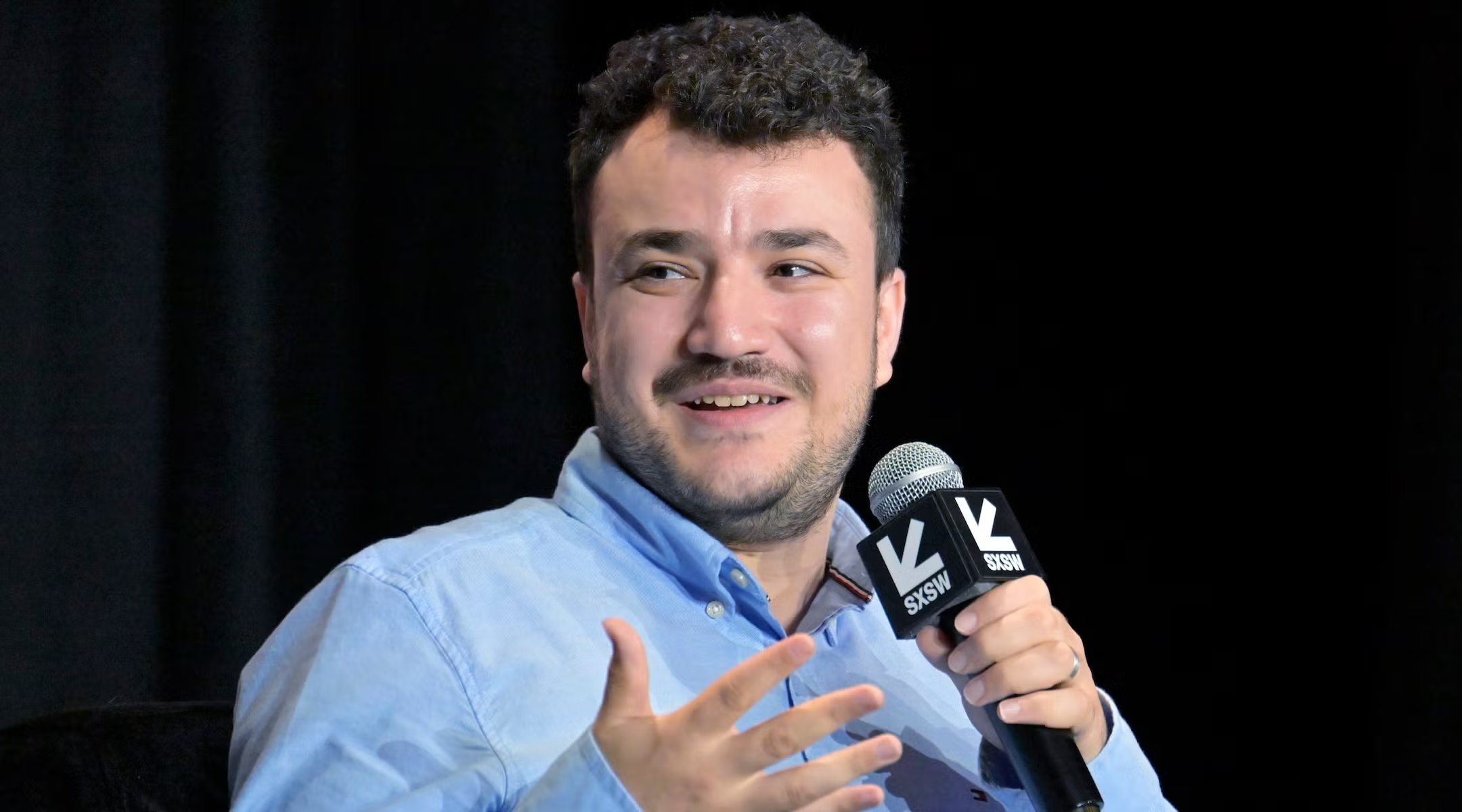
Photo: Mahmoud Khalil speaks at “The Guardian in Conversation with Mahmoud Khalil on the Cost of Dissent” during the SXSW Conference & Festivals on Mar. 15, 2026 in Austin, Texas. (Amanda Stronza / SXSW Conference & Festivals via Getty Images)