


By B. COOPER
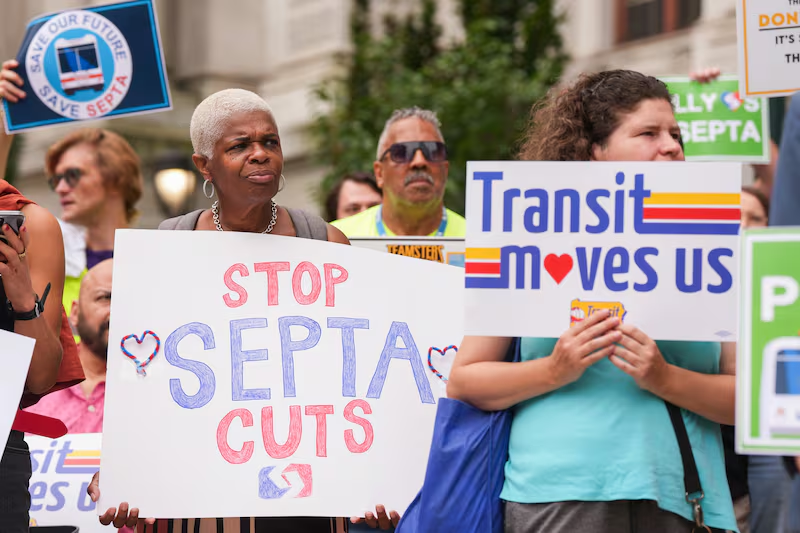
As of this writing, the Pennsylvania Senate has failed to pass a budget that would fund public transit, including SEPTA, a system that serves 800,000 people a day in the greater Philadelphia region. This funding was needed to get the faltering public transportation company out of a crippling $213 million deficit.
Unfortunately, SEPTA (South East Pennsylvania Transit Authority) decided—in light of its long-standing fiscal “death spiral”—to dramatically reduce service and raise rates. The first round of cuts went into effect on Sunday Aug. 24. At least 50 bus lines will be cut entirely, and most rail lines will halve their services. Eventually, several major regional rail lines will be eliminated, while the others will stop running after 9 p.m. And basic fares are rising to $2.90 for a single ride.
This is a major setback for the quality of life of hundreds of thousands of working people in Philadelphia and the greater region—including New Jersey and Delaware. Public transit cuts will also affect Pittsburgh and Harrisburg, and an Amtrak connection between New York City, Philadelphia, and Harrisburg. All of this means a severe increase of travel expenses for poor and middle-class people. It will also mean a massive increase in emissions of carbon and particulate matter due to the estimated daily addition of some 275,000 cars on the road (to say nothing of congestion).
This is occurring in a time when the nation spends almost $1 trillion dollars on its military annually, $175 billion on terrorizing and imprisoning immigrants in concentration camps, and hundreds of millions more on so-called “AI data centers” that drink up and poison the water of nearby communities.
SEPTA’s budget problem
SEPTA officials have complained for years of their fiscal “death spiral,” which has steadily placed limits on services. Unfortunately, they put the blame for this on the consumer, i.e., the working-class rider, rather than the capitalist government.
In 1961 the Southern Pennsylvania Transportation Compact ended the messy privatized system and combined several companies into a single network, which was reorganized as SEPTA in 1964. Several regional rail lines were cut in the process, but this was seen as a temporary measure pending electrification of the entire system. At the same time, plans were laid for a large expansion of the city’s subways, though most of the plans for expansion were never carried out.
In general, the formation of the publicly owned system was a step forward in improving the quality of life for working people. But SEPTA was handicapped by inconsistent funding. There was never a secure guarantee of funds from the state or federal government, with the can being eternally kicked down the road by both Republicans and Democrats.
Since SEPTA does not get regular, guaranteed financial support from the state or federal governments, a huge portion of its funding comes from fares. SEPTA—like all public transportation networks since the COVID-19 pandemic—has seen a drop in the number of people using its services, which creates a “spiral” in which the remaining customers need to pay more to keep the whole thing going.
At the same time, SEPTA has been seeing greater numbers of people not paying—creating a point of contention between riders and bus drivers that has been an unnecessary source of conflict. In late 2024, the Transport Workers United Local 234 threatened to strike over pay and, critically, safety on the job.
Today, SEPTA’s budget shortage cannot be fixed with fare hikes alone, and according to Pennsylvania state law (to rub salt into the wound), cannot be fixed by municipal taxation either. The average Pennsylvania family will pay 12% of its income in state and local taxes while the wealthiest only pay 6.2%.
Why is there an attack on public transit?
Reporting by outlets including the Philadelphia Inquirer, City-cast Philly, and Philly Voice have detailed information on many of the specifics of the budget wrangling between the two capitalist parties in the Pennsylvania Senate. People might think that there isn’t money available to consistently fund SEPTA (and other needed public services!). However, an examination of the budgeting decisions of the state and federal government reveal a different story, one of ideological motivation rather than economic realities.
The Republicans, who have had the majority in the state Senate for over 30 years, mainly because of gerrymandering, have a brutal “free market” fundamentalism that scorns the public good. Across the country, their party has done everything possible to sabotage or stonewall progress in public services such as health care, schools, and housing. The Trump-influenced Republican Party is also trying to curry favor with rural and small-town white voters by saying that their tax dollars shouldn’t go to “crime ridden” Democratic-run cities.
The Republican strategy of long-term destruction of public transit is on full display with their most recent budget proposal, in which $1 billion would be sapped from the Public Transportation Trust Fund, a fund that, according to SEPTA, is needed for maintenance and future capital improvements to the system at large.
Both parties uphold capitalism and its for-profit exploitation of labor, as well as the U.S. imperialist mission abroad. But whereas the Democratic Party tends to put itself forward as representing the “rational” and “fair” policies of U.S. capitalism, the Republican Party, especially under Trump, has more openly embraced racist and exclusionary myths in order to justify merciless exploitation. Of course, cuts to social services, including public transit, do not benefit rural whites or small businesses at all, who will be harmed by the negative impact to the economy of many of Trump’s policies. Trumpism can only benefit the very wealthy.
State and national budgets
Of course, $213 million is not a lot of money when speaking of the budget. This is easy to see when we examine the so-called Big Beautiful Bill passed recently as the crown jewel of Trump’s policies. The bill includes among many other provisions a $145 billion increase in annual military spending, money that even the Pentagon admits it can’t keep track of. This brings the net annual waste on the military to almost $1 trillion.
The so-called “beautiful” bill also increased ICE agent hiring by a whopping $8 billion, and allocates $45 billion for the building of new “detention centers.” This is alongside an obscene $50 billion allocation for border security and border wall construction. Even the money spent to build “shelters” for apprehended immigrant children, $3 billion, is 15 times the amount of money that would be needed to end SEPTA’s deficit.
Looking at the Pennsylvania state budget doesn’t look much better. For example, Pennsylvania’s 2024-25 budget allocated $2.7 billion to “corrections,” i.e., the racist mass incarceration system, and another $1.3 billion to the state police. By comparison, a measly $234 million—or less than one-fifth of the police budget—was given to environmental protection.
Whom does this budget serve? On a federal or state level, priority is clearly given to maintaining the oppressive organs of government over and above the actual needs of the working or middle classes, such as affordable housing, transportation, and clean air and water.
Public transportation must be funded!
When we compare the public transportation networks of the United States to other developed nations—even ones that are much poorer than the U.S.—we see abject failure. Public transit in nations such as Belgium, Austria, and Germany are much more robust, have much greater daily capacity, and are supported by consistent funding. Whatever other flaws these capitalist governments may have, public transit is supported as a basis for civil society.
Public transportation should not be a cost hoisted onto working people. Public transportation should be seen as a necessity. Moreover, it must be dramatically expanded if we want civilization to survive climate change. Such an expansion would provide mass employment. Philadelphia, for example, was once a major manufacturing hub for the construction of train and subway cars, before the industry was eclipsed by the auto manufacturers who lobbied the government to expand asphalt roads for cars.
Paying for the expanded system of mass transit could also be accomplished by raising taxes on the wealthiest and on corporations. Zohran Mamdani’s NYC primary campaign gained a lot of popularity among his working-class base by promising free buses funded partly by fining the slumlords and raising taxes on the wealthiest.
The U.S. has more than ample resources to provide for the common good. But the current government loyally serves only a privileged minority. The structure of government is designed to keep the capitalist owners of industry, high tech, and finance in control while marginalizing the bottom 90% of people and making their needs irrelevant to government policy.
Working people need a political movement independent of the Democrats and Republicans, based on the unions and other working-class organizations. It must fight uncompromisingly at the ballot box, in the streets, and at workplaces to defeat this reactionary regime. Only a workers’ government led by working-class leaders, backed by a democratic mass movement and democratic trade unions, could create a budget that actually fulfills the needs of working people, protects the environment, and ends support for war and genocide.
Fund mass transportation! Full mass transit within and between our towns and cities!
For free buses and subways! Make the rich pay! Make corporations pay!
Dismantle the military industrial complex! Tear down the walls! Close the prisons and camps!
End all support to Israel. Use the money instead to fund schools, trains, and health care!
For a democratic and fighting labor movement! For workers’ control of industry, transport, and the banks!
Photo: Jessica Griffin / The Philadelphia Inquirer