


By B. COOPER
UPDATE: It was announced on July 9 that, after eight days of a militant strike, DC 33 and the city of Philadelphia have come to a tentative agreement. It appears that the wage settlement adheres closely to the package that Mayor Cherelle Parker had been pushing from the beginning — a 3%, 3%, and 3% increase over three years.
The Philadelphia Inquirer commented on July 9: “… if the eight days of lost strike wages, totaling $1,458 for the average salary, are subtracted from the first year’s wages, then workers will earn less this year compared with the previous contract. Additionally, over the life of the contract, workers would have made more under Parker’s previous proposal than under the tentative agreement because of the lost eight days of pay.” There are reports that many union members are highly dissatisfied with the tentative contract. The union membership will vote on it probably in about a week. Our earlier article follows below.
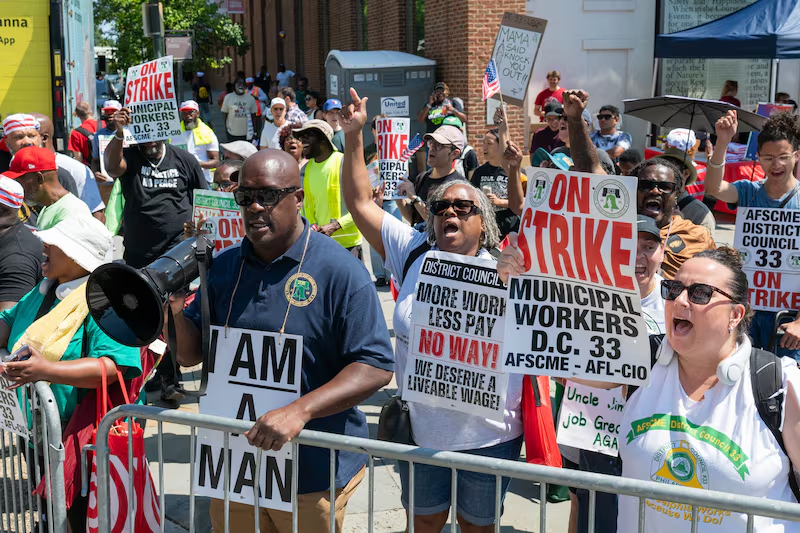
Over 9000 municipal workers covering trash collection, public libraries, street pavers, the waterworks, 911 call operators, crossing guards, mechanics, and many other services for the city of Philadelphia are on strike. They are represented by AFSME District Council 33 (DC 33), the city’s largest municipal union and one that includes a mainly Black membership.
The strike began at midnight on Tuesday, July 1, as negotiations between the union and the city fell through. Since the start of the strike, the workers have assembled picket lines at City Hall, the Municipal Services Building, and many other sites across Philadelphia. Most public libraries, recreation centers, and swimming pools have closed, and trash is piling up while daily temperatures hover close to 90 degrees.
On June 30, a day before the strike began, hundreds of members of various city unions and other supporters rallied outside City Hall to express solidarity with DC 33 and to explain the major demands of the union. More rallies have taken place during the week as other unions, such as the Philadelphia Federation of Teachers and the Teamsters, have expressed solidarity with the strikers. The DC 33 workers have been joined in solidarity by some workers from AFSME DC 47, including people who work at the Free Library of Philadelphia and museums in the city. DC 47’s contract also expired on July 1, but unfortunately, the union officials refused to take an immediate strike vote and agreed to a 14-day contract extension. A simultaneous DC 47 walkout would have greatly bolstered the strike of their siblings at DC 33.
Workers’ Voice members visited some of the picket lines in the city. The biggest grievance of the workers is pay, and several DC 33 members told Workers’ Voice that they must rely on food stamps to get by. DC 33 had been asking for an 8% yearly wage increase, but during negotiations, they lowered their demands to a 5% increase for every year of a three-year contract. Besides wages, the 2025 contract demands of the union lay out a number of other needs, including guarantees for the health plan, pandemic pay, cost of living adjustments, and changes to sick leave rules, among other demands.
“I’ve had several conversations with other city workers telling them that you don’t need to do any work you aren’t supposed to,” one worker told this reporter. He was referencing how the city is pressuring other city workers to do scab work, by “helping” to pick up trash that DC 33 members will not while they are on strike.
“You have to stand with all 10 toes for your rights. You have rights!” he said. When asked how they feel about the strike, he replied, “I feel confident in my union siblings, and we have each other’s backs.” Others whom we interviewed claimed that they were getting significant support from Philadelphia residents, as evidenced by the large pile of water bottles, soda, meals, and snacks that supporters had left next to the picket line.
Mayor Parker plays hardball
Mayor Cherelle Parker, a machine Democrat who touts herself as “pro-labor” but squarely aligns herself with the big business interests of the city, was able to obtain court injunctions to force some strikers back to work. She has openly enticed other union members to walk through the picket lines.
In a speech on July 3, Mayor Parker blamed the union for refusing her administration’s offer on wages. She went on to boast that the city’s “best offer” would amount to the largest contract given to the union in 30 years. The statement neglected to acknowledge the fact that the union had given up sizable concessions to previous administrations. This included the multi-year wage freeze and large pension concessions that the union agreed to in 1992.
Parker lamented that the city had already given DC 33 “the best offer on the table,” with a “historic wage increase” that would amount to a “13% raise over four years.” Her claim, while meager in itself, apparently included the 5% raise that the workers gained last year after the the DC 33 leadership had agreed to Parker’s request for a one-year contract extension. For the new contract, the city has been offering annual raises of merely 2.75%, 3%, and 3% over the course of three years.
DC 33 President Greg Boulware answered Parker by pointing out that last year’s 5% “wasn’t given to us. We fought for it!” In a July 5 interview with radio WURD, he said, “Our men and women earned that 5%. That 5% is now done and over with. It’s a wrap.”
Tragically, the city’s “best offer” today of less than 3% a year isn’t the same as offering a living wage. The city’s proposed raises fail to match the cost of living in the city or the rate of inflation. DC 33 is the city’s lowest paid bargaining unit; many of the workers receive no more than $46,000 a year. In comparable U.S. cities, sanitation workers have higher wages than in Philly, which more closely match the cost of living in those cities. A study by MIT backs up this conclusion, finding that DC 33 workers make $2000 below a living yearly wage for Philadelphia residents. Moreover, most economists project a steep rise in inflation later this year, due in part to Trump’s tariff policies.
The issue of real wages and inflation is a continually important one, one that other striking workers of Philadelphia had noted in their own struggles. In April, UNITE HERE Local 274 workers won a victory on this question (at least $20 an hour now; $24 by 2029) with a tentative settlement covering all three sports stadiums.
July 4 celebration: Artists’ protest as workers rally
Philadelphia’s’ Independence Day celebrations this year included the July 4 parade and the so-called “Wawa Welcome America” concert and fireworks show. DC 33 held pickets and rallies near both events, with workers chanting “DC! 33!” “No contract, no peace!” and “Don’t like the smell? Blame Cheryl!” In heartening actions, rapper/actor LL Cool J and singer Jasmine Sullivan publicly declared ahead of the concert that they were canceling their shows in solidarity with DC 33.
That afternoon, library, museum, and clerical workers gathered for a rally at the entrance to the Welcome America concert and close to the central branch of Philadelphia’s Free Library system. The crowd included both DC 33 and other workers and had the support of the local DSA chapter.
Several activists with the Free Mumia campaign, including Pam Africa, visited the rally to show solidarity with the strikers. Mumia Abu-Jamal is a writer, journalist and political prisoner whose false conviction of murder has been repeatedly upheld by the DA, despite evidence of his innocence. Pam Africa took a phone call from Mumia, who from prison, spoke with words of encouragement to the strikers, at one point exclaiming, “This is beautiful, beautiful, beautiful!”
One worker at the rally mentioned the problem of real wages, emphasizing that Parker’s offer does not match inflation. Another participant, a labor historian, spoke about the militant 1938 strike of sanitation workers, which helped to form the precursor to DC 33. That strike gathered working-class support throughout the city and caused Philadelphia’s capitalist politicians to buckle to the workers’ demands.
The person with the mic went around interviewing several workers. They approached a woman passing by in a car and asked about her thoughts on the strike. “Keep on fighting!” was her response.
On July 7, a week into the strike, American Federation of State, County and Municipal Employees national president Lee Saunders spoke at a DC 33 press conference and rally at the site where two picketers were struck by a vehicle last week. “You’re trying to make a decent living with good benefits and good pay, while you are providing essential services to the citizens of Philadelphia,” Saunders said to a crowd of striking workers. “You are the everyday heroes, and everyday heroes must be treated with respect and dignity—and that means money.” Since the city is not budging from what it offered at the start of the strike, and refuses to sit down in protracted negotiations, Boulware has announced that the union will be seeking an unfair labor practices injunction against Parker’s administration.
Photo: Kaiden J. Yu / The Philadelphia Inquirer